What Does Reflexive Mean in Spanish? Research-Backed Fluency Unlocked
Some verbs change meaning when reflexive - "dormir" (to sleep) vs. "dormirse" (to fall asleep)
Posted by
 Stewart Kaplan
Related reading
What Does Adonde Mean in Spanish? How Movement 'Clicks' for Learners
You have to know when prepositions combine with donde to show direction or position
What Does Ahi Mean in Spanish? Cognitive Mastery That Sticks
Learners mix up ahí, hay, and ay because they sound the same but mean totally different things.
What Does Aki Mean in Spanish: Unpacking Real Usage for Learners
Regional differences exist, but nearly everyone in Spanish-speaking communities gets what "aki" means in a text
TL;DR
- Reflexive verbs in Spanish show actions the subject does to itself, using reflexive pronouns (me, te, se, nos, os, se) that match the subject
- The subject and object are the same in reflexive sentences - "Yo me lavo" (I wash myself) vs. "Yo lavo el perro" (I wash the dog)
- Reflexive pronouns go before conjugated verbs, or attach to infinitives, present participles, and affirmative commands
- Common reflexive verbs: daily routines (ducharse, vestirse, despertarse), emotional changes (enojarse, alegrarse, aburrirse)
- Some verbs change meaning when reflexive - "dormir" (to sleep) vs. "dormirse" (to fall asleep)
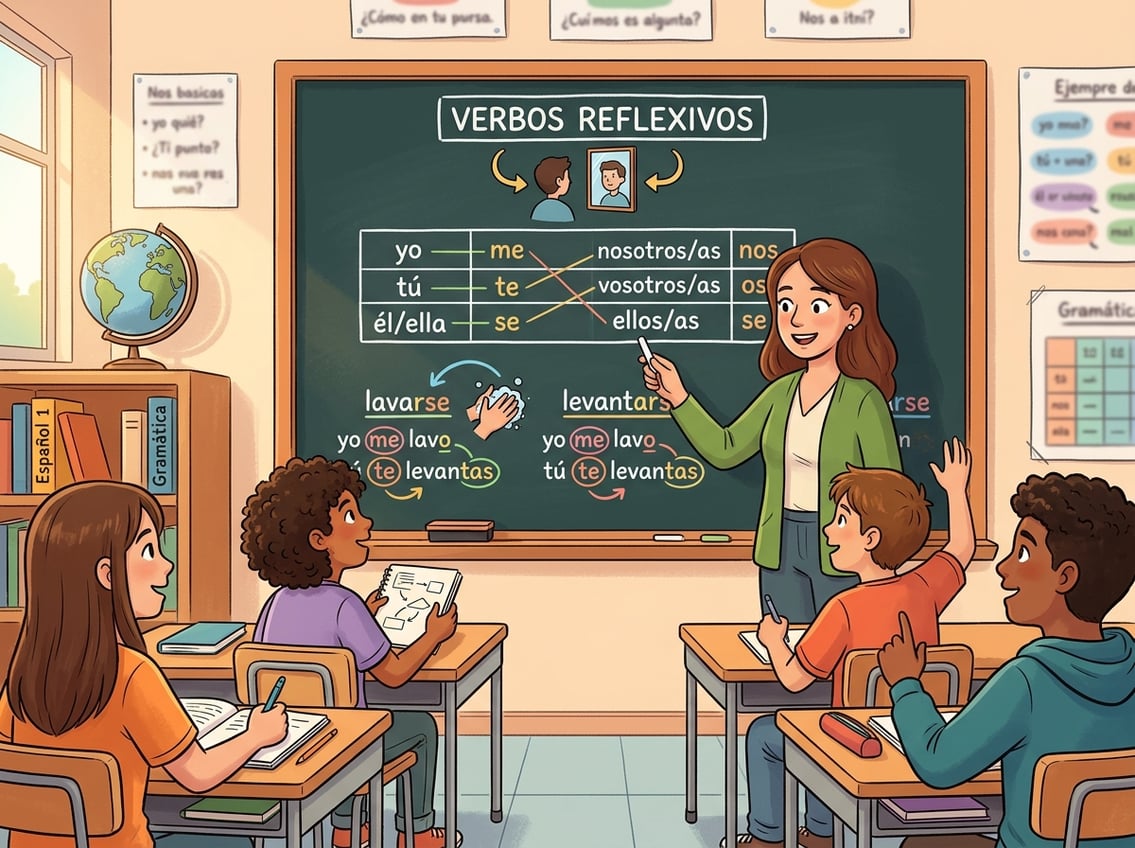
Core Definition and Linguistic Function
Reflexive verbs in Spanish describe actions the subject does to or for themselves, and they need reflexive pronouns that match the subject. The subject and object are the same person or group.
How Reflexive Actions Are Expressed
A verbo reflexivo uses a conjugated verb plus a pronombre reflexivo to show self-directed action.
Reflexive Pronoun Forms:
| Person | Singular | Plural |
|---|---|---|
| First | me | nos |
| Second (informal) | te | os |
| Second (formal) | se | se |
| Third | se | se |
Common Expression Patterns:
- Daily routines: Me ducho cada mañana (I shower every morning)
- Personal care: Te peinas antes de salir (You brush your hair before going out)
- Emotional responses: Se enoja rápidamente (He gets angry quickly)
- Physical positioning: Nos sentamos aquí (We sit down here)
Pronoun Placement Rules:
| Rule | Example |
|---|---|
| Before conjugated verbs and negative commands | Me levanto temprano (I get up early) |
| Attached to infinitives or gerunds | Voy a sentarme (I'm going to sit down), Estoy vistiéndome (I'm getting dressed) |
| Before conjugated verb or attached to infinitive | Me voy a dormir / Voy a dormirme (I'm going to sleep) |
Subject and Object: The Grammatical Mirror
| Type | Spanish | English | Subject | Object |
|---|---|---|---|---|
| Reflexive | Yo me lavo | I wash myself | Yo | me (myself) |
| Non-reflexive | Yo lavo el perro | I wash the dog | Yo | el perro (the dog) |
Key Identifiers:
- Infinitives end in -se: lavarse, vestirse, despertarse
- Reflexive pronoun matches the subject
- Subject and object are the same
| Rule | Example |
|---|---|
| Use reflexive form when subject = object | Me despierto (I wake myself up) |
| Use non-reflexive form when subject ≠ object | Despierto a mi hermano (I wake my brother up) |
Reflexive vs. Pronominal Verbs
Categories of Pronominal Verbs:
| Category | Example | Notes |
|---|---|---|
| Inherently pronominal | arrepentirse (to regret), atreverse (to dare) | Only exist with se |
| Change-of-meaning | irse (to go away), comerse (to eat up) | Meaning shifts with pronoun |
| Intensifying | me comí (I ate up) | Emphasis or completion |
| Type | Example | Literal Action on Self? |
|---|---|---|
| True reflexive | Me afeito (I shave myself) | Yes |
| Pronominal | Me arrepiento (I regret) | No |
| Intensifying | Me comí el pastel (I ate up the cake) | No |
| Rule | Example |
|---|---|
| Reflexive pronouns can add emphasis | Estúdiatelo (Really study it) vs. Estúdialo (Study it) |
Identifying Reflexive Verbs in Spanish
Recognizing the -se Ending
| Reflexive Infinitive | Base Verb | English |
|---|---|---|
| lavarse | lavar | to wash oneself |
| vestirse | vestir | to get dressed |
| ducharse | duchar | to shower |
| peinarse | peinar | to comb one's hair |
| levantarse | levantar | to get up |
| acostarse | acostar | to go to bed |
| sentarse | sentar | to sit down |
-se Ending Rules:
- Remove -se for the base verb
- Base verb may have a different meaning
- Some verbs only exist with -se
Reflexive Verbs vs. Non-Reflexive Verbs
| Verb | Non-Reflexive Meaning | Reflexive Meaning |
|---|---|---|
| llamar | to call (someone) | llamarse - to be named |
| dormir | to sleep | dormirse - to fall asleep |
| ir | to go | irse - to leave/go away |
| poner | to put/place | ponerse - to put on (clothing) |
| quitar | to remove (something) | quitarse - to take off |
| encontrar | to find | encontrarse - to feel/to meet |
| perder | to lose (something) | perderse - to get lost |
| acordar | to agree | acordarse - to remember |
| Rule | Example |
|---|---|
| Subject ≠ Object: Use non-reflexive | Despierto a mi hermano |
| Subject = Object: Use reflexive | Me despierto |
Always-Reflexive Verbs:
- arrepentirse (to regret)
- quejarse (to complain)
- atreverse (to dare)
- dignarse (to deign)
Common Reflexive Verbs Forms in Everyday Spanish
| Spanish | English | Example |
|---|---|---|
| despertarse | to wake up | Me despierto a las 7 |
| levantarse | to get up | Se levanta temprano |
| ducharse/bañarse | to shower/bathe | Nos duchamos por la mañana |
| cepillarse | to brush | Me cepillo los dientes |
| afeitarse | to shave | Se afeita cada día |
| maquillarse | to put on makeup | Se maquilla antes de salir |
| vestirse | to get dressed | Te vistes rápido |
| acostarse | to go to bed | Se acuestan a las 10 |
Emotional and Physical State Verbs:
- preocuparse (to worry)
- alegrarse (to be happy/rejoice)
- enojarse/enfadarse (to get angry)
- aburrirse (to get bored)
- cansarse (to get tired)
- enfermarse (to get sick)
- sentirse (to feel)
- asustarse (to get scared)
Movement and Position Verbs:
- acercarse (to approach/get close)
- alejarse (to move away)
- quedarse (to stay/remain)
- volverse (to turn around/become)
- parecerse (to resemble)
- fijarse (to notice/pay attention)
Reciprocal Actions (Plural Only):
| Verb | Meaning | Example |
|---|---|---|
| verse | to see each other | Nos vemos los lunes |
| hablarse | to talk to each other | Se hablan todos los días |
| abrazarse | to hug each other | Nos abrazamos al llegar |
| besarse | to kiss each other | Se besan en la mejilla |
| conocerse | to know each other | Se conocieron en 2020 |
Recognition in Context:
| Rule | Example |
|---|---|
| Reflexive pronouns before conjugated verbs | Me visto rápido |
| Reflexive pronouns attached to infinitives/gerunds | Voy a vestirme, Estoy vistiéndome |
Reflexive Pronouns: Forms and Usage
Spanish reflexive pronouns match the subject and follow placement rules depending on the verb form and sentence type.
Spanish Reflexive Pronoun Chart
| Subject | Reflexive Pronoun | Example | Translation |
|---|---|---|---|
| yo | me | me lavo | I wash myself |
| tú | te | te lavas | you wash yourself |
| él/ella/usted | se | se lava | he/she washes himself/herself, you wash yourself |
| nosotros/nosotras | nos | nos lavamos | we wash ourselves |
| vosotros/vosotras | os | os laváis | you all wash yourselves |
| ellos/ellas/ustedes | se | se lavan | they wash themselves, you all wash yourselves |
- Reflexive pronouns look like indirect object pronouns, except se replaces le and les in third person.
- Se is used for formal singular (usted), plural (ustedes), and all third-person subjects.
Pronoun Agreement with Subjects
| Person | Pronoun(s) | Example(s) |
|---|---|---|
| First | me (yo), nos (nosotros) | me levanto, nos ponemos |
| Second | te (tú), os (vosotros), se (usted/ustedes) | te duchas, os laváis, se levantan |
| Third | se (él/ella/ellos/ellas) | se lava, se ayudan |
Routine Examples:
- me levanto
- me ducho
- me preparo
- nos ponemos
Reciprocal Actions (plural subjects):
- nos abrazamos (we hug each other)
- se ayudan
- saludarse
Conjugation Pattern for lavarse:
- me lavo
- te lavas
- se lava
- nos lavamos
- os laváis
- se lavan
Pronoun Placement in Sentences
| Scenario | Example(s) |
|---|---|
| Before conjugated verbs | Me lavo las manos cada día Nos preparamos para la fiesta Se levanta a las siete |
| Before negative commands | No te preocupes No se caiga No os olvidéis |
| Attached to affirmative commands | Lávate las manos Siéntense, por favor Prepárate ahora |
| With infinitives (two options) | Voy a ducharme / Me voy a duchar Necesita levantarse / Se necesita levantar |
| With present participles (two options) | Estoy preparándome / Me estoy preparando Están vistiéndose / Se están vistiendo |
- Reflexive pronouns attach to the end of affirmative commands.
- With infinitives and gerunds, pronouns can go before the helping verb or attach to the end.
Rules of Conjugation and Pronoun Placement
| Rule | Example |
|---|---|
| Pronoun matches the subject in person and number | me lavo, te lavas, se lava, etc. |
| Pronoun goes before conjugated verbs | Me ducho cada mañana |
| With infinitives/gerunds, pronoun attaches or goes before helper | Voy a sentarme / Me voy a sentar |
| Affirmative command: pronoun attaches | Siéntate |
| Negative command: pronoun before verb | No te sientes |
Conjugating Regular and Irregular Reflexive Verbs
| Subject | Reflexive Pronoun |
|---|---|
| yo | me |
| tú | te |
| él/ella/usted | se |
| nosotros/nosotras | nos |
| vosotros/vosotras | os |
| ellos/ellas/ustedes | se |
Regular -AR verb (lavarse):
- yo me lavo
- tú te lavas
- él/ella se lava
- nosotros nos lavamos
- vosotros os laváis
- ellos se lavan
Irregular verb (despertarse):
- yo me despierto
- tú te despiertas
- él se despierta
Pronoun Placement with Conjugated Verbs
| Sentence Type | Example(s) |
|---|---|
| Standard | Me ducho cada mañana Te peinas antes de salir Nos levantamos temprano |
| Negative sentences | No me afeito los fines de semana No se preocupe No te olvides de llamar |
Special Cases: Infinitives, Gerunds, and Commands
| Verb Form | Pronoun Placement | Example(s) |
|---|---|---|
| Infinitive | attach or before helper | Voy a sentarme / Me voy a sentar Necesito bañarme / Me necesito bañar |
| Gerund | attach or before helper | Estoy duchándome / Me estoy duchando Está vistiéndose / Se está vistiendo |
| Affirmative command | attach | Siéntate aquí Lávense las manos Quítate el sombrero |
| Negative command | before verb | No te sientes ahí No se pegues |
Avoiding Common Mistakes
| ❌ Incorrect | ✓ Correct | Issue |
|---|---|---|
| Yo se lavo | Yo me lavo | Wrong pronoun for subject |
| Me lavar las manos | Lavarme las manos / Me voy a lavar | Wrong placement with infinitive |
| Él me ducha | Él se ducha | Pronoun doesn't match subject |
| Siéntate te | Siéntate | Double pronoun usage |
Checklist for Placement:
- Conjugated verb → pronoun before
- Infinitive → pronoun attached or before helping verb
- Gerund → pronoun attached or before helping verb
- Affirmative command → pronoun attached
- Negative command → pronoun before verb
Rule → The reflexive pronoun must always match the subject in both person and number.
Example: In me lavo, me matches yo.
Semantic Categories of Reflexive Verbs
Daily Routines and Personal Care
| Verb | Meaning | Example |
|---|---|---|
| lavarse | to wash oneself | Me lavo las manos antes de comer |
| ducharse | to shower | Se ducha cada mañana |
| bañarse | to bathe | Los niños se bañan por la noche |
| cepillarse | to brush | Me cepillo los dientes tres veces al día |
| peinarse | to comb one's hair | María se peina frente al espejo |
| afeitarse | to shave | Mi padre se afeita todos los días |
| maquillarse | to put on makeup | Ella se maquilla antes de salir |
| vestirse | to get dressed | Me visto rápido por las mañanas |
Routine verbs:
- levantarse
- acostarse
- dormirse
Rule → ponerse means to put on clothing or accessories.
Example: Se pone el abrigo cuando hace frío.
Emotional and Mental States
| Verb | Emotion/State | Example |
|---|---|---|
| alegrarse | to become happy | Me alegro de verte |
| enojarse | to get angry | Se enoja cuando llego tarde |
| preocuparse | to worry | Me preocupo por mi familia |
| aburrirse | to get bored | Los estudiantes se aburren en clase |
| cansarse | to get tired | Me canso después del trabajo |
| asustarse | to get scared | Se asustó con el ruido |
| enfermarse | to get sick | Se enfermó durante el invierno |
Mental verbs:
- acordarse (to remember): No me acuerdo de su nombre
- sentirse (to feel): Me siento feliz hoy
- fijarse (to notice): Se fija en todos los detalles
Rule → volverse signals a permanent change in character or state.
Example: Se volvió más serio con los años.
Movement and Position Changes
| Verb | Action | Usage |
|---|---|---|
| sentarse | to sit down | Me siento en la silla |
| acostarse | to lie down | Se acuesta en el sofá |
| levantarse | to stand up | Me levanto de la cama |
Location/Movement:
- acercarse: Se acerca a la ventana
- quedarse: Me quedo en casa hoy
- perderse: Se pierde en la ciudad
- encontrarse: Nos encontramos en el café
Social interactions:
- saludarse: Se saludan con un beso
- llamarse: Me llamo Pedro
- parecerse: Se parece a su madre
Rule → acostumbrarse means to get used to something.
Example: Me acostumbro a despertarme temprano.
Reciprocal Actions and Reflexives with Changed Meaning
- Reflexive pronouns in plural forms can express mutual actions.
- Some reflexive verbs have meanings that differ from their non-reflexive forms.
When Reflexive Verbs Show Mutual Actions
Reciprocal reflexives describe actions that two or more people do to each other, using the pronouns nos, os, and se.
Common Reciprocal Verbs:
| Spanish | English Translation | Example Context |
|---|---|---|
| Nos abrazamos | We hug each other | Greeting friends |
| Se ayudan | They help each other | Teamwork |
| Se conocen | They know each other | First meetings |
| Nos vemos | We see each other | Making plans |
| Se saludan | They greet each other | Passing each other daily |
Example Sentences:
- María y Juan se llaman todos los días. (María and Juan call each other every day.)
- Mis hermanos se pelean mucho. (My brothers fight with each other a lot.)
- ¿Os escribís mensajes? (Do you write messages to each other?)
Clarifying Reciprocal Meaning:
| Phrase Used | Meaning | Example |
|---|---|---|
| se | "each other" or "themselves" | Se ayudan. |
| el uno al otro | Explicit "each other" | Se lavan el uno al otro. |
| mutuamente | Mutually | Se respetan mutuamente. |
Verbs with Distinct Reflexive and Non-Reflexive Meanings
Many verbs shift meaning when used as verbos reflexivos.
Meaning Changes with Reflexive Form:
| Non-Reflexive | Reflexive | Meaning Shift |
|---|---|---|
| dormir | dormirse | Sleep vs. fall asleep |
| ir | irse | Go vs. leave/go away |
| poner | ponerse | Put vs. become/put on |
| llevar | llevarse | Carry vs. take away |
| acordar | acordarse | Agree vs. remember |
Contrasting Examples:
- Duermo ocho horas. (I sleep eight hours.) → Me duermo a las diez. (I fall asleep at ten.)
- Voy al mercado. (I go to the market.) → Me voy del mercado. (I leave the market.)
- Pongo el libro aquí. (I put the book here.) → Me pongo feliz. (I become happy.)
Rule → Example:
Rule: Reflexive verbs often change meaning compared to their non-reflexive forms.
Example: "Ir" (to go) vs. "irse" (to leave).
Practical Usage in Conversation
Daily Routine Context:
- Me despierto → Me levanto → Me ducho → Me visto
Social Interaction Patterns:
| Use Case | Spanish Phrase | English Translation |
|---|---|---|
| Making plans | ¿Cuándo nos vemos? | When do we see each other? |
| Greeting | Se saludan con un beso. | They greet each other with a kiss. |
| Messaging | Nos escribimos por WhatsApp. | We write to each other on WhatsApp. |
Distinguishing Reflexive from Reciprocal:
| Situation | Form Used | Interpretation |
|---|---|---|
| One person | Se lava | He washes himself |
| Two people (context clear) | Se lavan | They wash each other |
| Two people (clarification) | Se lavan el uno al otro | They wash each other |
Common Confusion Points:
| Verb Pair | Non-Reflexive Meaning | Reflexive Meaning |
|---|---|---|
| quedarse / quedar | to stay | to arrange to meet / to fit |
| comerse / comer | to eat up completely | to eat |
| hacerse / hacer | to become | to do/make |
Rule → Example:
Rule: Memorize verb pairs together to remember which reflexive forms have changed meanings.
Example: "Poner" (to put) vs. "ponerse" (to become/put on).
Mastery Through Practice: Real-Life Examples and Quizzes
Learners get better at reflexive verbs by using authentic sentences, quizzes, and focusing on common mistakes with pronominal verbs.
Illustrative Sentences from Daily Life
Morning Routine:
| Spanish | English | Reflexive Pronoun |
|---|---|---|
| Me despierto a las seis. | I wake up at six. | me |
| Te duchas antes del desayuno. | You shower before breakfast. | te |
| Ella se viste en cinco minutos. | She gets dressed in five minutes. | se |
Evening Activities:
| Spanish | English | Reflexive Pronoun |
|---|---|---|
| Nos acostamos a las diez. | We go to bed at ten. | nos |
| Os laváis las manos antes de cenar. | You all wash your hands before dinner. | os |
| Ellos se relajan después del trabajo. | They relax after work. | se |
Emotional States:
- Me siento feliz hoy. (I feel happy today.)
- Te preocupas demasiado. (You worry too much.)
- Se aburren en clase. (They get bored in class.)
With Body Parts:
- Me cepillo los dientes tres veces al día. (I brush my teeth three times a day.)
- Se peina el cabello todas las mañanas. (He combs his hair every morning.)
Reflexive Verbs Quiz for Self-Assessment
- Yo _____ (lavarse) las manos.
- Tú _____ (levantarse) temprano.
- Nosotros _____ (vestirse) rápidamente.
Answer Key:
- me lavo
- te levantas
- nos vestimos
Pronoun Placement:
| Verb Form | Correct | Also Acceptable* |
|---|---|---|
| Infinitive | Voy a ducharme. | Me voy a duchar. |
| Conjugated | Me ducho. | Ducho me. (incorrect) |
| Gerund | Estoy levantándome. | Me estoy levantando. |
*Both placements are fine in Spanish grammar.
Advanced Reflexive vs Non-Reflexive:
| Spanish Phrase | Meaning | Reflexive? |
|---|---|---|
| Llamo a mi madre. | I call my mother. | No |
| Me llamo Pedro. | My name is Pedro. | Yes |
Tips for Avoiding Common Pitfalls
Error 1: Missing Reflexive Pronoun
| Wrong | Correct |
|---|---|
| Levanto a las siete. | Me levanto a las siete. |
| Duchas por la mañana. | Te duchas por la mañana. |
Error 2: Using Possessive Adjectives with Body Parts
| Wrong | Correct |
|---|---|
| Me lavo mis manos. | Me lavo las manos. |
| Se cepilla sus dientes. | Se cepilla los dientes. |
Error 3: Incorrect Pronoun Matching
| Subject | Correct Pronoun |
|---|---|
| Yo | me |
| Tú | te |
| Él/ella/usted | se |
Error 4: Confusing Reflexive and Pronominal Verbs
| Non-Reflexive | Reflexive |
|---|---|
| dormir | dormirse |
| ir | irse |
| poner | ponerse |
- Practice with visual verb charts daily
- Record your own routine sentences using correct pronouns
- Use spaced repetition every 24–48 hours to reinforce pairing
Frequently Asked Questions
Reflexive verbs use special pronouns (me, te, se, nos, os, se) that match the subject. Pronoun placement depends on verb form, and some verbs change meaning when used reflexively.
What are reflexive verbs in Spanish, and how do they work in a sentence?
Reflexive verbs express actions where the subject acts on itself.
Structure:
| Rule | Example |
|---|---|
| Reflexive pronoun + conjugated verb | Me levanto. (I get up.) |
Examples:
| Spanish | English | Subject/Object |
|---|---|---|
| Yo me lavo | I wash myself | yo = me |
| Tú te peinas | You brush your hair | tú = te |
| Ella se mira | She looks at herself | ella = se |
Comparison with non-reflexive verbs:
| Type | Spanish | English | Object |
|---|---|---|---|
| Reflexive | Yo me lavo | I wash myself | myself |
| Non-reflexive | Yo lavo el carro | I wash the car | the car |
Rule → Example:
Rule: Reflexive pronoun must match the subject in person and number.
Example: "Nosotros nos levantamos." (We get up.)
How can you tell whether a Spanish verb is reflexive or not?
| Indicator | Example Infinitive |
|---|---|
| "-se" attached to infinitive | lavarse, vestirse, despertarse |
Categories of reflexive verb usage:
| Type | Example Verbs |
|---|---|
| Always reflexive | acordarse, quejarse, arrepentirse |
| Can be both | lavar/lavarse, vestir/vestirse |
Meaning changes with reflexive pronouns:
| Non-reflexive | Reflexive | Meaning shift |
|---|---|---|
| dormir | dormirse | State change |
| ir | irse | Departure |
| poner | ponerse | Self-directed action |
Some verbs are inherently reflexive and always need the pronoun.
How do you conjugate reflexive verbs in Spanish in the present tense?
Reflexive pronouns by subject:
| Subject | Reflexive Pronoun |
|---|---|
| yo | me |
| tú | te |
| él/ella/usted | se |
| nosotros/nosotras | nos |
| vosotros/vosotras | os |
| ellos/ellas/ustedes | se |
Conjugation example: lavarse (to wash oneself)
| Subject | Full conjugation |
|---|---|
| yo | me lavo |
| tú | te lavas |
| él/ella/usted | se lava |
| nosotros/nosotras | nos lavamos |
| vosotros/vosotras | os laváis |
| ellos/ellas/ustedes | se lavan |
Steps to conjugate:
| Step | Action | Example |
|---|---|---|
| 1 | Remove "-se" from infinitive | lavar |
| 2 | Conjugate the base verb | lavo, lavas, lava... |
| 3 | Add matching reflexive pronoun | me lavo, te lavas, etc. |
Additional example: despertarse (to wake up)
| Subject | Conjugation |
|---|---|
| yo | me despierto |
| tú | te despiertas |
| ella | se despierta |
| nosotros | nos despertamos |
| ellos | se despiertan |
Where do reflexive pronouns go in Spanish sentences (before the verb, attached, or both)?
Placement rules:
| Verb Form | Pronoun Placement | Example |
|---|---|---|
| Conjugated verb | Before the verb | Me lavo las manos |
| Negative command | Before the verb | No te preocupes |
| Affirmative command | Attached to end | Siéntate aquí |
| Infinitive | Attached to end OR before conjugated | Voy a ducharme / Me voy a duchar |
| Present participle | Attached to end OR before conjugated | Estoy duchándome / Me estoy duchando |
Examples with compound verbs:
- Quiero acostarme = Me quiero acostar (I want to go to bed)
- Estás vistiéndote = Te estás vistiendo (You’re getting dressed)
- Necesita sentarse = Se necesita sentar (He needs to sit down)
Rule → Example:
Rule: When attaching a reflexive pronoun to a present participle or affirmative command, add an accent mark if needed to keep the original stress. Example: Siéntate, duchándome