How to Say Everyday Questions in Spanish: Research-Backed Microlearning That Clicks
Practicing high-frequency questions with Spanish audio helps you remember and use them naturally
Posted by
 Stewart Kaplan
Related reading
What Does Adonde Mean in Spanish? How Movement 'Clicks' for Learners
You have to know when prepositions combine with donde to show direction or position
What Does Ahi Mean in Spanish? Cognitive Mastery That Sticks
Learners mix up ahí, hay, and ay because they sound the same but mean totally different things.
What Does Aki Mean in Spanish: Unpacking Real Usage for Learners
Regional differences exist, but nearly everyone in Spanish-speaking communities gets what "aki" means in a text
TL;DR
- Spanish questions use inverted question marks (¿?) and usually put the verb before the subject
- Question words - qué, dónde, cuándo, cómo, por qué - kick off questions and always have accent marks
- Common everyday questions cover greetings, directions, prices, and asking about time
- Formal questions use usted forms, informal ones use tú
- Practicing high-frequency questions with Spanish audio helps you remember and use them naturally
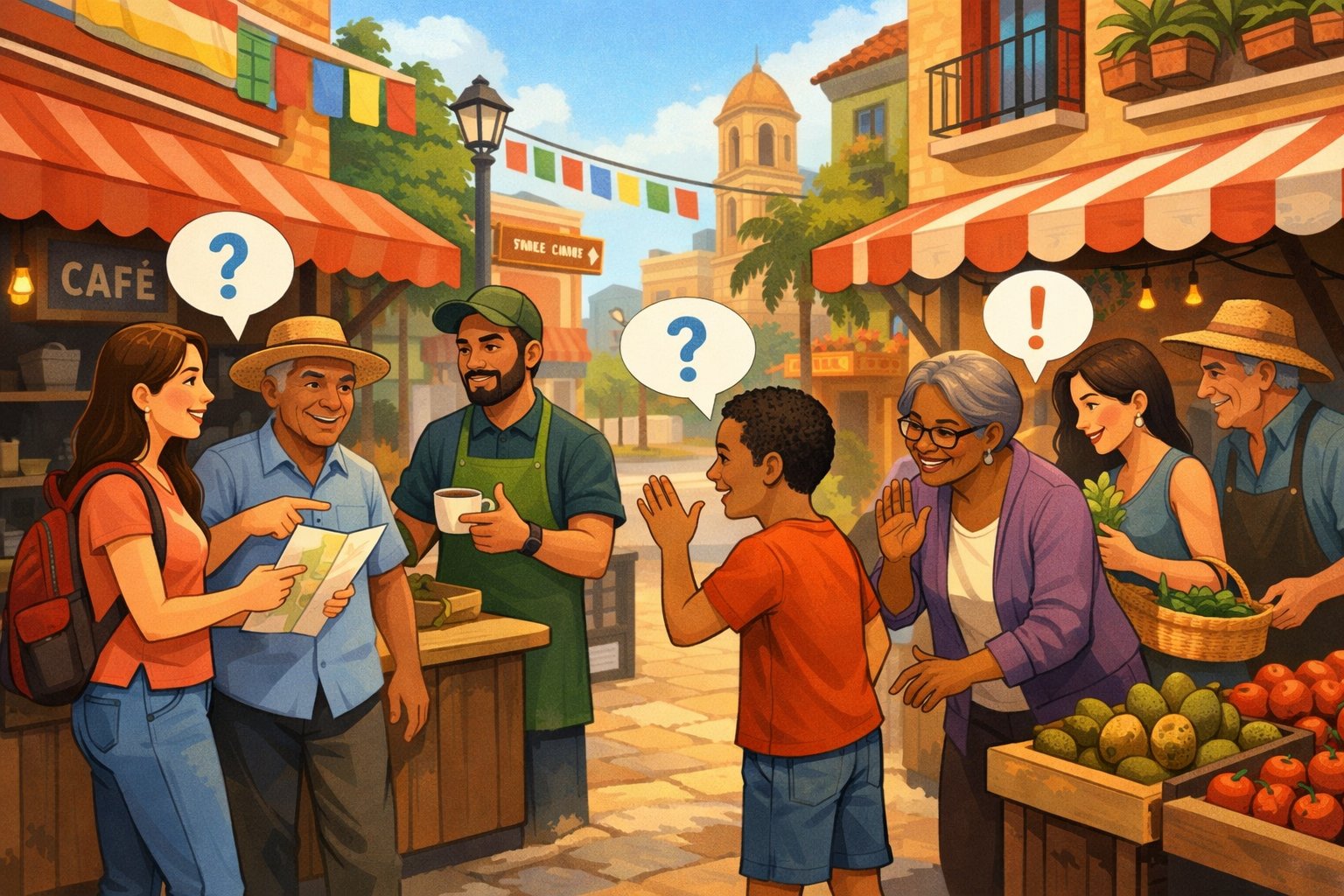
Essential Spanish Question Structures and Words
Spanish questions fall into two main types: yes/no questions that just need a simple answer, and information questions that use specific question words. Both types always need inverted question marks at the start and end.
Open vs. Closed Questions in Spanish
Closed Questions (Yes/No)
Closed questions need just sí or no. You make them by wrapping a statement in question marks or changing your tone.
| Statement | Question | Translation |
|---|---|---|
| Hablas español. | ¿Hablas español? | Do you speak Spanish? |
| Tienes hambre. | ¿Tienes hambre? | Are you hungry? |
| Vas a la fiesta. | ¿Vas a la fiesta? | Are you going to the party? |
Open Questions (Information)
Open questions start with a question word and need more than just yes or no. The basic structure is: question word + verb + subject.
| Question Word | Example | Translation |
|---|---|---|
| ¿Qué? | ¿Qué haces? | What are you doing? |
| ¿Dónde? | ¿Dónde vives? | Where do you live? |
| ¿Cuándo? | ¿Cuándo llegas? | When do you arrive? |
Key Spanish Question Words and Interrogative Pronouns
Core Question Words
| Spanish | English | Example |
|---|---|---|
| ¿Qué? | What? | ¿Qué quieres? (What do you want?) |
| ¿Quién? / ¿Quiénes? | Who? (singular/plural) | ¿Quién es? (Who is it?) |
| ¿Cuál? / ¿Cuáles? | Which? (singular/plural) | ¿Cuál prefieres? (Which do you prefer?) |
| ¿Cómo? | How? | ¿Cómo estás? (How are you?) |
| ¿Cuándo? | When? | ¿Cuándo es la reunión? (When is the meeting?) |
| ¿Dónde? | Where? | ¿Dónde está el baño? (Where is the bathroom?) |
| ¿Por qué? | Why? | ¿Por qué estudias español? (Why do you study Spanish?) |
| ¿Cuánto? / ¿Cuánta? / ¿Cuántos? / ¿Cuántas? | How much/many? | ¿Cuánto cuesta? (How much does it cost?) |
Special Forms
- ¿De quién? = Whose?
- ¿Para qué? = What for? (purpose)
- ¿Adónde? = To where? (for movement)
| Rule | Example |
|---|---|
| All interrogative pronouns need accent marks | ¿Quién viene? (Who is coming?) |
Inverted Question Marks: Spanish Punctuation Essentials
Spanish questions always start with ¿ and end with ?. This tells you right away that it’s a question.
| Rule | Example |
|---|---|
| Start with ¿ at question start | ¿Hablas inglés? |
| End with ? at question end | ¿Vienes mañana? |
| Correct | Incorrect |
|---|---|
| ¿Hablas inglés? | Hablas inglés? |
| Juan, ¿vienes mañana? | ¿Juan, vienes mañana? |
| Si tienes tiempo, ¿me ayudas? | ¿Si tienes tiempo, me ayudas? |
Mid-Sentence Questions
| Rule | Example |
|---|---|
| In questions inside sentences, put the inverted question mark only at the start of the question, not the whole sentence | Marta dijo, ¿verdad? (Marta said it, right?) |
Everyday Spanish Questions for Real-Life Conversations
Greetings and Icebreakers in Spanish
Spanish greetings change with formality and region. Basic Spanish questions for starting a chat include both formal and casual options.
| Spanish Question | English Translation | Formality |
|---|---|---|
| ¿Cómo estás? | How are you? | Informal |
| ¿Cómo está? | How are you? | Formal |
| ¿Qué tal? | How's it going? | Informal |
| ¿Qué onda? | What's up? | Very informal (Mexico) |
| ¿Todo bien? | Everything good? | Informal |
Common Responses:
- Bien, gracias – Good, thanks
- Muy bien – Very good
- Más o menos – So-so
- Regular – Okay
| Rule | Example |
|---|---|
| ¿Qué onda? is mainly Mexican; ¿Qué tal? is used almost everywhere; ¿Todo bien? can be a greeting or a real check-in | ¿Qué tal? ¿Todo bien? |
Personal Information and Get-to-Know-You Questions
These get-to-know-you questions in Spanish help you introduce yourself and connect with others.
| Question | Translation | Sample Answer |
|---|---|---|
| ¿Cómo te llamas? | What's your name? | Me llamo Ana |
| ¿De dónde eres? | Where are you from? | Soy de México |
| ¿Dónde vives? | Where do you live? | Vivo en Madrid |
| ¿Cuántos años tienes? | How old are you? | Tengo 28 años |
| ¿A qué te dedicas? | What do you do? | Soy profesor |
| ¿Hablas español? | Do you speak Spanish? | Sí, un poco |
| ¿Cuántos idiomas hablas? | How many languages do you speak? | Hablo dos idiomas |
Extra Personal Questions:
- ¿Cuántos hermanos tienes? – How many siblings do you have?
- ¿Tienes mascotas? – Do you have pets?
- ¿Qué te gusta hacer? – What do you like to do?
- ¿Cuál es tu comida favorita? – What's your favorite food?
| Rule | Example |
|---|---|
| Use personal scripts for questions like ¿Cómo te llamas? and ¿De dónde eres? to answer automatically | ¿Cómo te llamas? Me llamo Ana |
Daily Life, Shopping, and Common Situational Questions
Everyday Spanish phrases for shopping, getting around, and daily stuff help you handle real-life tasks.
Shopping and Transactions:
| Question | Translation | Context |
|---|---|---|
| ¿Cuánto cuesta esto? | How much does this cost? | Stores, markets |
| ¿Cuánto es? | How much is it? | Total price |
| ¿Acepta tarjetas? | Do you take cards? | Payment |
| ¿Tienes cambio? | Do you have change? | Cash transactions |
| ¿Me lo puedo probar? | Can I try it on? | Clothing stores |
Location and Navigation:
- ¿Dónde está el baño? – Where’s the bathroom?
- ¿Dónde está la estación? – Where’s the station?
- ¿Por dónde está el mercado? – Which way is the market?
Time and Schedule Questions:
- ¿Qué hora es? – What time is it?
- ¿A qué hora abren? – What time do they open?
- ¿A qué hora cierran? – What time do they close?
Help and Clarification:
| Question | Translation | When to Use |
|---|---|---|
| ¿Puede ayudarme? | Can you help me? | Asking for help |
| ¿Puedes hablar más despacio? | Can you speak slower? | If you don’t understand |
| ¿Qué significa esto? | What does this mean? | Understanding words |
| ¿Cómo se dice...? | How do you say...? | Asking for vocab |
| Rule | Example |
|---|---|
| Use ¿Cuánto cuesta esto? with gestures while shopping | (Pointing) ¿Cuánto cuesta esto? |
| Plug any place into ¿Dónde está...? to ask directions | ¿Dónde está la farmacia? |
Frequently Asked Questions
What are some examples of common questions used daily in Spanish?
| Spanish Question | English Translation | Context |
|---|---|---|
| ¿Cómo estás? | How are you? | Informal greeting |
| ¿Qué hora es? | What time is it? | Time inquiry |
| ¿Dónde está...? | Where is...? | Location |
| ¿Cuánto cuesta? | How much does it cost? | Shopping |
| ¿Hablas inglés? | Do you speak English? | Language ability |
| ¿De dónde eres? | Where are you from? | Origin |
| ¿Qué haces? | What are you doing? | Current activity |
| ¿Tienes...? | Do you have...? | Possession |
Other Frequent Daily Questions:
- ¿Cómo te llamas? – What's your name?
- ¿Qué te pasa? – What's wrong?
- ¿Te gusta...? – Do you like...?).
Can you list 25 common Spanish questions often used in conversation?
Introductions & Personal Information
- ¿Cómo te llamas? (What's your name?)
- ¿Cuántos años tienes? (How old are you?)
- ¿A qué te dedicas? (What do you do for work?)
- ¿Tienes hermanos? (Do you have siblings?)
Daily Activities & Preferences
- ¿Qué estás haciendo? (What are you doing?)
- ¿Adónde vas? (Where are you going?)
- ¿Te gusta la comida española? (Do you like Spanish food?)
- ¿Qué te gusta hacer? (What do you like to do?)
- ¿Cuál es tu color favorito? (What's your favorite color?)
Practical Situations
- ¿Cuánto cuesta esto? (How much does this cost?)
- ¿Dónde está el baño? (Where is the bathroom?)
- ¿A qué hora...? (At what time...?)
- ¿Puedes ayudarme? (Can you help me?)
- ¿Cómo se dice...? (How do you say...?)
Experience & Opinion
- ¿Has estado en...? (Have you been to...?)
- ¿Qué piensas de...? (What do you think about...?)
- ¿Cómo es...? (What is...like?)
- ¿Por qué? (Why?)
Plans & Future
- ¿Qué vas a hacer? (What are you going to do?)
- ¿Cuándo vienes? (When are you coming?)
- ¿Quieres ir a...? (Do you want to go to...?)
Communication
- ¿Me entiendes? (Do you understand me?)
- ¿Puedes repetir? (Can you repeat?)
- ¿Hablas español? (Do you speak Spanish?)
- ¿Cómo se escribe? (How do you spell it?)
Could you explain the differences between 'cuál' and 'qué' in Spanish question formation?
Qué (What)
- Use before nouns: ¿Qué libro lees? (What book are you reading?)
- Use before verbs: ¿Qué quieres? (What do you want?)
- Use for definitions: ¿Qué es esto? (What is this?)
Cuál (Which/What)
- Use before "es/son" + noun (selection): ¿Cuál es tu nombre? (What is your name?)
- Use for choices: ¿Cuál prefieres? (Which do you prefer?)
- Use for plural selection: ¿Cuáles son tus planes? (What are your plans?)
| Context | Use Qué | Use Cuál |
|---|---|---|
| Before noun | ✓ | ✗ |
| Before verb (not ser) | ✓ | ✗ |
| With es/son + noun | ✗ | ✓ |
| Asking for selection | ✗ | ✓ |
| Asking for definition | ✓ | ✗ |
Rule → Example
Rule: Use "qué" for asking about definitions or unknown things.
Example: ¿Qué es eso? (What is that?)
Rule: Use "cuál" for selecting from known options.
Example: ¿Cuál prefieres? (Which one do you prefer?)
How can I construct answers in complete sentences when responding to questions in Spanish?
Answer Structure Table
| Step | Description | Example |
|---|---|---|
| Affirmative/Negative | Start with "sí" or "no" | Sí / No |
| Repeat Main Verb | Use first person conjugation from the question | Hablo / Trabajo / Vivo |
| Add Details | Give extra info if needed | español / como profesor / en Madrid |
Rule → Example
Rule: Repeat the main verb in your answer, matching the question’s tense and person.
Example: ¿Hablas español? → Sí, hablo español.
Rule: Use subject pronouns ("yo") only for emphasis.
Example: Yo trabajo en una oficina.
| Question | Complete Answer |
|---|---|
| ¿De dónde eres? | Soy de México. |
| ¿Qué haces? | Trabajo como profesor. |
| ¿Te gusta el café? | Sí, me gusta mucho. |
| ¿Cuántos años tienes? | Tengo treinta años. |
| ¿Dónde vives? | Vivo en Madrid. |