How to Say How Are You in Spanish: Methods That Rapidly Click for Adults
Most adults studying Spanish can recite "¿Cómo estás?" within their first week of study, yet struggle to use it appropriately in real conversations. The gap...
Posted by
 Stewart Kaplan
Related reading
What Does Adonde Mean in Spanish? How Movement 'Clicks' for Learners
You have to know when prepositions combine with donde to show direction or position
What Does Ahi Mean in Spanish? Cognitive Mastery That Sticks
Learners mix up ahí, hay, and ay because they sound the same but mean totally different things.
What Does Aki Mean in Spanish: Unpacking Real Usage for Learners
Regional differences exist, but nearly everyone in Spanish-speaking communities gets what "aki" means in a text
TL;DR
- The most common ways to say "how are you" in Spanish are ¿Cómo estás? (informal) and ¿Cómo está? (formal), but Spanish speakers use at least seven different expressions depending on context and relationship.
- Adults retain phrases better when they encounter them in varied contexts with spaced repetition, not through isolated memorization.
- Choosing the wrong formality level (tú vs. usted) changes the entire social dynamic of a conversation in Spanish-speaking cultures.
- Memory-efficient learning requires progressive retrieval practice, where learners recall phrases with decreasing visual support rather than re-reading lists.
- High-frequency conversational phrases like greetings provide disproportionate communicative returns because they appear in nearly every interaction.
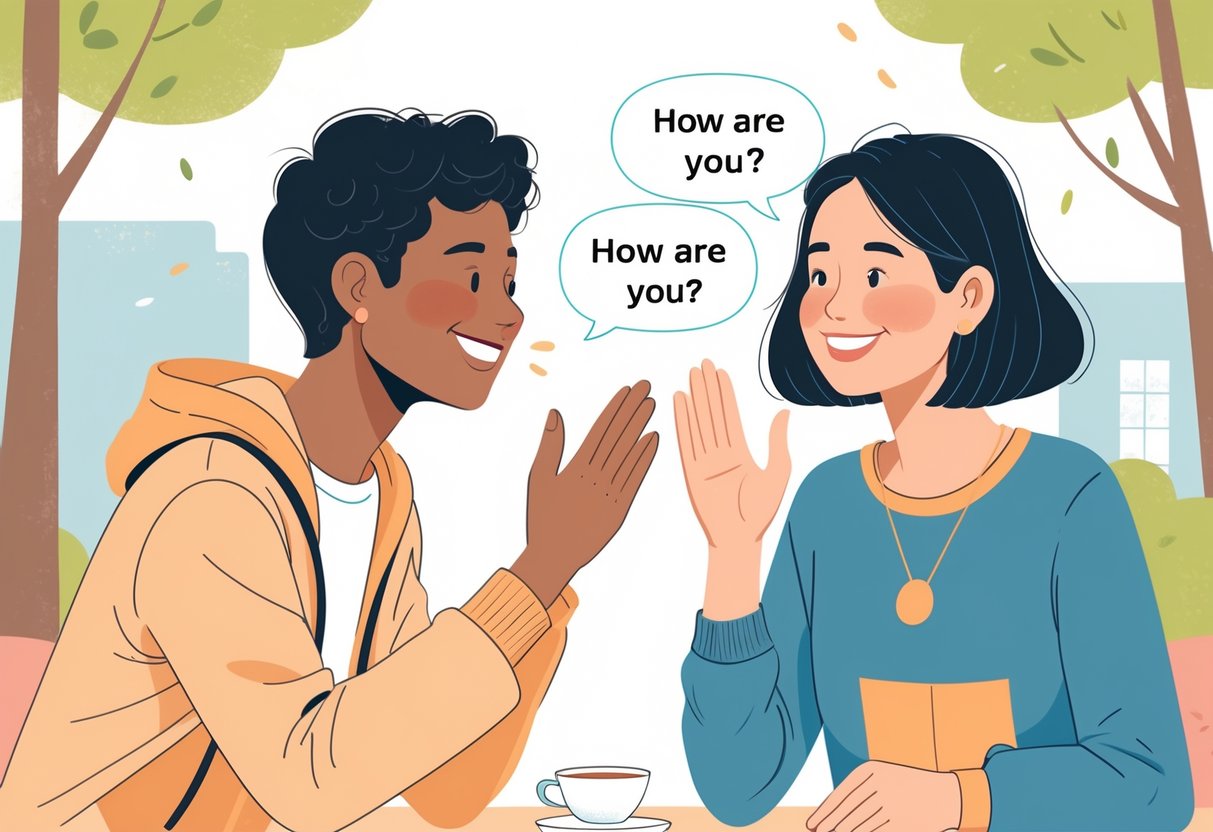
Most adults studying Spanish can recite "¿Cómo estás?" within their first week of study, yet struggle to use it appropriately in real conversations. The gap between recognition and production reveals a fundamental problem: traditional study methods optimize for short-term memorization rather than long-term retrieval. Learning how to say "how are you" in Spanish requires understanding not just the literal translation, but the contextual, formal, and regional variations that Spanish speakers navigate automatically.
The failure point for most adult learners occurs not from lack of effort, but from cognitively inefficient study methods. Vocabulary lists and app-based drilling create recognition memory, where learners can identify the correct answer when they see it. Real fluency requires production memory, where the brain retrieves the phrase without visual prompts. This distinction matters because the cognitive pathways for recognition and production are separate. When learners rely on flashcards or translation apps, they strengthen recognition circuits while leaving production circuits underdeveloped. The brain encodes information differently when it must retrieve rather than recognize, and this encoding difference determines whether a phrase remains accessible during live conversation.
High-frequency phrases like greetings provide hidden leverage because they appear in nearly every interaction. Mastering these variations of asking how someone is doing creates multiple daily opportunities for retrieval practice, which strengthens memory formation through repeated encoding cycles. This article translates expert-level language acquisition principles into immediately applicable steps, explaining why spaced repetition, contextual exposure, and progressive retrieval outperform cramming from a memory formation perspective. It breaks down the specific mechanisms that make certain study routines cognitively efficient for adult brains and provides a step-by-step framework learners can implement starting today.
Core Expressions: The Essential Ways to Say How Are You in Spanish
The Spanish language uses ¿Cómo estás? as its most common greeting, but the phrase changes based on formality level and whether the speaker addresses one person or multiple people. Spanish greetings require matching verb conjugations to social context, which creates a predictable system learners can master through contextual recall practice.
Understanding ¿Cómo Estás? and Its Variants
The phrase ¿Cómo estás? translates to "How are you?" and uses the informal second-person conjugation of the verb estar (to be). Adult learners benefit from encoding this phrase alongside its variations because the shared root word cómo creates a mental anchor that reduces cognitive load during retrieval.
The verb estar changes based on who receives the greeting. ¿Cómo estás? works for informal conversations with one person. ¿Cómo está? uses the formal third-person conjugation for polite address.
Auditory reinforcement matters here because Spanish speakers often drop the subject pronoun. Spanish speakers say ¿Cómo estás? instead of ¿Cómo tú estás? Learners who practice with audio recognize this pattern faster than those who only read written forms.
The variants share identical word order: cómo (how) + conjugated estar. This consistency allows learners to focus retrieval practice on verb endings rather than sentence structure.
Formal vs. Informal Greetings: When and Why
Spanish uses tú for informal situations and usted for formal contexts, which directly affects how learners conjugate estar. The phrase ¿Cómo está usted? includes the subject pronoun for emphasis in formal settings, though speakers often shorten it to ¿Cómo está?
Contextual recall works better than memorizing rules. Learners who practice ¿Cómo estás? in friend scenarios and ¿Cómo está usted? in professional scenarios build separate memory traces linked to social cues. This prevents the common error of using informal conjugations with supervisors or elderly speakers.
The formality distinction follows clear patterns:
- Informal (tú): friends, family members, children, peers
- Formal (usted): strangers, authority figures, elderly people, professional settings
Most Latin American countries use usted more frequently than Spain. Learners gain accuracy by noting regional differences during audio exposure rather than trying to memorize geographical rules.
Plural Forms: Addressing Groups in Spain and Latin America
Spain uses ¿Cómo estáis? for informal plural (addressing multiple friends), while Latin America uses ¿Cómo están? for all plural situations. This creates a retrieval challenge because the same social context requires different verb forms based on location.
The formal plural ¿Cómo están? works in both regions when addressing multiple people politely. Adult learners reduce confusion by practicing regional variants separately rather than simultaneously.
Step-by-Step Regional Practice
- Listen to ¿Cómo estáis? in Spanish media marked as from Spain
- Repeat the phrase while visualizing a group of friends
- Wait 24 hours, then recall the phrase without the audio prompt
- Listen to ¿Cómo están? in Latin American content
- Practice distinguishing the verb endings by sound alone
This spaced approach prevents interference between similar forms. The encoding → retrieval → reinforcement loop strengthens when learners separate practice sessions by region rather than mixing both variants in one study period.
Latin American Spanish dominates most learning materials, making ¿Cómo están? the safer default for plural greetings until learners gain exposure to Peninsular Spanish through Spanish speakers or media content.
Alternative Phrases: Beyond the Basics for Real Conversations
Spanish speakers rarely stick to textbook greetings in daily life. Regional variations like ¿qué onda? signal familiarity, while well-being questions such as ¿cómo te encuentras? prompt genuine responses rather than automatic replies.
Casual and Regional Variations
¿Qué tal? serves as the most universal casual greeting across Spanish-speaking countries. It functions identically to "What's up?" but requires an adjective response like bien or regular rather than "nothing much."
¿Cómo andas? translates literally to "How do you walk?" but means "How's it going?" This informal alternative to standard greetings appears frequently in Argentina and Uruguay. The verb andar conjugates regularly, making it accessible for learners.
¿Qué onda? dominates Mexican Spanish as the go-to casual phrase among friends. It carries more informality than ¿qué tal? and signals peer-level rapport.
Learners encode these variations most effectively when they practice recall in context rather than memorizing isolated translations. Hearing ¿qué tal? in a café interaction creates stronger retrieval pathways than drilling it from a vocabulary list because the brain links the phrase to social cues and physical settings.
Expressive and Slang Options
¿Qué pasa? asks "What's happening?" and expects responses like nada (nothing) or lo normal (the usual). Unlike ¿qué tal?, which requires adjective responses, ¿qué pasa? prompts narrative answers about events.
¿Qué hay? shortens ¿qué hay de nuevo? (what's new?) into two words. Appropriate responses include todo bien (all good) or no me quejo (can't complain).
¿Qué cuentas? literally asks "What do you tell?" but functions as "What's going on?" The phrase works best with friends rather than formal acquaintances because of its conversational intimacy.
Qué hubo appears primarily in Colombian Spanish as an extremely casual greeting between close friends. It contracts from "¿qué hubo?" but speakers often drop the question marks in speech.
Progressive word-removal training strengthens recall for these slang phrases. A learner might see "¿Qué ?" first, then "¿ pasa?" in subsequent exposures, forcing active retrieval rather than passive recognition.
Well-being-Focused Inquiries
¿Cómo te va? asks "How does it go for you?" and prompts responses using the same verb structure: me va bien (it's going well for me). This construction teaches learners to reuse grammatical patterns rather than memorize disconnected phrases.
¿Cómo te encuentras? translates to "How do you find yourself?" and carries more concern than casual greetings. Spanish speakers use this phrase when they genuinely want to know about someone's state, especially after illness or difficult news.
¿Cómo va todo? (How's everything going?) and ¿cómo has estado? (How have you been?) signal deeper interest than quick check-ins. They invite extended responses about life circumstances rather than one-word answers.
¿Cómo te ha ido? uses the present perfect tense to ask "How has it gone for you?" This phrase works particularly well when reconnecting with someone after time apart because it acknowledges the gap.
Contextual recall explains why these phrases stick better when learned through daily exposure rather than study sessions. A learner who encounters ¿cómo te va? in a five-minute morning routine builds retrieval strength through repeated, spaced attempts to recall the phrase before checking the answer. This encoding-retrieval-reinforcement loop outperforms flashcard drilling because it mimics how adults actually need to access language: spontaneously, in real time, without translation crutches.
Practical Strategies: Choosing the Right Greeting for Every Situation
Selecting the correct Spanish greeting depends on formality level, relationship dynamics, and time of day. Adults who learn to map greetings to specific social contexts encode them with stronger retrieval cues than those who memorize isolated phrases.
Context: Social, Professional, and Cultural Factors
Formal settings require "¿Cómo está usted?" with strangers, clients, or elders. The usted form signals respect and distance. Informal contexts use "¿Cómo estás?" with friends, family, or peers of similar age and status.
Time-based greetings follow strict patterns. "Buenos días" applies from sunrise until noon. "Buenas tardes" spans noon to approximately 7 PM. "Buenas noches" covers evening hours and serves as both a greeting and farewell.
Regional variations affect greeting choices. In Spain, casual greetings like "Buenas" are common among familiar speakers. Mexican Spanish favors "¿Qué tal?" in relaxed conversations. Caribbean speakers use "¿Qué hubo?" informally.
Plural forms change based on formality. "¿Cómo están ustedes?" addresses multiple people formally. "¿Cómo están?" works for informal groups. Adults who practice these distinctions in realistic dialogues build contextual recall pathways that flashcard drilling cannot create.
Mistakes Learners Make and How to Avoid Them
Adult learners frequently overgeneralize "Hola" across all situations, ignoring formality markers. Using "¿Cómo estás?" with a supervisor or elderly person signals disrespect unintentionally.
Another common error involves time-mismatched greetings. Saying "Buenos días" at 3 PM marks the speaker as non-proficient. Adults who train with Spanish audio at different times of day encode temporal cues through auditory reinforcement.
Many learners also confuse "estar" and "ser" conjugations when asking "How are you?" The correct form is always "¿Cómo está?" or "¿Cómo estás?" never "¿Cómo es?"
Step-by-Step Practice Method:
- Identify the context (formal/informal, time, relationship)
- Say the full greeting aloud with proper intonation
- Remove one word and recall the complete phrase
- Wait 10 seconds, then repeat from memory
- Increase the delay to 60 seconds the next day
This progressive word-removal approach forces retrieval rather than recognition, strengthening the encoding-retrieval-reinforcement loop that builds automatic production in Spanish conversation.
How to Respond to How Are You in Spanish: Natural and Local Answers
When someone asks "¿Cómo estás?" in Spanish, most learners freeze or default to textbook answers that mark them as non-Spanish speakers. Spanish speakers use a small set of high-frequency responses that vary based on formality and relationship, and mastering these requires repeated retrieval practice in realistic conversational contexts.
Standard and Polite Responses
The most common response is "Bien, gracias" (good, thanks), which works in nearly every situation. This two-word phrase accounts for the majority of casual replies and should be the first response learners encode into long-term memory through daily spoken repetition.
"Muy bien" (very good) adds slight emphasis without changing formality level. "Todo bien" (all good) functions similarly but signals a more relaxed tone.
For formal contexts, learners should use "Muy bien, gracias, ¿y usted?" (very good, thanks, and you?). The inclusion of "y usted" completes the conversational exchange and demonstrates social awareness. Learners who practice this response to "¿Cómo estás?" in full sentences retrieve the entire phrase pattern more efficiently than those who drill individual words.
Common responses:
- Bien, gracias – Good, thanks
- Muy bien – Very good
- Todo bien – All good
- Regular – Okay/So-so
- Más o menos – More or less
Cultural Nuances in Replies
Spanish speakers expect brief responses in casual greetings but longer exchanges with friends and family. The same phrase carries different weight depending on relationship context, not just formality.
When greeting acquaintances, "Bien, ¿y tú?" functions as a social acknowledgment rather than an invitation to share personal details. Close friends expect follow-up information: "Bien, un poco cansado pero bien" (good, a bit tired but good).
Spanish speakers rarely use only "bien" without "gracias" in face-to-face conversation. The omission sounds abrupt. However, in digital messaging, "bien" alone appears frequently because typing speed outweighs politeness norms.
Learners who practice responses as complete conversational turns - not isolated vocabulary - develop stronger contextual recall. Hearing "¿Cómo estás?" should trigger the full pattern "Bien, gracias, ¿y tú?" automatically, which only happens through retrieval practice that simulates real dialogue timing and social expectation.
Frequently Asked Questions
Spanish learners commonly struggle with choosing appropriate greetings based on formality level and regional context. The language offers distinct phrases for formal situations, casual interactions, and regional slang that each activate different social recognition patterns in Spanish speakers.
What are the different ways to inquire about someone's wellbeing in Spanish?
Spanish provides over 30 distinct expressions for asking about someone's wellbeing, each triggering different contextual associations in memory. The brain encodes these phrases most effectively when learners practice them in their authentic social contexts rather than as isolated vocabulary items.
The most common phrases include "¿Cómo estás?" for informal settings and "¿Cómo está usted?" for formal situations. Regional variations like "¿Qué tal?" work across multiple Spanish-speaking countries, while "¿Cómo te va?" asks specifically about how things are going for someone.
Learners retain these variations more effectively through spaced repetition that pairs each phrase with its appropriate social context. The encoding process strengthens when the brain associates the phrase with a specific person, setting, or relationship type rather than a simple English translation.
How can you ask someone if they are doing well in Spanish in a formal conversation?
Formal Spanish greetings require the usted form, which activates different grammatical patterns than informal speech. The standard formal greeting is "¿Cómo está usted?" which Spanish speakers use with strangers, elders, and professional contacts.
The phrase structure forces learners to encode both the verb conjugation (está versus estás) and the pronoun choice. This dual encoding creates stronger retrieval cues than memorizing translations alone.
Professional and formal contexts also accept "¿Cómo se encuentra?" and "¿Cómo le va?" These variations provide contextual flexibility while maintaining appropriate social distance. Adult learners benefit from practicing these phrases with audio reinforcement to encode the subtle pronunciation differences that signal formality.
What is the casual or informal way to ask 'How are you?' in Spanish?
The most common informal greeting is "¿Cómo estás?" which uses the tú form for friends, family, and peers. This phrase activates faster recall in conversational situations because it appears with higher frequency in daily interactions.
"¿Qué tal?" functions as an even more casual alternative that works across most Spanish-speaking regions. The phrase literally translates as "what such?" but Spanish speakers process it as a fixed expression rather than individual words.
"¿Cómo te va?" and "¿Qué haces?" offer additional informal options that slightly shift the conversational focus. The first asks how things are going, while the second literally means "what are you doing?" but functions as a greeting. Learners encode these distinctions most effectively when they practice complete conversational exchanges rather than isolated phrases.
Are there any slang or humorous expressions to say 'How are you?' in Spanish?
Regional slang creates strong memory associations because these phrases carry cultural context that aids encoding. Mexican Spanish uses "¿Qué onda?" while Argentine speakers say "¿Cómo andás?" with distinctive pronunciation patterns.
Colombian Spanish employs "¿Qué más?" which literally asks "what more?" but functions as a casual greeting. Spanish from Spain might use "¿Qué pasa?" or the shortened "¿Qué hay?" in informal settings.
The slang term "¿Quiubo?" represents a phonetic compression of "¿Qué hubo?" that appears in casual Mexican and Colombian speech. These regional variations strengthen retention when learners associate them with specific countries or speakers rather than treating them as interchangeable alternatives. Audio exposure to Spanish speakers using these phrases in natural conversation creates the auditory encoding necessary for recognition and production.
How do you respond to 'How are you?' in Spanish if you are feeling good?
The standard positive response is "Bien, gracias" which means "good, thanks." This phrase pair creates a retrieval loop because hearing the question automatically activates the response pattern in memory.
"Muy bien" intensifies the response to "very good" while "Todo bien" confirms that everything is good. Spanish speakers often add "¿y tú?" (and you?) or "¿y usted?" (formal) to continue the conversational exchange.
More elaborate responses include "Estoy muy bien" (I am very well) or "Me va muy bien" (It's going very well for me). The brain encodes these responses most effectively through progressive practice that starts with recognition, moves to prompted production, and advances to spontaneous retrieval without cues.