How to Say Simple Conversations in Spanish: Faster Adult Fluency Methods
Memory sticks better when you practice phrases with their common responses as pairs, not just single words
Posted by
 Stewart Kaplan
Related reading
What Does Adonde Mean in Spanish? How Movement 'Clicks' for Learners
You have to know when prepositions combine with donde to show direction or position
What Does Ahi Mean in Spanish? Cognitive Mastery That Sticks
Learners mix up ahí, hay, and ay because they sound the same but mean totally different things.
What Does Aki Mean in Spanish: Unpacking Real Usage for Learners
Regional differences exist, but nearly everyone in Spanish-speaking communities gets what "aki" means in a text
TL;DR
- Basic Spanish conversations use three main phrase groups: greetings (¡Hola!, Buenos días), question words (qué, cómo, dónde), and responses (Me llamo..., Soy de...)
- Formal vs. informal matters: tú forms (¿Cómo estás?) with friends, usted forms (¿Cómo está?) for elders or professionals
- Spanish question words always have accent marks (qué, cuál, dónde) and start with an inverted question mark (¿)
- Memory sticks better when you practice phrases with their common responses as pairs, not just single words
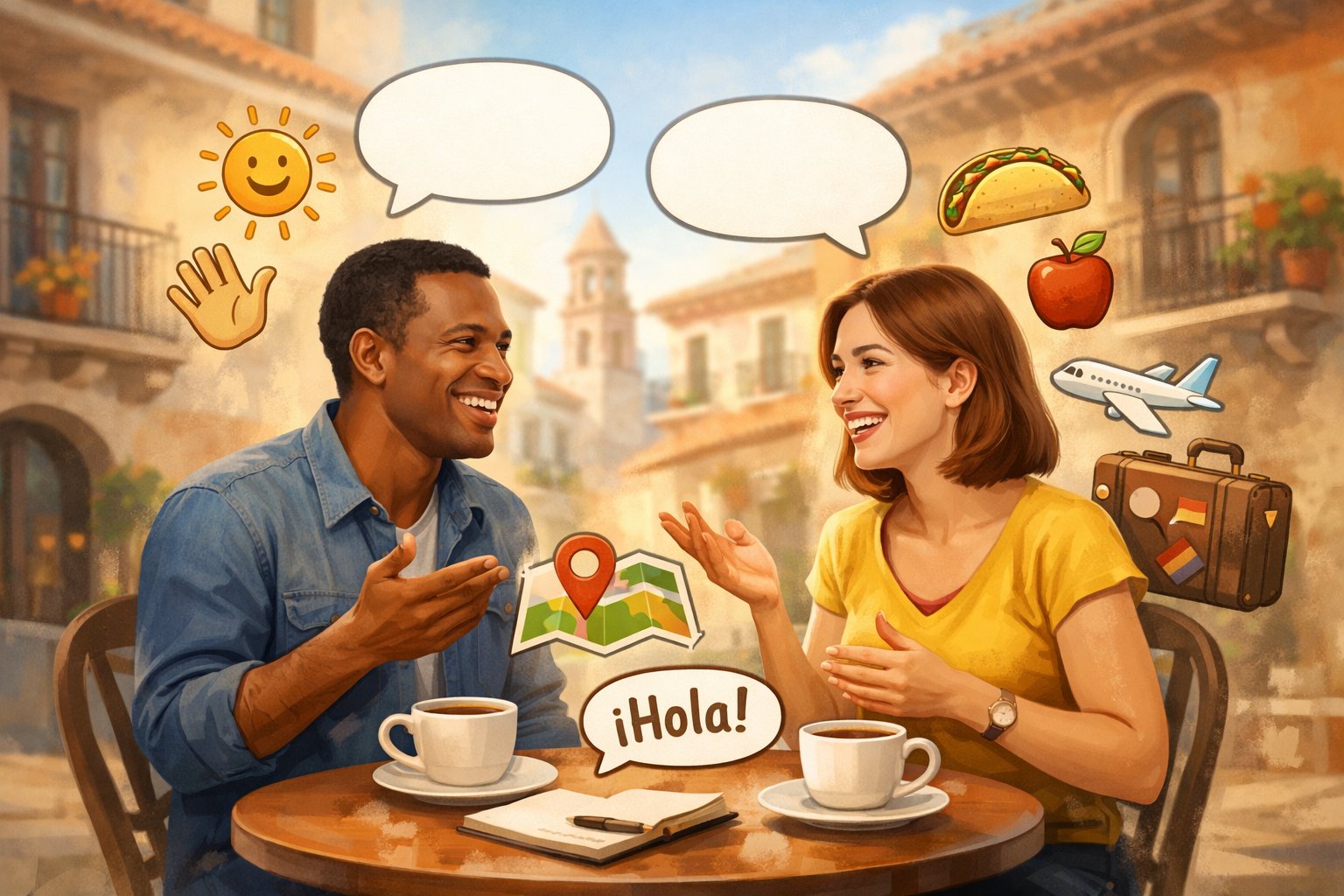
Fundamental Spanish Greetings and Conversation Starters
You’ll need the basics: time-based greetings like buenos días, buenas tardes, and informal ones like hola or chao. Some are formal, some are super casual, and which you use can depend on the region or who you’re talking to.
Key Spanish Greetings and Expressions
Time-Based Greetings
| Spanish | English | Usage Context |
|---|---|---|
| Buenos días | Good morning | Morning until noon |
| Buenas tardes | Good afternoon | Noon till evening |
| Buenas noches | Good evening/night | Evening/bedtime |
General Greetings
- Hola – Hi/Hello (casual, friends/family)
- Saludos – Greetings (neutral, can be written or spoken)
How to Say "How Are You?"
| Informal (tú) | Formal (usted) | Meaning |
|---|---|---|
| ¿Cómo estás? | ¿Cómo está? | How are you? |
| ¿Qué tal? | ¿Cómo le va? | What’s up?/How’s it going? |
| ¿Cómo te va? | ¿Cómo anda? | How is it going? |
Rule → Example:
Time-based greetings are used according to the time of day.
Rule: Use "Buenos días" before noon.
Example: "¡Buenos días, Marta!"
Essential Conversation Starters and Responses
Basic Introductions
| Question | Response | Notes |
|---|---|---|
| ¿Cómo te llamas? | Me llamo [name] | Informal name exchange |
| ¿De dónde eres? | Soy de [place] | Where you’re from |
| ¿Dónde vives? | Vivo en [place] | Where you live now |
Common Small Talk
- ¿Cuántos años tienes? – How old are you? (informal)
- ¿A qué te dedicas? – What do you do? (informal)
- ¿Tienes hijos? – Do you have kids?
Polite Expressions After Meeting
- Encantado (male) / Encantada (female) – Nice to meet you
- Es un placer – It’s a pleasure
- Mucho gusto – Pleased to meet you
Rule → Example:
After introductions, a polite phrase follows.
Rule: Say "Mucho gusto" after learning someone’s name.
Example:
A: ¿Cómo te llamas?
B: Me llamo Ana.
A: Mucho gusto, Ana.
Farewells and Parting Words
Standard Goodbyes
| Spanish | English | Formality |
|---|---|---|
| Adiós | Goodbye | Neutral |
| Hasta luego | See you later | Informal/neutral |
| Chao/Chau | Bye | Very informal |
| Nos vemos | See you | Informal |
Time-Specific Farewells
- Hasta mañana – See you tomorrow
- Hasta pronto – See you soon
- Hasta la próxima – Until next time
- Hasta ahora – See you in a minute
Polite Closings
- Que tengas un buen día (informal) – Have a nice day
- Que tenga un buen día (formal) – Have a nice day
Rule → Example:
Use "Hasta luego" or "Nos vemos" when leaving casually.
Example: "Me voy. ¡Hasta luego!"
Essential Phrases and Question Words for Everyday Spanish Conversations
Question words help you ask for info and keep conversations going. These are handy for all sorts of daily talk - just pair them with common verbs or phrases.
Foundational Question Words in Spanish
| Spanish | English | Example |
|---|---|---|
| ¿Qué? | What? | ¿Qué es esto? (What is this?) |
| ¿Quién? | Who? | ¿Quién es él? (Who is he?) |
| ¿Dónde? | Where? | ¿Dónde está el baño? (Where’s the bathroom?) |
| ¿Cuándo? | When? | ¿Cuándo llegas? (When do you arrive?) |
| ¿Por qué? | Why? | ¿Por qué no vienes? (Why aren’t you coming?) |
| ¿Cómo? | How? | ¿Cómo estás? (How are you?) |
| ¿Cuánto/a? | How much? | ¿Cuánto cuesta? (How much does it cost?) |
| ¿Cuál? | Which? | ¿Cuál prefieres? (Which do you prefer?) |
Rule → Example:
Spanish questions start with an inverted question mark and the question word.
Rule: Place "¿" at the beginning and the question word up front.
Example: "¿Dónde vives?"
Simple Questions and Daily Interactions
Time and Location
- ¿Qué hora es? - What time is it?
- ¿Dónde vives? - Where do you live?
- ¿Cuándo es tu cumpleaños? - When’s your birthday?
Requests
- ¿Me puedes ayudar? - Can you help me?
- ¿Hablas inglés? - Do you speak English?
- ¿Cuánto cuesta esto? - How much is this?
Daily Courtesies
| Spanish | English | Context |
|---|---|---|
| Disculpa | Excuse me | Informal |
| Disculpe | Excuse me | Formal |
| Por favor | Please | Universal |
| Gracias | Thank you | Universal |
Rule → Example:
Always say "Por favor" when asking for something.
Example: "Un café, por favor."
Making Connections: Getting to Know Someone
Introduction Sequence
- ¿Cómo te llamas? - What’s your name? (informal)
- Me llamo [name] - My name is [name]
- Mucho gusto - Nice to meet you
- ¿De dónde eres? - Where are you from?
Personal Info Questions
- ¿A qué te dedicas? - What do you do?
- ¿Tienes hermanos? - Do you have siblings?
- ¿Qué te gusta hacer? - What do you like to do?
Informal vs. Formal
| Informal (tú) | Formal (usted) |
|---|---|
| ¿Cómo estás? | ¿Cómo está? |
| ¿Cuántos años tienes? | ¿Cuántos años tiene? |
| ¿Qué haces? | ¿Qué hace? |
Rule → Example:
Use "tú" forms with friends or people your age, "usted" with strangers, elders, or in formal settings.
Example:
To your friend: ¿Cómo estás?
To your boss: ¿Cómo está?
Frequently Asked Questions
What are some basic phrases to start a conversation in Spanish?
| Spanish Phrase | English Translation | Context |
|---|---|---|
| Hola, ¿cómo estás? | Hi, how are you? | Informal greeting |
| Buenos días | Good morning | Before noon |
| Buenas tardes | Good afternoon | Afternoon |
| Buenas noches | Good evening/night | Late evening |
| ¿Cómo te llamas? | What’s your name? | Informal intro |
| ¿Cómo se llama? | What’s your name? | Formal intro |
| Mucho gusto | Nice to meet you | After introductions |
| ¿De dónde eres? | Where are you from? | Informal |
| ¿De dónde es usted? | Where are you from? | Formal |
Common responses:
- Bien, gracias. ¿Y tú? (Good, thanks. And you? - informal)
- Muy bien, ¿y usted? (Very good, and you? - formal)
- Me llamo [name] (My name is [name])
- Soy de [place] (I'm from [place])
Rule → Example:
To greet someone and ask their name:
Example: "Hola, ¿cómo te llamas?"
Can you provide examples of simple dialogues between two people in Spanish?
Meeting someone new:
- A: Hola, ¿cómo estás?
- B: Bien, gracias. ¿Y tú?
- A: Muy bien. ¿Cómo te llamas?
- B: Me llamo María. ¿Y tú?
- A: Soy Carlos. Mucho gusto.
- B: Mucho gusto, Carlos.
At a café:
- Cliente: Buenos días. ¿Qué tiene para desayunar?
- Camarero: Tenemos café, pan tostado y huevos.
- Cliente: Un café y pan tostado, por favor.
- Camarero: ¿Algo más?
- Cliente: No, gracias.
Asking for directions:
- A: Disculpe, ¿dónde está el banco?
- B: Está a dos cuadras, a la derecha.
- A: Muchas gracias.
- B: De nada.
Rule → Example:
Practice both sides of dialogues to improve recall.
Example:
A: ¿Dónde está el baño?
B: Está al fondo, a la izquierda.
How can I learn and practice basic Spanish conversation as a beginner?
Structured practice methods:
- Listen to Spanish audio for at least 5–10 minutes a day
- Repeat phrases out loud right after you hear them
- Record your own responses and compare with natural pronunciation
- Practice dialogues by gradually removing words (full text → partial → from memory)
- Review the same phrases after 1 day, 3 days, and 7 days
Practice formats by effectiveness:
| Method | Retention Benefit | Time Required |
|---|---|---|
| Daily audio + repetition | High – builds auditory memory | 10–15 min |
| Dialogue role-play | High – active speaking practice | 15–20 min |
| Flashcard drills | Medium – helps recognition | 10 min |
| Grammar exercises | Low – not for conversation | 20–30 min |
Platform content organization:
- Arranged by frequency and context, not grammar level
Memory reinforcement steps:
- Listen → Speak → Repeat daily
What are common Spanish expressions used in everyday conversations?
Essential everyday phrases:
| Spanish Expression | English Meaning | Usage Context |
|---|---|---|
| Por favor | Please | Making requests |
| Gracias | Thank you | Expressing gratitude |
| De nada | You're welcome | Responding to thanks |
| Perdón / Disculpe | Excuse me / Sorry | Getting attention/apologizing |
| No entiendo | I don't understand | Clarification needed |
| ¿Puedes repetir? | Can you repeat? | Informal request |
| ¿Puede repetir? | Can you repeat? | Formal request |
| Claro | Of course | Agreement |
| Vale | Okay | Agreement (Spain) |
| ¿Qué tal? | What's up? / How's it going? | Casual greeting |
| Con permiso | Excuse me | Passing through |
| Lo siento | I'm sorry | Apologizing |
Time-related expressions:
- Ahora (now)
- Luego (later)
- Mañana (tomorrow)
- Ayer (yesterday)
- Hoy (today)
Phrase learning tips:
- Use high-frequency phrases in real conversations
- Practice phrases in full sentences, not just as single words
Rule → Example:
Rule: Practice common expressions in real dialogue, not isolation
Example: Use “¿Puedes repetir?” during a conversation when you miss something