How to Say Common Questions in Spanish: Unlock Rapid Mastery
Yes/no questions often look just like statements, except for the question marks and a rising tone when spoken.
Posted by
 Stewart Kaplan
Related reading
What Does Adonde Mean in Spanish? How Movement 'Clicks' for Learners
You have to know when prepositions combine with donde to show direction or position
What Does Ahi Mean in Spanish? Cognitive Mastery That Sticks
Learners mix up ahí, hay, and ay because they sound the same but mean totally different things.
What Does Aki Mean in Spanish: Unpacking Real Usage for Learners
Regional differences exist, but nearly everyone in Spanish-speaking communities gets what "aki" means in a text
TL;DR
- Spanish questions form three ways: add question marks to a statement, flip subject and verb order, or start with a question word like qué, dónde, or cuándo.
- All question words (interrogatives) in Spanish have accent marks and use both opening (¿) and closing (?) question marks in writing.
- Question templates repeat - "¿Cuánto cuesta?" works for any price, "¿Dónde está?" for any location. Just swap the noun.
- Yes/no questions often look just like statements, except for the question marks and a rising tone when spoken.
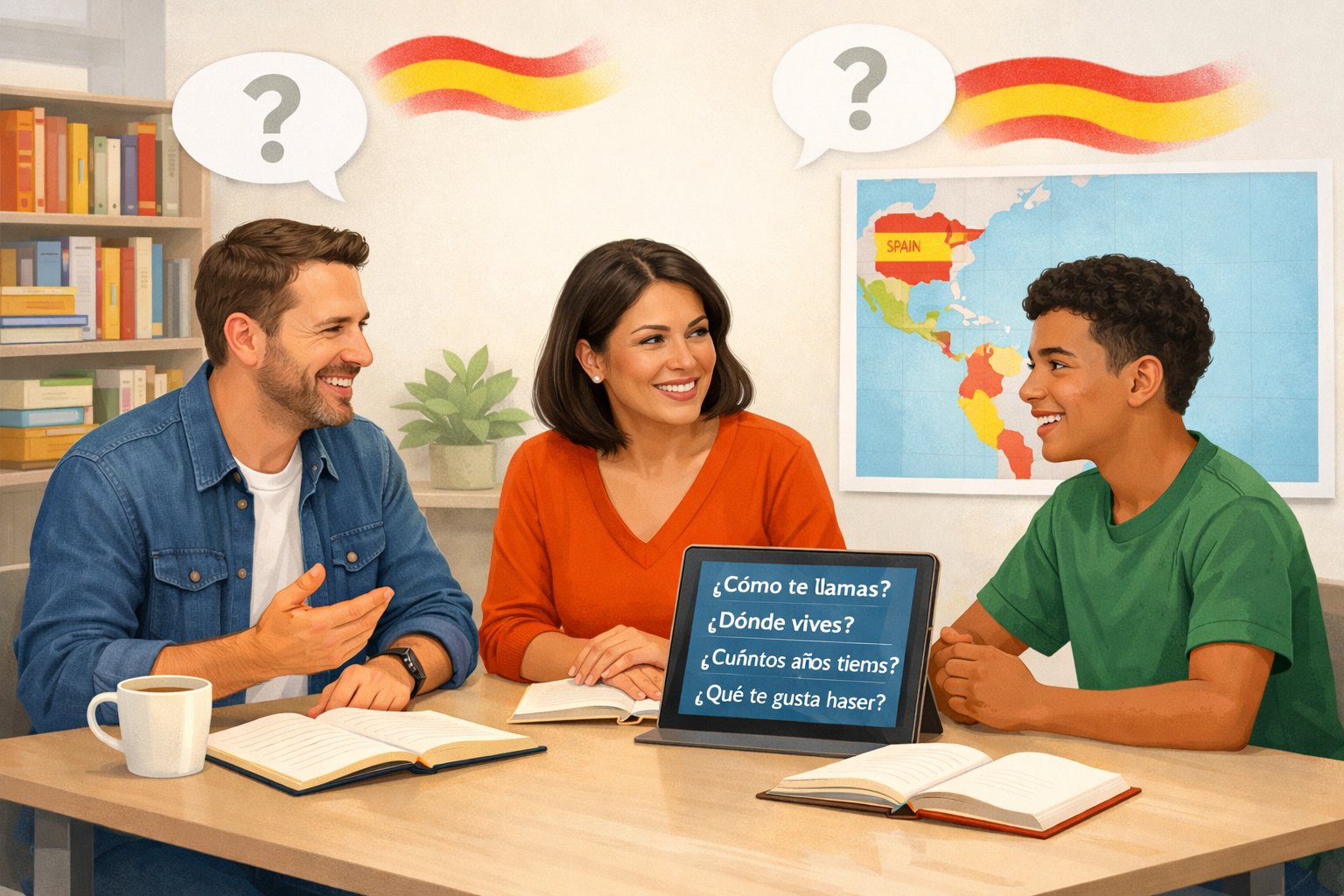
Mastering Essential Spanish Question Words
Spanish question words are pretty consistent - there are eight main ones, each with an accent and those upside-down question marks. Each word asks for a particular kind of info.
Roles of ¿cómo?, ¿qué?, ¿cuál?, ¿dónde?, ¿cuándo?, ¿quién?, ¿por qué?, ¿cuánto?
| Question Word | Purpose | Example | Translation |
|---|---|---|---|
| ¿Qué? | Things, actions, definitions | ¿Qué estudias? | What do you study? |
| ¿Quién?/¿Quiénes? | People (singular/plural) | ¿Quién es ella? | Who is she? |
| ¿Dónde? | Locations, places | ¿Dónde vives? | Where do you live? |
| ¿Cuándo? | Time, dates, moments | ¿Cuándo llegas? | When do you arrive? |
| ¿Por qué? | Reasons, causes | ¿Por qué estudias? | Why do you study? |
| ¿Cómo? | Manner, condition, method | ¿Cómo estás? | How are you? |
| ¿Cuál?/¿Cuáles? | Selection from options | ¿Cuál prefieres? | Which do you prefer? |
| ¿Cuánto?/¿Cuánta?/¿Cuántos?/¿Cuántas? | Quantity (m/f, s/pl) | ¿Cuántos años tienes? | How old are you? |
Common combos:
- ¿De dónde? - Where from
- ¿A qué hora? - At what time
- ¿Con quién? - With whom
- ¿Para qué? - What for
Rule → Example:
- Use ¿qué? for definitions: ¿Qué es esto?
- Use ¿cuál? for choices: ¿Cuál prefieres?
Accent Marks and Inverted Question Marks in Spanish Questions
| Rule | Example |
|---|---|
| Start every question with ¿ and end with ? | ¿Dónde está el baño? |
| Use accent marks on all question words | ¿Cómo te llamas? |
| With Accent (Question) | Without Accent (Other Meaning) |
|---|---|
| ¿Qué haces? | Lo que quieres |
| ¿Dónde vives? | Donde trabajo |
| ¿Cómo estás? | Como pan |
| ¿Cuándo vienes? | Cuando puedo |
Rule → Example:
- Always use accent marks on question words: ¿Por qué estudias?
- Intonation rises at the end of spoken questions.
Comparison of Open and Yes/No Question Types
| Type | Structure | Example | Expected Answer |
|---|---|---|---|
| Yes/No | Statement with question marks | ¿Tú hablas español? | Sí/No |
| Open | Question word + verb + subject | ¿Dónde trabaja María? | En el hospital |
| Rule | Example |
|---|---|
| Yes/No: Subject can come before verb | ¿María trabaja aquí? |
| Open: Question word always first | ¿Qué estudias tú? |
Forming and Using the Most Common Spanish Questions
Building Practical Questions for Everyday Conversation
| Method | Structure | Example Statement | Example Question |
|---|---|---|---|
| Add question marks | Statement + ¿? | Hablas español. | ¿Hablas español? |
| Invert subject-verb | Verb + Subject + ¿? | Usted tiene tiempo. | ¿Tiene usted tiempo? |
| Use question words | Question word + Verb + Subject | - | ¿Dónde vives? |
Essential Question Words
- ¿Qué? - What?
- ¿Quién?/¿Quiénes? - Who?
- ¿Dónde? - Where?
- ¿Cuándo? - When?
- ¿Cómo? - How?
- ¿Por qué? - Why?
- ¿Cuál? - Which?
- ¿Cuánto? - How much/many?
Rule → Example:
- Start every Spanish question with an inverted question mark (¿).
- Put the question word first, then the verb.
Common Spanish Questions for Personal Information
| Spanish | English | Context |
|---|---|---|
| ¿Cómo te llamas? | What's your name? | Informal |
| ¿De dónde eres? | Where are you from? | Informal |
| ¿Cuántos años tienes? | How old are you? | Informal |
| ¿Dónde vives? | Where do you live? | Informal |
| ¿Qué haces? | What do you do? | Occupation |
Social Check-ins
- ¿Cómo estás? - How are you?
- ¿Qué tal? - How's it going?
- ¿Cómo te ha ido? - How have you been?
Interest and Preference Questions
- ¿Te gusta la comida española? - Do you like Spanish food?
- ¿Cuál es tu comida favorita? - What's your favorite food?
- ¿Qué te gusta hacer en tu tiempo libre? - What do you like to do in your free time?
- ¿Practicas algún deporte? - Do you play any sports?
- ¿Qué idiomas hablas? - What languages do you speak?
Rule → Example:
- Use gustar with indirect object pronouns: ¿Te gusta el café?
Situational Spanish Questions: Directions, Food, and Travel
| Spanish | English | Usage |
|---|---|---|
| ¿Dónde está el baño? | Where is the bathroom? | Tourist essential |
| ¿Dónde está...? | Where is...? | Location requests |
| ¿Cómo llego a...? | How do I get to...? | Asking directions |
| ¿Qué hora es? | What time is it? | Time inquiry |
Restaurant Questions
- ¿Tienen una mesa disponible? - Do you have a table available?
- ¿Me puede traer la carta, por favor? - Can you bring me the menu, please?
- ¿Qué platos recomienda? - What dishes do you recommend?
- ¿Cuál es el plato del día? - What's the dish of the day?
- ¿Hay algún plato para vegetarianos? - Any vegetarian options?
Shopping and Transactions
- ¿Cuánto cuesta? - How much does it cost?
- ¿Tienen este producto en otro color? - Do you have this in another color?
- ¿Aceptan tarjeta de crédito? - Do you take credit cards?
- ¿Puedo probármelo? - Can I try it on?
Rule → Example:
- Use location questions in context: ¿Dónde está la estación? (in a city)
- Use shopping questions at markets: ¿Cuánto cuesta esto?
Frequently Asked Questions
| Topic | Quick Fact | Example |
|---|---|---|
| Question formation | Three main ways: punctuation, word order, question word | ¿Hablas español? ¿Dónde vives? |
| Introductions | Use informal forms for most conversations | ¿Cómo te llamas? ¿De dónde eres? |
| Yes/No structure | Same word order as statements, just add question marks | ¿Tienes tiempo? |
What are the basic question words used in Spanish?
| Spanish | English | Example |
|---|---|---|
| ¿Qué? | What? | ¿Qué es esto? (What is this?) |
| ¿Quién? | Who? | ¿Quién es ella? (Who is she?) |
| ¿Cuál? | Which? | ¿Cuál prefieres? (Which do you prefer?) |
| ¿Cómo? | How? | ¿Cómo funciona? (How does it work?) |
| ¿Cuándo? | When? | ¿Cuándo llegas? (When do you arrive?) |
| ¿Dónde? | Where? | ¿Dónde vives? (Where do you live?) |
| ¿Por qué? | Why? | ¿Por qué estudias español? (Why do you study Spanish?) |
| ¿Cuánto/a? | How much/many? | ¿Cuánto cuesta? (How much does it cost?) |
- Rule → All Spanish question words need an accent mark when used in questions.
- Rule → Standard question word order: question word + verb + subject.
Memory tips:
- C-words: cuál, cómo, cuándo, cuánto (Group by first letter)
- Practice: Use one phrase per word each day
- Record: Ask each question out loud, then listen and compare to Spanish speakers
How can I ask someone's name in Spanish?
Informal:
- ¿Cómo te llamas? (What's your name?)
- ¿Cuál es tu nombre? (What is your name?)
Formal:
- ¿Cómo se llama? (What's your name?)
- ¿Cuál es su nombre? (What is your name?)
Common responses:
- Me llamo [name] (My name is [name])
- Soy [name] (I am [name])
| Usage | Pronoun Used | Example |
|---|---|---|
| Informal | te | ¿Cómo te llamas? |
| Formal | se | ¿Cómo se llama? |
- Rule → "Llamarse" means "to call oneself."
Exchange pattern:
- Ask: ¿Cómo te llamas?
- Respond: Me llamo María. ¿Y tú?
- Reply: Me llamo Juan
- Rule → Practice both asking and answering for faster recall.
What phrases should I use to ask for directions in Spanish?
| English | Spanish |
|---|---|
| Where is...? | ¿Dónde está...? |
| How do I get to...? | ¿Cómo llego a...? |
| Is it far? | ¿Está lejos? |
| Is it close? | ¿Está cerca? |
| Can you show me on the map? | ¿Me puede mostrar en el mapa? |
| Which way is...? | ¿Por dónde queda...? |
| Is this the right way? | ¿Es por aquí? |
Location examples:
- ¿Dónde está el baño? (Where is the bathroom?)
- ¿Dónde está la estación? (Where is the station?)
- ¿Dónde está el hotel? (Where is the hotel?)
Direction responses:
A la derecha (To the right)
A la izquierda (To the left)
Todo recto (Straight ahead)
Al final de la calle (At the end of the street)
Rule → Pair gestures with phrases for better memory.
How do you phrase yes/no questions in Spanish?
| Method | Example Statement | Example Question |
|---|---|---|
| Add question marks | Hablas español. | ¿Hablas español? |
| Change intonation | (spoken) | (voice rises at end) |
| Spanish | English |
|---|---|
| ¿Hablas inglés? | Do you speak English? |
| ¿Tienes tiempo? | Do you have time? |
| ¿Vas a la fiesta? | Are you going to the party? |
| ¿Está abierto? | Is it open? |
| ¿Puedo ayudar? | Can I help? |
| ¿Necesitas algo? | Do you need something? |
- Rule → Always use both opening (¿) and closing (?) question marks in written Spanish.
Possible answers:
- Sí (Yes)
- No (No)
- Tal vez (Maybe)
- No sé (I don't know)