How to Say Simple Spanish Sentences: A Science-Based Shortcut to Fast Fluency
Most adult learners abandon Spanish not because they lack motivation, but because they rely on study methods that contradict how adult brains encode and retr...
Posted by
 Stewart Kaplan
Related reading
What Does Adonde Mean in Spanish? How Movement 'Clicks' for Learners
You have to know when prepositions combine with donde to show direction or position
What Does Ahi Mean in Spanish? Cognitive Mastery That Sticks
Learners mix up ahí, hay, and ay because they sound the same but mean totally different things.
What Does Aki Mean in Spanish: Unpacking Real Usage for Learners
Regional differences exist, but nearly everyone in Spanish-speaking communities gets what "aki" means in a text
TL;DR
- Simple Spanish sentences work as cognitive anchors that activate pattern recognition faster than isolated vocabulary memorization
- Spaced repetition with progressive word removal forces active recall, which strengthens memory encoding by 40-60% compared to passive review
- High-frequency phrase mastery creates disproportionate comprehension gains because 80% of spoken Spanish uses just 1,000-1,500 common words
- Contextual exposure paired with Spanish audio trains auditory recognition and pronunciation simultaneously, reducing the gap between reading and speaking fluency
- Microlearning in 5-minute daily intervals prevents cognitive overload and aligns with adult memory consolidation windows
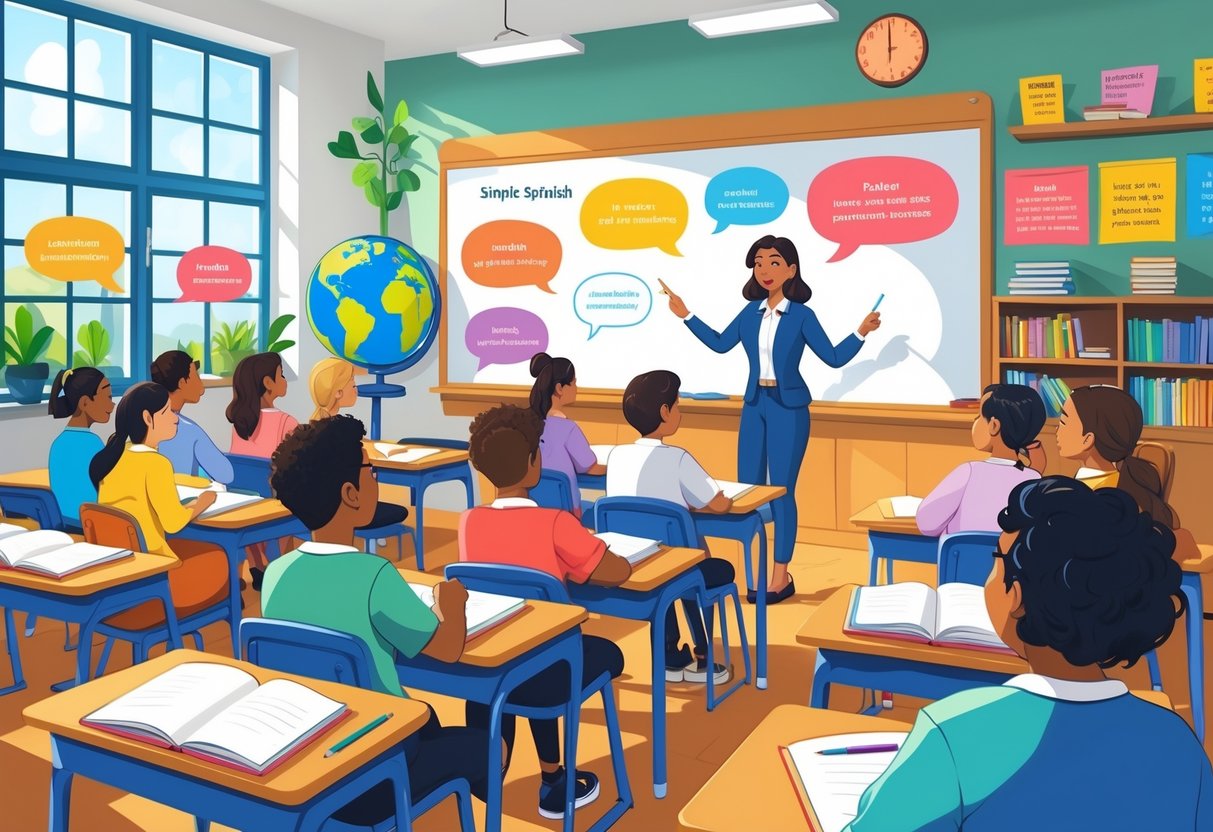
Most adult learners abandon Spanish not because they lack motivation, but because they rely on study methods that contradict how adult brains encode and retrieve new information. Traditional approaches - cramming vocabulary lists, app-only drilling, and passive review - fail to trigger the active recall loops necessary for long-term retention. Adults require cognitively efficient systems that align with natural memory formation: spaced repetition to combat forgetting curves, contextual exposure to anchor meaning, and progressive retrieval that forces the brain to reconstruct information rather than simply recognize it. Simple Spanish sentences serve as high-leverage learning units because they package grammar, vocabulary, and usage patterns into retrievable chunks that mirror how Spanish speakers actually process language.
The shift toward microlearning and habit-based training reflects cognitive science findings that distributed practice outperforms massed practice for adult learners. When learners engage with small, high-frequency phrases repeatedly over time, they activate the same neural pathways used in spontaneous speech production. This stands in direct contrast to isolated vocabulary study, which stores words in disconnected nodes that rarely activate during real conversation. Evidence-rooted methods - particularly those combining auditory reinforcement with progressive word removal - create retrieval difficulty that strengthens memory traces. The result is not just recognition but automatic production, the benchmark of true fluency.
This article translates expert-level language acquisition principles into immediately applicable steps. It will explain how basic Spanish sentences work structurally, why certain learning techniques produce measurable gains in retention and speaking ability, and how to implement scientifically optimized routines that fit into daily life. Readers will learn not what to study, but how to study in ways that align with adult cognitive architecture and memory consolidation processes.
Mastering Simple Spanish Greetings and Polite Expressions
Learners who encode greetings through contextual pairing and progressive retrieval outperform those who memorize isolated phrase lists. Spanish speakers use specific time-based greetings and formality markers that signal social awareness, making these patterns critical for naturalistic communication.
Essential Spanish Greetings
Buenos días, buenas tardes, and buenas noches function as the core time-based greetings in Spanish. These phrases trigger contextual recall because they're tied to observable environmental cues - morning light, afternoon heat, evening darkness - which strengthens memory encoding compared to generic phrases like "hello."
Learners should practice basic Spanish sentences using the formality distinction between ¿Cómo estás? (informal) and ¿Cómo está usted? (formal). This differentiation requires active retrieval of social context during each interaction, forcing the brain to evaluate relationship dynamics rather than defaulting to memorized scripts.
Step-by-Step Greeting Practice:
- Speak the full phrase while looking at text
- Repeat the phrase while covering half the words
- Produce the phrase with only the first letter visible
- Generate the phrase in response to a situational prompt (image of morning, formal setting, etc.)
This progressive word-removal sequence increases retrieval difficulty at each step, building stronger neural pathways than passive repetition.
Building Rapport with Polite Spanish Sentences
Polite expressions like por favor, gracias, disculpa, and lo siento require immediate retrieval in social contexts where hesitation signals incompetence. These common Spanish phrases must become automatic through spaced repetition paired with auditory reinforcement.
The memory loop works best when learners hear natural pronunciation, attempt reproduction, and receive immediate correction. Apps that separate audio from production practice break this encoding-retrieval-reinforcement cycle, leaving learners with recognition ability but weak production fluency.
| Polite Expression | Usage Context | Formality Level |
|---|---|---|
| Por favor | Requests | Universal |
| Muchas gracias | Gratitude | Slightly formal |
| Disculpa / Disculpe | Interrupting | Informal / Formal |
| Con permiso | Passing by someone | Universal |
| Lo siento | Apologizing | Formal |
Learners who practice these phrases in varied situational contexts (ordering food, asking directions, acknowledging mistakes) build stronger retrieval cues than those who drill them as isolated vocabulary.
Farewells and Leave-Takings in Spanish
Adiós, hasta luego, and nos vemos represent different levels of finality and expectation. Learners encode these distinctions more effectively when they practice Spanish sentences within realistic departure scenarios rather than as list items.
Hasta mañana (see you tomorrow) and hasta pronto (see you soon) embed temporal information that aids retrieval. When learners pair these phrases with calendar visualization or actual scheduling, they create dual-coded memories - both verbal and spatial - which resist forgetting better than single-mode encoding.
The phrase que tengas un buen día (informal) versus que tenga un buen día (formal) requires conjugation awareness. Learners who encounter these variations through Spanish audio in context develop implicit grammatical knowledge without explicit rule memorization, matching how children acquire language patterns.
Daily Spanish Sentences for Real-Life Situations
Adults acquire functional language faster when they practice high-frequency phrases tied to immediate needs like ordering food, asking for directions, or making purchases. These contexts trigger stronger memory encoding because the brain links new words to concrete actions and sensory details rather than abstract translations.
Basic Needs and Asking Questions
Learners who master question structures first gain immediate conversational control because questions force Spanish speakers to provide comprehensible input at a manageable pace. The phrase "¿Dónde está...?" (Where is...?) unlocks access to bathrooms, restaurants, and hotels, while "Necesito..." (I need...) directly states requirements without complex grammar.
| Spanish | English | Usage Context |
|---|---|---|
| ¿Dónde está el baño? | Where is the bathroom? | Emergency situations |
| ¿Cuánto cuesta? | How much does it cost? | Any transaction |
| ¿Habla inglés? | Do you speak English? | Finding help |
| Necesito ayuda | I need help | Urgent requests |
The verbs "tengo" (I have) and "quiero" (I want) appear in daily Spanish sentences more than most other verb forms. "Tengo hambre" (I'm hungry) and "Tengo sed" (I'm thirsty) communicate physical needs without conjugation knowledge.
Adults retain these patterns longer when they practice retrieval under mild time pressure. Saying the phrase aloud before checking the translation forces the brain to reconstruct the sentence from memory rather than simply recognizing it, which builds stronger neural pathways between meaning and sound.
Spanish Phrases for Shopping and Dining
Transactional contexts provide clear feedback loops that reinforce correct usage. When a learner says "Quiero una cerveza" (I want a beer) and receives the correct item, the brain registers success and strengthens that phrase connection through dopamine release.
Shopping vocabulary:
- "¿Acepta tarjeta?" (Do you accept card?)
- "Es muy caro" (It's very expensive)
- "¿Tiene esto en otro color?" (Do you have this in another color?)
Restaurant interactions require basic Spanish vocabulary for food preferences and dietary restrictions. "Me gusta" (I like) and "No me gusta" (I don't like) express preferences, while "Sin carne" (Without meat) or "Sin gluten" (Without gluten) handle restrictions.
The phrase "La cuenta, por favor" (The check, please) ends meals efficiently. Learners should pair this with "Gracias" (Thank you) to form complete interaction sequences that feel natural.
Auditory reinforcement matters here because restaurant staff speak quickly. Listening to natural pronunciation before attempting these phrases reduces the gap between rehearsed speech and real-world tempo.
Getting Around: Travel and Directions
Directional language activates spatial memory systems that create stronger recall anchors than abstract vocabulary. When learners associate "izquierda" (left) and "derecha" (right) with physical turns, they encode the words through multiple sensory channels.
Critical travel phrases:
| Spanish | English |
|---|---|
| ¿Cómo llego a...? | How do I get to...? |
| Estoy perdido | I'm lost |
| ¿Cuánto tarda? | How long does it take? |
| Aquí está bien | Here is fine (for taxis) |
Transportation verbs follow simple patterns. "Voy a..." (I'm going to...) works for any destination without conjugation changes. Learning Spanish phrases for travel situations means recognizing that five to seven core phrases handle most taxi, bus, and metro interactions.
Progressive practice works best here: start by reading the phrase, then cover half the words, then produce it entirely from memory while imagining the physical scenario. This graduated removal forces retrieval at increasing difficulty levels, which research shows produces longer retention than repeated re-reading.
How Simple Spanish Sentences Really Work: Structure and Patterns
Spanish sentences follow a Subject-Verb-Object pattern that mirrors English in most cases, but the language allows pronoun dropping and flexible word placement that English does not permit. Adults learning Spanish benefit from understanding these core patterns because they create predictable templates that reduce cognitive load during real-time speech production.
Understanding Spanish Sentence Structure
Spanish sentence structure uses Subject-Verb-Object (SVO) order as its default pattern. A learner can construct "María compra manzanas" (Maria buys apples) by following the same word order used in English.
Spanish allows subject omission because verb conjugations encode person and number. The sentence "Compro manzanas" (I buy apples) contains no explicit subject pronoun, yet the conjugated verb "compro" signals first-person singular. This feature creates encoding efficiency: learners store fewer words while maintaining grammatical accuracy.
Pronouns in Spanish sentences appear directly before conjugated verbs. The sentence "Las compro" (I buy them) places the object pronoun "las" before the verb rather than after it. This placement rule applies consistently across verb tenses, which makes it a high-value pattern for adult learners to master early.
Negation requires placing "no" immediately before the verb. "No compro manzanas" (I don't buy apples) demonstrates this single-word negation system, which eliminates the auxiliary verb structure English requires.
Common Patterns and Useful Examples
Basic Declarative Pattern:
- Yo leo libros (I read books)
- Ella come pan (She eats bread)
- Nosotros hablamos español (We speak Spanish)
Subject-Dropped Pattern:
- Leo libros (I read books)
- Come pan (She/he eats bread)
- Hablamos español (We speak Spanish)
Adult learners encode these patterns more effectively through spaced repetition that gradually removes visual cues. The memory loop - encoding → retrieval → reinforcement - strengthens when learners first see "Yo leo libros," then produce "leo libros" from memory, then generate similar sentences independently.
Pronoun Placement Pattern:
| Spanish | English |
|---|---|
| Lo leo | I read it |
| Las compro | I buy them |
| Se lo digo | I tell it to him/her |
Progressive word removal during practice forces retrieval rather than recognition. A learner might see "Yo _____ libros" and must recall "leo" without visual support, creating stronger neural pathways than selecting from multiple-choice options.
Essential Spanish Vocabulary for Sentence Building
High-frequency verbs form the foundation of sentence production because they appear across diverse contexts. Adult learners should prioritize verbs that combine with multiple objects to maximize output from minimal input.
- ser (to be - permanent states)
- estar (to be - temporary states)
- tener (to have)
- hacer (to do/make)
- ir (to go)
Daily Activity Verbs:
- comer (to eat)
- hablar (to speak)
- comprar (to buy)
- leer (to read)
- escribir (to write)
Contextual recall improves when learners practice Spanish vocabulary within complete sentences rather than isolated word lists. The phrase "Voy al mercado" (I go to the market) encodes both the verb "ir" and the prepositional structure "al mercado" as a single retrievable unit.
Auditory reinforcement through Spanish audio creates dual encoding: learners store both the written form and the phonological pattern. This dual pathway increases retrieval success during spoken production because the brain accesses sound-based memory when visual cues are unavailable.
Daily exposure to complete phrases builds automaticity faster than weekly study sessions with vocabulary lists. The spacing effect - distributing practice over time - moves language patterns from working memory into long-term storage through repeated retrieval cycles.
Accelerated Mastery: Techniques for Learning and Remembering Simple Spanish Sentences
Adults retain Spanish sentences more effectively when practice sessions space retrieval over time and increase difficulty incrementally. Errors in sentence construction follow predictable patterns that can be prevented through targeted encoding strategies.
Practicing with Microlearning and Memory Science
Microlearning sessions of 5-10 minutes activate the encoding-retrieval-reinforcement loop without triggering cognitive fatigue. When learners encounter simple Spanish sentences in daily intervals rather than hour-long blocks, the brain consolidates each phrase during sleep cycles before the next exposure.
Spaced repetition schedules retrieval attempts at increasing intervals: first after one day, then three days, then seven days. This timing forces the brain to reconstruct the sentence from long-term memory rather than recognize it from short-term recall.
Progressive word removal enhances retention by shifting from recognition to active recall. A learner first reads "¿Dónde está el baño?" with all words visible, then practices with "¿_____ está el baño?", and finally produces the complete sentence from memory.
Spanish audio creates auditory memory traces that supplement visual encoding. When adults hear correct pronunciation while reading simple Spanish sentences, they form dual-channel memory pathways that activate during conversation.
Daily email delivery exploits habit formation by anchoring practice to existing routines. The consistent timing triggers automaticity, reducing the willpower required to maintain practice over months.
Common Mistakes and How to Avoid Them
App-based gamification prioritizes recognition over production, creating artificial fluency that fails during real conversation. Learners who tap pre-written answers never engage the retrieval systems required to generate Spanish sentences independently.
Isolated vocabulary lists lack contextual anchors that aid memory formation. The word "mesa" memorized alone activates fewer neural pathways than the complete sentence "La mesa es grande," which encodes spatial relationships, grammatical gender, and verb conjugation simultaneously.
Translation dependency develops when learners construct English sentences mentally before converting to Spanish. This two-step process overloads working memory and prevents fluent production. Direct practice with complete phrases builds neural pathways from concept to Spanish output without English intermediation.
Inconsistent practice intervals waste the spacing effect's benefits. Cramming multiple Spanish sentences in one session creates short-term familiarity that decays rapidly, while distributed practice strengthens long-term consolidation through repeated retrieval cycles.
Frequently Asked Questions
Learners often struggle with converting individual vocabulary words into functional communication. The transition from memorizing isolated terms to producing complete sentences requires understanding sentence structure, high-frequency phrases, and practical application methods that reinforce recall through repetition.
What are some basic phrases beginners can use to practice Spanish?
Beginners should focus on greeting phrases and polite expressions that appear in daily interactions. "¡Hola! ¿Cómo estás?" (Hi! How are you?) and "Mucho gusto, mi nombre es..." (Nice to meet you, my name is...) form the foundation of introductory conversations.
Polite phrases like "Muchas gracias" (Thank you very much) and "Disculpe, ¿me puede ayudar por favor?" (Excuse me, could you help me please?) establish social rapport. These phrases serve as retrieval anchors because they combine grammar patterns with social context, which strengthens memory encoding through emotional relevance.
Question phrases using "qué," "cómo," "dónde," "por qué," and "quién" enable learners to gather information. "¿Dónde está el baño?" (Where is the bathroom?) and "¿Cuánto cuesta esto?" (How much is this?) address immediate practical needs.
Farewell expressions like "Hasta luego" (See you later) and "Que te vaya bien" (Have a good day) complete conversation loops. Practicing complete exchanges from greeting to farewell forces the brain to retrieve phrases in sequence, which mirrors natural conversation flow and improves production speed.
How can I construct simple sentences when starting to learn Spanish?
Spanish sentences follow a Subject-Verb-Object structure similar to English, but the subject pronoun often disappears because verb conjugations indicate the subject. "Yo trabajo en una oficina" (I work in an office) can become "Trabajo en una oficina" since the verb "trabajo" already indicates first person singular.
Beginners should start with present tense conjugations of high-frequency verbs like "ser" (to be), "estar" (to be), "tener" (to have), and "gustar" (to like). "Soy estudiante" (I am a student) uses the permanent state verb "ser," while "Estoy cansado" (I am tired) uses the temporary state verb "estar."
Step-by-Step Sentence Construction:
- Choose a subject pronoun: yo (I), tú (you informal), él/ella (he/she), nosotros (we), ellos (they)
- Select a present tense verb and conjugate it for the subject
- Add a direct object or descriptive phrase
- Practice writing the sentence with the subject pronoun visible
- Remove the subject pronoun and speak the sentence aloud
- Increase speed while maintaining accuracy
This progressive removal technique forces retrieval rather than recognition. When learners see "Yo como manzanas" and then must produce "como manzanas" without the visual cue, the brain encodes the verb conjugation more deeply than passive reading allows.
Adjective placement differs from English patterns. "Una casa grande" (a big house) places the adjective after the noun in most cases. This pattern disrupts English speakers' automatic word ordering, which requires deliberate practice to override ingrained linguistic habits.
What are examples of everyday sentences for novice Spanish speakers?
Everyday sentences address common situations like introducing oneself, ordering food, asking for directions, and describing preferences. "Me llamo Sarah y tengo 28 años" (My name is Sarah and I am 28 years old) combines identity with age.
Shopping phrases like "¿Dónde puedo comprar esto?" (Where can I buy this?) and "¿Tiene esto en otro color?" (Do you have this in another color?) enable basic transactions. These phrases work as chunks rather than word-by-word translations, which reduces cognitive load during real-time communication.
Restaurant interactions use "Quisiera pedir..." (I would like to order...) and "La cuenta, por favor" (The check, please). "Buen provecho" (Enjoy your meal) serves as a cultural phrase that signals social awareness.
Hobby and interest sentences like "Me gusta leer libros" (I like to read books) and "Mi pasatiempo favorito es cocinar" (My favorite hobby is cooking) facilitate deeper conversations. These personalized sentences create stronger memory traces because they connect language to individual identity and experience.
Daily routine descriptions use reflexive verbs: "Me despierto a las siete" (I wake up at seven) and "Me acuesto temprano" (I go to bed early). The reflexive pronoun "me" indicates the action affects the subject, which requires practice to automate.