What Does Present Progressive Mean in Spanish: The Learning Breakthrough
Spanish uses present progressive less than English uses present continuous
Posted by
 Stewart Kaplan
Related reading
What Does Adonde Mean in Spanish? How Movement 'Clicks' for Learners
You have to know when prepositions combine with donde to show direction or position
What Does Ahi Mean in Spanish? Cognitive Mastery That Sticks
Learners mix up ahí, hay, and ay because they sound the same but mean totally different things.
What Does Aki Mean in Spanish: Unpacking Real Usage for Learners
Regional differences exist, but nearly everyone in Spanish-speaking communities gets what "aki" means in a text
TL;DR
- The Spanish present progressive (presente progresivo) uses estar + gerund to talk about actions happening right now
- Regular gerunds: add -ando to -ar verbs, -iendo to -er/-ir verbs (hablando, comiendo, escribiendo)
- Present progressive highlights ongoing action in the moment; simple present sometimes does this too in Spanish
- Pronouns can go at the end of the gerund (with an accent) or before estar
- Spanish uses present progressive less than English uses present continuous
Core Structure and Meaning
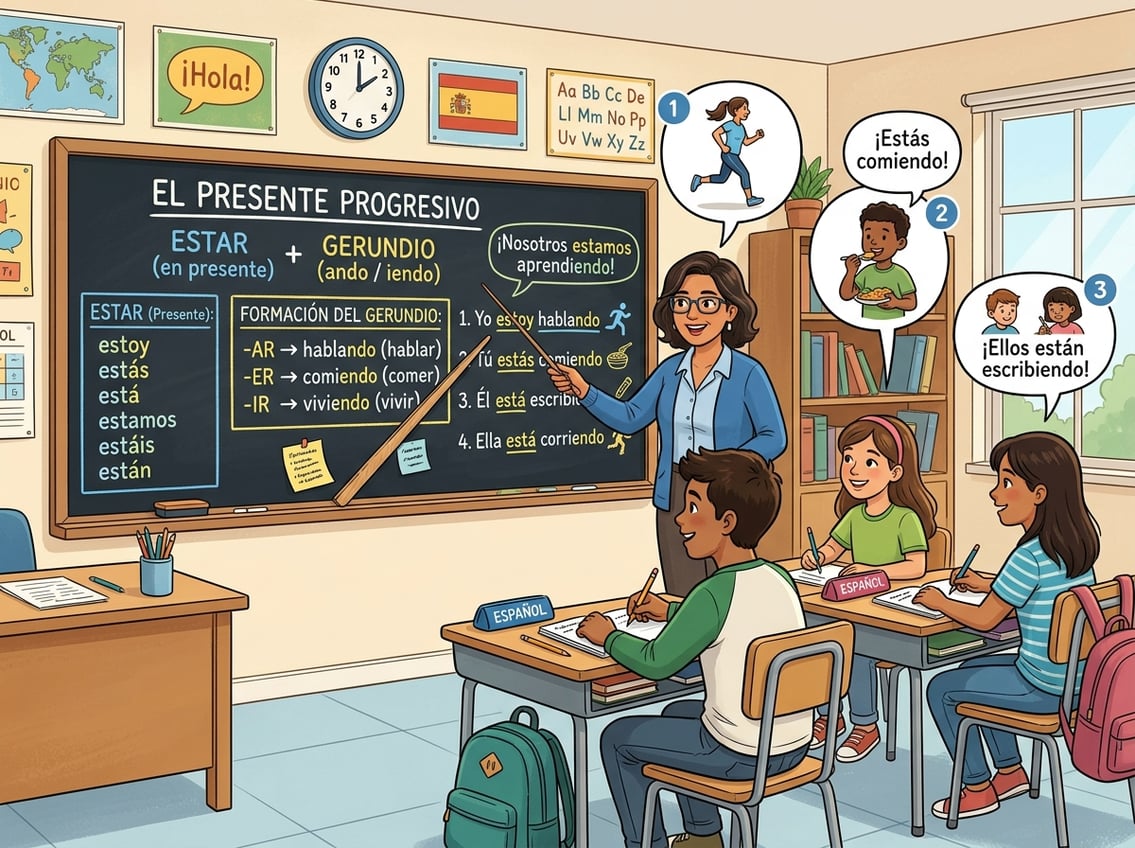
The present progressive in Spanish uses estar (in the present tense) plus a gerund to show actions happening right now. The gerund doesn’t change for subject - just estar does.
Breaking Down the Formula: Estar + Gerund
Basic Formula
estar (conjugated) + gerund = present progressive
Estar Conjugations
| Subject | Estar Form | + Gerund | English |
|---|---|---|---|
| yo | estoy | hablando | I am speaking |
| tú | estás | hablando | you are speaking |
| él/ella/usted | está | hablando | he/she is speaking |
| nosotros | estamos | hablando | we are speaking |
| vosotros | estáis | hablando | you all are speaking |
| ellos/ellas/ustedes | están | hablando | they are speaking |
Gerund Formation Rules
- -ar verbs: stem + -ando (hablar → hablando)
- -er verbs: stem + -iendo (comer → comiendo)
- -ir verbs: stem + -iendo (escribir → escribiendo)
Only estar changes with the subject, not the gerund.
What 'In Progress' Means for Spanish
The present progressive describes actions happening now - right as you’re speaking.
When to Use Present Progressive
- Actions happening right now
- Temporary activities in progress
- Actions still going, not finished
Present Progressive Examples
- Estoy cocinando la cena. (I am cooking dinner right now.)
- Los niños están jugando afuera. (The children are playing outside.)
- María está estudiando para el examen. (María is studying for the exam.)
Spanish speakers can also use simple present for things happening now. "¿Qué haces?" and "¿Qué estás haciendo?" both mean "What are you doing?"
Role of Present Participle (Gerundio)
The Spanish gerund is the action word in the present progressive.
Gerundio Characteristics
- Doesn’t change for gender or number
- Always ends in -ando or -iendo
- Acts as the main verb for the action
- Stays the same while estar changes
Common Gerunds
| Infinitive | Gerund | English |
|---|---|---|
| hablar | hablando | speaking |
| comer | comiendo | eating |
| vivir | viviendo | living |
| trabajar | trabajando | working |
| leer | leyendo | reading |
| dormir | durmiendo | sleeping |
The gerund shows the action; estar shows who and when.
Conjugating 'Estar' for the Present Progressive
Estar changes with the subject, and each form pairs with a gerund to make presente continuo phrases. Accents matter for clarity.
All Forms of Estar
| Subject Pronoun | Estar Conjugation | Example with Gerund | Translation |
|---|---|---|---|
| yo | estoy | estoy comiendo | I am eating |
| tú | estás | estás hablando | you are speaking |
| él/ella/usted | está | está escribiendo | he/she is writing, you are writing |
| nosotros/nosotras | estamos | estamos corriendo | we are running |
| vosotros/vosotras | estáis | estáis leyendo | you all are reading |
| ellos/ellas/ustedes | están | están durmiendo | they are sleeping, you all are sleeping |
Pattern Table: Estar Forms
| Person | Estar Form | Example |
|---|---|---|
| 1st singular | estoy | estoy trabajando |
| 2nd singular | estás | estás estudiando |
| 3rd singular | está | está mirando |
| 1st plural | estamos | estamos aprendiendo |
| 3rd plural | están | están haciendo |
Accents and Pronunciation
| Form | Accent? |
|---|---|
| estoy | No |
| estás | Yes |
| está | Yes |
| estamos | No |
| estáis | Yes |
| están | Yes |
Rule → Only the first-person singular and plural forms (estoy, estamos) have no accent. All others have an accent on the last syllable.
When adding a gerund, keep the accent on estar.
Creating Regular and Irregular Gerunds
Gerunds form differently depending on verb endings and stem changes. Regular ones follow simple rules; irregulars need to be memorized.
Regular Gerunds: -ando and -iendo Endings
| Verb Type | Ending | Example Verb | Gerund |
|---|---|---|---|
| -ar | -ando | hablar | hablando |
| -er | -iendo | comer | comiendo |
| -ir | -iendo | vivir | viviendo |
Rule → Drop -ar, -er, or -ir from the infinitive and add -ando (-ar) or -iendo (-er/-ir).
Examples
- Estoy hablando con mi amigo. (I am talking with my friend.)
- Está comiendo una manzana. (He is eating an apple.)
- Estamos viviendo en Madrid. (We are living in Madrid.)
Irregular Gerunds and Spelling Changes
Vowel Clash Rule
If the verb stem ends in a vowel, change -iendo to -yendo.
| Infinitive | Regular Gerund | Actual Gerund | English |
|---|---|---|---|
| leer | leiendo | leyendo | reading |
| oír | oiendo | oyendo | hearing |
| traer | traiendo | trayendo | bringing |
| caer | caiendo | cayendo | falling |
| ir | iendo | yendo | going |
Examples
- Está leyendo un libro. (She is reading a book.)
- Están trayendo la comida. (They are bringing the food.)
Stem-Changing -ir Verbs in Gerund Form
| Infinitive | Stem Change | Gerund | English |
|---|---|---|---|
| sentir | e → i | sintiendo | feeling |
| pedir | e → i | pidiendo | asking |
| servir | e → i | sirviendo | serving |
| repetir | e → i | repitiendo | repeating |
| dormir | o → u | durmiendo | sleeping |
| morir | o → u | muriendo | dying |
Rule → Only -ir stem-changing verbs change their stem vowel in the gerund. -ar and -er verbs do not.
Examples
- Está durmiendo en el sofá. (He is sleeping on the sofa.)
- Están durmiendo ahora. (They are sleeping now.)
- Está escribiendo una carta. (She is writing a letter.)
- Estoy escribiendo mi tarea. (I am writing my homework.)
- Estamos pidiendo ayuda. (We are asking for help.)
Using the Spanish Present Progressive Naturally
| Language | Usage Frequency | Example |
|---|---|---|
| English | Very frequent | "I am eating" (always present progressive) |
| Spanish | Less frequent | "Como" or "Estoy comiendo" (both possible) |
Rule → Use present progressive in Spanish only for actions happening right now or in progress; for general or habitual actions, use the simple present.
When to Use Present Progressive
Actions happening right now
- Estoy comiendo = I’m eating (right now)
- Estoy hablando = I’m speaking (currently)
- Está lloviendo = It’s raining (at this moment)
- Están comiendo = They’re eating (right now)
Actions in progress during the current period
- Estoy trabajando en un proyecto = I’m working on a project (this week/month)
- Estoy viviendo con mis padres = I’m living with my parents (temporarily)
Emphasizing an ongoing action
| Question | Response |
|---|---|
| ¿Qué haces? | Leo un libro. (simple statement) |
| ¿Qué estás haciendo? | Estoy leyendo un libro. (emphasizes current action) |
Temporary vs. Habitual Actions
Temporary actions → present progressive
- Estoy cocinando para la fiesta = I’m cooking for the party
- Estoy viviendo en Madrid este mes = I’m living in Madrid this month
- Estoy trabajando desde casa hoy = I’m working from home today
Habitual actions → simple present
| Incorrect | Correct |
|---|---|
| Estoy yendo al trabajo cada día | Voy al trabajo cada día |
| Estoy comiendo desayuno a las 8 | Como desayuno a las 8 |
| Estoy hablando español en casa | Hablo español en casa |
| Language | Usage Example |
|---|---|
| English | I am going to work tomorrow |
| Spanish | Voy al trabajo mañana (NOT: Estoy yendo) |
Key Differences from English
Simple present in Spanish for planned/future actions
- English: I am going to work tomorrow
- Spanish: Voy al trabajo mañana
State verbs don’t use progressive
| Correct | Incorrect |
|---|---|
| Tengo hambre | Estoy teniendo hambre |
Future plans use simple present
- English: We are meeting at 5 PM
- Spanish: Nos encontramos a las 5
Common Phrases and Everyday Usage
High-frequency present progressive
| Spanish | English |
|---|---|
| Estoy comiendo | I’m eating |
| Estoy trabajando | I’m working |
| Estoy cocinando | I’m cooking |
| Estoy hablando | I’m speaking/talking |
| Estoy viviendo | I’m living |
Questions about current actions
- ¿Qué estás haciendo? = What are you doing? (right now)
- ¿Qué haces? = What do you do? / What are you doing?
| Question | Meaning |
|---|---|
| ¿Qué estás haciendo? | About the current moment |
| ¿Qué haces? | General habit or current action (depends on context) |
Typical conversational exchanges
- ¿Qué estás haciendo? → Estoy comiendo
- ¿Dónde estás? → Estoy trabajando
- ¿Por qué no contestas? → Estoy cocinando
Pronoun Placement and Sentence Construction
Pronoun placement options:
| Option | Structure | Example |
|---|---|---|
| Before estar | [Pronoun] + estar + gerund | Me estoy lavando |
| Attached to gerund | estar + gerund+pronoun | Estoy lavándome |
| Pronoun Type | Before estar | Attached to gerund |
|---|---|---|
| Reflexive | Me estoy lavando | Estoy lavándome |
| Direct object | Lo estoy comprando | Estoy comprándolo |
| Indirect object | Te estoy escribiendo | Estoy escribiéndote |
Examples with reflexive verbs:
- Me estoy bañando = Estoy bañándome
- Se están vistiendo = Están vistiéndose
- Nos estamos preparando = Estamos preparándonos
Examples with object pronouns:
- Lo estamos buscando = Estamos buscándolo
- Te estoy llamando = Estoy llamándote
- Les está explicando = Está explicándoles
Attaching Pronouns to Gerunds
Steps to attach pronouns:
- Start with the gerund
- Add the pronoun to the end
- Add an accent to keep the stress
| Verb | Base Gerund | With Pronoun | Translation |
|---|---|---|---|
| hablar | hablando | hablándole | speaking to him/her |
| comer | comiendo | comiéndolo | eating it |
| escribir | escribiendo | escribiéndote | writing to you |
| leer | leyendo | leyéndolo | reading it |
| dormir | durmiendo | durmiéndose | falling asleep |
| pedir | pidiendo | pidiéndolo | asking for it |
Accent Rules for Stress
Rule → Example
Rule: When attaching pronouns to gerunds, put an accent on the stressed vowel (á or é) to keep the original stress.
| Without pronoun | With pronoun | Stressed syllable |
|---|---|---|
| hablando | hablándome | -án- |
| comiendo | comiéndolo | -én- |
| escribiendo | escribiéndote | -én- |
| lavando | lavándose | -án- |
| Incorrect | Correct |
|---|---|
| estoy bañandome | estoy bañándome |
| estamos comprandolo | estamos comprándolo |
Practical Application: Quizzes and Real-Life Practice
Sample Sentences
| Spanish | English | Context |
|---|---|---|
| Estoy comiendo | I’m eating | Current activity |
| Estás estudiando | You’re studying | Asking what someone is doing |
| Ella está bailando | She’s dancing | Describing someone’s action |
| Estamos trabajando | We’re working | Group activity |
| Están durmiendo | They’re sleeping | Reporting on others |
Common Question Formats
- ¿Qué estás haciendo? (What are you doing?)
- ¿Qué está pasando? (What’s happening?)
- ¿Dónde estás trabajando? (Where are you working?)
- ¿Con quién estás hablando? (Who are you talking to?)
Common Response Patterns
| Pattern | Example |
|---|---|
| Estoy [gerund] + location/object | Estoy comiendo en casa |
| No estoy haciendo nada | I’m not doing anything |
| Estoy [gerund] pero voy a [infinitive] | Estoy leyendo pero voy a salir |
Present Progressive Quiz Practice
| Type | What it Tests | Example |
|---|---|---|
| Fill in blank | Estar conjugation | Yo _____ comiendo |
| Multiple choice | Gerund formation | leer → leyendo/leendo/leando |
| Translation | Structure | “They are running” → Están corriendo |
| Error correction | Common mistakes | Estoy comiendome → Me estoy comiendo |
Practice Sequence:
- Do 10–15 present progressive quiz items with regular verbs.
- Add irregular gerunds (dormir → durmiendo, leer → leyendo).
- Practice pronoun placement with reflexive verbs.
- Mix all patterns in timed quizzes.
Troubleshooting Common Errors
| Error | Correction | Rule |
|---|---|---|
| Estoy comendo | Estoy comiendo | -er/-ir verbs use -iendo |
| Está corrando | Está corriendo | -ar verbs use -ando |
| Estamos duermiendo | Estamos durmiendo | Stem changes: o → u |
| Están leendo | Están leyendo | i between vowels → y |
| Error | Correction |
|---|---|
| Estoy me lavando | Me estoy lavando / Estoy lavándome |
| Están lo haciendo | Lo están haciendo / Están haciéndolo |
| Estoy lavandome | Estoy lavándome |
| Usage Error | Correct Usage |
|---|---|
| Estoy trabajando en un banco (for job) | Trabajo en un banco |
| Estoy trabajando ahora mismo (for current action) | Estoy trabajando ahora mismo |
Frequently Asked Questions
| Topic | Key Point |
|---|---|
| Present progressive form | estar + gerund for actions happening now |
| Usage difference | Not for habits or routines - just ongoing actions |
| Pronoun placement | Before estar or attached to gerund (with accent) |
How do you form the present progressive tense in Spanish?
The present progressive is built with two parts:
Formula:estar (conjugated) + gerund (-ando or -iendo)
Regular gerund formation:
| Verb Type | Ending | Example Verb | Gerund |
|---|---|---|---|
| -ar | -ando | hablar | hablando |
| -er | -iendo | comer | comiendo |
| -ir | -iendo | escribir | escribiendo |
Steps:
- Conjugate estar for the subject.
- Drop the infinitive ending (-ar, -er, -ir).
- Add -ando for -ar verbs or -iendo for -er/-ir verbs.
- Put the gerund after estar.
Irregular gerunds:
- Stem changes: dormir → durmiendo, pedir → pidiendo
- Spelling changes: leer → leyendo, oír → oyendo
When should you use the present progressive in Spanish instead of the simple present?
Use the present progressive only for actions happening right now, not for future plans.
Present progressive is for:
- Actions occurring at this moment
- Temporary situations happening now
- Highlighting that something’s in progress
Examples:
- Estoy comiendo ahora (I am eating right now)
- Los niños están jugando (The children are playing)
Simple present is for:
- Habits
- Future plans or scheduled events
- General statements
- Regularly occurring actions
Comparison Table:
| Situation | Spanish Tense | Example |
|---|---|---|
| Right now | Present progressive | Estoy estudiando |
| Habit (every day) | Simple present | Estudio todos los días |
| Future plan | Simple present | Mañana voy al cine |
| General truth | Simple present | Hablo español |
Rule → Example:Rule: Spanish often uses the simple present where English uses the progressive. Example: "Trabajo ahora" (I’m working now) is common, but "Estoy trabajando ahora" is only for right-this-minute actions.
What are some common Spanish present progressive examples in everyday sentences?
Daily activities:
- Estoy cocinando la cena (I am cooking dinner)
- Están viendo televisión (They are watching television)
- Estamos limpiando la casa (We are cleaning the house)
- Estás haciendo la tarea (You are doing homework)
Work and study:
- Marco está escribiendo un ensayo (Marco is writing an essay)
- Estoy trabajando en un proyecto (I am working on a project)
- Están estudiando para el examen (They are studying for the exam)
Communication:
- Estoy hablando con mi madre (I am speaking with my mother)
- Está llamando a su amigo (He/she is calling his/her friend)
Location and movement:
- Los niños están comiendo en el patio (The children are eating in the yard)
- El abuelo está durmiendo en la sala (Grandpa is sleeping in the living room)
With pronouns:
- Me estoy lavando el pelo (I am washing my hair)
- Estoy lavándome el pelo (I am washing my hair)
How do you conjugate hablar in the present progressive tense?
The gerund hablando stays the same, but estar changes with the subject.
Full conjugation:
| Subject | Estar | Gerund | Complete Form | English |
|---|---|---|---|---|
| Yo | estoy | hablando | estoy hablando | I am speaking |
| Tú | estás | hablando | estás hablando | you are speaking |
| Él/Ella/Usted | está | hablando | está hablando | he/she is speaking, you are speaking |
| Nosotros/Nosotras | estamos | hablando | estamos hablando | we are speaking |
| Vosotros/Vosotras | estáis | hablando | estáis hablando | you all are speaking |
| Ellos/Ellas/Ustedes | están | hablando | están hablando | they are speaking, you all are speaking |
Example sentences:
- Yo estoy hablando con el profesor (I am talking with the teacher)
- Tú estás hablando muy rápido (You are speaking very fast)
- Nosotros estamos hablando español (We are speaking Spanish)
How do you conjugate dormir in the present progressive tense, including stem-changing forms?
Dormir uses a stem change in the gerund: o turns into u, so it’s durmiendo.
Conjugation with stem change:
| Subject | Estar | Gerund | Complete Form | English |
|---|---|---|---|---|
| Yo | estoy | durmiendo | estoy durmiendo | I am sleeping |
| Tú | estás | durmiendo | estás durmiendo | you are sleeping |
| Él/Ella/Usted | está | durmiendo | está durmiendo | he/she is sleeping |
| Nosotros/Nosotras | estamos | durmiendo | estamos durmiendo | we are sleeping |
| Vosotros/Vosotras | estáis | durmiendo | estáis durmiendo | you all are sleeping |
| Ellos/Ellas/Ustedes | están | durmiendo | están durmiendo | they are sleeping |
Other stem-changing gerunds:
- Morir → muriendo (dying)
- Pedir → pidiendo (asking)
- Servir → sirviendo (serving)
- Seguir → siguiendo (following)
Rules for stem-changing gerunds:
- Rule: In -ir verbs with o→u or e→i stem changes, the gerund keeps the change.
- Example: dormir → durmiendo, pedir → pidiendo