Average Time to Learn Spanish: Breakthroughs in Rapid Mastery
Discover the science-backed timeline for learning Spanish. From basic survival phrases to professional fluency, understand how many hours you actually need and what factors accelerate your progress.
Posted by
 Stewart Kaplan
Related reading
Basic Spanish Words Every Beginner Should Learn (Organized by Category)
Master 200+ essential Spanish words organized by category: greetings, food, travel, and emergency phrases. Includes example sentences for each word. Perfect for beginners building vocabulary.
Best Apps to Learn Spanish (2026 Review): Ranked by Speed & Retention
Compare the best Spanish learning apps in 2026. Ranked by speed to fluency, retention rates, and value. Includes Duolingo, Babbel, Rosetta Stone, Pimsleur, and more.
Can You Learn Spanish in 3 Months? Reality Check + 90-Day Sprint Plan
Honest assessment of what's achievable in 3 months of Spanish learning. Includes realistic expectations, fluency levels, and a complete 90-day sprint plan.
Average Time to Learn Spanish: What the Science Reveals
The Foreign Service Institute estimates 600-750 classroom hours to reach professional proficiency, but actual timelines vary based on learning methods, practice intensity, and whether learners aim for basic conversation or advanced fluency.
Official Estimates and Study Hour Benchmarks
The Foreign Service Institute provides concrete data from training thousands of diplomats in foreign languages. Spanish requires approximately 600-750 classroom hours to reach Professional Working Proficiency, classified as ILR Level 3.
The FSI calculation includes a critical detail: students spend equal time on independent study. This means the real total reaches 1,200-1,500 hours when combining classroom instruction with homework and practice.
Timeline breakdown by daily study commitment:
- 1 hour per day: 20-40 months (1.5-3+ years)
- 2 hours per day: 10-20 months
- 3+ hours per day: 6-13 months
For more details on optimizing your daily study time, see our guide on how many hours a day to learn Spanish.
These benchmarks assume high-quality learning methods. Adults acquire Spanish skills faster when they encounter words in meaningful contexts rather than isolated vocabulary lists. Spaced repetition systems that reintroduce phrases at strategic intervals create stronger neural pathways than cramming sessions.
Daily exposure through Spanish audio reinforces pronunciation patterns and trains the ear to recognize natural speech rhythms. Short, consistent practice sessions leveraging contextual recall outperform sporadic marathon study blocks because memory consolidation happens during rest periods between learning sessions.
Differences Between Conversational and Full Fluency
Basic conversational ability develops much faster than professional proficiency. A learner can handle tourist situations and simple exchanges in 40-60 hours, while full fluency demands 2,000-3,000 hours. Learn more about reaching conversational Spanish and achieving true fluency.
Proficiency milestones:
| Level | Hours Required | Capabilities |
|---|---|---|
| Basic survival phrases | 40-60 | Order food, ask directions, handle emergencies |
| Conversational | 150-250 | Chat about everyday topics, understand slow speech |
| Professional working | 600-1,000 | Discuss complex topics, read newspapers, work meetings |
| Near-full fluency | 2,000-3,000 | Understand regional dialects, cultural nuances, idioms |
The gap between levels explains why many learners plateau. Moving from tourist Spanish to workplace competence requires auditory reinforcement through Spanish speaker exposure. Progressive difficulty training, where support gradually disappears as competence grows, mirrors natural language acquisition patterns.
Comparisons for English Speakers
Spanish sits in Category I for English speakers, making it one of the easiest languages to learn. The FSI categorizes languages by difficulty, with Spanish requiring significantly less time than other options. For a detailed breakdown of English speaker advantages, check out how long it takes English speakers to learn Spanish.
Comparative learning hours:
- Spanish: 600 hours
- German: 750 hours
- Russian: 1,100 hours
- Arabic: 2,200 hours
- Mandarin: 2,200 hours
English and Spanish share thousands of cognates, words with similar spelling and meaning. This overlap gives learners an instant vocabulary boost of 1,000+ words through pattern recognition.
Adults who already speak another Romance language cut learning time by 30-40%. Prior bilingual experience accelerates acquisition by 20-30% because the brain has already developed neural pathways for switching between language systems.
Common Misconceptions and Exaggerated Claims
Marketing claims promising fluency in three months misrepresent how adults actually acquire Spanish skills. These timeline promises ignore learning quality, creating unrealistic expectations that lead to frustration.
Misleading claims versus reality:
- Myth: Apps alone create fluency in months
- Reality: App-only learners often need 2-3x longer than FSI estimates
The misconception that memorizing vocabulary lists builds speaking ability persists despite research showing isolated word study produces weak retention. Words learned without context fade quickly because the brain lacks retrieval cues.
Another false belief suggests passive listening suffices for language acquisition. Comprehensible input matters, but learners must understand roughly 80% of content for progress. Material too difficult creates frustration without learning gains.
Age myths also distort expectations. While children acquire accents more easily, adults learn grammar and vocabulary faster through pattern recognition and self-discipline. Seniors may need 20% more time but absolutely can reach fluency with consistent practice.
Key Factors Affecting Your Spanish Learning Timeline
The speed at which someone progresses from beginner to conversational depends heavily on three core variables: why they're learning, what languages they already speak, and how often they practice each week.
Learning Motivation and Goal Setting
Adults who attach Spanish learning to specific life outcomes retain vocabulary 40% faster than those studying without clear purpose. A learner planning to relocate to Mexico City will absorb conversational phrases more rapidly than someone vaguely interested in "being bilingual." The brain prioritizes information tied to immediate survival or social needs.
Setting micro-goals accelerates progress. Instead of "become fluent," effective learners target "order food confidently" or "hold a 10-minute conversation about work." These concrete benchmarks trigger dopamine release when achieved, reinforcing the habit loop that keeps study consistent.
Spaced repetition systems work because they align with how memory consolidates during sleep. Daily exposure to new phrases, even for five minutes, builds stronger neural pathways than weekend cramming sessions. Tools that deliver progressive difficulty through contextual sentences rather than isolated words produce better recall because the brain stores language in usage patterns, not lists.
Impact of First Language and Language Background
English speakers learning Spanish enjoy a 30% vocabulary head start due to shared Latin roots. Words like "university" (universidad) and "important" (importante) require minimal effort. Romance language speakers progress even faster because verb conjugation patterns feel familiar.
Speakers of languages with different grammar structures face steeper initial climbs. Japanese or Korean locals must rewire expectations around word order and gendered nouns. However, anyone who has learned a second language already possesses metalinguistic awareness that speeds acquisition of a third.
Auditory processing differs across language backgrounds. Spanish speakers distinguish phonemes English speakers conflate, like the rolled R. Spanish audio repetition trains the ear to catch these distinctions. Hearing phrases spoken by Spanish speakers while reading the text creates dual encoding that strengthens both listening comprehension and pronunciation simultaneously.
Study Frequency and Consistency of Practice
Three 20-minute sessions per week outperform one 60-minute session because the brain needs time between exposures to move information from working memory to long-term storage. Daily practice, even brief, prevents the forgetting curve from erasing progress.
Disappearing-text training forces active recall rather than passive recognition. When learners see a phrase, then see it again with words progressively removed, they must retrieve the missing pieces from memory. This retrieval practice strengthens connections more effectively than re-reading complete sentences.
Contextual learning beats isolated drilling. Adults acquire grammar naturally when they encounter structures within meaningful sentences rather than through explicit rule memorization. Receiving daily phrases through email creates consistent touchpoints without requiring app logins, reducing friction that causes abandonment. The combination of Spanish audio, visual text, and gradual word removal engages multiple memory systems, producing retention rates that vocabulary lists alone cannot match.
Levels of Spanish Proficiency and Timeframes
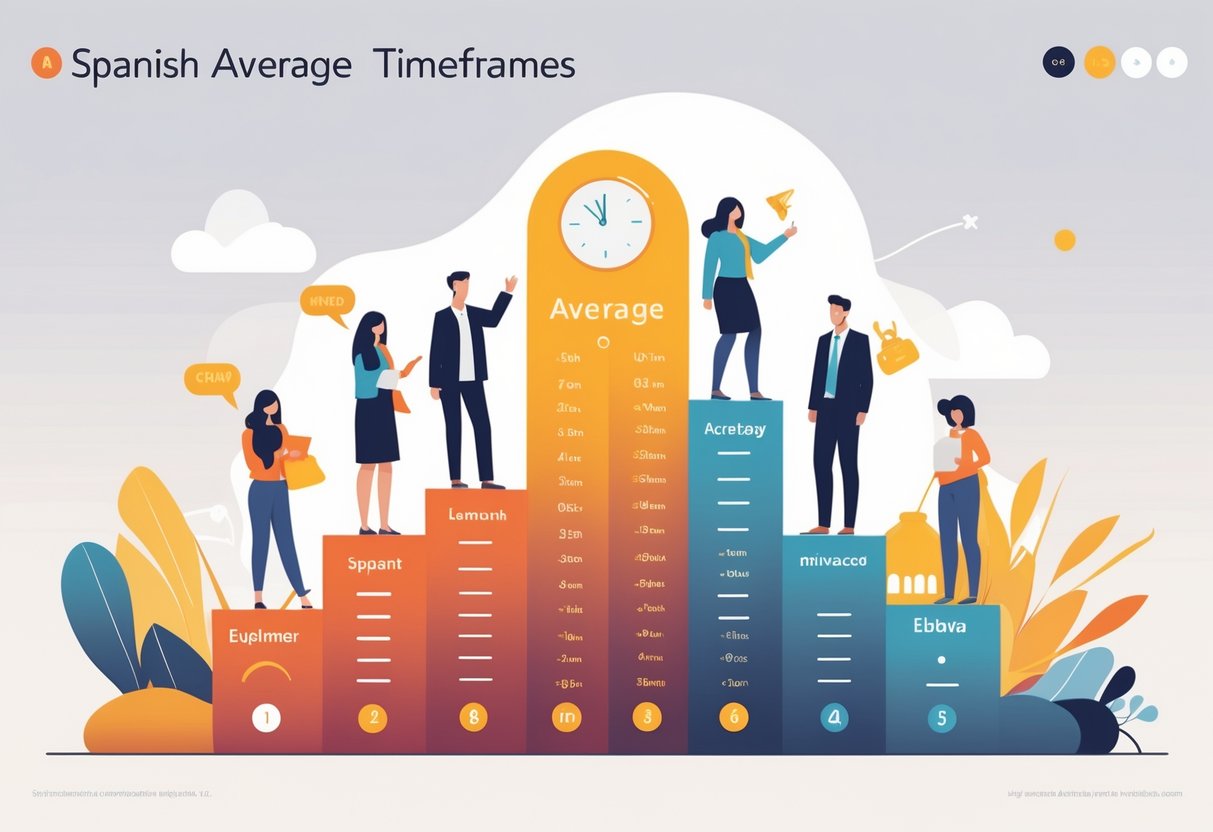
Most learners reach survival Spanish in weeks, conversational fluency in months, and natural mastery in years. The timeline depends on study methods, daily practice time, and how the brain encodes new language patterns.
Time to Achieve Survival Spanish
Survival Spanish takes 20 to 40 hours of focused study. Learners can introduce themselves, order food, ask for directions, and handle basic transactions. This level covers roughly 300 to 600 essential words and simple present-tense phrases. For a complete guide, see how long to learn basic Spanish.
The brain retains survival phrases best through spaced repetition and contextual recall. When learners hear Spanish audio daily and practice phrases in realistic scenarios, memory formation strengthens. Daily 5-minute email routines that deliver common expressions with progressive word removal force active recall rather than passive recognition.
Apps alone rarely build conversational confidence at this stage. Learners need auditory reinforcement paired with disappearing-text training, where they reconstruct sentences with fewer visual cues over time. This method mirrors how adults acquire a second language by strengthening neural pathways through retrieval practice. Understanding the different levels of Spanish proficiency helps learners set realistic early goals.
Time to Achieve Conversational Fluency
Conversational fluency requires 400 to 600 hours of active practice. Learners can discuss familiar topics, express opinions, and understand Spanish speakers in everyday situations. This corresponds to B1 or B2 proficiency, where Spanish skills include handling past and future tenses and navigating social conversations.
The Foreign Service Institute estimates that English speakers need 600 to 750 classroom hours to reach professional working proficiency. However, classroom time alone doesn't guarantee fluency. Adults retain language better when they engage multiple memory systems simultaneously. For a breakdown of total hours needed, read how many hours to learn Spanish.
Contextual recall accelerates progress at this stage. Learners who practice daily phrases in full sentences rather than isolated vocabulary words develop stronger grammatical intuition. Spanish audio paired with progressive text removal trains the ear while reinforcing sentence structure. Research-backed routines that combine these elements create dramatically stronger retention than vocabulary lists.
How long does it take to learn Spanish to a conversational level? Most dedicated learners reach B1 fluency in 6 to 12 months with consistent daily practice.
Time to Reach Natural Mastery
Natural mastery demands 1,200 to 2,000 hours over several years. Learners achieve C1 or C2 proficiency, understanding nuanced expressions, regional dialects, and complex abstract concepts. They can debate, write professionally, and switch between formal and informal registers effortlessly.
At this level, the brain has formed deep neural connections between Spanish and meaning without English translation. This requires sustained immersion and varied input sources. Auditory reinforcement through podcasts, films, and conversations with Spanish speakers becomes essential.
Advanced learners benefit from tactical steps that challenge existing knowledge. Disappearing-text training at higher complexity levels forces retrieval of sophisticated grammatical structures. Daily routines that expose learners to idiomatic phrases and cultural context strengthen both fluency and cultural competency.
Learning statistics show that reaching advanced proficiency requires sustained effort beyond traditional classroom hours. The path to mastery involves consistent daily exposure, active production, and methods that align with how adult brains consolidate long-term language memories.
Modern Methods That Accelerate Spanish Learning
New learning techniques built on memory science deliver faster results than outdated classroom drills. Adults retain Spanish vocabulary and grammar more effectively when lessons match how the brain naturally stores language patterns.
Benefits of Microlearning and Spaced Repetition
Short, daily practice sessions build stronger neural pathways than weekend marathon study blocks. The brain consolidates new Spanish words during rest periods between exposures, making 5-10 minute sessions more productive than hour-long cram sessions.
Spaced repetition schedules reviews at increasing intervals - 24 hours, then 3 days, then 7 days. This timing matches the forgetting curve, catching vocabulary right before the brain discards it. Effective rapid learning strategies rely on this approach to move words from short-term to long-term memory.
Daily email lessons work particularly well because they arrive consistently without requiring app logins or willpower. Learners see the same phrase multiple times across several days, with portions of the text progressively hidden. This forces active recall rather than passive recognition. Spanish audio accompanies each phrase, embedding correct pronunciation through repeated listening.
Duolingo uses spaced repetition in its algorithm, but daily email systems offer advantages. They require no screen time beyond reading, arrive on schedule without decision fatigue, and present full phrases instead of isolated words.
Active Techniques Versus Passive Study
Active recall - retrieving information from memory without prompts - builds retention three times faster than passive review. When learners see "Buenos ___" and must remember "días," the effort creates stronger memory traces than simply reading "Buenos días" repeatedly.
Progressive text removal transforms phrases into fill-in-the-blank exercises automatically. Day one shows the complete sentence. Day three removes two words. Day five leaves only key anchors. This graduated challenge keeps difficulty matched to growing ability.
Active learning techniques include:
- Speaking phrases aloud immediately after hearing them
- Writing sentences from memory before checking accuracy
- Translating from English to Spanish rather than Spanish to English
- Explaining grammar rules in one's own words
Passive methods like watching subtitled shows or reading while checking translations feel productive but create weak memory formation. The brain takes shortcuts when answers appear simultaneously with questions.
Common Pitfalls of Traditional Study Approaches
Vocabulary lists sorted alphabetically group unrelated words, providing no context for usage. The brain remembers information better when connected to meaning, emotion, or narrative. Lists of "abierto, abogado, abrigo" offer no retrieval cues.
Grammar-first curricula delay practical communication until learners master verb conjugation tables. Adults lose motivation when they cannot speak functionally after months of study. Practical strategies that accelerate progress prioritize common phrases that work immediately in conversation.
Traditional textbooks present all material with equal weight. Students spend identical time on rare subjunctive forms and essential present tense verbs. Frequency-based learning focuses on the 1,000 most common words first, enabling basic conversation faster.
Classroom pacing forces everyone through material at the same speed, leaving some bored and others confused. Self-directed methods allow learners to repeat difficult concepts without holding back on mastered content. Digital tools track individual progress but often gamify practice into shallow exposure rather than deep processing.
Immersive Strategies for Fast-Track Mastery
Direct interaction with Spanish speakers and authentic Spanish content builds faster fluency than classroom study alone. These methods force the brain to retrieve vocabulary under real pressure and encode new patterns through context rather than translation.
Using Language Exchange and Spanish Speaker Interaction
Language exchange connects learners with Spanish speakers who want to practice English. Both parties benefit from real conversation without paying for tutors.
Platforms like Tandem and HelloTalk match users based on first languages and interests. Sessions typically alternate between 30 minutes of Spanish and 30 minutes of English. This structure ensures equal value for both people.
The real benefit comes from contextual recall under time pressure. When a Spanish speaker asks a question, the brain must retrieve vocabulary immediately without translation aids. This stress creates stronger memory formation than reviewing flashcards.
Spanish speakers also correct pronunciation and grammar in real time. A learner might say "Yo soy 25 años" and immediately hear "Tengo 25 años" as the correction. This instant feedback loop prevents fossilized errors from becoming habits.
Daily five-minute conversations produce better retention than weekly hour-long sessions. The spaced repetition effect works better with frequent, shorter exposure. Learners who engage with Spanish speakers daily show faster gains in comprehension and speaking confidence than those who study in isolated chunks.
Leveraging Spanish Media and Real-Life Contexts
Watching Spanish movies and TV shows exposes learners to natural speech patterns, slang, and regional accents that textbooks never cover. Subtitles in Spanish force reading comprehension while auditory reinforcement builds listening skills simultaneously.
Start with content designed for learners or dubbed versions of familiar shows. The brain fills gaps more easily when it already knows the plot. Once comfortable, switch to Spanish programming like news broadcasts or YouTube channels aimed at Spanish speakers.
Podcasts offer portable immersion during commutes or exercise. Shows like "Coffee Break Spanish" layer explanations in English while gradually increasing Spanish content. More advanced learners benefit from pure Spanish podcasts on topics they already understand in English.
Reading Spanish news sites, blogs, or social media posts builds vocabulary in context. The brain remembers words better when tied to stories or current events rather than isolated lists. Progressive reading methods that remove English translations gradually train the mind to think directly in Spanish without mental translation.
Daily exposure through multiple media types creates overlapping memory pathways that strengthen retention more than single-method study.
Optimizing Your Resources for Every Skill

Matching the right tools to each language skill creates faster progress because reading, listening, speaking, and writing each rely on different memory systems. Adults retain Spanish best when they practice all four skills with methods designed for how the brain stores new language patterns.
Balancing Reading, Listening, Speaking, and Writing
Reading builds vocabulary recognition, but it doesn't train the ear or mouth. Listening activates auditory memory pathways that reading alone never reaches. Speaking forces active recall, which strengthens neural connections far more than passive recognition.
Writing reinforces grammar patterns through motor memory. Each skill needs separate practice time because they store information in different parts of the brain.
The most effective approach dedicates 20-30 minutes daily spread across all four areas rather than spending two hours on just one. Adults learning Spanish should read simple texts, listen to Spanish audio, speak aloud even when alone, and write short sentences every day. Spaced repetition strengthens recall by reviewing material at increasing intervals before memory fades.
Contextual learning through complete phrases works better than isolated vocabulary. When learners see "buenos días" in a morning email, hear natural pronunciation, then write it in context, the brain creates multiple retrieval paths. Progressive word removal in practice sessions forces active recall instead of passive recognition, which research shows produces longer retention.
Selecting Effective Apps and Programs
Duolingo offers gamified lessons that introduce basic Spanish vocabulary and grammar patterns. It works well for beginners building foundational skills over 2-3 months to reach A1 level.
However, apps alone rarely produce conversational ability because they focus on recognition over production.
The best programs combine multiple learning modes in one system. Spanish audio recordings train pronunciation accuracy that text can't teach. Daily exposure through short lessons maintains consistency without overwhelming schedules. Phrase-based learning delivers practical Spanish skills faster than word lists because the brain stores language in chunks, not isolated terms.
Look for tools that gradually remove support as you progress. Systems that start with full phrases, then hide words you should know, force your brain to retrieve rather than recognize. This builds the active recall needed for real conversations. Five-minute daily practice with complete sentences, natural pronunciation, and progressive difficulty creates stronger neural pathways than hour-long vocabulary drills.
Setting Realistic Expectations and Measuring Progress
Progress in learning Spanish happens in stages, not overnight, and tracking small wins helps learners stay committed when fluency feels distant. Understanding how memory consolidates and recognizing natural slowdowns prevents frustration during the months it takes to build conversational ability.
Tracking Your Improvement Over Time
Adults learning Spanish need concrete markers to see growth that daily practice alone won't reveal. The brain strengthens language pathways through spaced repetition, where reviewing material at increasing intervals moves words from short-term to long-term memory.
Recording weekly vocabulary counts, tracking how many phrases a learner can recall without prompts, or noting the percentage of a podcast they understand provides measurable data. Memory research shows that contextual recall - using words in full sentences rather than isolated lists - creates stronger neural connections. Daily 5-minute routines that present phrases with progressive word removal force active retrieval, which studies confirm builds retention better than passive review.
Audio exposure matters because adults process new sounds slowly. Listening to Spanish speakers daily, even for brief sessions, trains the ear to recognize rhythm and intonation patterns that written text can't teach.
Simple tracking methods include:
- Weekly voice recordings to hear pronunciation changes
- Counting sentences constructed without translation help
- Noting conversation length in Spanish before switching to English
- Recording how many Spanish-audio phrases can be repeated accurately
Real progress appears when a learner stops translating internally before speaking, a shift that typically emerges after consistent exposure to contextual patterns rather than vocabulary drills alone.
Dealing With Plateaus and Staying Motivated
Every Spanish learner hits periods where progress stalls despite regular study. These plateaus happen because the brain consolidates previous learning before it can absorb more complex patterns.
Plateaus often occur at the 3-6 month mark when basic grammar is mastered but conversation still feels difficult. Rather than increasing study hours, learners benefit more from changing input types. Switching from app-based exercises to phrase-focused practice with disappearing-text training forces the brain to work harder at retrieval, which accelerates breakthrough moments.
Adults retain information better when learning happens in small, daily doses rather than marathon sessions. Research on memory formation shows that 5-minute daily email lessons with Spanish audio create stronger recall than hour-long weekly classes because the brain gets multiple exposure cycles.
Motivation tactics that work:
- Setting 30-day streaks for phrase practice instead of vague "fluency" goals
- Joining conversation groups where speaking errors are expected
- Focusing on understanding rather than perfect grammar initially
- Celebrating comprehension milestones like following a full movie scene
When progress feels slow, learners should measure how long it takes to learn Spanish phrases they actually use in conversation, not how many words they've memorized. Practical communication ability matters more than test scores, and real-world usage reveals genuine advancement that vocabulary lists can't capture.