How Long to Learn Basic Spanish: Science-Backed Speed & Real Results
Start speaking basic Spanish in weeks, not years. Learn what 'basic' really means, realistic timelines for survival phrases, and proven methods to build confidence quickly.
Posted by
 Stewart Kaplan
Related reading
Basic Spanish Words Every Beginner Should Learn (Organized by Category)
Master 200+ essential Spanish words organized by category: greetings, food, travel, and emergency phrases. Includes example sentences for each word. Perfect for beginners building vocabulary.
Best Apps to Learn Spanish (2026 Review): Ranked by Speed & Retention
Compare the best Spanish learning apps in 2026. Ranked by speed to fluency, retention rates, and value. Includes Duolingo, Babbel, Rosetta Stone, Pimsleur, and more.
Can You Learn Spanish in 3 Months? Reality Check + 90-Day Sprint Plan
Honest assessment of what's achievable in 3 months of Spanish learning. Includes realistic expectations, fluency levels, and a complete 90-day sprint plan.
Defining Basic Spanish: What Does 'Basic' Really Mean?
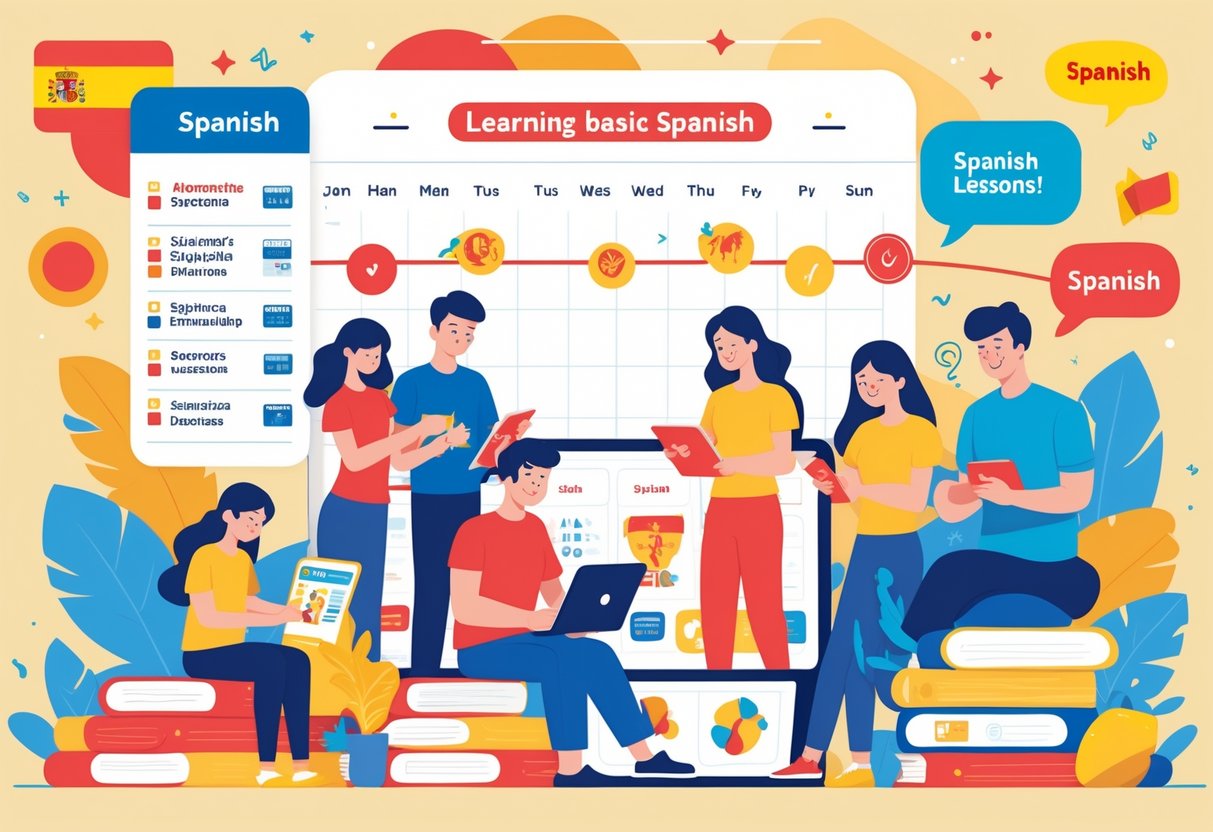
The term "basic Spanish" means different things depending on your goals, but it generally refers to the A1 or A2 proficiency levels where learners can handle everyday situations and simple conversations. Understanding what "basic" means helps you set realistic expectations and choose the right learning methods. For context on overall timelines, see how long it takes to learn Spanish.
Common Real-Life Goals
Most learners define basic Spanish through practical situations rather than formal levels. Ordering food at a restaurant represents one common goal. Asking for directions in a new city is another.
Some learners want to have simple conversations with Spanish-speaking neighbors or coworkers. Others need survival Spanish for an upcoming trip. A traveler might focus on hotel check-ins, taxi directions, and emergency phrases.
The context matters significantly. A student preparing for a job interview needs different vocabulary than someone planning a vacation. Basic Spanish for a medical professional includes patient care terms, while a retail worker prioritizes customer service phrases.
Common basic Spanish goals include:
- Introducing yourself and asking basic questions
- Shopping and handling money exchanges
- Navigating transportation systems
- Ordering meals and drinks
- Making hotel reservations
- Asking for help or directions
Phrase Café's daily email approach matches these real-world needs by delivering contextual phrases that learners encounter in actual conversations, not isolated vocabulary words.
Proficiency Guidelines and Levels
The Common European Framework of Reference for Languages provides clear benchmarks. The A1 level requires 70-80 hours of study and covers very basic grammar and vocabulary.
The A2 level takes an additional 80-100 hours. Learners at this stage can understand frequently used expressions about personal information, family, shopping, and local geography. To progress further, see how long to learn conversational Spanish.
| Level | Hours Needed | Typical Timeline | Abilities |
|---|---|---|---|
| A1 | 70-80 | 2-3 months | Basic greetings, simple questions |
| A2 | 150-180 total | 4-7 months | Simple conversations, routine tasks |
Most people consider A2 as genuinely basic because learners can handle immediate needs. The jump from A1 to A2 requires spaced repetition and contextual practice. Adults learning Spanish retain phrases better when they hear natural pronunciation repeatedly and see words disappear gradually during practice, forcing active recall rather than passive recognition.
Conversational Spanish vs. Fluency
Conversational Spanish and fluency represent distinctly different achievements. Conversational ability starts around the B1 level, requiring 300-360 total study hours.
Basic Spanish stops well before this point. A learner with basic Spanish can exchange simple information but struggles with longer discussions. They know present tense verbs but haven't mastered past or future conjugations.
Fluency demands reaching C2 level with 920-1,100 hours of study. Fluent speakers handle complex topics, understand regional accents, and use idiomatic expressions naturally. The gap between basic and fluent Spanish spans roughly 800 hours of additional learning.
Key differences:
- Basic Spanish: Simple present tense, common phrases, survival vocabulary
- Conversational Spanish: Multiple tenses, expressing opinions, understanding responses
- Fluency: Complex grammar, cultural nuances, professional communication
Daily five-minute sessions using progressive word removal train the brain to retrieve phrases without visual cues, mimicking real conversations where no written prompts exist. This auditory reinforcement combined with spaced repetition creates stronger neural pathways than cramming vocabulary lists.
Typical Timelines: How Long to Learn Basic Spanish?
Most beginners reach basic Spanish proficiency in 70-80 hours of focused study, which translates to roughly two to three months at a steady pace. The timeline shortens or extends based on daily practice intensity, learning methods that align with how adults retain new languages, and whether learners prioritize survival phrases or formal grammar first.
Estimated Hours and Weeks for Beginners
The U.S. Foreign Service Institute estimates 600-750 hours for fluency, but basic Spanish requires far less time. Reaching the A1 level demands 70-80 study hours. At one hour per day, learners complete this in 10-11 weeks.
At 30 minutes daily, the timeline extends to 20-22 weeks. Intensive learners who dedicate two hours each day finish in five to six weeks.
These estimates assume active recall methods rather than passive review. Spaced repetition strengthens memory formation by presenting words at increasing intervals. This prevents the forgetting curve that destroys vocabulary retention.
Contextual recall embeds phrases in realistic scenarios instead of isolated word lists. Adults retain "¿Dónde está el baño?" faster when they visualize asking for directions rather than memorizing "baño" as a standalone term.
Daily exposure through Spanish audio reinforces pronunciation patterns and listening comprehension simultaneously. Short, consistent sessions outperform marathon study blocks because the brain consolidates new language structures during rest periods between practice.
Quick-Start Survival Skills
Travelers and casual learners often prioritize immediate communication over grammatical perfection. Basic survival Spanish covers greetings, numbers, ordering food, asking directions, and emergency phrases.
This limited vocabulary set requires only 20-30 focused hours. Learners who concentrate on high-frequency phrases reach conversational survival level in two to four weeks with daily practice.
The key is selecting phrases that appear in multiple contexts. "¿Cuánto cuesta?" works in markets, restaurants, and shops. "No entiendo" communicates confusion in any situation.
Auditory reinforcement through Spanish speakers prevents English pronunciation habits from corrupting Spanish sounds. Hearing authentic "r" trills and soft "d" sounds trains the ear before the mouth attempts replication.
Progressive removal of written support accelerates recall. Learners start with full phrase visibility, then practice with disappearing words until they produce complete sentences from memory alone.
Progression Milestones
Basic Spanish learning follows predictable stages that mark real competence gains. Week one typically focuses on pronunciation foundations and present-tense verb basics.
Weeks two through four introduce essential vocabulary clusters: family terms, common objects, time expressions, and location words. Learners begin forming simple sentences using "ser" and "estar."
Weeks five through eight expand verb conjugations to past and future tenses while building conversational exchanges. Learners start understanding Spanish speaker conversations when topics stay within familiar vocabulary.
Weeks nine through twelve solidify irregular verbs and introduce subjunctive mood basics. At this point, most learners handle everyday interactions with manageable effort.
Daily five-minute email reviews maintain active recall between longer study sessions. This micro-practice prevents vocabulary decay without demanding extensive time blocks that busy adults struggle to protect.
Key Factors That Influence Learning Speed
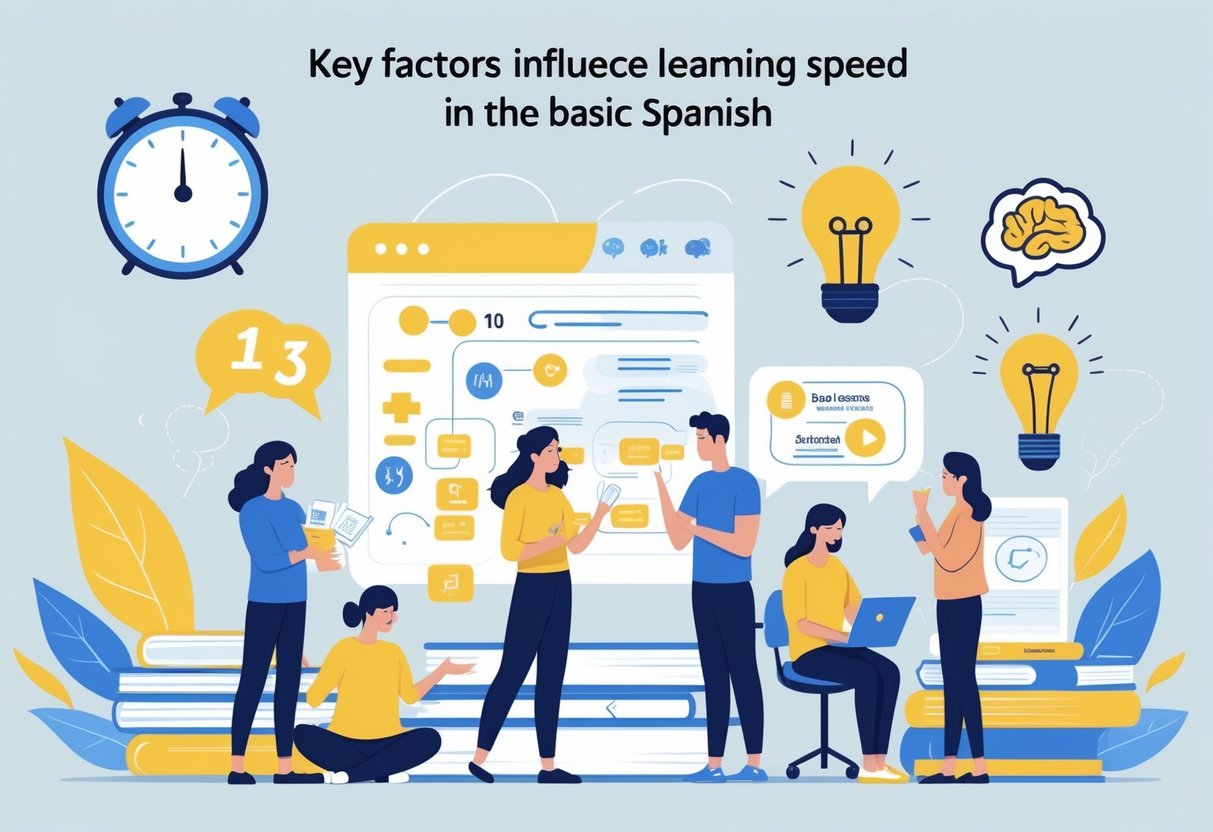
The speed at which someone picks up basic Spanish depends on how they study, what languages they already know, and how much time they dedicate each day. These three factors shape whether a learner reaches conversational ability in months or years.
Learning Style and Study Methods
Different approaches to learning Spanish produce dramatically different results because of how the brain encodes new information. Spaced repetition helps move vocabulary from short-term to long-term memory by presenting words at increasing intervals. This method works better than cramming because it forces the brain to actively retrieve information right before forgetting it.
Contextual learning speeds up acquisition by connecting Spanish phrases to real situations rather than isolated word lists. When learners see "¿Cómo estás?" in an actual conversation context, the brain links meaning, emotion, and usage patterns together. This creates multiple memory pathways that make recall faster and more automatic.
Auditory reinforcement from Spanish speakers trains the ear to recognize natural pronunciation and rhythm. Listening to authentic Spanish daily, even for five minutes, builds pattern recognition that textbooks cannot replicate. The brain starts anticipating word endings, verb conjugations, and common phrases through repeated exposure.
Progressive learning techniques that gradually remove visual support force active recall rather than passive recognition. When a learner sees a phrase with missing words, their brain must reconstruct the complete sentence from memory. This retrieval practice strengthens neural connections more effectively than simply rereading complete sentences.
Prior Language Experience
People who already speak a Romance language like French, Italian, or Portuguese pick up Spanish much faster because they share thousands of cognates and similar grammar structures. A French speaker recognizes that "importante" means important without translation because the words look nearly identical.
English speakers benefit from over 30% vocabulary overlap with Spanish, particularly in academic and technical terms. Words like "hospital," "música," and "familia" require almost no learning time. The brain recognizes these patterns and builds on existing knowledge rather than starting from zero.
However, adults learning their first foreign language face a steeper initial curve. Their brains must develop entirely new cognitive pathways for switching between languages, processing different word orders, and handling verb conjugations. This doesn't make Spanish impossible to learn, but it does mean the first few months require more conscious effort to establish these mental systems.
Time Commitment and Consistency
Daily practice matters more than total hours because language learning depends on regular neural activation. Studying 15 minutes every day produces better results than cramming for two hours once a week. The brain consolidates new information during sleep, so daily exposure gives it more opportunities to strengthen Spanish pathways.
Consistency affects how long it takes because gaps in practice allow vocabulary and grammar patterns to fade. When learners skip several days, their brains must work harder to retrieve previously learned material, essentially relearning the same content multiple times.
Structured daily routines that combine multiple learning methods create the fastest progress. A five-minute session that includes reading a new phrase, hearing natural pronunciation, and practicing recall through fill-in-the-blank exercises activates different brain regions simultaneously. This multi-sensory approach builds stronger memory traces than single-method studying, helping learners retain more information with less total time investment.
Research-Backed Strategies for Faster Progress
Learning Spanish becomes more efficient when you apply methods that align with how the brain stores and retrieves new language patterns. Short, structured practice sessions combined with real-world exposure help adults build lasting fluency faster than traditional classroom approaches alone.
Spaced Repetition and Microlearning
Spaced repetition works by presenting information at increasing intervals, which strengthens long-term memory formation. Instead of cramming vocabulary for hours, learners review words just before they would naturally forget them. This timing creates stronger neural pathways in the brain.
Microlearning breaks down a Spanish course into small, daily sessions that fit into busy schedules. Five-minute practice blocks produce better results than occasional hour-long study sessions. The brain processes new language patterns more effectively when exposure happens consistently rather than sporadically.
Phrase-based learning delivers better retention than isolated vocabulary lists. When learners encounter complete phrases with context, they remember both meaning and usage. Progressive removal of words from familiar phrases - where one or two words disappear each day - forces active recall rather than passive recognition.
Daily email programs that deliver a single phrase with Spanish audio leverage both spaced repetition and microlearning principles. The combination of reading, listening, and contextual usage creates multiple memory anchors for each phrase.
Immersion and Spanish Speaker Interaction
Immersion accelerates learning the Spanish language by forcing the brain to process authentic communication patterns. Listening to Spanish speakers reveals natural pronunciation, rhythm, and common expressions that textbooks rarely capture.
Daily exposure to Spanish audio trains the ear to distinguish sounds that don't exist in English. Learners who hear phrases spoken at natural speed develop better comprehension than those who only practice with slowed-down recordings.
Conversation with Spanish speakers provides immediate feedback on pronunciation and grammar. Even brief exchanges help learners identify gaps in their understanding. Video calls, language exchange meetups, and Spanish-speaking community events create low-pressure practice opportunities.
Media consumption in Spanish reinforces vocabulary in context. Podcasts, news broadcasts, and social media content expose learners to current language usage. Watching content with Spanish subtitles builds both listening and reading skills simultaneously.
Goal Setting and Motivation Tracking
Clear, measurable goals give direction to learning Spanish efforts. Setting a target like "order food in Spanish" or "introduce myself in 30 seconds" creates concrete milestones rather than vague fluency aspirations.
Breaking down larger goals into weekly targets maintains momentum. A learner might aim to master 10 new phrases each week or complete three 5-minute practice sessions daily. Small wins build confidence and create positive feedback loops that encourage continued study.
Tracking progress visually helps learners see improvement over time. Marking off completed lessons, logging study minutes, or recording conversation attempts provides tangible evidence of advancement. This visibility becomes particularly important during plateaus when progress feels slow.
Streak-based systems leverage commitment psychology by encouraging daily practice. When learners maintain a consecutive-day record, they become more likely to continue rather than break the pattern. Daily email programs with phrase delivery create natural streak opportunities that require minimal time investment.
Choosing Your Learning Method: Courses, Apps, and More
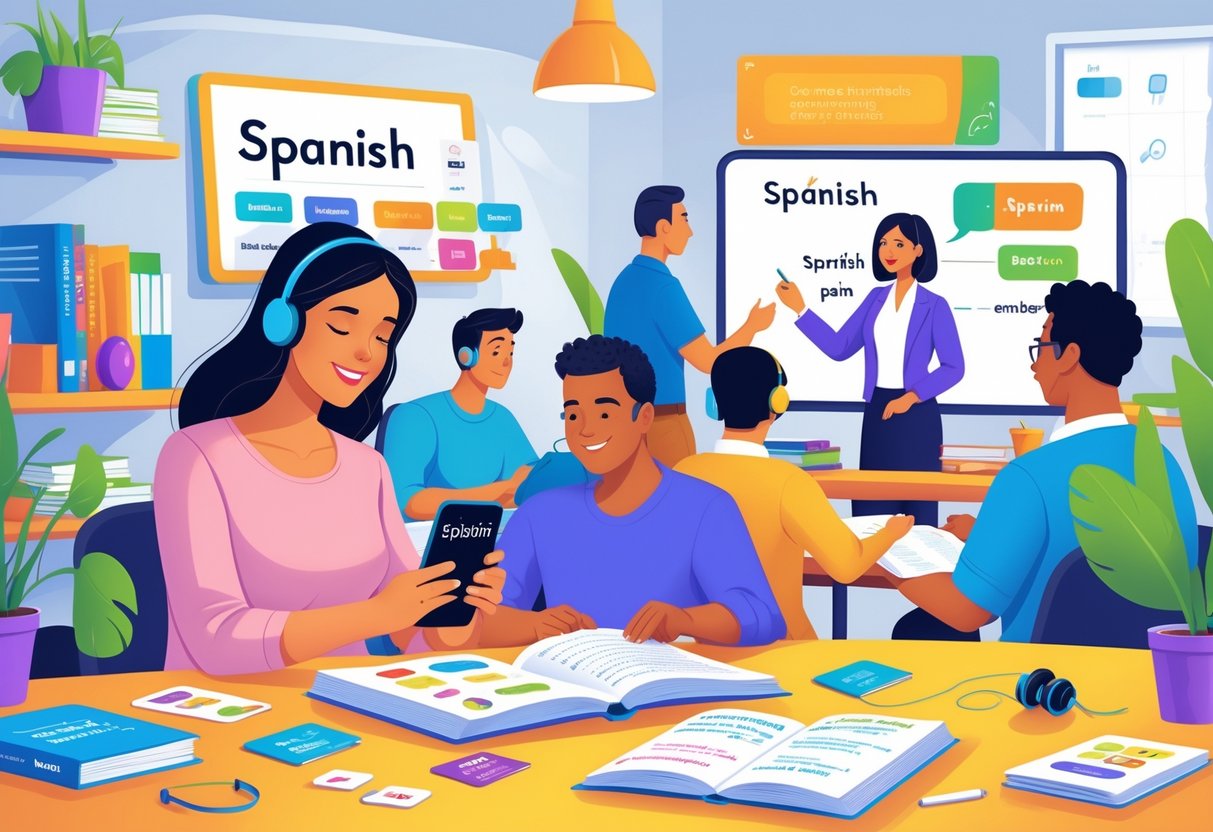
The path to basic Spanish fluency depends heavily on whether a learner chooses structured instruction or independent study, and how they integrate digital tools into daily practice. Adults retain language best through methods that combine contextual exposure with spaced repetition rather than isolated vocabulary drilling.
Formal Spanish Course vs. Self-Study
A formal Spanish course provides structure, accountability, and direct feedback from instructors. Comprehensive classroom-style programs typically offer 120+ hours of lesson time per level and follow established curricula that build grammar systematically. Traditional courses excel at teaching verb conjugations and complex grammar rules through guided practice.
Self-study offers flexibility and allows learners to focus on personally relevant material. This approach works well for adults who understand their learning style and can maintain consistent practice schedules. The challenge lies in maintaining motivation without external accountability.
Research shows adults acquire languages most effectively through contextual recall rather than memorization. Daily exposure to Spanish phrases in meaningful contexts creates stronger neural pathways than studying word lists. Progressive learning methods that gradually remove English translations force active recall, which strengthens memory formation far more than passive review.
Auditory reinforcement from Spanish speakers adds crucial pronunciation patterns that textbooks cannot provide. Five-minute daily sessions with authentic audio create consistent exposure without overwhelming the learner's schedule.
The Role of Apps and Online Platforms
Language learning apps serve as supplementary tools rather than complete solutions. Most apps focus on gamified vocabulary drilling, which produces recognition but not production skills. Learners may recognize words when they see them but struggle to recall them in conversation.
The most effective digital approaches combine multiple reinforcement techniques. Spaced repetition systems expose learners to material at increasing intervals, matching how the brain naturally consolidates memories. Context-based learning through daily phrase delivery creates practical language skills faster than isolated word study.
Key features that accelerate retention:
- Spanish audio for pronunciation modeling
- Progressive text removal that forces active recall
- Daily micro-lessons that fit into existing routines
- Contextual phrases rather than isolated vocabulary
Apps work best when they complement speaking practice rather than replace it. Unlimited tutoring options starting around $179 monthly provide conversation practice that apps cannot replicate.
Common Pitfalls That Slow Down Learners
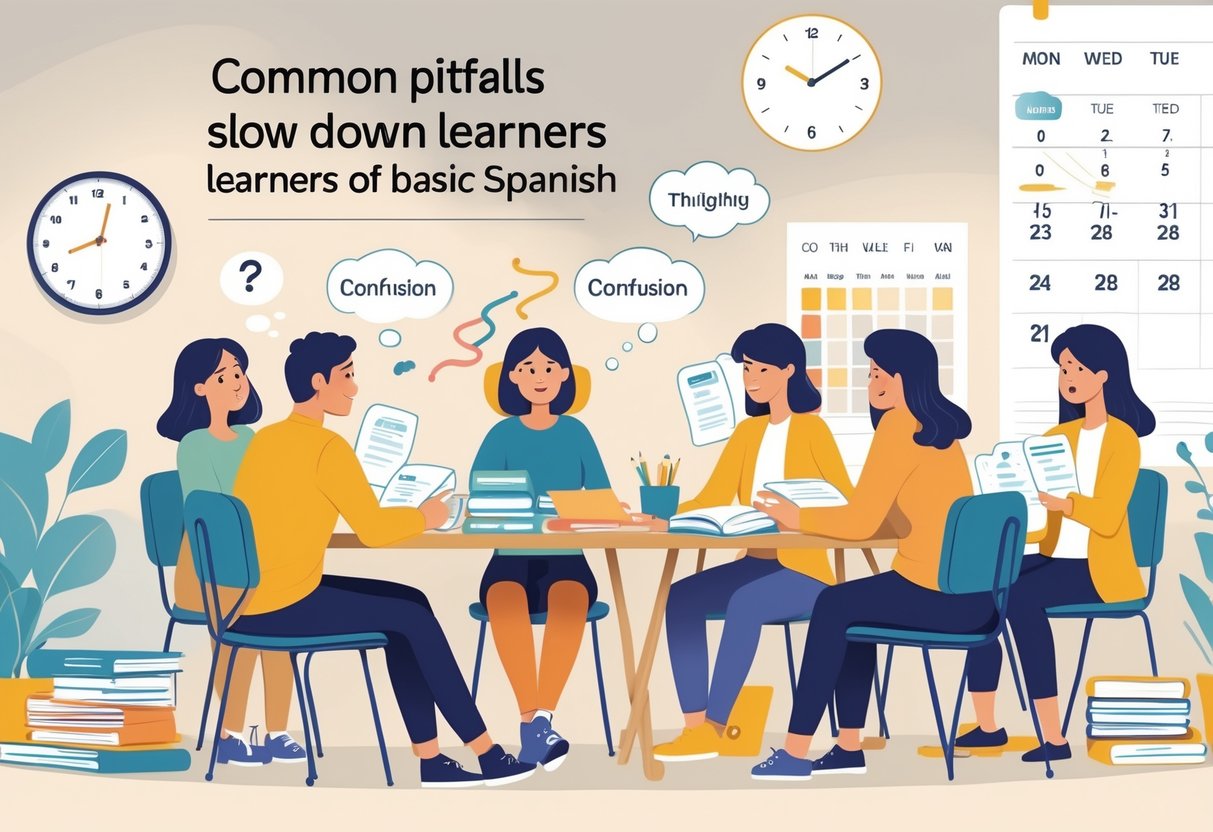
Many adults stumble over the same obstacles when learning Spanish, and these mistakes can add months or even years to their timeline. The biggest problems stem from study methods that don't match how the brain actually stores new language patterns and a lack of consistent exposure to real Spanish usage.
Overreliance on Traditional Study
Spending hours memorizing vocabulary lists or completing grammar worksheets feels productive, but it creates shallow knowledge that disappears quickly. The brain stores language most effectively through contextual recall, where words appear inside full phrases or sentences rather than in isolation.
Traditional study methods focus on recognition instead of production. A learner might recognize "tener" means "to have" on a flashcard but freeze when trying to say "I have to go" in conversation. This happens because the brain hasn't built the neural pathways needed for quick retrieval.
Spaced repetition solves this problem by revisiting material at specific intervals just before the brain would forget it. Daily exposure to complete phrases, rather than random words, trains the mind to retrieve language automatically. When learners receive Spanish phrases through structured daily practice with Spanish audio, they build auditory reinforcement that connects sound patterns to meaning.
Progressive training methods that gradually remove words from familiar phrases force the brain to actively recall missing pieces. This process strengthens memory formation far more than passive review.
Infrequent Practice
Spanish language learners who study for two hours once a week make slower progress than those who practice 15 minutes daily. The brain needs regular activation to move information from short-term to long-term memory.
Each time a learner stops practicing for several days, the neural connections weaken. When they return to studying, they spend most of their time relearning old material instead of advancing. Daily exposure maintains these pathways and allows new information to layer onto existing knowledge.
Five-minute daily sessions work better than marathon study blocks because they prevent cognitive fatigue. The brain processes and consolidates language patterns more effectively in short, focused bursts. This approach also fits naturally into busy schedules, making consistency sustainable over months.
Email-based learning systems that deliver one phrase daily remove the friction of deciding what to study. Learners simply review the day's material during breakfast or commute time.
Lack of Real Conversation Practice
Reading and listening build comprehension, but they don't train the muscles and mental processes needed for speaking. Many learners understand Spanish far better than they can produce it because they've never practiced forming sentences under time pressure.
Real conversation forces the brain to retrieve vocabulary, apply grammar rules, and produce sounds simultaneously. This multi-step process requires different neural pathways than passive comprehension. Without regular speaking practice, these production pathways remain underdeveloped.
Spanish audio exposure helps learners internalize proper pronunciation and rhythm before attempting to speak. Hearing phrases repeatedly in context trains the ear to recognize natural Spanish patterns. When learners then practice speaking these same phrases aloud, they're reinforcing both auditory and motor memory.
Language exchange partners, tutors, or even speaking practice alone all activate production skills. The key is moving beyond mental translation to direct Spanish thinking, which only develops through regular output practice.
Sustaining Motivation and Measuring Your Spanish Progress
Consistent practice depends on tracking specific improvements and recognizing breakthrough moments, not waiting for inspiration to arrive. Adult learners who measure progress through concrete milestones and reward small victories build the habits that carry them through plateaus and frustration.
Tracking Milestones and Breakthroughs
Adults learning Spanish need measurable checkpoints to evaluate their advancement. Recording vocabulary retention rates every two weeks reveals which words stick and which fade within 48 hours. A learner might track how many new verbs they conjugate correctly in conversation or count the number of full sentences they produce without pausing to translate.
Spaced repetition systems expose memory gaps that passive review misses. When learners revisit phrases after one day, then three days, then seven days, they discover which patterns their brain consolidates and which require more contextual exposure. Daily five-minute email routines that present phrases with progressive word removal force active recall rather than passive recognition. This disappearing-text training mimics how memory actually forms through retrieval practice rather than repeated reading.
Habits matter more than motivation because consistency creates the neural pathways that make Spanish automatic. Testing comprehension monthly through timed conversations or recorded speaking samples provides evidence of fluency growth that vague feelings of improvement cannot match.
Celebrating Small Wins
Recognizing specific achievements prevents learners from abandoning their Spanish study during the intermediate plateau. Completing a full phone conversation without switching to English represents a tangible victory worth documenting. Understanding a podcast episode without subtitles or writing three paragraphs about daily routines marks progress that deserves acknowledgment.
Spanish audio exposure combined with contextual practice produces faster spoken comprehension than vocabulary lists alone. When learners hear phrases in multiple contexts rather than isolated words, their brain builds associations that support long-term retention. Research-backed routines that deliver daily phrases with natural pronunciation create auditory anchors that strengthen recall during actual conversations. Adults who track these comprehension milestones maintain momentum through the difficult middle stages when progress feels slower than the initial beginner phase.