How Long to Learn Conversational Spanish: Rapid Pathways That Work
Reach conversational Spanish fluency in months with the right approach. Explore realistic timelines, daily practice requirements, and the learning methods that actually work for real conversations.
Posted by
 Stewart Kaplan
Related reading
Basic Spanish Words Every Beginner Should Learn (Organized by Category)
Master 200+ essential Spanish words organized by category: greetings, food, travel, and emergency phrases. Includes example sentences for each word. Perfect for beginners building vocabulary.
Best Apps to Learn Spanish (2026 Review): Ranked by Speed & Retention
Compare the best Spanish learning apps in 2026. Ranked by speed to fluency, retention rates, and value. Includes Duolingo, Babbel, Rosetta Stone, Pimsleur, and more.
Can You Learn Spanish in 3 Months? Reality Check + 90-Day Sprint Plan
Honest assessment of what's achievable in 3 months of Spanish learning. Includes realistic expectations, fluency levels, and a complete 90-day sprint plan.
Defining Conversational Spanish and What It Entails
Conversational Spanish centers on practical communication rather than textbook perfection. It involves understanding everyday exchanges, responding naturally in common situations, and building confidence through repeated exposure to real phrases. For overall context, see average time to learn Spanish.
Conversational Spanish vs. Full Fluency
Conversational Spanish allows learners to handle daily interactions without mastering every grammar rule or specialized vocabulary. A conversational speaker can order food, ask directions, and chat about basic topics. Full fluency requires understanding complex literature, business negotiations, and nuanced cultural references. Learn more about achieving true fluency.
Research shows adults retain language best through contextual exposure rather than isolated vocabulary drills. When learners encounter phrases in realistic situations repeatedly, their brains form stronger memory pathways. This explains why conversational Spanish skills develop faster than academic fluency.
The difference appears in time investment too. Conversational ability typically requires 600-750 focused hours for English speakers. Full fluency demands several thousand hours of immersion and study.
Real-Life Communication Skills
Conversational Spanish emphasizes three core abilities: understanding spoken Spanish, responding appropriately, and expressing basic needs. These skills differ sharply from reading comprehension or writing essays.
Adults acquire these abilities most effectively through spaced repetition with auditory reinforcement. Hearing Spanish speakers pronounce phrases while seeing them in context activates multiple memory systems simultaneously. Progressive removal of written prompts during practice forces active recall, which neuroscience research confirms strengthens long-term retention.
Daily five-minute exposure to authentic phrases builds neural patterns more effectively than hour-long cramming sessions. The brain consolidates learning during rest periods between practice. Short, consistent sessions with Spanish audio create the auditory blueprints learners need for real conversations.
Common Scenarios for Conversational Use
Most conversational Spanish happens in predictable situations:
- Restaurants and cafes: ordering meals, asking about ingredients, requesting the check
- Shopping: inquiring about prices, sizes, and availability
- Transportation: buying tickets, asking for directions, confirming destinations
- Social interactions: introducing oneself, discussing hobbies, making plans
- Emergency situations: explaining problems, asking for help, understanding instructions
Learners who focus on high-frequency phrases for these scenarios achieve practical communication faster than those studying grammar rules first. The Foreign Service Institute data confirms that consistent daily study of 1-2 hours leads to conversational ability in 6-12 months when practice emphasizes these real-world exchanges. Memory formation works best when new phrases connect to concrete situations rather than abstract concepts.
How Long Does It Take To Learn Conversational Spanish?
Most learners reach basic conversational ability in 3 to 6 months with consistent practice, though the exact timeline depends on study intensity, prior language experience, and how effectively the brain encodes new patterns through repetition and context.
Typical Time Ranges and Hour Benchmarks
The Foreign Service Institute estimates that English speakers need 600 to 750 study hours to reach a strong conversational level in Spanish. This translates to different timelines based on daily commitment.
A learner who studies 30 minutes daily reaches conversational ability in roughly 3 to 4 years. Someone who dedicates 1 hour per day cuts that window to 18 to 24 months. Intensive learners practicing 2 to 3 hours daily can achieve the same goal in 6 to 12 months.
These benchmarks assume effective study methods. Passive exposure alone extends timelines significantly because the brain requires active retrieval practice to move vocabulary from short-term recognition into long-term recall. Spaced repetition systems strengthen memory pathways by reintroducing phrases at optimal intervals before forgetting occurs. Contextual learning through daily Spanish audio and progressive word removal exercises train the brain to recognize patterns rather than memorize isolated words. Phrase Café's 5-minute daily email format puts these ideas into a letter from Sara every weekday morning. She reads it to you, and a coach walks you through it while you say each line out loud.
What 'Conversational' Means on the CEFR Scale
The Common European Framework of Reference for Languages defines conversational ability primarily at the A2 and B1 levels. A2 learners handle routine exchanges about familiar topics like shopping, local geography, and employment. B1 speakers manage most travel situations, describe experiences, and explain opinions on familiar subjects.
| CEFR Level | Conversational Ability | Approximate Hours |
|---|---|---|
| A1 | Basic phrases, simple needs | 100-150 |
| A2 | Routine exchanges, everyday topics | 180-200 |
| B1 | Travel situations, connected speech | 350-400 |
| B2 | Spontaneous interaction, detail | 500-600 |
Most people consider B1 the true conversational threshold because it allows participation in unscripted discussions without constant pauses. The brain reaches this milestone faster when it processes complete phrases rather than individual words, which is why contextual recall methods outperform traditional vocabulary drilling for conversational goals.
Factors That Shape Your Timeline
First language background affects acquisition speed dramatically. English speakers benefit from shared Latin roots in roughly 30% of Spanish vocabulary, reducing the cognitive load needed to encode new terms.
Daily consistency matters more than total weekly hours. The brain consolidates language patterns during sleep, so five 20-minute sessions create stronger neural connections than one 100-minute weekend cram. This spacing effect explains why daily email lessons with natural pronunciation clips generate better retention than sporadic app sessions.
Immersion opportunities accelerate timelines when combined with structured practice. Watching Spanish content trains the ear to parse rapid speech, but only if learners already possess the foundational phrases to anchor comprehension. Active output practice through speaking and writing forces the brain to retrieve patterns on demand rather than passively recognize them. Phrase Café's coach builds this by giving you each line of the day's letter in English and having you say it in Spanish, from memory, out loud.
CEFR Levels and the Step-by-Step Path to Conversation
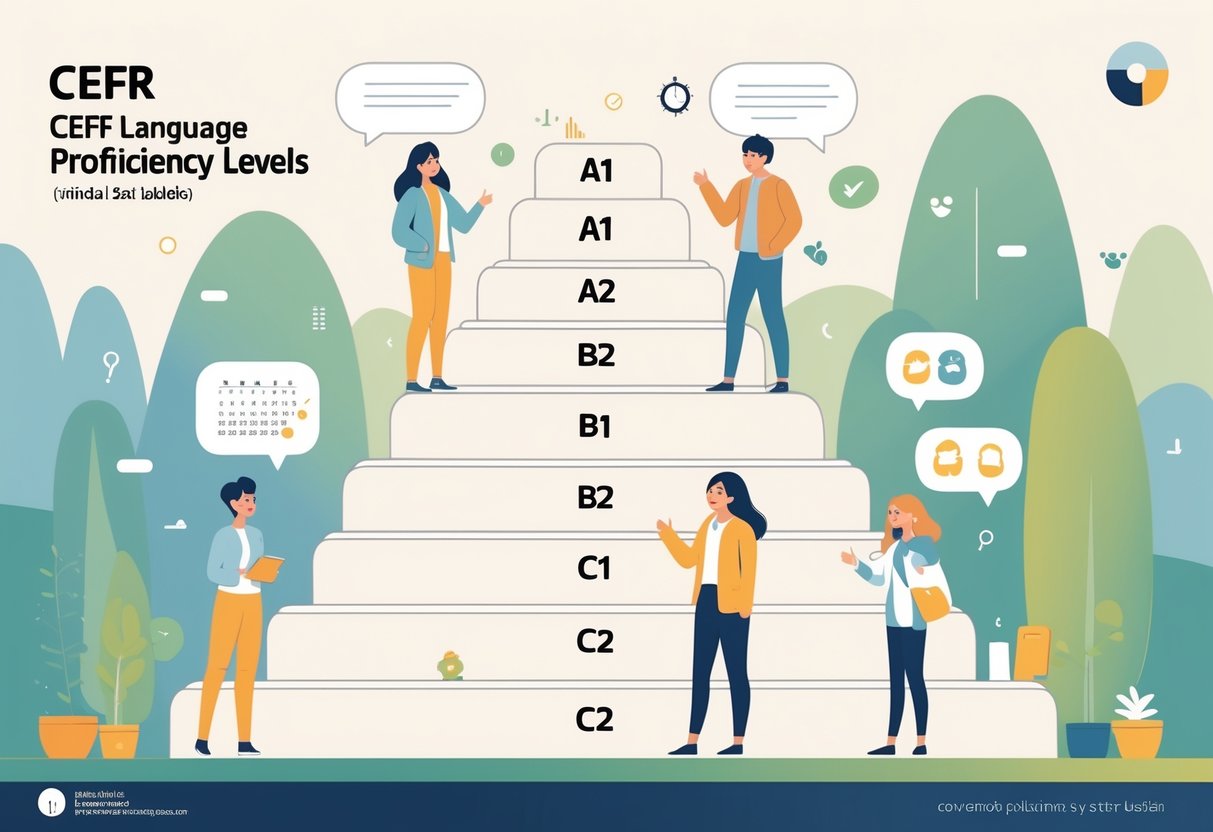
The Common European Framework of Reference for Languages organizes Spanish learning into six distinct levels, each marking clear progress toward conversation. Understanding these benchmarks helps learners track their ability to handle real exchanges, from basic greetings to complex discussions.
A1 and A2: Basic Communication Milestones
At the A1 level, learners can introduce themselves and ask simple personal questions when others speak slowly. This stage requires about 100-150 hours of study and focuses on high-frequency phrases used in daily contexts.
Research shows that adults retain vocabulary best when they encounter words in full sentences rather than isolated lists. Daily exposure to complete phrases activates contextual memory networks, allowing the brain to store both meaning and usage patterns simultaneously. Spaced repetition strengthens these connections by reintroducing material at optimal intervals before forgetting occurs.
The A2 stage builds on this foundation by expanding into common expressions for shopping, work, and personal information. Learners need approximately 180-200 hours to reach this level. They can describe their background and immediate surroundings in simple terms.
Spanish audio reinforcement plays a critical role at these early stages. Hearing correct pronunciation and natural rhythm helps learners develop accurate mental models of the language. Progressive removal of words from practiced phrases forces active recall, which cognitive studies show produces stronger memory traces than passive review.
B1 and B2: Moving Toward Confident Conversation
B1 marks the shift to understanding main points in clear, standard Spanish on familiar topics. Learners can handle most travel situations and produce simple connected text. This level requires 380-420 hours of dedicated practice.
At this stage, disappearing-text training becomes particularly effective. When learners must mentally fill in missing words from familiar phrases, they activate retrieval pathways that cement long-term retention. This technique mimics real conversation demands where speakers must produce language without visual prompts.
B2 learners interact with fluency and spontaneity that allows comfortable exchanges with Spanish speakers. They understand complex texts and can discuss topics in detail. Reaching B2 typically takes 500-600 hours of study.
Adults at these intermediate levels benefit most from consistent daily exposure rather than marathon study sessions. Five-minute daily routines that combine auditory input with active production create multiple memory consolidation cycles each week, leading to measurably better retention than weekly hour-long sessions.
C1: When Does Fluency Occur?
C1 represents advanced ability to use Spanish flexibly for social, academic, and professional purposes. Learners express ideas fluently without obvious searching for words. They understand demanding texts and recognize implicit meaning.
This level requires approximately 700-800 hours of study and marks what most people consider functional fluency. Learners can participate in nuanced discussions, follow complex arguments, and adjust their language to different contexts.
The path to C1 demands sustained engagement with authentic materials and regular conversation practice. Research-backed approaches that combine daily phrase exposure, Spanish audio models, and active recall through progressive difficulty create the neural efficiency needed for automatic language production. Contextual learning at this stage shifts from memorization to internalization, where grammar patterns and vocabulary become instinctive rather than consciously applied.
Key Factors Affecting Learning Speed
The speed at which someone reaches conversational Spanish depends on three main variables: whether they've learned another language before, how motivated and consistent they are with practice, and the type of environment where they study and speak.
Prior Language Experience
Someone who already speaks French, Italian, or Portuguese will learn Spanish faster than a complete beginner. These Romance languages share thousands of cognates and similar grammar structures with Spanish. Even learners with experience in any second language benefit from established neural pathways for language acquisition.
English speakers start with an advantage because Spanish uses the same alphabet and follows predictable pronunciation rules. The Foreign Service Institute classifies Spanish as a Category I language, meaning it's among the easiest for English speakers to master.
Previous language study teaches learners how to recognize patterns, memorize vocabulary efficiently, and tolerate the discomfort of making mistakes. These skills transfer directly to Spanish study. A person who struggled through German verb conjugations will adapt more quickly to Spanish subjunctive moods than someone tackling grammar concepts for the first time.
Personal Motivation and Consistency
Daily practice adds up faster than occasional long sessions. A learner who studies 15 minutes every morning will progress more quickly than someone who crams for two hours on weekends. This happens because the brain consolidates new information during sleep cycles between practice sessions.
Spaced repetition strengthens long-term memory formation better than massed practice. When a learner encounters a Spanish phrase on Monday, again on Wednesday, and once more on Saturday, the brain builds stronger neural connections than reviewing the same phrase ten times in one sitting.
Motivation determines whether someone maintains that daily habit. Learners with clear goals like preparing for a trip to Mexico or communicating with Spanish-speaking family members stick with practice routines longer. They connect each study session to a meaningful outcome.
Contextual recall works better than isolated vocabulary lists. Phrase Café sends a letter from Sara every weekday morning, one chapter of a real story, which is easier to remember than disconnected words. Then the coach has you say each line out loud.
Learning Environment and Practice Frequency
Immersion environments accelerate Spanish fluency dramatically. Learners who live in Spanish-speaking countries, work in bilingual offices, or spend time with Spanish speakers progress faster than those studying alone at home. Real conversations force immediate recall and provide instant feedback on pronunciation and word choice.
Auditory reinforcement strengthens both listening comprehension and speaking accuracy. Hearing Spanish audio daily trains the ear to recognize natural speech patterns, intonation, and rhythm. This exposure makes it easier to reproduce authentic pronunciation.
Active speaking practice produces faster results than passive study methods like reading or watching videos. The brain forms different neural pathways when producing language versus consuming it. Even five minutes of daily speaking creates more progress toward conversational Spanish than an hour of grammar exercises.
Digital tools work best when they replicate real-world communication. Phrase Café's daily five-minute email routine fits naturally into morning coffee or commute time, creating sustainable practice frequency. The Spanish audio recordings provide the auditory reinforcement that textbooks can't deliver, while the coach has you say every line out loud.
Evidence-Backed Strategies to Accelerate Conversational Skills
Research shows that adults learn spanish most effectively when they combine frequent exposure, active recall, and immediate use. These methods work because they align with how the brain encodes long-term memory and builds automatic language responses.
Microlearning and Science of Memory
Short, daily practice sessions produce better retention than marathon study blocks. The brain consolidates new information during rest periods between learning sessions, a process called spaced repetition.
Five-minute daily sessions work better than cramming for an hour once a week. This approach prevents cognitive overload and allows the hippocampus to transfer new vocabulary from short-term to long-term storage. Learning strategies backed by research emphasize consistent daily practice over intensive but sporadic sessions.
Progressive word removal strengthens memory by forcing active recall. When learners see a phrase with one word missing, then two words missing, and finally must produce the entire phrase from memory, they engage retrieval practice. This technique builds neural pathways faster than passive reading.
Spanish audio reinforcement adds auditory encoding to visual memory. Hearing correct pronunciation while reading creates dual pathways in the brain, making phrases easier to recall during actual conversation.
Active Speaking Early and Often
Speaking practice must begin immediately, even with basic vocabulary. Waiting until you feel "ready" delays the neural adaptations needed for spontaneous speech production.
The brain processes real-time conversation differently than reading or listening. When you speak conversational spanish, your brain simultaneously retrieves vocabulary, applies grammar rules, and controls pronunciation. This complex coordination only develops through repeated practice.
Prioritizing speaking and listening accelerates progress because it trains the brain for the actual task you want to perform. Role-playing common scenarios like ordering food or asking directions builds confidence and automaticity.
Speaking errors provide crucial feedback. Each mistake triggers corrective learning, where the brain adjusts its language production systems. Avoiding conversation to prevent errors actually slows skill development.
Setting Measurable, Achievable Goals
Specific targets create accountability and reveal progress. Vague goals like "get better at Spanish" lack the clarity needed to guide daily practice decisions.
Effective goals include clear metrics:
- Hold a three-minute conversation by March 15
- Learn 50 common verbs in present tense within two weeks
- Understand 80% of a five-minute podcast by month end
Breaking larger objectives into weekly milestones maintains motivation. Tracking completed practice sessions builds momentum and shows cumulative progress that feels invisible day-to-day.
Time-bound deadlines trigger focused effort. When you commit to using ten new phrases in conversation this week, you actively seek opportunities to practice rather than passively waiting for perfect conditions.
Modern Tools and Real-World Practice

Digital apps provide structured lessons and spaced repetition that help build vocabulary, while Spanish media offers authentic input that trains your ear to everyday speech patterns. Language exchange connects learners with real speakers for immediate feedback and conversational practice.
App-Based Learning: Duolingo, Babbel, Rosetta Stone
Duolingo uses gamification and short daily lessons to build vocabulary through spaced repetition. The app prompts learners to recall words at increasing intervals, which strengthens long-term memory formation. However, its focus on isolated sentences limits conversational context.
Babbel structures lessons around real-world dialogues and practical phrases. The platform emphasizes contextual learning rather than random vocabulary, which helps adults connect new words to situations they might encounter. Each lesson builds on previous material using spaced review.
Rosetta Stone relies on immersive image-word associations without translation. This method aims to create direct connections between Spanish and meaning, though it requires more time investment than text-based approaches.
While these apps build recognition skills, they rarely train production under time pressure. Adults need practice recalling phrases quickly during actual conversations. Daily email programs that progressively remove words from familiar phrases force active recall rather than passive recognition. This disappearing-text method combined with Spanish audio creates stronger neural pathways than multiple-choice drilling alone.
Spanish Media for Immersion
Watching Spanish shows, movies, and YouTube videos exposes learners to natural speech rhythms and colloquial expressions. Netflix offers Spanish-language content with adjustable subtitles that support comprehension at different levels.
Podcasts designed for learners slow down speech and explain vocabulary in context. News in Slow Spanish and similar programs provide auditory reinforcement that trains the ear to recognize word boundaries and pronunciation patterns.
Music helps memorize phrases through repetition and melody. Listening to the same songs repeatedly embeds common grammatical structures without conscious effort.
The key is active listening with focused attention rather than background noise. Learners should pause to repeat phrases aloud or write down new expressions. This active engagement transforms passive input into retrievable knowledge through contextual recall mechanisms.
Language Exchange for Real Conversation
Platforms like Tandem and HelloTalk connect learners with Spanish speakers seeking English practice. These exchanges provide immediate feedback on pronunciation, grammar, and word choice that apps cannot replicate.
Video calls force learners to produce language spontaneously under social pressure. This real-time challenge activates different neural pathways than writing or app exercises. Adults must retrieve vocabulary quickly and construct sentences without pause buttons.
Local conversation groups and language exchange meetups offer face-to-face practice with cultural context. In-person interaction adds body language and social cues that deepen understanding.
Consistency matters more than duration. Daily five-minute conversations build fluency faster than weekly hour-long sessions because frequent retrieval practice prevents memory decay. Combining structured phrase practice with spontaneous conversation creates the strongest foundation for conversational Spanish.
Overcoming Plateaus and Tracking Progress
Learning plateaus happen when the brain has absorbed foundational patterns but hasn't yet automated them through repeated contextual use. Recognizing these stalls early and measuring real conversational ability keeps learners moving toward fluency.
Recognizing and Breaking Through Learning Plateaus
Most adults hit a plateau after building a 500–800 word vocabulary. They understand basic grammar but struggle to speak naturally in Spanish conversation.
This happens because passive recognition doesn't equal active recall. The brain needs repeated retrieval practice in varied contexts to move words from short-term awareness into automatic speech patterns.
Diversifying learning methods breaks this stall. Adults should rotate between listening to Spanish audio, speaking without translation buffers, and writing short responses to real scenarios.
Daily email routines that present phrases with progressive word removal force active recall. When learners see "¿Cómo ___ llamas?" instead of the complete phrase, their brain must retrieve the missing word from memory rather than passively reading it.
This disappearing-text training builds stronger neural pathways than vocabulary lists. Spaced repetition schedules these retrieval moments at optimal intervals, right before the brain would forget.
Celebrating Small Wins and Adjusting Your Approach
Track conversational milestones instead of word counts. Can the learner order food without switching to English? Can they describe their weekend using past tense verbs?
These concrete markers show whether practice translates into functional ability. Recording short speaking sessions every two weeks reveals pronunciation improvements and growing sentence complexity that daily progress feels invisible.
Adults who learn Spanish fluently adjust their approach when specific skills lag. If listening comprehension stalls, they increase Spanish audio exposure. If speaking feels clunky, they add daily 5-minute speaking drills.
Small wins compound when learners shift from "study 30 minutes" to "complete three real exchanges in Spanish today." This outcome focus turns abstract practice into measurable communication gains that sustain motivation through intermediate stages.