How Long Does It Take to Learn Spanish Fluently? Science-Backed Shortcuts to Mastery
Master the timeline to true Spanish fluency. Learn the difference between conversational ability and native-like mastery, and discover the most efficient learning methods to reach your fluency goals.
Posted by
 Stewart Kaplan
Related reading
Basic Spanish Words Every Beginner Should Learn (Organized by Category)
Master 200+ essential Spanish words organized by category: greetings, food, travel, and emergency phrases. Includes example sentences for each word. Perfect for beginners building vocabulary.
Best Apps to Learn Spanish (2026 Review): Ranked by Speed & Retention
Compare the best Spanish learning apps in 2026. Ranked by speed to fluency, retention rates, and value. Includes Duolingo, Babbel, Rosetta Stone, Pimsleur, and more.
Can You Learn Spanish in 3 Months? Reality Check + 90-Day Sprint Plan
Honest assessment of what's achievable in 3 months of Spanish learning. Includes realistic expectations, fluency levels, and a complete 90-day sprint plan.
How Long Does It Take to Learn Spanish Fluently?
The short answer: 600-750 hours for conversational fluency, 1,000-1,200 hours for professional fluency. But the real answer depends on three factors: your daily commitment, your learning method, and how you define "fluent."
This guide breaks down exactly what to expect at each stage - from your first "hola" to thinking in Spanish without translation. You'll see realistic timelines for different learner types, the science behind why some methods work faster, and a clear progress path to follow.
If you're just starting out, read our Complete Beginner Roadmap first - it gives you the exact 6-step system to build your foundation.
Your Progress Path: From Zero to Fluent
Here's what your Spanish journey looks like, broken into clear milestones:
Stage 1: Survival Spanish (0-100 hours)
Timeline: 1-3 months at 1 hour/day
What you can do: Introduce yourself, order food, ask for directions, count to 100, use basic greetings
Focus areas: Pronunciation fundamentals, high-frequency vocabulary, present tense of ser/estar/tener
Stage 2: Tourist Fluency (100-250 hours)
Timeline: 3-6 months at 1 hour/day
What you can do: Handle travel situations, have simple conversations about daily life, understand slow native speech
Focus areas: Past tense, expanded vocabulary (1,000+ words), listening comprehension
Stage 3: Conversational Fluency (250-500 hours)
Timeline: 6-12 months at 1 hour/day
What you can do: Discuss opinions, tell stories, understand most TV shows with subtitles, read simple articles
Focus areas: Subjunctive mood, idiomatic expressions, conversation practice with natives
Stage 4: Professional Fluency (500-750 hours)
Timeline: 12-18 months at 1 hour/day
What you can do: Work in Spanish, understand rapid native speech, read literature, express nuanced ideas
Focus areas: Advanced grammar, professional vocabulary, cultural fluency
Stage 5: Near-Native Fluency (750-1,200+ hours)
Timeline: 18-36 months at 1 hour/day
What you can do: Think in Spanish, understand jokes and wordplay, speak with minimal accent, handle any situation
Focus areas: Immersion, regional dialects, advanced literature and media
Time Estimates by Fluency Level
The Foreign Service Institute classifies Spanish as a Category I language, requiring approximately 600-750 hours for professional working proficiency. This estimate applies to English speakers learning through intensive, structured programs.
Basic conversational ability emerges around 100-200 hours of study. At this stage, learners can introduce themselves, order food, and handle simple daily interactions.
Intermediate fluency develops between 380-420 hours. Learners understand main points in clear speech and handle most travel situations without difficulty.
Advanced fluency requires 700-800 hours of dedicated practice. At this level, adults can discuss complex topics, understand implicit meanings, and use the language flexibly in professional settings.
The key difference between these timelines lies in how learners engage with material. Spaced repetition creates stronger memory formation than cramming vocabulary lists. Adults who receive daily exposure to contextual phrases retain material 3-4 times longer than those who study sporadically.
Daily routines that combine auditory reinforcement with contextual recall accelerate progress significantly. When learners hear native audio paired with written phrases, their brains form dual pathways for retrieval. Progressive removal of words from familiar sentences strengthens active recall rather than passive recognition.
Short daily sessions of 5-10 minutes produce better results than weekly hour-long blocks because they align with how the brain consolidates new information during sleep cycles.
Defining Fluency in Realistic Terms
Fluency doesn't mean perfection or knowing every word in Spanish. It means communicating effectively without constant translation in your head.
Conversational fluency allows learners to handle everyday situations, express opinions, and understand native speakers in familiar contexts. Most experts agree this level takes 6-12 months with one hour of daily practice.
Professional fluency requires understanding nuance, idioms, and cultural references. Learners can present complex ideas, understand rapid speech, and adjust their language for different audiences.
Adults often confuse recognition with production. They can understand far more Spanish than they can speak because comprehension requires passive recall while speaking demands active retrieval. This gap explains why learners feel stuck despite understanding movies or podcasts.
Effective training addresses this gap through disappearing-text exercises. When learners practice phrases with words progressively removed, they strengthen active production pathways. This technique forces the brain to generate language rather than simply recognize it.
Native audio serves as the foundation for proper pronunciation and natural rhythm. Adults who listen to native speakers daily develop better accent patterns than those who rely solely on text-based learning.
Comparing Spanish Fluency Timelines to Other Languages
Spanish ranks among the fastest languages for English speakers to learn compared to other languages. The FSI estimates 600-750 hours for Spanish versus 2,200 hours for Arabic or Mandarin.
This advantage comes from shared vocabulary and similar grammar structures. English borrowed thousands of words from Latin, making Spanish cognates instantly recognizable. Words like "information" (información) and "hospital" (hospital) require minimal memorization.
| Language Category | Examples | Hours to Proficiency |
|---|---|---|
| Category I (Easiest) | Spanish, French, Italian | 600-750 hours |
| Category II | German | 900 hours |
| Category III | Indonesian, Swahili | 1,100 hours |
| Category IV (Hardest) | Arabic, Mandarin, Japanese | 2,200 hours |
German requires more time despite being Germanic like English because of complex case systems. Spanish grammar follows predictable patterns that adults can internalize through consistent exposure.
Romance languages share similar sentence structures, so learners with French or Italian backgrounds progress faster. However, English speakers still benefit from straightforward pronunciation rules where letters maintain consistent sounds.
The actual timeline depends more on learning methods than language difficulty. Adults who engage with contextual phrases daily through multiple channels build neural pathways faster than those using translation apps alone.
Fundamental Stages of Learning Spanish
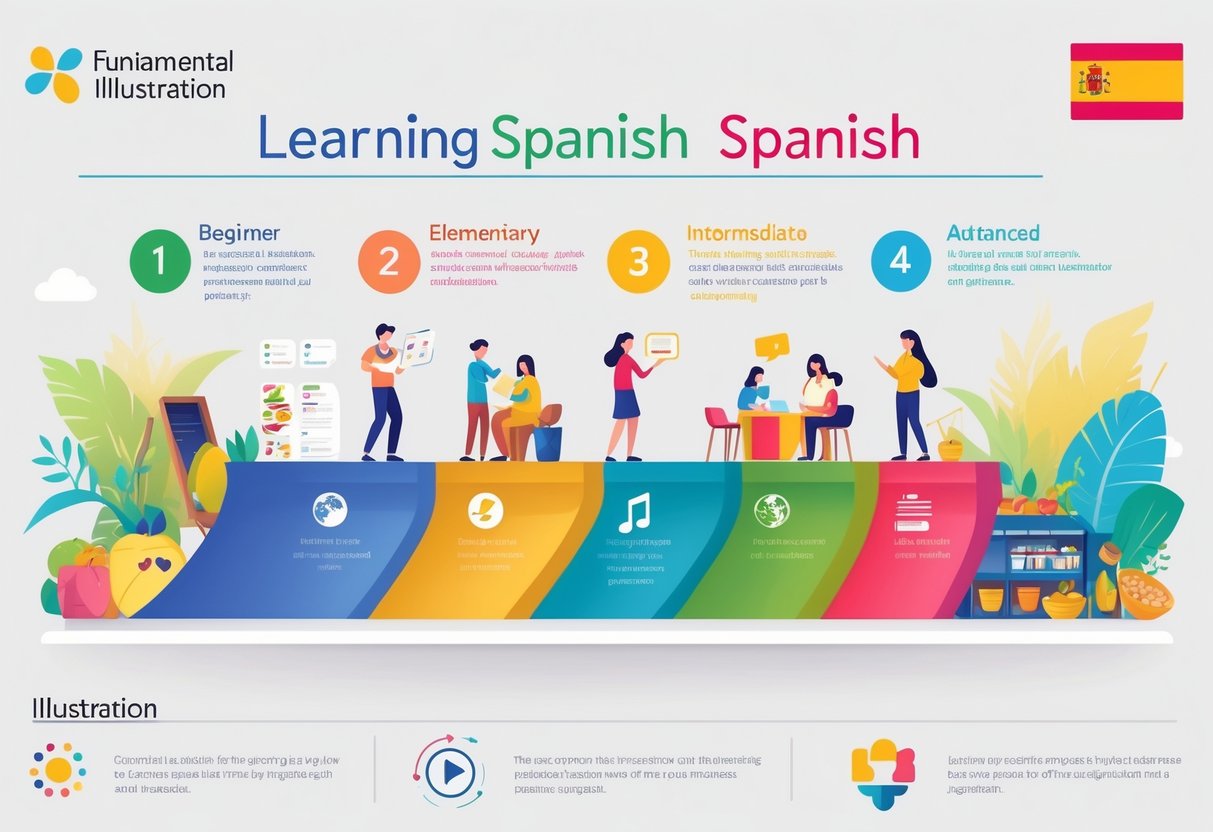
Learning Spanish fluently requires progressing through distinct stages that build language skills systematically. Each stage demands specific study hours and focuses on different aspects of communication, from basic phrases to complex conversations.
Beginner Milestones and Timeline
Reaching the A1 level requires 100-150 hours of focused study. Learners at this stage acquire basic greetings, introductions, and essential phrases for daily interactions. They begin recognizing present tense verbs and gendered nouns while building a foundation of 500-800 words.
The brain consolidates these early language skills most effectively through spaced repetition rather than cramming. Daily exposure to Spanish phrases with native audio reinforces proper pronunciation patterns before incorrect habits form. Short, consistent practice sessions of 5-10 minutes create stronger neural pathways than sporadic hour-long study blocks.
Moving to A2 requires an additional 80-100 hours. Learners can now handle simple conversations about shopping, family, and work. They understand common expressions and describe their immediate environment in basic terms. Contextual recall methods - learning phrases within real scenarios rather than isolated vocabulary lists - produce measurably better retention at this stage.
Intermediate Level Progression and Duration
The B1 level takes about 380-420 hours of total study time. Learners understand the main points of standard Spanish on familiar topics. They handle most travel situations and produce connected text about personal interests. Reading Spanish content with progressive difficulty builds comprehension faster than translation exercises.
B2 proficiency requires 500-600 hours total. Learners interact with native speakers more naturally and grasp complex texts. They express detailed opinions without frequently searching for words. Auditory reinforcement through podcasts and conversations strengthens listening skills that textbooks cannot develop.
Key B-Level Skills:
- Spontaneous conversation with native speakers
- Understanding implicit meaning in texts
- Writing detailed explanations on various subjects
- Following extended discussions on familiar topics
The intermediate stage challenges learners because grammar complexity increases while vocabulary expands rapidly. Progressive removal of English translations during study forces the brain to think directly in Spanish.
Advanced Proficiency and Full Fluency
C1 level demands approximately 700-800 hours of dedicated practice. Learners express ideas fluently without obvious hesitation. They understand demanding texts and recognize subtle implied meanings. Language skills at this level support academic and professional communication effectively.
C2 mastery typically requires 1000-1200 hours total. Learners comprehend virtually everything they hear or read. They summarize complex information from multiple sources coherently. Full fluency means thinking in Spanish without mental translation.
Adults learn spanish most effectively at advanced levels through immersion-style techniques. Consuming native media without subtitles trains the ear to process rapid speech patterns. Writing summaries of Spanish podcasts or articles builds both comprehension and expression simultaneously.
The brain requires consistent challenge to maintain advanced language skills. Daily engagement with native-level content prevents skill degradation that occurs during breaks from practice.
Key Factors That Determine Your Learning Speed
Your path to Spanish fluency depends on three main elements: how often you practice, what language skills you already have, and why you want to learn. These factors work together to shape how quickly you progress.
Time Commitment and Study Frequency
The FSI estimates 600-750 hours to reach Spanish fluency for English speakers. Breaking this down means studying one hour daily gets learners there in about two years, while three hours daily cuts that to eight months.
Consistency matters more than total time. Daily 30-minute sessions build stronger neural pathways than cramming three hours on weekends. The brain consolidates language patterns during sleep, so regular exposure allows spaced repetition to work effectively.
Daily study schedules and their timeframes:
| Daily Study Time | Months to Fluency | Total Commitment |
|---|---|---|
| 30 minutes | 36-48 months | Moderate |
| 1 hour | 18-24 months | Standard |
| 2 hours | 9-12 months | Intensive |
| 3+ hours | 6-8 months | Immersive |
Spacing practice across the day improves retention. Morning vocabulary review, midday audio practice, and evening contextual exercises create multiple memory anchors. Short, frequent sessions activate recall mechanisms more effectively than single long blocks.
Individual Background and Language Experience
Native English speakers have a moderate advantage when they learn Spanish because both languages share Latin roots and about 30% cognates. Romance language speakers like French or Italian learners reach fluency in 9-12 months compared to 18-24 months for English speakers.
Previous language learning experience accelerates Spanish acquisition. Adults who studied another foreign language already understand grammar concepts like conjugation and gender agreement. They recognize patterns faster and adapt to new pronunciation rules with less resistance.
Age affects learning style more than capacity. Adults excel at understanding grammar rules and making logical connections between concepts. They benefit from explicit instruction and contextual learning that ties new phrases to real situations. Native audio reinforcement helps adults overcome pronunciation challenges by providing clear models for imitation.
Motivation and Goal Setting
Clear objectives determine learning intensity and method selection. Someone wanting conversational skills for travel needs 4-7 months to reach A2 level, while job seekers should target B2 proficiency requiring 11-24 months.
Common goals and realistic timeframes:
- Travel communication: 2-3 months (A1 basics)
- Social conversation: 7-13 months (B1 independent)
- Professional use: 11-24 months (B2 proficient)
- Complete fluency: 18-36 months (C2 mastery)
Emotional connection to Spanish culture, music, or personal relationships increases engagement. Learners with intrinsic motivation practice more willingly and persist through difficult concepts like subjunctive mood. Setting weekly micro-goals maintains momentum better than vague aspirations about eventual fluency.
Effective Methods to Accelerate Spanish Acquisition
The fastest progress comes from combining memory science with daily exposure. Techniques like immersion, spaced repetition, and blended practice create stronger neural pathways than passive study alone.
Immersive Learning Techniques
Immersion forces the brain to process Spanish in real time without translation. Learners who surround themselves with Spanish input develop faster comprehension and natural sentence patterns.
Watching Spanish shows with Spanish subtitles builds both listening and reading skills simultaneously. The brain connects spoken sounds to written words while absorbing grammar patterns in context.
Consistent practice and immersion accelerate learning because they activate contextual recall. The mind remembers words better when tied to situations rather than isolated lists.
Changing phone settings to Spanish creates hundreds of daily micro-exposures. Each notification and menu becomes a practice opportunity that reinforces vocabulary without dedicated study time.
Speaking with native speakers through language exchanges provides immediate feedback. The pressure to respond quickly strengthens retrieval speed and builds confidence in real conversations.
Microlearning and Spaced Repetition
Spaced repetition exploits how memory consolidates over time. Reviewing material at increasing intervals prevents forgetting and moves information into long-term storage.
Short daily sessions outperform marathon study blocks. Five-minute daily practice creates consistent neural activation that builds retention more effectively than occasional longer sessions.
Progressive word removal strengthens active recall. When learners see phrases with disappearing text, they must retrieve missing words from memory rather than passively recognize them. This retrieval practice creates stronger memory traces than simple reading.
Daily phrase emails deliver content directly to inboxes at optimal intervals. Receiving native audio recordings alongside written phrases provides auditory reinforcement that helps learners internalize pronunciation and rhythm patterns naturally.
YouTube channels offering daily Spanish phrases demonstrate contextual usage. Learners benefit from seeing how native speakers use expressions in authentic situations rather than memorizing decontextualized vocabulary.
Blended Approaches: Apps and Real-World Practice
Combining digital tools with human interaction addresses different learning needs. Apps like Rosetta Stone provide structured lessons while conversations apply knowledge under real conditions.
Technology delivers consistency and tracking that manual methods cannot match. Apps schedule reviews, measure progress, and adapt difficulty based on performance data.
Real-world practice develops spontaneous language production. Ordering coffee in Spanish or asking directions forces learners to construct sentences without time to overthink grammar rules.
Learning Spanish through multiple methods creates redundant memory pathways. Hearing a word in an app, seeing it in a text, and using it in conversation reinforces the same information through different channels.
Language apps work best as supplements rather than sole resources. Pairing app drills with speaking practice, reading Spanish news, and listening to podcasts creates comprehensive exposure that develops all language skills simultaneously.
Popular Resources and Tools for Learning Spanish

Language learning apps and online resources provide structured pathways that align with how adults build second-language memory through spaced repetition and contextual exposure. Video-based platforms strengthen auditory processing and visual association, while community networks offer the social reinforcement that solidifies new language patterns.
Comprehensive Language Platforms
Adults learn best when new words appear in context, disappear gradually, and return at calculated intervals. Rosetta Stone uses image association to build vocabulary without translation, forcing the brain to create direct connections between Spanish words and their meanings. This mimics natural language acquisition but lacks the daily reinforcement that prevents memory decay.
Duolingo and Babbel structure lessons around progressive difficulty and gamification. They work well for establishing basic patterns but often fail to create the deep contextual memory needed for fluent recall. The brain requires multiple exposures across different contexts, ideally with native audio that reinforces proper pronunciation and rhythm.
Phrase Café addresses these gaps by delivering one daily email with a practical Spanish phrase, native audio, and progressive word removal. This disappearing-text training forces active recall rather than passive recognition. The five-minute daily format matches the optimal study duration for busy adults while building consistent exposure over months. Each phrase includes cultural context that creates stronger memory anchors than isolated vocabulary lists.
Video-Based and Interactive Content
YouTube channels provide free access to native speakers demonstrating real conversational patterns and cultural context. Channels like SpanishDict and Butterfly Spanish show how phrases work in actual dialogue, strengthening auditory comprehension and natural speech rhythms.
Visual learning activates additional neural pathways that reinforce verbal memory. Watching native speakers allows learners to connect facial expressions, gestures, and intonation with specific phrases. This multi-sensory approach creates more retrieval cues than audio-only or text-only methods.
Interactive content works best when it requires active production rather than passive watching. Shadowing exercises, where learners repeat phrases immediately after hearing them, build muscle memory for pronunciation while strengthening auditory processing.
Community and Peer Support Networks
Language exchange platforms like Tandem and HelloTalk connect learners with native Spanish speakers for conversation practice. Real dialogue forces immediate recall under pressure, which strengthens memory consolidation more effectively than scripted exercises.
Online forums and social media groups provide accountability and answer specific questions about grammar, idioms, and regional variations. Peer support helps learners persist through the intermediate plateau where progress feels slow despite consistent effort.
The most effective community tools combine structured input with social interaction. Regular conversation partners create predictable contexts where new phrases can be practiced repeatedly until they become automatic.
Learning Spanish for Travel and Daily Life
Travel Spanish requires fewer study hours than professional fluency but demands immediate recall under pressure. Most learners need 70 to 80 hours to reach the A1 level, which covers basic travel needs in two to three months.
Essential Travel Phrases and Survival Skills
Travelers benefit most from contextual learning that mimics real situations. The brain stores phrases more effectively when tied to specific locations or actions rather than isolated vocabulary lists.
Daily exposure through spaced repetition builds the strongest foundation. When learners receive phrases each morning tied to common scenarios like ordering food or asking directions, their recall improves significantly. Audio reinforcement from native speakers trains the ear to recognize natural pronunciation and speed.
Progressive difficulty strengthens retention. Starting with complete phrases, then removing one word at a time, forces active recall rather than passive recognition. This disappearing-text method creates stronger neural pathways than reading static translations.
Five-minute daily practice sessions outperform hour-long weekly study. The brain consolidates new information during sleep, so consistent small doses allow better processing than cramming. Learners who practice greetings, numbers, and basic questions each morning retain them longer than those who study vocabulary lists for extended periods.
Key survival phrases include location questions, food orders, emergencies, and transportation needs. These cover 80% of tourist interactions.
Adapting Spanish for Specific Travel Needs
Regional vocabulary changes across Spanish-speaking countries. A traveler to Mexico needs different food terms than someone visiting Argentina. The word for bus varies from autobús to colectivo to guagua depending on location.
Learners save time by focusing on their destination's dialect. Someone planning a Barcelona trip should learn Castilian pronunciation, while those heading to Colombia benefit from coastal Caribbean variations.
Common regional differences:
| Concept | Spain | Mexico | Argentina |
|---|---|---|---|
| Juice | zumo | jugo | jugo |
| Car | coche | carro | auto |
| To take | coger | tomar | tomar |
Travelers need roughly one to three months of focused practice for basic trip preparation. Daily email-based learning keeps travel phrases fresh without requiring app downloads or WiFi access abroad. Native audio helps learners recognize local accents before arrival, reducing comprehension shock during actual conversations.
Overcoming Traditional Learning Pitfalls

Many learners waste months or years using methods that fail to build lasting memory pathways. Adults need strategies that align with how the brain naturally stores and retrieves new language patterns.
Common Mistakes That Slow Progress
Relying on vocabulary lists alone creates weak memory traces that fade quickly. The brain stores words best when they appear inside full phrases tied to real situations. Studying isolated words forces learners to rebuild context every time they speak.
Skipping daily audio exposure leaves pronunciation patterns unformed. Adult brains need repeated listening to native speakers to recognize sound boundaries and rhythm. Without this auditory reinforcement, learners develop incorrect accent habits that become harder to fix later.
Using apps without real conversation practice builds recognition skills but not production ability. Many people can read Spanish far better than they can speak it because they never practice forming sentences under time pressure. Reaching conversational fluency requires both input and active output.
Cramming before feeling ready overwhelms working memory. The brain needs time between learning sessions to move information from short-term to long-term storage. Students who study for three hours once per week make slower progress than those practicing 30 minutes daily.
Science-Backed Strategies for Rapid Mastery
Spaced repetition strengthens neural pathways by reviewing material at increasing intervals. Research shows that revisiting phrases after one day, three days, then one week creates stronger recall than massed practice. This timing matches how memory consolidation actually works in the brain.
Progressive word removal forces active retrieval rather than passive recognition. When learners see a phrase with one word missing, then two words missing, their brain must reconstruct the full sentence from memory. This retrieval practice builds faster recall than simply rereading complete sentences.
Contextual phrase learning packages grammar and vocabulary together in usable chunks. Instead of memorizing conjugation tables, learners absorb patterns through repeated exposure to phrases like "I would like to go" or "Have you seen my keys?" The brain stores these ready-made units for immediate use in conversation.
Daily 5-minute routines maintain momentum without creating cognitive overload. Short, consistent sessions allow the brain to process new information during sleep and rest periods between practice. Phrase Café's research-backed approach delivers one phrase per day with native audio and progressive removal exercises, creating stronger retention than hour-long vocabulary drilling sessions.
Native audio repetition trains the ear to hear phonetic distinctions that don't exist in English. Listening to the same phrase multiple times at natural speed helps learners identify where words begin and end, which syllables carry stress, and how intonation changes meaning.
Timeline by Learner Type
Your actual timeline depends heavily on your commitment level and learning intensity:
| Learner Type | Weekly Hours | Time to Conversational | Time to Fluency |
|---|---|---|---|
| Casual Learner | 3-5 hours/week | 12-18 months | 3-4 years |
| Consistent Learner | 7-10 hours/week | 6-9 months | 18-24 months |
| Immersion Learner | 20+ hours/week | 2-3 months | 6-12 months |
Casual learners study when they have time - a few app sessions per week, occasional podcast listening. Progress is slow but steady.
Consistent learners commit to daily practice - 1 hour minimum, structured lessons, regular conversation practice. This is the sweet spot for most adults.
Immersion learners treat Spanish like a job - multiple hours daily, living in Spanish-speaking countries, or creating full immersion environments at home.
Your Next Steps
Ready to start your Spanish journey? Here are the best resources to accelerate your progress:
- Complete Beginner Roadmap - A 6-step system to go from zero to conversational
- 30-Day Spanish Challenge - A structured day-by-day program for beginners
- 3-Month Sprint Plan - What's realistic in 90 days and how to maximize progress