How Long Does It Take to Learn Spanish from English? Science-Backed Shortcuts to Rapid Progress
English speakers have a unique advantage when learning Spanish. Discover why Spanish is easier for English speakers and the realistic timeline to reach conversational and professional fluency.
Posted by
 Stewart Kaplan
Related reading
Basic Spanish Words Every Beginner Should Learn (Organized by Category)
Master 200+ essential Spanish words organized by category: greetings, food, travel, and emergency phrases. Includes example sentences for each word. Perfect for beginners building vocabulary.
Best Apps to Learn Spanish (2026 Review): Ranked by Speed & Retention
Compare the best Spanish learning apps in 2026. Ranked by speed to fluency, retention rates, and value. Includes Duolingo, Babbel, Rosetta Stone, Pimsleur, and more.
Can You Learn Spanish in 3 Months? Reality Check + 90-Day Sprint Plan
Honest assessment of what's achievable in 3 months of Spanish learning. Includes realistic expectations, fluency levels, and a complete 90-day sprint plan.
How Long Does It Take to Learn Spanish from English?
English speakers typically need 600 to 750 hours of dedicated study to reach fluency in Spanish, though conversational ability arrives much sooner at around 300 to 400 hours. The timeline varies based on study methods, daily practice consistency, and how learners structure their exposure to the language. For a detailed breakdown of hours needed, see how many hours to learn Spanish.
Typical Timelines for English Speakers
The U.S. Foreign Service Institute categorizes Spanish as a Category I language for English speakers, requiring approximately 24 to 30 weeks of classroom instruction. This estimate assumes 25 hours per week of intensive study.
For learners studying one hour daily, reaching conversational fluency takes 11 to 24 months. Full fluency requires 1.5 to 3 years of consistent practice.
Daily Study Duration Impact:
- 30 minutes daily: 3 to 4 years to fluency
- 1 hour daily: 1.5 to 3 years to fluency
- 2 hours daily: 9 to 18 months to fluency
- 3+ hours daily: 6 to 12 months to fluency
The quality of study time matters more than quantity alone. Adults retain vocabulary better through spaced repetition and contextual learning rather than cramming sessions. Daily exposure to Spanish audio combined with progressive difficulty creates stronger neural pathways than sporadic intensive study blocks.
Milestones and Proficiency Stages
The Common European Framework of Reference for Languages provides clear benchmarks for measuring Spanish proficiency:
| Level | Hours Required | Time Frame | Abilities |
|---|---|---|---|
| A1 | 70-80 | 2-3 months | Basic greetings, simple phrases |
| A2 | 150-180 | 4-7 months | Simple conversations, everyday situations |
| B1 | 300-360 | 7-13 months | Conversational fluency begins |
| B2 | 540-620 | 11-24 months | Comfortable casual conversations |
| C1 | 740-860 | 15-30 months | Advanced proficiency |
| C2 | 920-1100 | 30-36 months | Natural fluency |
Most learners plateau between B1 and B2 levels. This happens when passive vocabulary exceeds active recall ability. Breaking through requires contextual practice where phrases appear in multiple situations, allowing the brain to form flexible retrieval patterns rather than rigid memorization links.
Measuring Progress: Key Benchmarks
Progress in learning Spanish shows up in specific, measurable ways at each stage. At 2 months, learners handle basic introductions and common questions. At 6 months, they follow simple conversations and express basic needs.
Early Stage Indicators (0-6 months):
- Recognizing cognates without translation
- Understanding slow, clear speech
- Forming present-tense sentences
Intermediate Markers (6-18 months):
- Following full-speed conversations in familiar contexts
- Switching between past and future tenses
- Thinking in Spanish during routine activities
Auditory reinforcement accelerates all these milestones. Hearing natural pronunciation daily trains the ear to parse word boundaries and recognize patterns faster than reading alone. When learners receive daily phrases with accompanying audio, their comprehension speed increases because they build sound-meaning connections simultaneously.
Disappearing-text training pushes active recall further. When parts of familiar phrases gradually vanish, the brain must reconstruct complete sentences from memory rather than simply recognizing them. This retrieval practice strengthens long-term retention more effectively than repeated exposure to complete phrases.
Factors that Influence Your Spanish Learning Speed
Your timeline depends heavily on how much time you dedicate each day and whether you already speak another language. The method you choose and your specific goals also shape how quickly you progress.
Study Consistency and Intensity
Daily practice beats sporadic cramming every time. The Foreign Service Institute data shows that one hour per day can lead to conversational fluency in about 18 months, while two hours daily cuts that to 9-12 months.
Spaced repetition drives these results because the brain strengthens neural pathways through repeated exposure over time. When learners review Spanish phrases at expanding intervals, they move vocabulary from short-term to long-term memory more effectively than through mass review sessions.
Daily exposure through multiple formats accelerates this process. Listening to Spanish audio reinforces pronunciation patterns that reading alone cannot teach. Writing sentences with new vocabulary creates stronger recall than passive review.
A learner who studies 30 minutes in the morning and 30 minutes in the evening will typically outperform someone who studies for three hours once per week. The consistency allows the brain to consolidate learning during sleep and maintain active neural connections.
Learning Goals and Motivation
Conversational fluency requires far less study time than natural mastery. Most learners reach comfortable conversation around the B2 level, which represents roughly 80% of language competency.
Natural fluency at the C2 level can take five years or more of dedicated study. PhD programs typically only require C1 certification, and most jobs need B2 at most.
Your reason for learning directly affects how quickly you progress. A learner preparing for a move to Mexico City will naturally engage more deeply with practical vocabulary than someone studying without immediate application.
Clear goals also help learners choose appropriate materials. Someone aiming for business Spanish needs different vocabulary than a traveler focused on restaurant and hotel conversations.
Prior Language Experience
Speakers of romance languages gain a massive advantage when learning Spanish. Portuguese speakers find 89% vocabulary overlap, while Italian speakers recognize 82% of Spanish words.
Even French speakers benefit from 75% similarity despite different pronunciation patterns. German speakers face more challenges but still share some Latin-derived vocabulary with Spanish.
Multilingual adults learn subsequent languages faster than their second language because they already understand how grammar systems work differently across languages. They recognize patterns more quickly and make fewer assumptions based solely on their first language.
Someone who already speaks two languages typically reaches conversational Spanish in 8-12 months compared to 15-18 months for a monolingual English speaker with the same study intensity.
Language Similarities and Cognates
Spanish shares thousands of cognates with English, making vocabulary acquisition easier than languages like Mandarin or Arabic. Words like "hotel," "chocolate," and "animal" look nearly identical.
The consistent pronunciation rules help English speakers progress faster too. Each Spanish letter typically makes the same sound, unlike English where "ough" produces eight different sounds.
Contextual learning with cognates works better than memorizing isolated word lists. When learners encounter "universidad" in a sentence about education, they build stronger associations than studying the word alone. Progressive removal of familiar words in repeated phrases forces the brain to actively recall rather than passively recognize.
Romance languages share verb conjugation patterns that become familiar across the language family. A French speaker already understands the concept of gendered nouns and adjective agreement, cutting months off the learning curve.
Proficiency Levels Explained: What Does 'Fluent' Mean?
Fluency exists on a spectrum rather than as a single destination. The Common European Framework of Reference for Languages provides six distinct levels that measure what learners can actually do with Spanish, from basic greetings to nuanced professional discourse.
Conversational Versus Natural Skills
Conversational ability typically begins at the B1 level, where learners handle most travel situations and familiar topics without preparation. They produce connected sentences about personal interests and explain opinions briefly. Spanish speakers must occasionally slow down or rephrase, but communication flows without major breakdowns.
Natural proficiency operates at C2, where learners grasp virtually everything heard or read. They differentiate subtle meaning shifts in complex situations and reconstruct arguments from multiple sources coherently. This level requires extensive exposure to contextual language use rather than isolated vocabulary drilling.
The gap between these stages involves memory formation patterns. Spaced repetition builds initial recall, but contextual learning - seeing phrases in full sentences rather than word lists - creates stronger neural pathways. Daily exposure to Spanish audio reinforces pronunciation and natural phrasing that textbooks cannot capture. Progressive challenges, like filling in missing words from familiar phrases, force active retrieval that strengthens long-term retention far beyond passive reading.
CEFR Levels and What You Can Do at Each Stage
The CEFR divides language learning into six levels that describe specific capabilities:
A1 (Beginner): Learners understand basic phrases for immediate needs. They introduce themselves and ask simple questions about personal details. Interaction requires slow, clear speech from patient partners.
A2 (Elementary): Learners handle routine exchanges about family, shopping, and employment. They describe their background and immediate environment in simple terms.
B1 (Intermediate): Learners grasp main points of clear input on familiar topics. They manage most travel situations and produce connected text about personal interests.
B2 (Upper Intermediate): Learners understand complex texts on concrete and abstract topics. They interact with fluency that allows regular conversation with Spanish speakers without strain.
C1 (Advanced): Learners comprehend demanding, longer texts and recognize implicit meaning. They express ideas fluently without obvious searching for expressions.
C2 (Mastery): Learners understand virtually everything with ease. They express themselves spontaneously and precisely, even in complex situations.
Memory consolidation accelerates when learners encounter the same phrases repeatedly in varied contexts. Daily email routines that present Spanish phrases with progressive word removal force the brain to actively reconstruct meaning. This retrieval practice, combined with Spanish audio models, builds automaticity that rote memorization cannot achieve. Five-minute daily sessions outperform sporadic hour-long cramming because the brain requires time between exposures to solidify new neural connections.
Professional and Academic Language Requirements
Most employers specify professional working proficiency at B2 or the ILR Level 3 equivalent. At this stage, professionals participate effectively in conversations on practical, social, and professional topics. They discuss specialized fields with reasonable ease and maintain comprehension at normal speech rates.
Academic programs typically require C1 for graduate studies conducted in Spanish. Students must understand lectures, participate in seminars, and produce well-structured academic writing. They need to grasp culturally different concepts and recognize implicit meanings in complex texts.
The Federal Service Institute estimates 600-750 classroom hours to reach professional working proficiency in Spanish from English. This timeline assumes consistent study with qualified instruction, not self-directed app use alone.
Professional language acquisition requires domain-specific vocabulary within natural sentence structures. Learners who encounter technical terms in isolated lists struggle to deploy them correctly under pressure. Contextual exposure through complete phrases allows the brain to link vocabulary with grammatical patterns and appropriate usage situations simultaneously. Auditory reinforcement through Spanish recordings trains the ear to recognize professional register and formality levels that written materials alone cannot convey.
The Role of Language Families: Spanish, English, and Romance Languages
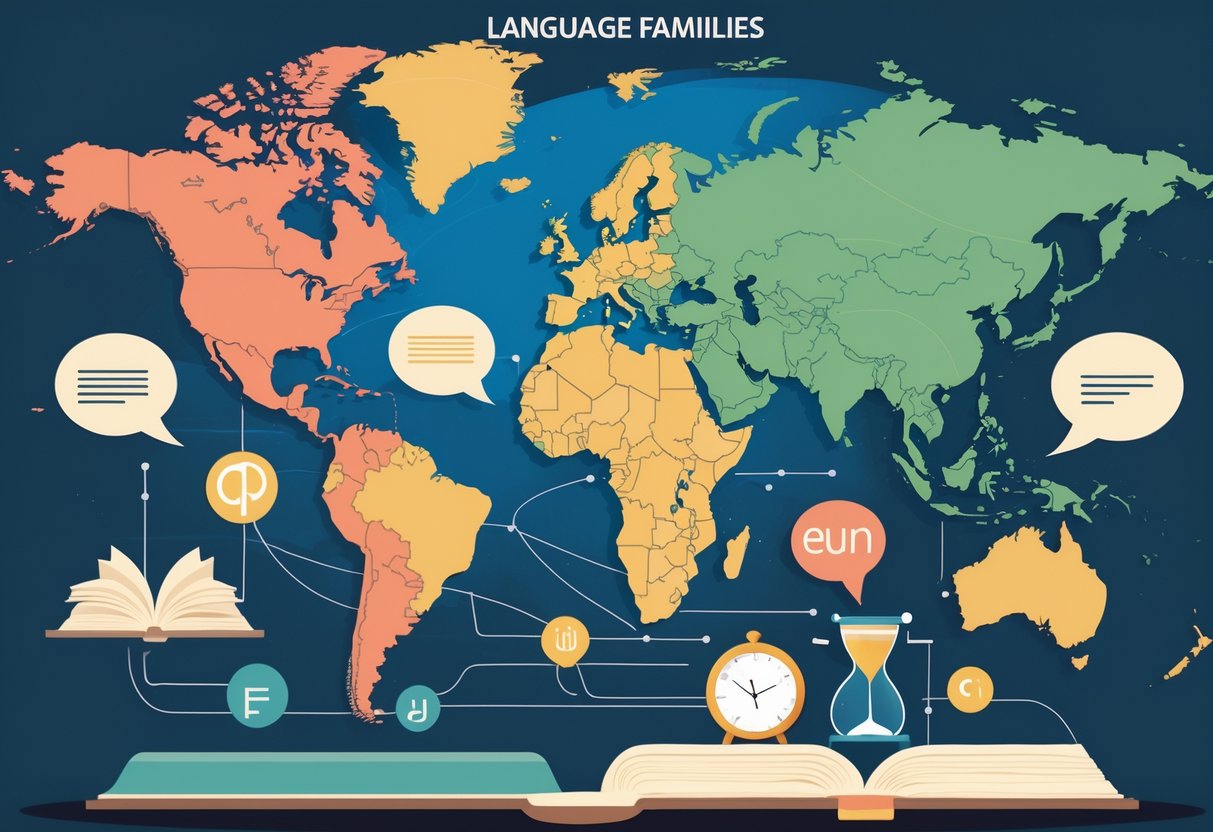
Spanish belongs to the Romance language family while English stems from Germanic roots, yet English speakers gain unexpected advantages from extensive Latin borrowing that creates thousands of recognizable vocabulary bridges between the two languages.
How English Gives You a Head Start
English contains roughly 10,000 words borrowed directly from Spanish and another 30,000 from Latin roots. This vocabulary overlap means adult learners already recognize words like "chocolate," "patio," "tornado," and "guitar" without study.
The real advantage extends beyond obvious cognates. Abstract terms share Latin ancestry: "education" becomes "educación," "important" transforms to "importante," and "information" shifts to "información." Adult learners who understand this pattern can instantly access thousands of words.
This recognition advantage works best when learners practice contextual recall rather than isolated word lists. When learners encounter "necesario" in a full sentence about daily routines, the brain links it to the English "necessary" through meaning and usage patterns. Spaced repetition systems that present these cognates in natural phrases strengthen neural pathways more effectively than flashcard drilling.
Spanish audio reinforcement proves essential because pronunciation differs significantly. While "hospital" exists in both languages, Spanish pronunciation follows consistent phonetic rules. Daily exposure through audio-backed phrase training helps learners internalize these sound patterns while leveraging their existing vocabulary knowledge.
Comparing Spanish, French, and German
Adult English speakers typically acquire Spanish faster than German or French due to verb conjugation patterns and pronunciation consistency. Spanish evolved from Latin alongside French, Portuguese, and Italian, creating systematic rules that learners can apply predictably.
German requires mastering three grammatical genders and four noun cases. Spanish uses two genders and simpler case structures. French spelling contains silent letters and nasal vowels that challenge English speakers more than Spanish phonetics.
| Language | Grammatical Genders | Pronunciation Difficulty | Cognate Overlap |
|---|---|---|---|
| Spanish | 2 | Low | High |
| French | 2 | High | High |
| German | 3 | Medium | Medium |
Spanish pronunciation follows consistent rules where letters produce predictable sounds. French contains silent endings and vowel combinations that don't match written forms. This consistency allows learners to apply disappearing-text training more effectively with Spanish, where progressive word removal reinforces both spelling and sound patterns simultaneously.
The Advantage of Knowing Other Romance Languages
Learners who already speak French, Italian, or Portuguese cut their Spanish acquisition time significantly. All Romance languages descended from Vulgar Latin, sharing core vocabulary and grammatical structures that transfer directly.
A French speaker recognizes that "parler" becomes "hablar" in Spanish, following predictable consonant shifts. Italian speakers already understand the subjunctive mood that challenges English speakers. Portuguese shares nearly 89% lexical similarity with Spanish.
The transfer works at the structural level. Romance languages place adjectives after nouns, use gendered articles, and conjugate verbs through person and number. Adult learners with one Romance language already possess the mental framework for these patterns.
This advantage accelerates most when learners focus on auditory reinforcement that highlights the differences rather than similarities. Five-minute daily sessions with Spanish audio phrases reveal where Spanish diverges from French pronunciation or where Italian sentence rhythm differs from Spanish patterns. The brain learns to categorize and separate the languages through repeated contextual exposure rather than explicit grammar comparison.
Science-Backed Study Methods for Accelerated Spanish Learning
The brain retains Spanish vocabulary 34% better through spaced repetition than cramming. Adults learning Spanish need methods that match how memory actually forms through contextual recall and auditory reinforcement.
Traditional Classes Versus Microlearning
Traditional Spanish courses meet two to three times per week for 60-90 minute sessions. This schedule creates gaps between exposure that weaken memory consolidation. The brain needs frequent, shorter contact with new material to move information from short-term to long-term storage.
Microlearning breaks study into 5-15 minute daily sessions. Research shows this approach produces stronger retention because it matches the brain's natural attention span and provides regular reinforcement. Daily practice improves fluency more effectively than weekly intensive sessions.
Spaced repetition algorithms time each review right before a learner would forget the material. This technique strengthens neural pathways more efficiently than linear curriculum progression. Daily exposure to Spanish phrases through email or app notifications creates multiple touchpoints that cement vocabulary without requiring dedicated study blocks.
Technology and Adaptive Learning Apps
Duolingo and similar apps use gamification to maintain engagement. These platforms track progress and adjust difficulty based on performance. However, app-only learning often lacks contextual depth needed for real conversations.
Effective language learning technology includes:
- Spanish audio for accurate pronunciation modeling
- Contextual phrases rather than isolated vocabulary
- Progressive difficulty that reveals full sentences gradually
- Daily reminders that create consistent exposure habits
Adaptive systems identify weak areas and increase practice frequency for struggling concepts. This personalized approach prevents learners from moving forward with gaps in foundational knowledge. Audio reinforcement activates different brain regions than reading alone, creating multiple memory anchors for each phrase.
Immersive and Active Practice Techniques
The brain learns Spanish faster through active recall than passive review. Testing yourself on phrases before looking at answers forces deeper processing that strengthens memory formation. Disappearing-text training gradually removes words from sentences, requiring learners to reconstruct meaning from context.
Immersion in a Spanish-speaking country accelerates learning to 9-12 months for fluency. Home immersion replicates this through constant Spanish exposure in daily routines. Listening to Spanish podcasts during commutes, changing phone settings to Spanish, and thinking in Spanish throughout the day create neural patterns similar to living abroad.
Contextual learning embeds vocabulary in real situations rather than abstract lists. The phrase "¿Dónde está el baño?" sticks better when learned while imagining needing a bathroom than memorizing "dónde" means "where." Spanish audio paired with text activates both auditory and visual processing, doubling memory pathway strength.
Estimating Your Study Time: Hours, Weeks, and Years
The Foreign Service Institute provides a framework of 575-750 hours to reach professional proficiency in Spanish, though individual timelines vary based on study intensity, method quality, and how effectively the brain encodes new patterns through spaced repetition and contextual exposure.
Foreign Service Institute Guidelines
The Foreign Service Institute classifies Spanish as a Category I language for English speakers, requiring approximately 24 weeks of intensive study. This translates to 575-600 classroom hours when learners study 25 hours per week in an immersion setting.
These numbers represent a baseline for professional working proficiency, not fluency. The estimate assumes consistent, structured learning with trained instructors and daily practice that engages multiple memory pathways.
For self-directed learners, the timeline typically extends because most people cannot sustain 25 hours of weekly study. A more realistic schedule of 5-10 hours per week pushes the timeline to 12-24 months for intermediate proficiency. Study time calculators help learners map out personalized schedules based on available hours and target deadlines.
Customizing Your Timeline
Individual timelines depend on three factors: prior language experience, study method efficiency, and consistency.
Learners with Romance language backgrounds often reach conversational ability 30-40% faster because cognates and grammatical structures already exist in memory. Adults without this advantage need methods that build stronger neural pathways through auditory reinforcement and contextual recall rather than isolated vocabulary drilling.
The brain retains information better when exposed to content daily in short bursts rather than marathon sessions. Phrase Café uses this with a short letter every weekday morning. Sara reads it to you, then the coach asks for each line and you say it out loud. You are pulling the words up, not just looking at them.
Planning study schedules around course difficulty helps learners allocate more time to challenging grammar concepts while maintaining momentum with easier conversational patterns.
Setting Realistic Expectations for Progress
Beginners typically achieve basic conversational ability within 3-6 months when studying 30 minutes daily. This level includes ordering food, asking directions, and handling simple exchanges.
Intermediate proficiency - holding longer conversations and understanding Spanish speakers at normal speed - requires 12-18 months of consistent practice. The gap between basic and intermediate narrows significantly when learners use spaced repetition systems that present phrases at optimal intervals before forgetting occurs.
Advanced fluency takes 2-3 years for most English speakers. This includes understanding regional accents, idioms, and cultural nuances that don't translate directly. Daily exposure to Spanish audio accelerates this stage because the brain needs repeated examples to internalize pronunciation patterns and rhythm that textbooks cannot convey effectively.
How to Sustain Motivation and Make Progress Stick

Motivation fades when learners rely on willpower alone, but building daily routines and tracking visible progress turns study time into automatic behavior. Adults who master Spanish focus on small, repeatable actions and concrete milestones that prove their efforts are working.
Building Effective Habits
Consistency matters more than intensity when learning Spanish. Adults who study for five minutes every day retain more than those who cram for an hour once a week because spaced repetition strengthens memory formation over time.
The brain needs regular exposure to new material to move words from short-term to long-term memory. When learners receive daily Spanish phrases through email, they create a low-friction habit that doesn't require app logins or scheduling decisions. This removes the friction that kills motivation.
Progressive learning works best when it challenges memory without overwhelming it. Phrase Café's coach gives you a line in English and waits for you to say it in Spanish, so you recall it instead of just recognizing it. This active retrieval makes neural pathways stronger than passive review.
Spanish audio reinforcement adds another layer to habit formation. Hearing correct pronunciation while reading creates multiple memory anchors. Adults process spoken Spanish differently than written text, so combining both formats in a five-minute daily routine builds better quality motivation than vocabulary lists alone.
Tracking Growth and Celebrating Milestones
Learners need proof that their study time produces real results. Setting specific goals like learning 10 new words each week creates measurable progress markers that maintain momentum.
Tracking phrases learned, days studied consecutively, or conversations held in Spanish makes abstract progress concrete. Adults lose motivation when they can't see improvement, so keeping a simple log or using a tracking system shows how daily five-minute sessions accumulate into hundreds of mastered phrases.
Small wins matter because they trigger dopamine release that reinforces the learning habit. Celebrating the first time understanding a Spanish song lyric or successfully ordering at a restaurant validates the effort invested. These moments prove that contextual recall works better than memorizing isolated words.
Regular assessment helps learners stay on track and adjust their approach. Testing comprehension every few weeks reveals which phrases stuck and which need more repetition. This feedback loop keeps learning Spanish aligned with real-world communication goals rather than abstract fluency targets.