How Many Hours to Learn Spanish: Fast-Track Mastery with Science
Understand the exact number of hours needed to master Spanish at different proficiency levels. Discover how study quality matters more than quantity and methods that maximize your learning efficiency.
Posted by
 Stewart Kaplan
Related reading
Basic Spanish Words Every Beginner Should Learn (Organized by Category)
Master 200+ essential Spanish words organized by category: greetings, food, travel, and emergency phrases. Includes example sentences for each word. Perfect for beginners building vocabulary.
Best Apps to Learn Spanish (2026 Review): Ranked by Speed & Retention
Compare the best Spanish learning apps in 2026. Ranked by speed to fluency, retention rates, and value. Includes Duolingo, Babbel, Rosetta Stone, Pimsleur, and more.
Can You Learn Spanish in 3 Months? Reality Check + 90-Day Sprint Plan
Honest assessment of what's achievable in 3 months of Spanish learning. Includes realistic expectations, fluency levels, and a complete 90-day sprint plan.
How Many Hours to Learn Spanish: What Science and Experts Say
The U.S. Foreign Service Institute tracked thousands of adult learners and found Spanish requires approximately 600-750 classroom hours to reach professional working proficiency. When independent study hours are included, the total climbs to 1,200-1,500 hours for English speakers to handle complex conversations and work situations in Spanish. For a timeline breakdown, see average time to learn Spanish.
Typical Study Time for English Speakers
English speakers benefit from Spanish being a Category I language, meaning it shares vocabulary roots, alphabet, and grammatical structures with English. The FSI data shows 480 hours of classroom instruction creates a foundation, but this number assumes equal time spent on homework and practice.
Adults learning Spanish engage different memory systems than children. The brain stores new Spanish phrases through contextual recall rather than isolated vocabulary drilling. When learners encounter "quiero café" while imagining a morning routine instead of memorizing "quiero" on a flashcard, the hippocampus creates stronger neural pathways.
Spaced repetition makes this process efficient. Reviewing a phrase after one day, then three days, then one week embeds it into long-term memory. Phrase Café's daily email format leverages this principle by delivering five-minute lessons at consistent intervals, allowing the brain to consolidate information between sessions rather than cramming.
The method matters more than raw hours. Adults who practice sentence construction with Spanish audio reach conversational fluency in 6-12 months studying one hour daily, while app-only learners often need twice that time.
Benchmarks for Conversational Fluency
Conversational fluency sits at approximately 150-250 hours of quality study time. At this stage, learners handle everyday topics, understand slow speech, and construct basic sentences across present, past, and future tenses.
The brain needs auditory reinforcement to recognize Spanish at natural speeds. Listening to Spanish speakers activates the temporal lobe differently than reading text. When adults hear "¿Cómo estás?" repeatedly in context, their auditory cortex begins predicting sound patterns and word boundaries automatically.
Most learners reach these benchmarks:
- Basic survival phrases: 40-60 hours
- Simple conversations: 150-250 hours
- Work proficiency: 600-1,000 hours
- Advanced fluency: 2,000+ hours
Disappearing-text training accelerates this timeline. When learners see a full Spanish sentence, then the same sentence with key words removed, their brain actively reconstructs meaning rather than passively reading. This retrieval practice creates stronger memory traces than recognition-only exercises.
Phrase Café's coach asks you for each line of the day's letter, so you recall it instead of just recognizing it. This approach mirrors how memory consolidation actually works during sleep cycles.
Advanced Proficiency and Diminishing Returns
Beyond 1,000 hours, learners face diminishing returns. The jump from intermediate to advanced takes longer than beginner to intermediate because it requires cultural nuance, regional dialects, and 10,000+ word vocabulary instead of the 3,000 words that cover 95% of daily conversation.
Fluent fluency demands 2,000-3,000 hours spread over years. At this point, learners aren't acquiring new grammar systems but rather refining accent, absorbing idioms, and building specialized vocabulary.
The brain's procedural memory takes over around the 800-hour mark. Spanish production becomes more automatic, requiring less conscious effort to construct sentences. However, this automation only develops through consistent output practice, not passive consumption.
Contextual recall remains critical at advanced levels. Adults who read Spanish novels, watch regional television, and engage in specialized conversations build semantic networks that isolated study cannot replicate. The brain links new vocabulary to existing knowledge structures through meaningful use.
Daily exposure matters more than marathon sessions. Fifteen minutes of Spanish each morning through structured phrases with Spanish audio maintains neural pathways better than weekend cramming sessions, which overload working memory without allowing consolidation time.
Decoding CEFR: The Framework for Measuring Spanish Progress
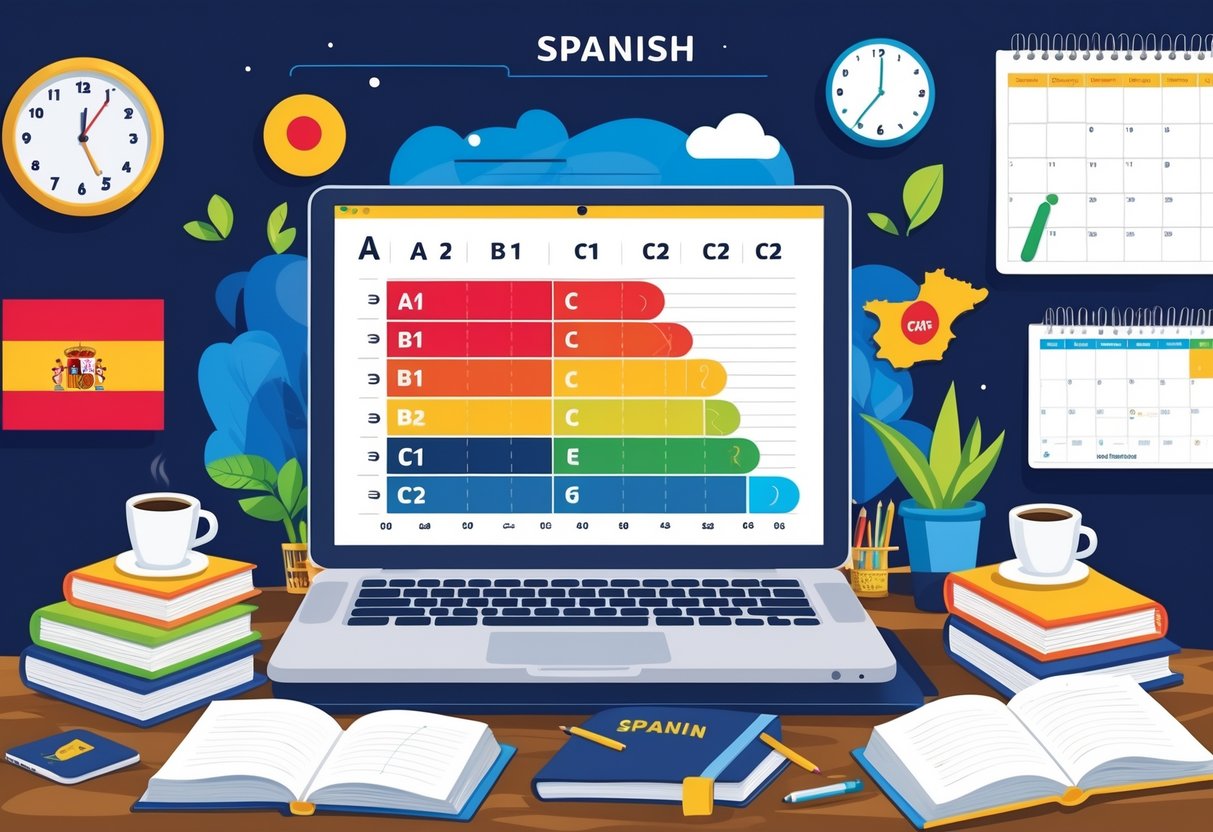
The Common European Framework of Reference for Languages provides learners with clear benchmarks to track Spanish acquisition from complete beginner to mastery. Each level requires specific hour investments and builds on distinct cognitive milestones that shape how adults internalize new language patterns.
What Is CEFR and Why It Matters
The CEFR establishes six proficiency levels that measure what learners can actually do with Spanish rather than testing isolated grammar rules. Understanding the Common European Framework of Reference helps students set realistic goals and track development effectively.
This framework works because it aligns with how the brain processes language through functional communication tasks. Instead of memorizing vocabulary lists, learners progress by completing real-world actions like introducing themselves, describing past events, or expressing opinions.
The system divides into three broad categories: A (Basic User), B (Independent User), and C (Proficient User). Each contains two sublevels that reflect increasingly complex language control. Research shows that spaced repetition of contextual phrases builds stronger neural pathways than isolated word drilling, which is why daily exposure to complete sentences accelerates movement through CEFR levels.
A1 Level: Basic User Timeframe
Reaching the A1 level requires 100-150 hours of focused study. At this stage, learners handle simple introductions and express basic personal information using present tense verbs.
The brain at A1 prioritizes high-frequency chunks over grammatical analysis. Adults acquire starter phrases faster when they encounter them repeatedly in varied contexts with Spanish audio reinforcement. Phrase Café's approach of delivering daily Spanish sentences via email leverages this principle by exposing learners to complete, usable expressions every 24 hours.
Progressive text removal within these daily exercises strengthens active recall. When learners see a phrase with one word missing, then two words missing, their retrieval effort deepens memory formation far more effectively than passive reading.
A2 Level: Elementary User Milestones
The A2 milestone takes an additional 180-200 hours beyond A1. Learners at this level describe routines, make simple plans, and handle basic workplace communication in manual labor settings.
This stage demands increased contextual vocabulary across multiple life domains. The brain consolidates A2 material through consistent exposure to themed content rather than random word lists. Daily five-minute email routines create ideal spacing intervals that prevent forgetting while avoiding cognitive overload.
Auditory reinforcement becomes critical at A2 as learners begin distinguishing pronunciation nuances that affect meaning. Hearing Spanish speakers deliver the same phrases they've practiced visually creates dual encoding pathways that boost long-term retention by up to 40% compared to text-only study methods.
Intermediate and Advanced CEFR Levels: B1 to C2 Explained
The journey from intermediate to advanced Spanish requires 380 to 1,200 hours of focused study, with each level demanding different cognitive skills and learning strategies. Learners at these stages benefit most from contextual practice that mirrors real-world language use rather than isolated vocabulary drills.
B1 Level: Conversational Competence
Reaching B1 requires approximately 380-420 hours of learning, marking the point where learners can handle most travel situations and discuss familiar topics. At this stage, the brain shifts from processing individual words to recognizing phrase patterns and common expressions.
Spaced repetition becomes critical for B1 learners because the vocabulary load increases significantly. The cognitive science shows that adults retain phrases better than isolated words when they encounter them in varied contexts over time. Daily exposure to Spanish audio helps learners internalize natural speech rhythms and proper intonation patterns that textbooks cannot convey.
Progressive learning techniques work particularly well at B1. When learners see a complete Spanish phrase, then practice it with one word removed, then two words removed, their brains actively reconstruct the pattern rather than passively reading. This active recall strengthens neural pathways more effectively than rereading the same material.
Key B1 capabilities include:
- Understanding main points in clear conversations
- Handling practical situations while traveling
- Describing experiences and giving brief reasons for opinions
- Writing simple connected texts on familiar subjects
B2 Level: Working Toward Fluency
The B2 level takes about 500-600 hours of study and represents a major milestone where learners can interact with Spanish speakers without significant strain. This level requires understanding implicit meaning and subtle language nuances that go beyond literal translation.
Contextual recall becomes the dominant learning mechanism at B2. Adults process complex grammar more effectively when they encounter structures embedded in meaningful scenarios rather than as abstract rules. The brain's language centers activate more strongly when new phrases appear alongside familiar context clues.
Auditory reinforcement through Spanish speakers helps B2 learners distinguish between formal and informal registers. Daily listening practice trains the ear to catch idiomatic expressions and cultural references that mark the difference between textbook Spanish and natural conversation. Short, consistent sessions of 5-10 minutes prove more effective than hour-long cramming because they prevent cognitive overload.
B2 learners benefit from seeing how individual components fit into larger communication patterns. When practice materials progressively remove scaffolding while maintaining context, learners develop the flexibility to construct original sentences rather than memorizing fixed expressions.
C1 and C2: Advanced and Mastery Time Requirements
Advanced C1 requires 700-800 hours while C2 mastery demands 1,000-1,200 hours of dedicated practice. These levels represent the ability to use Spanish flexibly across professional, academic, and social contexts with near-fluent precision.
Memory formation at advanced levels depends heavily on meaningful repetition across multiple contexts. The brain consolidates long-term language memory most effectively when learners encounter sophisticated vocabulary and structures regularly in natural settings. Research shows that adults acquire advanced expressions through repeated exposure in varied situations rather than memorization exercises.
C1 and C2 distinctions:
| Level | Hours Required | Primary Abilities |
|---|---|---|
| C1 | 700-800 | Express ideas fluently without searching for words, understand implicit meaning, use language flexibly for complex purposes |
| C2 | 1,000-1,200 | Understand virtually everything heard or read, summarize information from multiple sources, express subtle shades of meaning |
Daily exposure to authentic Spanish content becomes non-negotiable at these levels. Advanced learners need regular contact with complex texts, nuanced conversations, and culturally embedded expressions that only real Spanish materials provide. Five-minute daily sessions using progressive difficulty techniques maintain and expand advanced vocabulary more effectively than sporadic intensive study.
The CEFR levels at C1 and C2 measure not just knowledge but the automatic retrieval and appropriate use of sophisticated language in real-time communication. This automaticity develops through consistent practice that challenges learners to produce language under realistic conditions rather than controlled exercises.
Key Factors That Impact How Long Learning Spanish Takes

The time needed to reach proficiency varies widely based on what level you're aiming for, how closely your first language aligns with Spanish grammar and vocabulary, and whether you practice daily or sporadically.
Individual Language Goals
The hours required change dramatically depending on your target level. Someone aiming for basic travel phrases needs far less time than someone pursuing professional fluency.
The Foreign Service Institute estimates that English speakers need 600-750 classroom hours to reach General Professional Proficiency in Spanish. This equals roughly B2 or C1 level, where learners can discuss complex topics with confidence.
A conversational level requires significantly fewer hours. Learners focused on everyday communication typically need 200-300 hours of quality study. This covers ordering food, asking directions, and handling basic social situations.
Language goals determine study approach:
- Travel Spanish: 50-100 hours for survival phrases
- Conversational fluency: 200-300 hours for daily interactions
- Professional proficiency: 600-750 hours for workplace communication
- Fluent mastery: 1,500+ hours for academic or literary work
Adult learners benefit most from contextual recall rather than isolated vocabulary drills. When Spanish phrases arrive daily through spaced repetition systems, the brain stores them in accessible neural pathways. Progressive removal of words from familiar phrases forces active retrieval, which strengthens long-term memory far more effectively than passive review.
First Language and Linguistic Similarity
English speakers gain a major advantage when learning Spanish as a romance language. Despite English being classified as Germanic, over 60% of English vocabulary derives from Latin and French sources.
This overlap means thousands of Spanish words look familiar immediately. Words like "hospital," "important," and "familia" require minimal memorization. Both languages share the Latin alphabet and follow subject-verb-object sentence structure.
Romance languages like Spanish, French, Italian, Portuguese, and Romanian all stem from Latin. English speakers already recognize many grammatical patterns without realizing it. Verb conjugations and gendered nouns present challenges, but the core vocabulary foundation already exists.
Speakers of other Romance languages learn Spanish even faster. A Portuguese or Italian speaker might reach conversational fluency in 100-150 hours because grammar structures mirror their first language.
Spanish audio reinforcement accelerates accent acquisition for English speakers. Hearing authentic pronunciation daily trains the ear to distinguish sounds that don't exist in English, like the rolled "r" or soft "j." This auditory input creates mental models that passive reading cannot build.
Consistency and Study Habits
Daily practice of 15-30 minutes produces better results than weekly three-hour sessions. The brain consolidates new information during sleep, so spreading study time across multiple days allows for better memory formation.
Active learning methods deliver superior retention compared to passive exposure. Learners who speak, write, and construct sentences retain vocabulary at much higher rates than those who only listen or read.
Effective study habits include:
- Daily exposure to Spanish content
- Speaking practice with conversation partners
- Writing exercises that apply new grammar
- Spaced repetition of previously learned material
Study time quality matters more than quantity. Thirty minutes of focused conversation practice outperforms two hours of unfocused app scrolling. Disappearing-text training forces the brain to recall phrases from memory rather than simply recognizing them on screen.
Research on language learning shows that retrieval practice creates stronger neural pathways than repeated exposure. When learners receive daily Spanish phrases with progressive word removal, they activate the prefrontal cortex regions responsible for long-term storage. Five-minute daily emails that require active recall build automaticity faster than hour-long weekend cramming sessions.
Immersion accelerates all aspects of acquisition. Watching Spanish shows, listening to podcasts, and reading news articles between structured lessons keeps the language active in working memory.
The Power of Microlearning and Modern Approaches
Breaking language learning into short, focused sessions creates stronger memory pathways than traditional multi-hour study blocks. Daily exposure through structured micro-sessions builds consistent progress while fitting into busy schedules.
Why Traditional Methods Fall Short
Traditional classroom approaches often require 45 to 90-minute sessions that exceed the brain's optimal attention span for language acquisition. Most adults can only maintain deep focus on new vocabulary and grammar patterns for 15 to 20 minutes before retention drops sharply.
Lengthy study sessions also create scheduling barriers. A learner who commits to hour-long blocks three times per week accumulates just 156 hours annually. This timeline pushes conversational fluency goals beyond two years for most students.
Vocabulary lists and isolated grammar drills fail to activate contextual memory networks. The brain stores language most effectively when words appear in meaningful phrases tied to real situations. Students who memorize word lists without context forget 70 to 80 percent within weeks.
How Microlearning Dramatically Accelerates Progress
Microlearning approaches that break lessons into 5 to 10-minute sessions deliver superior retention through spaced repetition. Daily exposure to new phrases creates multiple memory touchpoints rather than cramming information into infrequent blocks.
Ten minutes of daily practice accumulates over 60 hours annually with better retention rates than sporadic longer sessions. This consistency allows learners to reach basic conversational skills within 200 hours across just three to four years of sustainable practice.
Progressive phrase training strengthens recall through disappearing-text techniques. Learners see complete Spanish phrases with English translations, then practice as words gradually disappear. This method forces active retrieval rather than passive recognition.
Spanish audio reinforcement during micro-sessions builds pronunciation accuracy and listening comprehension simultaneously. Hearing authentic speech patterns daily trains the ear to recognize natural rhythm and intonation that textbooks cannot convey.
Research-Backed Study Techniques
Spaced repetition systems distribute review sessions across expanding time intervals. A phrase learned today reappears tomorrow, then three days later, then a week later. This timing matches the brain's natural forgetting curve and converts short-term exposure into long-term memory.
Contextual phrase learning embeds vocabulary within complete sentences tied to specific situations. Instead of memorizing "hambre" as an isolated word, learners encounter "Tengo mucha hambre" in a restaurant context. The situational anchor makes retrieval automatic when similar circumstances arise.
Daily email delivery creates accountability and routine without app fatigue. A five-minute email lesson arrives at the same time each morning, building a sustainable habit that requires no willpower to maintain. This consistency matters more for study time accumulation than sporadic motivation-driven sessions.
Auditory reinforcement through Spanish recordings activates both visual and auditory memory channels. Learners who read and hear phrases simultaneously show 40 percent better recall than those using text alone.
Essential Resources That Speed Up Spanish Learning

The right tools can cut your learning time significantly by targeting how your brain builds language patterns through repetition, context, and consistent exposure. Digital platforms, authentic media, and direct instruction each play distinct roles in strengthening memory and fluency.
Apps and Online Platforms
Duolingo offers gamified lessons that work well for building initial vocabulary through spaced repetition. The app presents words and phrases multiple times across different contexts, which helps move information from short-term to long-term memory.
Babbel focuses on conversational phrases rather than isolated words, which aligns with how adults learn language most effectively. Its lessons build on previous material in structured intervals.
Rosetta Stone uses immersive image-word association without English translation. This method forces learners to think directly in Spanish, though it requires more time investment upfront.
Daily email programs like Phrase Café turn a daily routine into a letter from Sara every weekday morning. She reads it to you, and a coach walks you through it while you say each line out loud. It takes 5 to 10 minutes a day.
Immersive Spanish Media
Spanish podcasts provide auditory reinforcement that strengthens listening comprehension and pronunciation patterns. Programs designed for learners typically use slower speech and repeat key vocabulary.
Spanish books at appropriate reading levels expose learners to grammar structures in natural contexts. Graded readers let students progress from simple stories to complex texts without overwhelming frustration.
Watching Spanish television shows and films with Spanish subtitles trains the brain to connect spoken and written language simultaneously. This dual input accelerates pattern recognition and helps learners understand everyday speech rhythms.
Structured Courses and Tutoring
Formal Spanish courses provide systematic grammar instruction and structured progression through language levels. They establish the framework that self-study alone often misses.
Private tutoring through platforms like iTalki delivers personalized feedback and conversational practice. One-on-one sessions force active speaking, which builds fluency faster than passive learning methods.
Group classes add social accountability and create opportunities for peer learning. The combination of structured curriculum and regular speaking practice addresses multiple aspects of language acquisition that isolated study cannot replicate.