What Does Infinitive Form Mean in Spanish: Science-Based Mastery
Spotting infinitives helps you pick up vocab faster since dictionaries list verbs in this form, and you can spot verb families by their endings
Posted by
 Stewart Kaplan
Related reading
What Does Adonde Mean in Spanish? How Movement 'Clicks' for Learners
You have to know when prepositions combine with donde to show direction or position
What Does Ahi Mean in Spanish? Cognitive Mastery That Sticks
Learners mix up ahí, hay, and ay because they sound the same but mean totally different things.
What Does Aki Mean in Spanish: Unpacking Real Usage for Learners
Regional differences exist, but nearly everyone in Spanish-speaking communities gets what "aki" means in a text
TL;DR
- The infinitive in Spanish is just the base form of a verb before you conjugate it. Look for -ar, -er, or -ir endings (hablar, comer, vivir)
- Spanish infinitives can act as verbs ("I want to eat" = Quiero comer) or nouns ("Eating is good" = Comer es bueno). English uses gerunds (-ing) for the noun job.
- Infinitives show up after conjugated verbs (debo estudiar, puedo ir), after prepositions (antes de salir, para aprender), in impersonal expressions (es importante hablar), and on signs (No fumar)
- The three infinitive types split verbs by conjugation: -ar (most common), -er, and -ir
- Spotting infinitives helps you pick up vocab faster since dictionaries list verbs in this form, and you can spot verb families by their endings
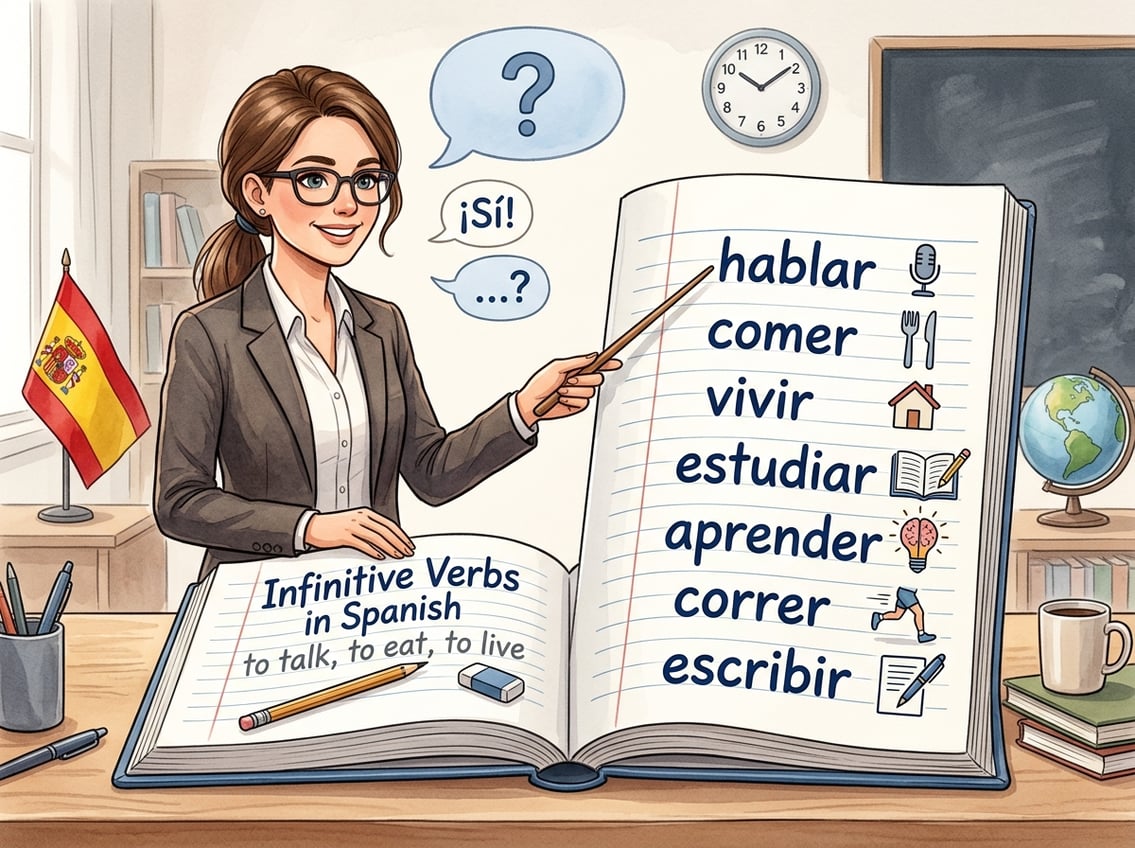
Core Definition and Function of Spanish Infinitives
Spanish infinitives are just verbs ending in -ar, -er, or -ir. They're the starting point for all verb forms and can also work as nouns.
The Role in Spanish Grammar
Spanish infinitives do a lot of heavy lifting. Here’s what they’re mainly used for:
Primary Functions
- Dictionary form: The entry form for Spanish verbs
- Verb stem source: The base for all conjugations
- Noun use: Subject or object in a sentence, no conjugation needed
- Command/signs: Used for instructions and formal notices
Infinitive Endings
| Ending | Example | English | Stem |
|---|---|---|---|
| -ar | hablar | to speak | habl- |
| -er | comer | to eat | com- |
| -ir | vivir | to live | viv- |
Fact: The -ar group is the biggest and has fewer irregulars than -er or -ir.
Infinitive vs. Conjugated Forms
| Feature | Infinitive | Conjugated Form |
|---|---|---|
| Person | Not marked | yo, tú, él, etc. |
| Time | Not marked | present, past, future |
| Form | Single word | Changes for subject |
| Ending | -ar, -er, -ir | varies |
Example Comparison
- Infinitive: hablar (to speak)
- Conjugated: hablo (I speak), hablas (you speak), habló (he/she spoke)
Rule → Example:
Rule: Infinitives don't change for person or tense.
Example: hablar = "to speak" no matter who or when.
Comparison with English Infinitives
| Language | Form | Example |
|---|---|---|
| English | two words (to + verb) | to read, to write |
| Spanish | one word | leer, escribir |
As nouns: Spanish uses infinitives, English uses gerunds (-ing)
After prepositions: Spanish needs the infinitive; English uses gerund
- Antes de comer (Before eating)
- Sin hablar (Without speaking)
Infinitive Endings: -ar, -er, and -ir
Spanish infinitives always end in -ar, -er, or -ir. Each group has its quirks and a bunch of super common verbs you’ll see all the time.
-ar Verbs: Patterns and Examples
Common -ar Infinitives
| Infinitive | English Translation | Frequency Level |
|---|---|---|
| hablar | to speak | High |
| llamar | to call | High |
| comprar | to buy | High |
| llevar | to carry/wear | High |
| buscar | to look for | High |
| escuchar | to listen | High |
| mirar | to watch/look at | High |
| visitar | to visit | Medium |
Recognition Pattern
Rule → Example:
Rule: Drop the -ar ending for the stem.
Example: hablar → habl-
Fact Table
| Group | % of Verbs | Priority for Learners |
|---|---|---|
| -ar | ~80% | Highest |
-er Verbs: Usage and Key Verbs
Common -er Infinitives
| Infinitive | English Translation | Usage Context |
|---|---|---|
| comer | to eat | Daily routine |
| leer | to read | Daily activity |
| correr | to run | Physical activity |
| beber | to drink | Daily routine |
| vender | to sell | Commerce |
| meter | to put in | Physical action |
| comprender | to understand | Communication |
| creer | to believe | Opinion |
| romper | to break | Physical action |
Stem Formation
- comer → com-
- leer → le-
- beber → beb-
Contrast Table
| Tense/Form | -er and -ir Same? | Exception |
|---|---|---|
| Most tenses | Yes | Present nosotros/vosotros |
-ir Verbs: Features and Variations
Common -ir Infinitives
| Infinitive | English Translation | Pattern Type |
|---|---|---|
| vivir | to live | Regular |
| escribir | to write | Regular |
| permitir | to allow | Regular |
| recibir | to receive | Regular |
| abrir | to open | Irregular participle |
| cubrir | to cover | Irregular participle |
| pedir | to ask for | Stem-changing (e→i) |
| servir | to serve | Stem-changing (e→i) |
Stem Formation (Regular)
- vivir → viv-
- escribir → escrib-
- permitir → permit-
Irregular Patterns Table
| Verb | Regular Conjugation? | Irregular Past Participle |
|---|---|---|
| abrir | Yes | abierto |
| cubrir | Yes | cubierto |
Rule → Example:
Rule: Some -ir verbs change their stem vowel when conjugated.
Example: pedir → pido (e→i change in some forms)
Recognizing and Building Infinitive Vocabulary
Spanish infinitives fit three endings. Recognizing these helps you link verbs to related words and spot patterns.
Common Regular Infinitives
-AR Verbs
| Infinitive | English | Stem |
|---|---|---|
| hablar | to speak | habl- |
| comprar | to buy | compr- |
| cantar | to sing | cant- |
| escuchar | to listen | escuch- |
| trabajar | to work | trabaj- |
-ER Verbs
| Infinitive | English | Stem |
|---|---|---|
| comer | to eat | com- |
| beber | to drink | beb- |
| leer | to read | le- |
| correr | to run | corr- |
| vender | to sell | vend- |
-IR Verbs
| Infinitive | English | Stem |
|---|---|---|
| vivir | to live | viv- |
| escribir | to write | escrib- |
| abrir | to open | abr- |
| recibir | to receive | recib- |
| permitir | to allow | permit- |
Rule → Example:
Rule: Remove the ending to get the verb stem.
Example: escuchar → escuch-
Irregular and Reflexive Infinitives
Common Irregular Infinitives
- ser (to be)
- ir (to go)
- hacer (to do/make)
- tener (to have)
- poder (to be able)
- querer (to want)
- deber (to have to/should)
Modal Verbs with Infinitives
- querer + infinitive: want to do something
- deber + infinitive: should/must do something
- poder + infinitive: can/be able to do something
- preferir + infinitive: prefer to do something
Reflexive Infinitives (end in -se)
- levantarse (to get up)
- llamarse (to be called)
- ducharse (to shower)
- vestirse (to get dressed)
Expression Patterns
- me gusta + infinitive: I like to [verb]
- me encanta + infinitive: I love to [verb]
Relation to Nouns and Adjectives
Many Spanish nouns and adjectives come from infinitive verbs, so you get word clusters that make learning easier.
Verb-to-Noun Patterns
| Infinitive | Related Noun | English |
|---|---|---|
| viajar | el viaje | trip/journey |
| viajar | el viajero | traveler |
| trabajar | el trabajo | work/job |
| entrar | la entrada | entrance |
| salir | la salida | exit |
| llegar | la llegada | arrival |
| cantar | el canto | song |
| bailar | el baile | dance |
Verb-to-Adjective Patterns
| Infinitive | Related Adjective | English |
|---|---|---|
| cansar | cansado | tired |
| interesar | interesante | interesting |
| aburrir | aburrido | boring/bored |
| emocionar | emocionado | excited |
Rule → Example
Learning one infinitive lets you pick up several related words:
Rule: One infinitive = multiple related words
Example: trabajar → el trabajo, trabajador, trabajando
How and When to Use Infinitives in Sentences
Spanish infinitives show up in three main ways: after conjugated verbs, with modal/auxiliary verbs, and after prepositions in set phrases.
After Conjugated Verbs
Infinitives follow conjugated verbs either directly or with que.
Direct infinitive (no connector)
| Spanish | English |
|---|---|
| Quiero comer. | I want to eat. |
| Prefiere estudiar. | He prefers to study. |
| Necesitan descansar. | They need to rest. |
| Sabe bailar. | She knows how to dance. |
Common verbs that take a direct infinitive:
- querer (to want)
- poder (can, to be able to)
- deber (must, should)
- necesitar (to need)
- preferir (to prefer)
- saber (to know how)
Infinitive with que
| Spanish | English |
|---|---|
| Tiene que trabajar. | He has to work. |
| Hay que estudiar. | One must study. |
Rule → Example
Rule: tener que + infinitive = “to have to” (obligation)
Example: Tengo que salir (I have to leave)
With Modal and Auxiliary Verbs
Modal verbs (like poder, deber, tener que, hay que) always use an infinitive right after.
| Modal Verb | Meaning | Example | Translation |
|---|---|---|---|
| poder | can, to be able to | Puedo nadar. | I can swim. |
| deber | must, should | Debe llamar. | He must call. |
| tener que | to have to | Tengo que salir. | I have to leave. |
| hay que | one must | Hay que esperar. | One must wait. |
Rule → Example
Rule: Modal verb + infinitive = ability, necessity, or obligation
Example: Debo estudiar (I must study)
After Prepositions and in Periphrasis
Verbal periphrasis uses a conjugated verb + preposition + infinitive for specific meanings.
Common periphrastic constructions
| Construction | Meaning | Example | Translation |
|---|---|---|---|
| acabar de + infinitive | to have just | Acabo de llegar. | I just arrived. |
| empezar a + infinitive | to begin to | Empiezo a entender. | I'm beginning to understand. |
| aprender a + infinitive | to learn to | Aprende a leer. | She's learning to read. |
| dejar de + infinitive | to stop, cease | Dejó de fumar. | He stopped smoking. |
| volver a + infinitive | to do again | Vuelve a intentar. | Try again. |
Infinitives after prepositions
| Spanish | English |
|---|---|
| antes de comer | before eating |
| después de trabajar | after working |
| para estudiar | in order to study |
| sin hablar | without speaking |
Rule → Example
Rule: Spanish prepositions always use the infinitive, not a conjugated verb.
Example: para comer (in order to eat)
Practical Sentence Structures with Infinitives
Spanish infinitives pop up as subjects, objects, and commands in daily conversation.
Infinitives as Subjects and Nouns
Spanish infinitives act like nouns when they’re the subject. English uses -ing forms, but Spanish sticks to the infinitive.
Subject patterns:
- Nadar es divertido. (Swimming is fun.)
- Leer libros mejora el vocabulario. (Reading books improves vocabulary.)
- Cocinar requiere paciencia. (Cooking requires patience.)
- Viajar cuesta dinero. (Traveling costs money.)
With articles:
- El fumar está prohibido. (Smoking is prohibited.)
- El estudiar es importante. (Studying is important.)
Opinion expressions:
| Spanish Structure | English Translation | Usage |
|---|---|---|
| Me gusta cantar | I like to sing | Personal preference |
| Me encanta bailar | I love to dance | Strong preference |
| Me molesta esperar | Waiting bothers me | Annoyance |
| Es difícil aprender | It's difficult to learn | General statement |
| Es necesario practicar | It's necessary to practice | Obligation |
Objects and Opinion Statements
Infinitives often follow conjugated verbs as direct objects, no preposition needed.
Verb + infinitive patterns:
| Conjugated Verb | Infinitive | Complete Sentence | Translation |
|---|---|---|---|
| Quiero | comer | Quiero comer pizza | I want to eat pizza |
| Necesito | estudiar | Necesito estudiar más | I need to study more |
| Puedo | hablar | Puedo hablar español | I can speak Spanish |
| Debo | trabajar | Debo trabajar mañana | I must work tomorrow |
Common verbs taking infinitives:
- poder (can)
- querer (want)
- deber (must)
- necesitar (need)
- desear (wish)
- saber (know how)
- preferir (prefer)
Me gusta / me encanta patterns:
- Me gusta leer novelas. (I like to read novels.)
- Me encanta viajar en verano. (I love to travel in summer.)
- Nos gusta caminar por el parque. (We like to walk through the park.)
- Les encanta jugar fútbol. (They love to play soccer.)
Commands and Instructions
Infinitives replace formal commands in signs and recipes.
Public signs and warnings:
- No fumar (No smoking)
- Empujar (Push)
- Tirar (Pull)
- No tocar (Do not touch)
- Mantener cerrado (Keep closed)
Recipe instructions:
- Hervir el agua (Boil the water)
- Agregar la sal (Add the salt)
- Mezclar los ingredientes (Mix the ingredients)
- Cocinar por 20 minutos (Cook for 20 minutes)
Instructional contexts:
| Context | Example | Translation |
|---|---|---|
| Recipe | Batir los huevos | Beat the eggs |
| Manual | Conectar el cable | Connect the cable |
| Sign | Mantener limpio | Keep clean |
| Warning | No pisar el césped | Don't step on the grass |
Rule → Example
Rule: Infinitives in commands = general audience, not a specific person
Example: No correr (No running)
Mastering Infinitives: Strategies and Common Pitfalls
Focused practice and awareness of common mistakes help you nail Spanish infinitives. The tough spots? Daily use, knowing when to use infinitives or gerunds, and dodging conjugation errors.
Microlearning and Practice Techniques
| Time | Activity | Focus |
|---|---|---|
| 5 min | High-frequency infinitive phrases with audio | Listening/pronunciation |
| 5 min | Word removal drills | Active recall |
| 5 min | Sentence construction | Context use |
Memory Formation Loop
- Listen to a Spanish speaker say the infinitive in a sentence
- Recreate the sentence with one word missing
- Repeat, removing more words each time
- Day 1: Learn 10 new infinitive verbs
- Day 2: Review previous 10, add 10 more
- Day 4: Review all 20
- Day 7: Review all 20
- Day 14: Review all 20
Rule → Example
Rule: Hearing infinitives in phrases boosts retention
Example: Voy a comer (I’m going to eat) sticks better than just comer
Distinguishing Infinitives from Gerunds
When to Use Each Form
| Situation | Infinitive | Gerund (-ando/-iendo) |
|---|---|---|
| After prepositions (except "en") | antes de comer (before eating) | - |
| After "en" | - | en llegando (upon arriving) |
| As subject | Correr es saludable (Running is healthy) | - |
| After estar | - | está corriendo (is running) |
| After modal verbs | puedo hablar (I can speak) | - |
| Progressive actions | - | estoy comiendo (I am eating) |
Key Structural Differences
| Form | Function | Example |
|---|---|---|
| Infinitive | Noun, object, after another verb | Quiero aprender (I want to learn) |
| Gerund | Ongoing action, with estar or as adverb | Está leyendo (He is reading) |
Common Verb + Infinitive Combinations
- querer + infinitive: quiero aprender (I want to learn)
- poder + infinitive: puede escribir (he/she can write)
- necesitar + infinitive: necesito dormir (I need to sleep)
- deber + infinitive: deben estudiar (they should study)
Rule → Example
Rule: After most verbs, Spanish uses the infinitive, not the gerund.
Example: Me gusta bailar (I like dancing / to dance) not Me gusta bailando
English speakers often slip up and use gerunds where Spanish needs the infinitive.
Typical Errors and How to Avoid Them
| Error Type | Incorrect | Correct | Rule |
|---|---|---|---|
| Adding "to" equivalent | para a comer | para comer | Never use a after para + infinitive |
| Using gerund as subject | Corriendo es bueno | Correr es bueno | Use infinitive as subject, not gerund |
| Conjugating after modal | puedo hablo | puedo hablar | Second verb after modal stays in infinitive |
| Wrong ending pattern | corrir | correr | Stick to correct verb endings for each verb (-ar/-er/-ir) |
Prevention Strategies
- Sort verbs by their endings (-ar, -er, -ir) when studying
- Drill modal + infinitive combos (like "puedo hablar") every day
- If the verb is the subject, use the infinitive
- Double-check estar + gerund vs. other verb + infinitive
Pronunciation Practice Focus
- -ar endings: Emphasize the stem, stress on -ar (habl-AR)
- -er endings: Short, crisp sound (com-ER)
- -ir endings: Like -er but with an "ee" twist (viv-IR)
| Practice Area | What to Watch For | Example |
|---|---|---|
| -ar endings | Stress on stem | hablar |
| -er endings | Shorter, less stressed ending | comer |
| -ir endings | "ee" sound at end | vivir |
- Mastering Spanish infinitives through consistent daily practice leads to fewer mistakes with tougher tenses.
- The infinitive is the base for every verb pattern.
Frequently Asked Questions
How do you identify an infinitive verb in Spanish?
| Check Step | What to Look For | Example |
|---|---|---|
| Ending | -ar, -er, or -ir at the end | hablar, comer, vivir |
| No subject agreement | Doesn't change for person/tense | comer (not como/comes) |
- Infinitives in Spanish always end in -ar, -er, or -ir.
- They show no subject or tense.
Quick ID Steps:
- Look at the verb ending (-ar, -er, -ir)
- Make sure it’s not conjugated (no subject attached)
What are some common examples of Spanish infinitives ending in -ar, -er, and -ir?
| Ending | Infinitive | English |
|---|---|---|
| -ar | hablar | to speak |
| -ar | cantar | to sing |
| -ar | comprar | to buy |
| -ar | mirar | to watch |
| -er | comer | to eat |
| -er | beber | to drink |
| -er | leer | to read |
| -er | correr | to run |
| -ir | vivir | to live |
| -ir | escribir | to write |
| -ir | abrir | to open |
| -ir | recibir | to receive |
- The -ar group is the biggest, and has fewer oddball verbs than -er or -ir.
When should you use the infinitive instead of a conjugated verb in Spanish?
| Usage Pattern | Example in Spanish | English Translation |
|---|---|---|
| After another verb | Quiero comer | I want to eat |
| With prepositions | Para estudiar | In order to study |
| As subject | Fumar es malo | Smoking is bad |
| In negative commands | No fumar | No smoking |
- The infinitive stays unchanged in these spots.
How does the Spanish infinitive compare to the English infinitive form?
| Feature | Spanish Example | English Example |
|---|---|---|
| Structure | hablar | to speak |
| As subject | Nadar es divertido | Swimming is fun |
| After verbs | Quiero bailar | I want to dance |
| After preps | Para ganar | To win |
Rule → Spanish uses the infinitive where English often uses the gerund (-ing):
Example: "Fumar es malo" → "Smoking is bad"
Is "ser" considered an infinitive in Spanish, and why?
| Property | "ser" Details |
|---|---|
| Ending | -er (standard infinitive ending) |
| Meaning | "to be" |
| Conjugated forms | soy, eres, es, somos, son |
| Usage | Used after other verbs, as subject |
Examples:
- Quiero ser médico (I want to be a doctor)
- Puede ser difícil (It can be difficult)
- Para ser feliz (To be happy)
Rule → "Ser" is an infinitive and acts like any other, even though it’s irregular when conjugated.