What Does ER Mean in Spanish: Rapid Mastery Through Patterns
To master -ER verbs, watch for stem changes (e→ie, o→ue), oddball yo forms (-go, -zco, -jo), and special preterite endings
Posted by
 Stewart Kaplan
Related reading
What Does Adonde Mean in Spanish? How Movement 'Clicks' for Learners
You have to know when prepositions combine with donde to show direction or position
What Does Ahi Mean in Spanish? Cognitive Mastery That Sticks
Learners mix up ahí, hay, and ay because they sound the same but mean totally different things.
What Does Aki Mean in Spanish: Unpacking Real Usage for Learners
Regional differences exist, but nearly everyone in Spanish-speaking communities gets what "aki" means in a text
TL;DR
- ER in Spanish usually means the -ER verb ending - one of three main verb groups (-AR, -ER, -IR) that shape how verbs conjugate in all tenses
- Regular -ER verbs like comer (to eat) are pretty straightforward: drop -ER, add endings like -o, -es, -e, -emos, -éis, -en (present tense)
- ER sometimes pops up as an abbreviation (think: emergency room), in names, or as a speech filler (like "uh" in English)
- Irregular -ER verbs (ser, tener, hacer) need to be memorized - they break the regular pattern
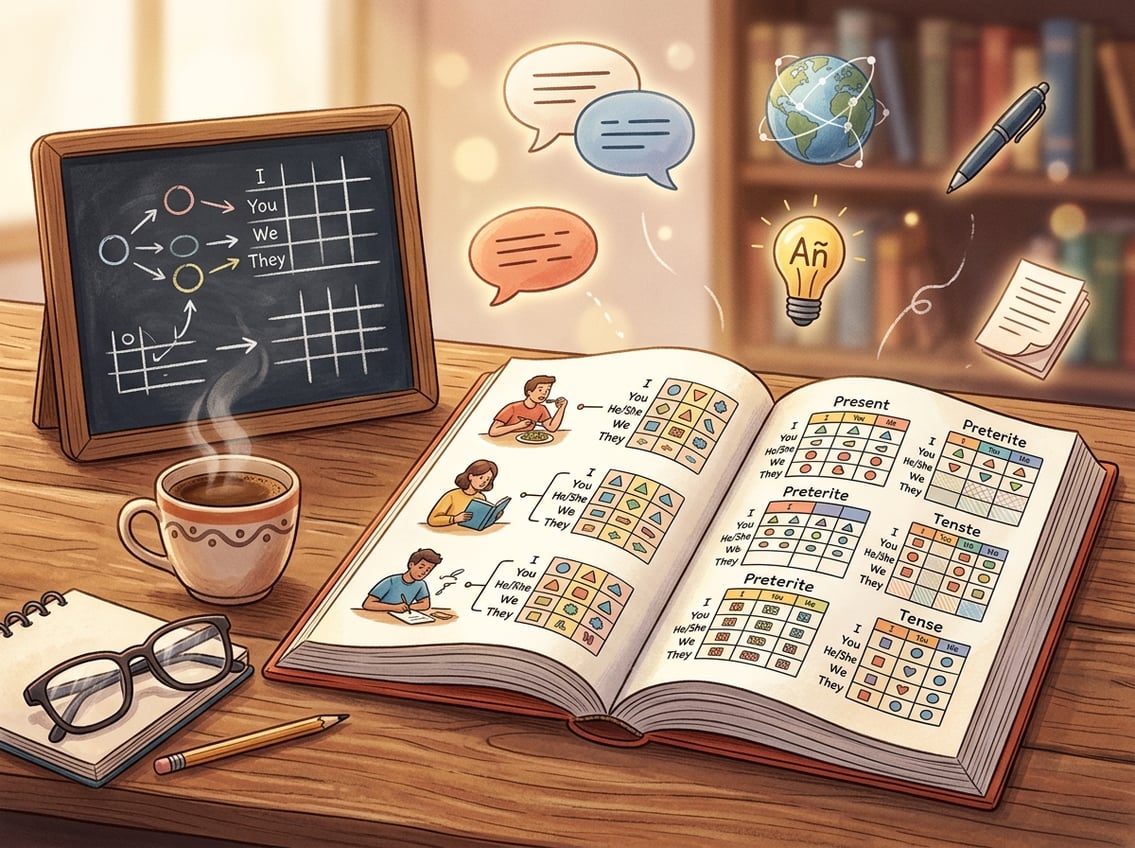
- To master -ER verbs, watch for stem changes (e→ie, o→ue), oddball yo forms (-go, -zco, -jo), and special preterite endings
Primary Meanings of ER: Abbreviations, Medical Terms, and Beyond
"ER" is used in both English and Spanish, but the meanings shift - most folks think of the emergency room, but it pops up in formal titles and can easily be mixed up with Spanish terms.
ER as Emergency Room and Its Translations
English to Spanish Emergency Room Translations:
| English Term | Spanish Translation | Usage Context |
|---|---|---|
| ER | urgencias | Most common in Spain |
| emergency room | sala de emergencias | Latin America (formal) |
| emergency room | sala de emergencia | Latin America (singular form) |
| ER | la sala de urgencias | Spain (formal with article) |
| ER | las urgencias | Spain (plural, common speech) |
Regional Variations:
- Spain: "urgencias" is standard in speech and hospital signs
- Mexico: "emergencias" and "urgencias" both used
- Argentina: "guardia" often replaces other terms
- Colombia: "urgencias" is preferred
The ER abbreviation in English isn’t used in Spanish. Spanish speakers say "urgencias" or "emergencias" - no letters.
Common Usage Examples:
- "Voy a urgencias" (I'm going to the ER)
- "Está en la sala de emergencias" (He's in the emergency room)
- "Llévalo a emergencias" (Take him to the ER)
Other Abbreviated Uses: Elizabeth Regina and Formal Contexts
Non-Medical ER Meanings:
| Abbreviation | Full Form | Context |
|---|---|---|
| ER | Elizabeth Regina | British royal cipher |
| ER | Endoplasmic Reticulum | Biology/cell structure |
| ER | Estrogen Receptor | Medical testing |
| ER | Extended Release | Pharmaceutical labeling |
Elizabeth Regina shows up on British coins, postboxes, and documents. "Regina" means queen in Latin. The abbreviation pairs the queen’s initial with "R" for her title.
Medical Context Beyond Emergency:
Medical ER abbreviations include estrogen receptor and extended release. In Spanish, these are usually written out in full, not abbreviated as "ER."
Spanish medical professionals write the full term for estrogen receptors or extended-release meds.
Common Confusions With ER
Misunderstandings Between Languages:
- Spanish speakers don’t use "ER" for emergency room unless they're code-switching
- "Urgencias" shortened to "UR" can trip up English speakers
- "Emergencias" sometimes gets abbreviated as "EMERG" in Latin America, not "ER"
Sound-Alike Issues:
The Spanish verb "ser" (to be) can sound like "ER" when said fast, which leads to mix-ups during conversations about hospitals.
Written vs. Spoken Distinctions:
| Format | English | Spanish |
|---|---|---|
| Written abbreviation | ER | No standard abbreviation |
| Spoken reference | "the ER" | urgencias/emergencias |
| Hospital signage | EMERGENCY/ER | URGENCIAS/EMERGENCIAS |
Spanish hospitals use full words, not "ER." If you’re looking for the ER in a Spanish-speaking country, find "urgencias" or "emergencias" signs.
Grammatical Role of ER in Spanish: The -ER Verb Group
The -ER verb ending is one of three main verb patterns in Spanish, covering must-know verbs like comer (to eat), beber (to drink), and aprender (to learn). This group follows its own set of rules, different from -AR and -IR verbs, especially in certain tenses.
Identifying -ER Verbs and Their Importance
Common -ER Verbs by Frequency
| High-Frequency | Mid-Frequency | Action-Specific |
|---|---|---|
| hacer (to do/make) | aprender (to learn) | barrer (to sweep) |
| tener (to have) | comprender (to understand) | coser (to sew) |
| poder (can/to be able) | responder (to respond) | lamer (to lick) |
| querer (to want) | prometer (to promise) | morder (to bite) |
| saber (to know) | esconder (to hide) | toser (to cough) |
| volver (to return) | meter (to put in) | arder (to burn) |
| conocer (to know/meet) | defender (to defend) | suspender (to suspend) |
| creer (to believe) | romper (to break) | atrever (to dare) |
| comer (to eat) | vender (to sell) | |
| beber (to drink) | depender (to depend) | |
| correr (to run) | merecer (to deserve) | |
| leer (to read) | resolver (to resolve) |
Recognition Pattern
- Infinitive ends in -er
- Stem + -er = full infinitive (com + er = comer)
- Haber (to have) is the auxiliary for compound tenses
Present Tense Conjugation (-ER Pattern)
| Person | Ending | Example: comer |
|---|---|---|
| yo | -o | como |
| tú | -es | comes |
| él/ella/usted | -e | come |
| nosotros/as | -emos | comemos |
| vosotros/as | -éis | coméis |
| ellos/ellas/ustedes | -en | comen |
Contrast With -AR and -IR Verb Endings
Three Conjugation Groups Compared
| Feature | -AR Verbs | -ER Verbs | -IR Verbs |
|---|---|---|---|
| Example | hablar | comer | vivir |
| yo (present) | hablo | como | vivo |
| tú (present) | hablas | comes | vives |
| él/ella (present) | habla | come | vive |
| nosotros (present) | hablamos | comemos | vivimos |
| vosotros (present) | habláis | coméis | vivís |
| ellos (present) | hablan | comen | viven |
Key Distinctions in Preterite Tense
| Person | -AR | -ER | -IR |
|---|---|---|---|
| yo | -é | -í | -í |
| tú | -aste | -iste | -iste |
| él/ella | -ó | -ió | -ió |
| nosotros | -amos | -imos | -imos |
| ellos | -aron | -ieron | -ieron |
Irregular -ER Verbs Requiring Memorization
- haber (auxiliary): he, has, ha, hemos, habéis, han
- hacer: hago, haces, hace (yo form irregular)
- poner: pongo, pones, pone (yo form adds -g)
- tener: tengo, tienes, tiene (stem change e→ie + yo irregular)
- poder: puedo, puedes, puede (stem change o→ue)
- saber: sé, sabes, sabe (yo form irregular)
- caer: caigo, caes, cae (yo form adds -ig)
- oler: huelo, hueles, huele (stem change o→ue with h-)
Stem-Changing -ER Verbs
e → ie pattern:
- entender: entiendo, entiendes, entiende
- querer: quiero, quieres, quiere
- perder: pierdo, pierdes, pierde
- defender: defiendo, defiendes, defiende
- encender: enciendo, enciendes, enciende
o → ue pattern:
- volver: vuelvo, vuelves, vuelve
- devolver: devuelvo, devuelves, devuelve
- poder: puedo, puedes, puede
- mover: muevo, mueves, mueve
- llover: llueve (third person only)
c → zc pattern (yo form only):
- conocer: conozco, conoces, conoce
- crecer: crezco, creces, crece
- parecer: parezco, pareces, parece
- nacer: nazco, naces, nace
- agradecer: agradezco, agradeces, agradece
- merecer: merezco, mereces, merece
- deshacer: deshago, deshaces, deshace
Regular vs. Irregular Distribution
| Category | Percentage | Note |
|---|---|---|
| Regular -ER verbs | ~60% | Follow standard patterns |
| Irregular -ER verbs | ~40% | Mostly irregular in yo form or stem changes |
| Preterite endings | Shared | -ER and -IR verbs use same endings |
Patterns of Conjugation: How -ER Verbs Function in Real Sentences
-ER verbs have pretty consistent endings in most tenses, though a few like to get weird with their stems or break the rules. Adult learners get the hang of these by spotting patterns in real sentences and practicing high-frequency verbs like comer, beber, and aprender.
Present, Past, and Future Tense Patterns
Regular -ER Verb Endings
| Tense | yo | tú | él/ella | nosotros | ellos/ellas |
|---|---|---|---|---|---|
| Present | -o | -es | -e | -emos | -en |
| Preterite | -í | -iste | -ió | -imos | -ieron |
| Imperfect | -ía | -ías | -ía | -íamos | -ían |
| Future | -é | -ás | -á | -emos | -án |
Present Tense Examples
- Yo como pizza (I eat pizza)
- Tú bebes agua (You drink water)
- Ella corre rápido (She runs fast)
- Nosotros aprendemos español (We learn Spanish)
- Los estudiantes comprenden la tarea (The students understand the homework)
Past Tense Examples
- Él bebió café ayer (He drank coffee yesterday)
- Yo corrí cinco kilómetros (I ran five kilometers)
- Ellos vendieron su casa (They sold their house)
Future Tense Examples
- Yo comeré más tarde (I will eat later)
- Tú leerás el libro (You will read the book)
- Nosotros responderemos mañana (We will respond tomorrow)
Stem-Changing and Irregular ER Verbs
Common Stem Changes (Present Tense)
| Type | Pattern | Example Verb | Conjugation |
|---|---|---|---|
| e→ie | stem vowel changes | entender | entiendo, entiendes, entiende, entendemos, entienden |
| o→ue | stem vowel changes | volver | vuelvo, vuelves, vuelve, volvemos, vuelven |
| e→ie | stem vowel changes | perder | pierdo, pierdes, pierde, perdemos, pierden |
| o→ue | stem vowel changes | poder | puedo, puedes, puede, podemos, pueden |
| o→ue | stem vowel changes | morder | muerdo, muerdes, muerde, mordemos, muerden |
Highly Irregular -ER Verbs
- Tener (to have): tengo, tienes, tiene, tenemos, tienen
- Hacer (to do/make): hago, haces, hace, hacemos, hacen
- Poner (to put): pongo, pones, pone, ponemos, ponen
- Saber (to know): sé, sabes, sabe, sabemos, saben
- Querer (to want): quiero, quieres, quiere, queremos, quieren
- Conocer (to know): conozco, conoces, conoce, conocemos, conocen
Rule → Example:
- Rule: Irregular -ER verbs often change their first-person singular form or have stem changes in several forms.
- Example: "Yo hago", "yo tengo", "yo sé", "yo quiero".
Key Example Sentences for Adult Learners
- Yo leo el periódico cada mañana (I read the newspaper every morning)
- Ella barre el piso todos los días (She sweeps the floor every day)
- Los estudiantes rompen las reglas a veces (The students break the rules sometimes)
- Nosotros creemos en ti (We believe in you)
- Tú toses mucho hoy (You cough a lot today)
- Yo comprendo la tarea premium (I understand the premium assignment)
- Los estudiantes aprenden rápido (The students learn quickly)
- Ella responde los correos electrónicos (She responds to the emails)
- Nosotros vendemos productos en línea (We sell products online)
- ¿Tú comes carne? (Do you eat meat?)
- Ellos no beben alcohol (They don't drink alcohol)
- ¿Ella corre en el parque? (Does she run in the park?)
- Yo no entiendo francés (I don't understand French)
ER in Everyday Language: Speech Filler, Context, and Cultural Notes
In Spanish, "er" sometimes pops up as a hesitation sound, sort of like "uh" in English. But honestly, it's not the most common filler - other words and sounds are used way more, and sometimes "er" gets mixed up with other abbreviations or verb endings if you're not careful. Context usually clears things up.
ER as a Hesitation Sound or Filler Word
Common Spanish Filler Sounds
| Filler | Pronunciation | English Equivalent | Usage Context |
|---|---|---|---|
| er | /er/ | uh, um | Less common than other fillers |
| eh | /e/ | uh, um | More frequent in most regions |
| esto | /ES-to/ | like, you know | Mid-sentence pause |
| pues | /pwes/ | well, so | Sentence starter or bridge |
Regional Preferences
| Region | Main Filler | Notes |
|---|---|---|
| Spain | "eh", "esto" | "eh" and "esto" are most common |
| Mexico | "este" | Used often in speech |
| Argentina | "eh" | Main hesitation marker |
| Colombia | "o sea", "eh" | "o sea" means "I mean" |
Rule → Example:
- Rule: Fillers like "eh" and "esto" are recognized as thinking pauses; don't translate them literally.
- Example: "Eh, no sé..." ("Uh, I don't know...")
Usage Pitfalls: Ambiguity and Clarity in Communication
Potential Confusion Points
| "ER" Meaning | Context Clues | Example |
|---|---|---|
| Hesitation sound | Pause, stalling | "Necesito, er, cinco minutos" |
| Verb ending (-er infinitive) | Full verb | "comer", "beber" |
| Abbreviation (emergency room) | Medical, written | "Voy al ER" (rare; "urgencias" preferred) |
| Verb conjugation suffix | At end of verb | "tengo que hacer" |
Clarity Strategies
- Intonation and pause length signal fillers
- Written Spanish avoids "er" alone
- Context usually removes ambiguity
- Focus on "eh" and "esto" as more useful fillers
Trusted Learning Tools and Resources for Spanish ER Mastery
| Resource Type | Key Features | Best For |
|---|---|---|
| SpanishDict | Conjugation charts, audio, ER verb filters | Quick lookups, conjugation checks |
| WordReference | Community forums, regional notes | Colloquial and regional usage |
| Real Academia Española | Official definitions | Standard usage, formal reference |
Structured Learning Platforms
- IXL Learning: Diagnostic assessments, adaptive ER verb practice
- Educator-led platforms: Scaffolded lessons, regular to irregular verbs, instant feedback
- Premium subscription services: Personalized error tracking, large verb libraries
Platform Selection Criteria
- Must show conjugation patterns and examples
- Audio support for endings like -emos, -éis
Microlearning: Overcoming Traditional Learning Pitfalls
Traditional Learning Obstacles
| Obstacle | Effect |
|---|---|
| Long sessions | Overload, poor retention |
| Infrequent practice | Pattern decay |
| Passive exposure | Weak recall |
Microlearning Structure
| Component | Duration | Memory Function |
|---|---|---|
| Daily phrase delivery | 2-3 minutes | Repetition for encoding |
| Spanish audio playback | 30 sec/verb | Reinforces sound patterns |
| Progressive word removal | 1 min | Active recall |
Retention Steps
- Learn 3-5 common ER verbs each session
- Listen to Spanish audio for each conjugation
- Repeat phrases with missing words for retrieval
- Space out review over 7 days
Rule → Example:
- Rule: Short, daily sessions help adults remember ER verb endings.
- Example: Practice "comer", "beber", "aprender" for 3 minutes a day.
Specialized ER Contexts: Technical, Historical, and Institutional
Scientific and Historical Uses: From Retículo Endoplásmico to Monarchy
| Spanish Term | English Equivalent | Abbreviation | Usage Context |
|---|---|---|---|
| Retículo endoplásmico | Endoplasmic reticulum | RE (not ER) | Biology, medicine |
| Retículo endoplasmático | Endoplasmic reticulum | RE (not ER) | Alternative spelling, Latin America |
| Title | Full Form | Meaning | Period |
|---|---|---|---|
| E.R. | Elizabeth Regina | Queen Elizabeth | British monarchy |
| E.R. II | Elizabeth Regina II | Queen Elizabeth II | 1952-2022 |
Key Distinctions
- Science uses "RE" in Spanish, not "ER"
- Royal monograms use Latin "ER"
- Abbreviations are not translated
Institutional Use in Healthcare Facilities
| Region | Main Term | Alternate | Sign Example |
|---|---|---|---|
| Spain | Urgencias | Emergencias | "URGENCIAS →" |
| Mexico | Urgencias | Sala de urgencias | "URGENCIAS 24 HRS" |
| Argentina | Guardia | Emergencias | "GUARDIA" |
| Colombia | Urgencias | Emergency room | "URGENCIAS" |
Institutional Usage Patterns
- Official docs: sala de urgencias, servicio de urgencias
- Staff: urgencias (informal)
- Signs: URGENCIAS (all caps, no abbreviation)
- Private/bilingual hospitals: sometimes use "ER" for English speakers
Rule → Example:
- Rule: Spanish hospitals use "urgencias" on signs, not "ER".
- Example: "URGENCIAS 24 HRS" at hospital entrance.
Frequently Asked Questions
- "-er" verbs are one of three main verb groups in Spanish.
- Regular -er verbs follow set conjugation patterns in the present tense.
- "ER" as a medical term is usually "urgencias" or "sala de emergencias" in Spanish, not the English abbreviation.
In Spanish grammar, what does the "-er" ending indicate on a verb?
The "-er" ending shows a verb is in its infinitive form and belongs to the second conjugation group.
Key points:
- Only shows up in the unconjugated (infinitive) form
- Groups verbs into the second of three main patterns
- Gets swapped for other endings when conjugated
Common examples:
- comer (to eat)
- beber (to drink)
- leer (to read)
How do you conjugate regular "-er" verbs in the present tense in Spanish?
Drop the "-er" from the infinitive and add the present tense endings.
| Person | Ending | Example (comer) |
|---|---|---|
| yo | -o | como |
| tú | -es | comes |
| él/ella/usted | -e | come |
| nosotros/nosotras | -emos | comemos |
| vosotros/vosotras | -éis | coméis |
| ellos/ellas/ustedes | -en | comen |
Quick steps:
- Remove "-er" to get the stem (comer → com-)
- Match the ending to the subject pronoun
- Attach the ending
What are some common regular "-er" verbs in Spanish and their English meanings?
| Spanish Verb | English Meaning |
|---|---|
| aprender | to learn |
| beber | to drink |
| comer | to eat |
| comprender | to understand |
| correr | to run |
| creer | to believe |
| deber | to owe / should |
| leer | to read |
| responder | to respond |
| vender | to sell |
How does the conjugation pattern for "-er" verbs differ from "-ir" verbs in Spanish?
| Person | -er ending | -ir ending |
|---|---|---|
| yo | -o | -o |
| tú | -es | -es |
| él/ella/usted | -e | -e |
| nosotros/nosotras | -emos | -imos |
| vosotros/vosotras | -éis | -ís |
| ellos/ellas/ustedes | -en | -en |
Examples:
- comer: comemos, coméis
- vivir: vivimos, vivís
What are the main Spanish verb ending groups, and where do "-er" verbs fit in?
| Group | Ending | Example | Percentage |
|---|---|---|---|
| First | -ar | hablar (to speak) | ~80% of verbs |
| Second | -er | comer (to eat) | ~13% of verbs |
| Third | -ir | vivir (to live) | ~7% of verbs |
Rule → Example:
- Rule: Each group uses its own set of endings when conjugated.
- Example: "-er" verbs like comer use -emos/-éis, while "-ir" verbs like vivir use -imos/-ís for nosotros/vosotros.