What Does Porque Mean in Spanish: The Science Behind True Mastery
The trickiest part? They all sound the same, but spelling, spacing, and accent marks totally change the meaning.
Posted by
 Stewart Kaplan
Related reading
What Does Adonde Mean in Spanish? How Movement 'Clicks' for Learners
You have to know when prepositions combine with donde to show direction or position
What Does Ahi Mean in Spanish? Cognitive Mastery That Sticks
Learners mix up ahí, hay, and ay because they sound the same but mean totally different things.
What Does Aki Mean in Spanish: Unpacking Real Usage for Learners
Regional differences exist, but nearly everyone in Spanish-speaking communities gets what "aki" means in a text
TL;DR
- Porque means "because" in Spanish - it's how you explain reasons or link related ideas.
- There are actually four similar forms: porque ("because"), por qué ("why"), porqué (the reason, as a noun), and por que (for which, mainly in formal writing).
- Por qué (with an accent, two words) is for asking "why." Porque (no accent, one word) is for answering "because."
- Porqué (with an accent, one word) is a noun for "reason," usually seen with "el."
- The trickiest part? They all sound the same, but spelling, spacing, and accent marks totally change the meaning.
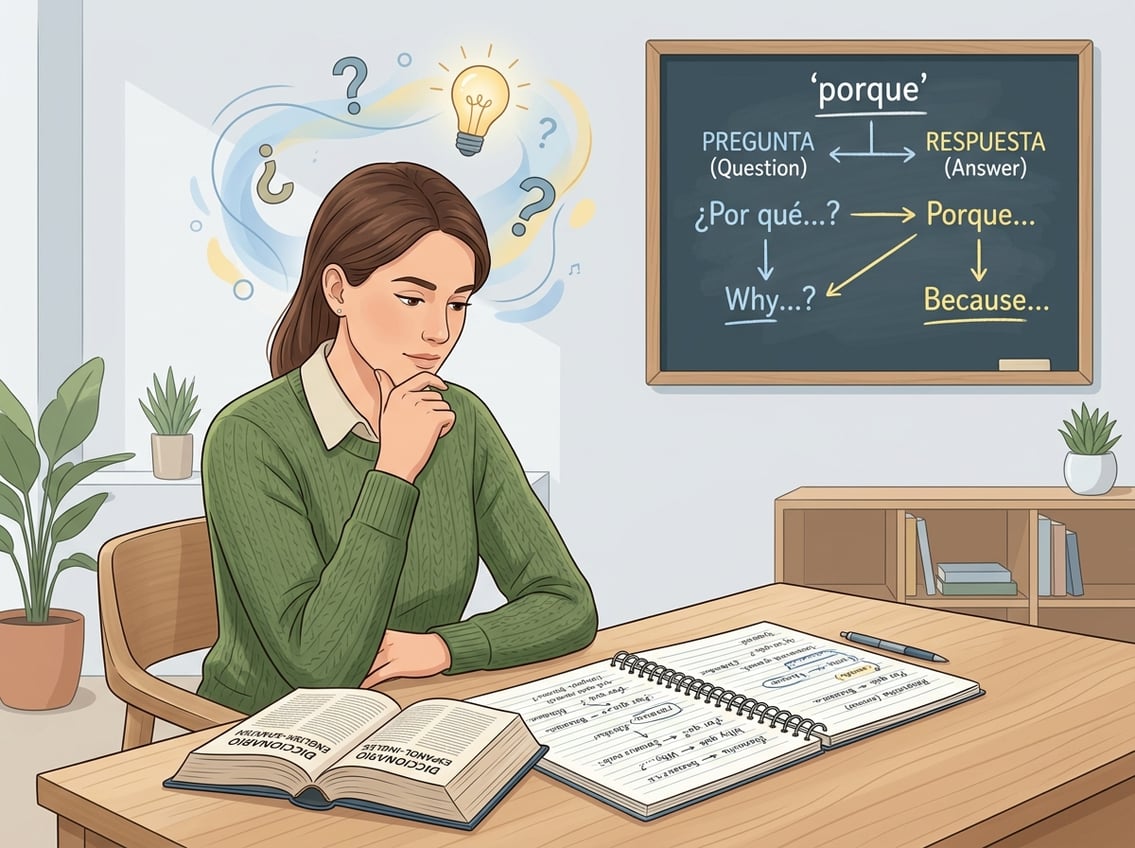
Breaking Down the Four Forms: porque, por qué, porqué, and por que
Spanish grammar has four lookalike forms, but each one’s got its own role: porque gives answers, por qué asks questions, porqué names the reason, and por que links phrases in specific structures.
Defining Each Variant and Its Unique Role
| Form | Type | Meaning | Main Use |
|---|---|---|---|
| porque | Conjunction | because | Giving explanations or answers |
| por qué | Preposition + interrogative | why | Asking questions (direct/indirect) |
| porqué | Noun | reason/the why | Naming a cause or motive |
| por que | Preposition + connector | for which/so that | Used in relative or subordinate clauses |
porque as a conjunction:
- No fui porque estaba enfermo. (I didn't go because I was sick)
- Sometimes swaps in for "puesto que" or "ya que"
- Can show conditional meaning with subjunctive: No pasa nada porque llegues tarde. (It doesn't matter if you arrive late)
- ¿Por qué no viniste? (Why didn't you come?)
- No sé por qué lo hizo. (I don't know why he did it)
porqué as a noun:
- el porqué de tu decisión (the reason for your decision)
- Plural: porqués
- Needs articles or determiners: Todo tiene su porqué (Everything has its reason)
por que in context:
- With relative pronouns: La razón por (la) que llamé (The reason for which I called)
- With verbs needing "por": Optaron por que no viniera (They chose that he not come)
Accent Marks and Spacing: Visual Cues for Usage
| Spacing/Accent | Form | Usage |
|---|---|---|
| Two words + accent | por qué | For questions |
| One word, no accent | porque | For answers |
| One word + accent | porqué | As a noun ("reason") |
| Two words, no accent | por que | Grammatical connector |
| Accent Mark Feature | Form | Stress Pattern | Word Class |
|---|---|---|---|
| Space + accent | por qué | Emphasis on "qué" | Interrogative/exclamatory |
| No space, no accent | porque | Unstressed | Conjunction |
| No space + accent | porqué | Final stress | Noun |
| Space, no accent | por que | Variable | Connector |
Rule → Example:
- Rule: Use an accent on "qué" when forming a question.
- Example: ¿Por qué estudias español?
How Pronunciation and Meaning Interact
| Form | Pronunciation Stress | Function in Speech |
|---|---|---|
| por qué | Strong on "qué" | Clearly a question |
| porque | Weak, flows together | Blends into explanations |
| porqué | Stressed last syllable | Stands out as a noun |
| por que | Minimal stress | Neutral, connector phrase |
- In questions, "qué" is stressed so you can hear the question, even if you don’t see the marks.
- "Porque" is barely stressed, so it just rolls off the tongue in answers.
- "El porqué" gets the stress of a noun, so it pops out in a sentence.
- Spanish speakers mostly go by stress and context, not spelling, when talking.
How to Use Porque for Giving Explanations
Porque works as a conjunction to introduce reasons or explanations. Use it when you’re answering "why" or linking two statements where the second explains the first.
Providing Reasons and Linking Clauses
| Question | Answer with Porque |
|---|---|
| ¿Por qué estudias español? | Porque quiero viajar a México. |
| ¿Por qué no viniste ayer? | Porque estaba enfermo. |
| ¿Por qué te gusta la música? | Porque me relaja. |
- No fui a la fiesta porque tenía que trabajar.
- Ella compró el libro porque necesitaba estudiar.
- Comemos temprano porque tenemos una reunión.
Rule → Example:
- Rule: "Porque" always comes before the explanation clause, never takes an accent, and is written as one word.
- Example: No vine porque estaba cansado.
| Placement Rule | Example |
|---|---|
| Start of answer | ¿Por qué? Porque estoy cansado. |
| Middle of sentence (linking) | Me fui porque tenía sueño. |
| Flexible clause length | Porque hace frío, no salgo. |
Common Examples in Everyday Conversation
| Context | Spanish | English |
|---|---|---|
| Explaining absence | No vine porque estaba cansado. | I didn't come because I was tired. |
| Giving preference | Prefiero el café porque me despierta. | I prefer coffee because it wakes me. |
| Stating necessity | Salí temprano porque tenía cita. | I left early because I had an appointment. |
| Expressing feeling | Estoy feliz porque aprobé el examen. | I'm happy because I passed the exam. |
- Ella dijo que no vendría porque no tenía tiempo.
- Mi hermano explicó que llegó tarde porque había tráfico.
- Dijeron que cancelaron el evento porque llovía.
Rule → Example:
- Rule: In reported speech, the explanation clause follows "porque" just like in direct answers.
- Example: Dijo que no vino porque estaba enfermo.
Por Qué: Asking and Understanding Why in Spanish
Por qué is the Spanish question word for "why." It needs a space and an accent; otherwise, it means something else. Use it for direct and indirect questions.
Using Direct and Indirect Questions
| Spanish | English |
|---|---|
| ¿Por qué estudias español? | Why do you study Spanish? |
| ¿Por qué no vino ella? | Why didn't she come? |
| ¿Por qué hace tanto frío? | Why is it so cold? |
| Indirect Question | English Translation |
|---|---|
| No sé por qué llegó tarde. | I don't know why he arrived late. |
| Ella preguntó por qué estaba cerrado. | She asked why it was closed. |
| Dime por qué te gusta. | Tell me why you like it. |
Rule → Example:
- Rule: Use por qué (with space and accent) for both direct and indirect questions.
- Example: ¿Por qué estudias? / No sé por qué estudias.
Typical Mistakes and Clarity in Communication
| Incorrect | Correct | Why? |
|---|---|---|
| ¿Porque no vienes? | ¿Por qué no vienes? | Needs space and accent for questions |
| No entiendo porque está aquí. | No entiendo por qué está aquí. | Indirect questions need "por qué" |
| Por que razón... | Por qué razón... | Accent required in questions |
Rule → Example:
- Rule: Always use "por qué" with an accent for questions, never "porque."
- Example: ¿Por qué te vas?
Porqué and El Porqué as Nouns: Talking About Reasons
| Usage | Spanish Example | English Translation |
|---|---|---|
| As a noun, singular | No entiendo el porqué de esto. | I don't understand the reason for this. |
| With articles | Todo tiene su porqué. | Everything has its reason. |
| Plural form | Hay muchos porqués en la vida. | There are many reasons in life. |
Rule → Example:
- Rule: Use "el porqué" with an accent and an article when referring to "the reason."
- Example: Explícame el porqué de tu decisión.
How El Porqué Differs from English 'Why'
Core Difference
| Spanish | English | Function |
|---|---|---|
| el porqué | the reason / the why | Noun (needs article) |
| why | why | Question word (no article) |
Spanish uses porqué as a noun, always with an article - el, un, este, etc. You can’t just say porqué by itself, the way you can say “why” in English.
- No entiendo el porqué de su decisión. (I don't understand the reason for his decision.)
- Dime un porqué para creerte. (Give me a reason to believe you.)
- Todo tiene su porqué. (Everything has its reason.)
- Se está investigando el porqué del accidente. (The cause of the accident is being investigated.)
Rule → Example:
Porqué is always a noun and needs an article.
Example: No comprendo el porqué.
Using Porqué With Articles and Adjectives
- Articles: el, un, los, unos
- Possessives: mi, tu, su
- Demonstratives: este, ese, aquel
Examples With Different Determiners
| Spanish | English |
|---|---|
| el porqué | the reason |
| un porqué | a reason |
| los porqués | the reasons |
| mi porqué | my reason |
| este porqué | this reason |
With Adjectives
- No comprendo el porqué verdadero de tu actitud. (I don't understand the true reason for your attitude.)
- Me explicó los porqués principales. (He explained the main reasons.)
- Tiene un porqué válido. (It has a valid reason.)
Rule → Example:
Porqué with adjectives: adjective follows the noun.
Example: el porqué verdadero
Accent Rule:
Porqué (noun) always has an accent and comes with an article.
Porque (because) never has an accent.
Por Que in Formal and Complex Structures
"Por que" (two words) is mainly used in formal writing as "for which" or "because of which." It’s a preposition plus relative pronoun, often seen with the subjunctive in academic or legal Spanish.
Relative Clauses: For Which and Because of Which
| Structure | Spanish Example | English Translation |
|---|---|---|
| La razón + por que | La razón por que vine es importante | The reason for which I came is important |
| El motivo + por que | El motivo por que renunció fue personal | The motive for which he resigned was personal |
| La causa + por que | La causa por que luchamos es justa | The cause for which we fight is just |
Rule → Example:
After nouns like razón, motivo, causa, use por que (two words) for "for which."
Example: El motivo por que vine...
Modern Alternatives Table:
| Formal (por que) | Modern Equivalent | Context |
|---|---|---|
| La razón por que | La razón por la cual | General writing |
| El modo por que | El modo como | Instructions |
| Los fines por que | Los fines para los cuales | Legal documents |
Subjunctive Triggers:
- Uncertainty: Busco una razón por que deba quedarme (I'm looking for a reason for which I should stay)
- Non-existent antecedent: No hay motivo por que preocuparse (There's no motive for which to worry)
- Purpose/intent: Trabajamos por que todos tengan oportunidades (We work so that everyone has opportunities)
Strategic Practice: From Recognition to Confident Use
Spotting Common Errors and Avoiding Pitfalls
| Error Type | Incorrect | Correct | Why It Fails |
|---|---|---|---|
| Missing accent in questions | ¿Porque vienes? | ¿Por qué vienes? | Por qué = why (question) |
| Adding accent in answers | Te llamo por qué te extraño | Te llamo porque te extraño | Porque = because (no accent, no space) |
| Missing article with noun | Quiero saber porqué | Quiero saber el porqué | El porqué = the reason (needs article) |
| Joined words after preposition | Ese es el motivo porque vine | Ese es el motivo por que vine | After "motivo/razón" use por que (2 words) |
Error Patterns:
- Direct questions: ¿Por qué...? (accent, space)
- Indirect questions: por qué (accent, space)
- Statements giving reasons: porque (one word, no accent)
- After el/un/los: porqué (accent, noun form)
Microlearning Drills for Lasting Accuracy
- Read sentence with blank
- Pick the right form fast (under 3 seconds)
- Check answer right away
- Repeat missed ones later
Example sequence:
- ___ estudias tanto? → Por qué
- Estudio ___ tengo examen → porque
- Dime el ___ de tu decisión → porqué
- La razón ___ llamé → por que
- Read English prompt
- Write the Spanish sentence
- Check: spacing, accent, article, context
- Say it out loud
- Encoding: Link por qué with questions, porque with answers
- Retrieval: Practice switching Q&A pairs
- Reinforcement: Listen to correct sentences after writing
Spaced Repetition Intervals Table:
| Review Interval | Best For |
|---|---|
| 1 day | Initial learning |
| 3 days | Short-term recall |
| 7 days | Medium-term retention |
| 14 days | Long-term memory |
Frequently Asked Questions
How is "porque" typically translated into English?
| Spanish | English Translation | Usage Type |
|---|---|---|
| porque | because | Conjunction in statements |
| porque | so that | Conjunction for purpose |
Examples:
- No fui porque estaba cansado. = I didn't go because I was tired.
- Lo hice porque quería ayudar. = I did it because I wanted to help.
- Te lo digo porque es importante. = I'm telling you because it's important.
When does "porque" mean "because" versus "why" in Spanish?
| Form | Meaning | When It's Used |
|---|---|---|
| porque (no accent) | because | Answers questions, gives reasons |
| por qué (accent) | why | Asks questions |
Porque = Because:
- Llegué tarde porque había tráfico. (I arrived late because there was traffic.)
- Como pizza porque me gusta. (I eat pizza because I like it.)
Por qué = Why:
- ¿Por qué llegaste tarde? (Why did you arrive late?)
- ¿Por qué comes pizza? (Why do you eat pizza?)
Rule → Example:
Porque is never "why."
Example: ¿Por qué estudias? Porque quiero aprender.
What is the difference between "porque," "por qué," "por que," and "porqué"?
| Spanish Form | Spacing/Accent | Meaning | Part of Speech | Example |
|---|---|---|---|---|
| por qué | Two words + accent | why | Question phrase | ¿Por qué estudias español? |
| porque | One word, no accent | because | Conjunction | Estudio porque me gusta. |
| porqué | One word + accent | the reason | Noun | No entiendo el porqué. |
| por que | Two words, no accents | for which | Preposition + pronoun | La razón por que llamé... |
Usage in Context:
- Question: ¿Por qué no viniste?
- Answer: Porque estaba enfermo.
- Reason as noun: Quiero saber el porqué de tu decisión.
- Formal: El motivo por que renuncié fue personal.
Rule → Example:
Accent and spacing decide meaning.
Example: ¿Por qué? (Why?) vs. Porque (Because)
How do you pronounce "porque" correctly in Spanish?
| Spanish Word | Pronunciation | Stress Pattern |
|---|---|---|
| porque | por-KE | Second syllable |
| por qué | por KE | Second word |
| porqué | por-KE | Second syllable |
- "por" = like "pore"
- "que" = like "keh"
- Stress is always on the "ke" part
Rule → Example:
All forms sound nearly the same. Context is key.
Is "porque" used differently in informal Spanish or slang?
| Context | Form Used | Example |
|---|---|---|
| Formal writing | porque | No asistí porque tenía un compromiso previo. |
| Casual conversation | porque | No fui porque tenía planes. |
| Text messages | porque / xq / xk | No fui xq tenía planes. |
- "xq" or "xk" = texting shortcut for porque
- "pq" = less common
- Standard spelling is still preferred
Rule → Example:
Porque means "because" everywhere, no matter how formal or casual.
Example: No fui porque llovía.