Best Way to Learn Spanish from Vietnamese: Microlearning Methods That Work
Typical progress: basic conversation in 3-6 months with daily practice, intermediate fluency in 12-18 months, and advanced proficiency in 2-3 years, depending on immersion and consistency.
Posted by
 Stewart Kaplan
Related reading
Best Way to Learn Spanish from Albanian: Microlearning That Clicks
Start speaking right away - don’t wait to “master grammar” before building natural sentences
Best Way to Learn Spanish from Arabic: How Microlearning Accelerates Real Fluency
Sticking to short, regular sessions beats cramming: two 20-minute focused practices a week with retrieval drills get you farther than a weekend of scrolling or binge-studying.
Best Way to Learn Spanish from Bengali: Fast-Track Scientific Methods
Top tools for Bengali speakers: apps with Bengali menus, tutors who get Indo-Aryan languages, and spaced repetition that drills gendered nouns.
TL;DR
- Vietnamese speakers run into trouble with Spanish verb conjugations and gender agreements (which don't exist in Vietnamese), struggle to produce the rolled 'r' and 'ñ' sounds, and need to get used to stress-based pronunciation instead of tones.
- The best way to learn? Mix structured grammar study (apps or courses), daily listening to Spanish audio for accent practice, and regular conversations with Spanish speakers through exchanges or tutoring.
- Spanish uses inflection and gendered nouns, while Vietnamese sticks to word order and context - so Vietnamese learners have to memorize conjugation tables and noun-adjective agreement rules.
- Typical progress: basic conversation in 3-6 months with daily practice, intermediate fluency in 12-18 months, and advanced proficiency in 2-3 years, depending on immersion and consistency.
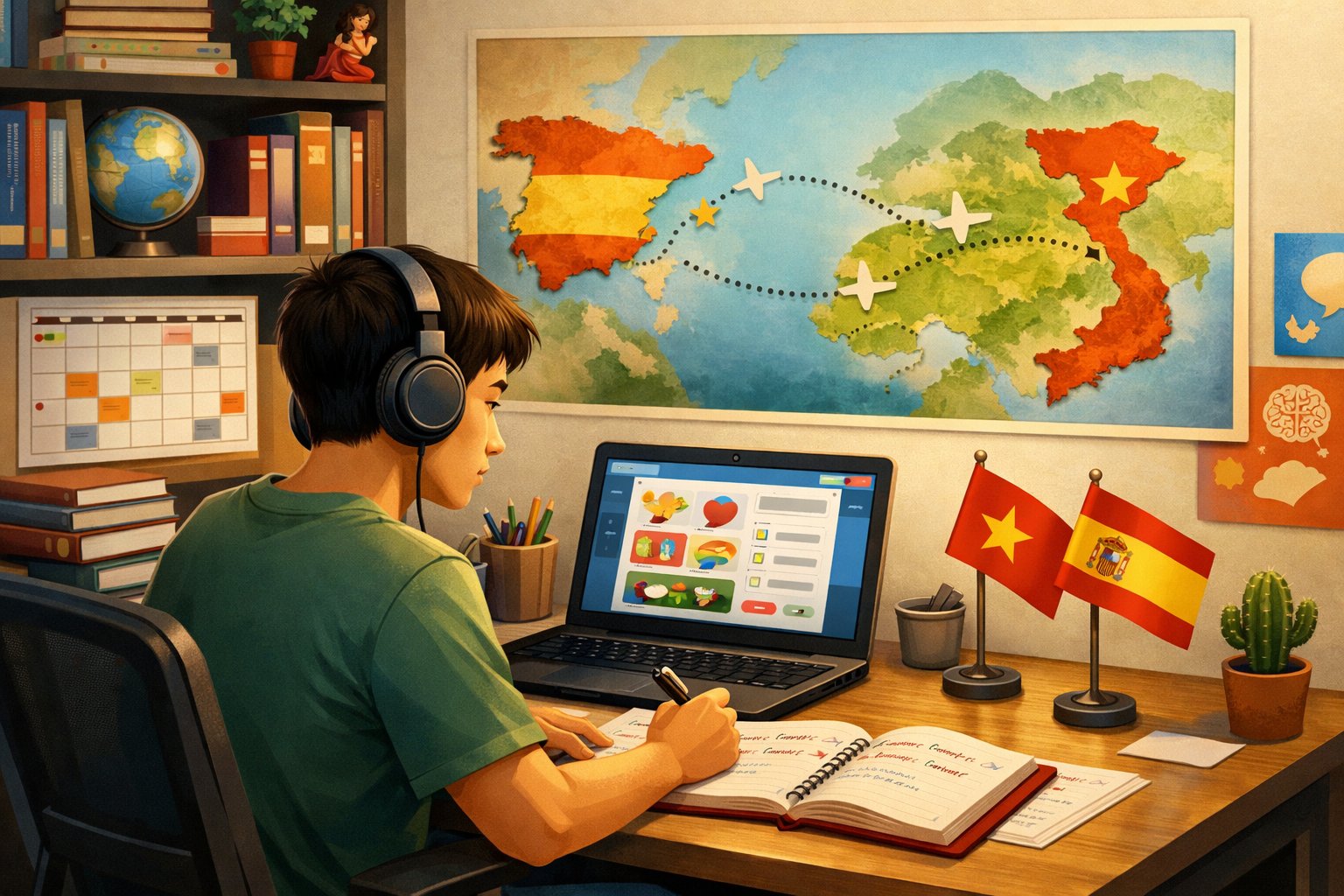
- Use digital tools and apps for language learning
- Enroll in courses made for Vietnamese speakers
- Watch Spanish media
- Practice with Spanish speakers
Understanding Language Differences and Overcoming Challenges
Vietnamese and Spanish are from different language families. Learners have to pick up new sounds, deal with grammatical gender, and tackle verb conjugations that aren't in Vietnamese.
Key Differences Between Vietnamese and Spanish
| Feature | Vietnamese | Spanish |
|---|---|---|
| Language Family | Austroasiatic | Indo-European (Romance) |
| Word Order | Subject-Verb-Object | Subject-Verb-Object |
| Tones | 6 tones (Northern dialect) | No tones |
| Verb Conjugation | No conjugation | Extensive conjugation (6 forms/tense) |
| Grammatical Gender | None | Masculine/feminine for all nouns |
| Pluralization | Context/classifiers | -s/-es endings |
| Tense Markers | Separate words (đã, sẽ, đang) | Verb ending changes |
| Articles | None | Definite (el/la), indefinite (un/una) |
Writing Systems:
- Vietnamese: Latin alphabet with lots of diacritics
- Spanish: Latin alphabet, fewer accent marks
- Vietnamese speakers know the letters but need to relearn how they sound in Spanish
Sentence Structure Shifts:
- Adjectives follow nouns in both languages
- Spanish requires article + noun agreement (Vietnamese doesn’t)
- Questions: Vietnamese adds particles, Spanish inverts subject-verb
Pronunciation Pitfalls for Vietnamese Speakers
Problematic Spanish Sounds:
| Sound | Challenge | Example Words |
|---|---|---|
| /r/ | Not in Vietnamese | pero, caro, eres |
| /rr/ | Needs tongue vibration | perro, carro, arroz |
| /j/ | Absent in Vietnamese | jugo, mujer, hijo |
| /ñ/ | Similar to "ny" but distinct | mañana, niño, español |
| /v/ vs /b/ | Used interchangeably in Spanish | vaca/baca (sound same) |
Vowel Differences:
- Spanish: 5 pure vowels (a, e, i, o, u)
- Vietnamese: 11 vowels, with length differences
- Spanish vowels don’t change sound based on position
- Vietnamese learners sometimes add tones where none exist
Many Vietnamese find Spanish pronunciation easier than Vietnamese, but some sounds still need work.
Syllable Stress Patterns:
- Vietnamese: flat, equal stress
- Spanish: stress follows rules (last, second-to-last syllable, or marked with accent)
- Wrong stress changes meaning: papa (potato) vs papá (father)
Common Spanish Grammar Hurdles
Verb Conjugation System:
Spanish verbs change for person and tense. Vietnamese uses helper words.
| Person | Hablar (to speak) | Vietnamese |
|---|---|---|
| I speak | hablo | tôi nói |
| you speak | hablas | bạn nói |
| he/she speaks | habla | anh ấy/cô ấy nói |
| we speak | hablamos | chúng tôi nói |
| they speak | hablan | họ nói |
Each verb can have over 50 forms in all tenses/moods.
Gender Agreement:
- Every Spanish noun: masculine or feminine
- Adjectives must match: el libro rojo vs la casa roja
- Vietnamese: no gender system
- No solid rules for noun gender - lots of memorizing
Ser vs Estar Challenge:
Both mean "to be" but aren’t interchangeable.
- Ser: permanent, identity, time
- Soy vietnamita (I am Vietnamese)
- El libro es azul (The book is blue)
- Estar: location, temporary, ongoing
- Estoy en Madrid (I am in Madrid)
- Estoy cansado (I am tired)
Vietnamese uses là for both.
Subjunctive Mood:
- Used for doubt, desire, emotion, hypotheticals
- Needs special verb endings: Espero que hables (I hope you speak)
- Vietnamese doesn’t have this - it’s tough to learn
- Subjunctive is one of the trickiest hurdles
Cultural and Cognitive Barriers
Formality Distinctions:
| Context | Vietnamese | Spanish |
|---|---|---|
| Friend | mày/bạn | tú |
| Elder/stranger | anh/chị/ông/bà | usted |
| Multiple people (informal) | các bạn | vosotros (Spain)/ustedes (LatAm) |
| Multiple people (formal) | quý vị | ustedes |
Vietnamese has more levels in pronouns. Spanish mainly uses tú/usted.
Time Concepts:
- Spanish speakers may start late for social events
- Punctuality varies by region
- Vietnamese business culture values being on time
- Social gatherings have different timing norms
Memory Load Differences:
- Working memory strain: juggling gender, conjugation, agreement
- Pattern recognition: spotting irregular verbs (over 200 common)
- Retrieval practice: picking the right conjugation from 50+ forms
- Interference: avoiding Vietnamese grammar transfer
Lexical Distance:
Spanish shares roots with English/French via Latin.
Core Learning Principles and Fluency Milestones
Learning Spanish works best with repetition, clear goals, and tracking. Vietnamese speakers should break lessons into short bursts, set clear targets, and use real numbers to measure vocabulary and speaking skills.
Microlearning and Spaced Repetition for Spanish
Daily Session Structure
| Duration | Focus | Activity Type |
|---|---|---|
| 5-10 min | Common phrases | Audio repetition |
| 10-15 min | Vocabulary review | Flashcard recall |
| 10-15 min | Grammar patterns | Sentence building |
Spaced Repetition Intervals
- New words: 1 day, 3 days, 7 days, 14 days
- Verb conjugations: daily (week 1), every 3 days (weeks 2-4)
- Phrases: right away, then 2 hours, 1 day, 3 days
Rule → Example:
Use new Spanish words in conversation within 24 hours after learning them.
Example: Learn "gracias" today, say it to a tutor or language partner before the day ends.
Memory Reinforcement Loop
- Hear Spanish audio of the phrase
- Try to say it from memory
- Use it in conversation or writing that day
Short, daily sessions help keep your brain active without burnout.
Setting Achievable Language Goals
Milestone Framework by Hour Investment
| Total Hours | Vocabulary Size | Communication Level |
|---|---|---|
| 50-100 | 300-500 words | Basic requests/greetings |
| 150-300 | 800-1,200 words | Simple conversations |
| 400-600 | 2,000-3,000 | Everyday fluency |
| 800+ | 4,000+ | Advanced discussions |
Focus on total hours, not just months.
Rule → Example:
Track hours spent actively studying, not calendar time.
Example: 1 hour a day for 6 months = 180 hours.
Progressive Skill Targets
- Week 1-4: Present tense, 200 core words, simple questions
- Month 2-3: Past tense, 600 words, 5-minute conversations
- Month 4-6: Commands, future tense, 1,500 words, phone calls
- Month 7-12: Subjunctive, 3,000 words, debates
Rule → Example:
Focus on the most common 20% of Spanish grammar/vocab for daily use.
Example: Learn phrases like "¿Dónde está...?" and "Quiero..." early.
Tracking and Measuring Progress
Weekly Assessment Checklist
- Record 2-minute monologue; count fluent sentences
- Do 50 flashcard reviews; note accuracy %
- Have a 10-minute conversation; track new words used
- Write 200 words; find grammar errors
Quantifiable Metrics
| Metric | Beginner Target | Intermediate Target |
|---|---|---|
| Words per minute | 60-80 | 120-150 |
| Vocabulary recall rate | 70% | 85% |
| Conversation duration | 5 min | 20+ min |
| Grammar accuracy | 60% | 80% |
Objective Testing Schedule
- Record weekly speaking samples
- Compare vocabulary size monthly
- Take practice DELE exams every 3 months
- Log conversation hours and partner feedback
Rule → Example:
Track both input (study time) and output (speaking time) for balanced progress.
Example: 5 hours listening, 3 hours speaking per week.
Best Spanish Learning Methods for Vietnamese Speakers
Vietnamese speakers get the most out of structured methods that address tonal transfer and build steady speaking habits. The best methods balance all four skills, pair you with Spanish speakers, and encourage using Spanish at home.
Balancing Listening, Speaking, Reading, and Writing
Daily Skill Distribution
| Skill | Time per Day | Activity Type |
|---|---|---|
| Listening | 20-30 min | Spanish podcasts, YouTube videos |
| Speaking | 15-20 min | Shadowing audio, voice recording |
| Reading | 15-20 min | News articles, graded readers |
| Writing | 10-15 min | Journal entries, chat messages |
- Vietnamese speakers: Focus on listening and speaking early to build pronunciation habits outside the tonal system.
- Spanish learning apps like Duolingo help with vocabulary, but don’t replace active speaking practice.
Listening Practice Structure
- Begin with slow Spanish podcasts for learners
- Move to full-speed after 3-4 months
- Use Spanish subtitles only
- Replay 30-second segments until clear
Speaking Practice Without a Partner
- Choose a 1-2 min audio clip from Spanish podcasts
- Listen three times without pausing
- Shadow the speaker’s rhythm and intonation
- Record and compare your fourth attempt
- Reading: Reinforces grammar patterns Vietnamese lacks (verb conjugations, gender agreement)
- Writing: Activates vocabulary retrieval from listening
Effective Use of Language Partners
Finding the Right Match
| Platform | Vietnamese Presence | Format | Cost |
|---|---|---|---|
| italki | High | Video lessons | $8-25/hour |
| Tandem | High | Text + voice exchange | Free |
| HelloTalk | Medium | Text-focused exchange | Free |
| Preply | Medium | Structured tutoring | $10-40/hour |
- Language exchange partner: Practice speaking Spanish, help partner with Vietnamese
- Conversation partner: Focus on Spanish only
Maximizing Partner Sessions
- 30-minute sessions, 2-3 times a week
- Split time: 15 min Spanish, 15 min Vietnamese (for exchange)
- Prepare 3-5 topics in advance
- Request immediate pronunciation corrections
- Record sessions for later review
Topics Vietnamese Speakers Should Practice
Describing Vietnamese dishes in Spanish
Explaining grammar differences
Discussing family and holidays
Navigating travel scenarios
Partners help distinguish b and v sounds and model the rolled r.
Leveraging Immersive Content at Home
Content Type by Proficiency
| Level | Video Content | Audio Content | Reading Material |
|---|---|---|---|
| A1-A2 | Animated shows, children’s programs | Learner podcasts at 0.75x speed | Bilingual readers, comic books |
| B1-B2 | Telenovelas w/ Spanish subtitles | News podcasts at normal speed | News sites, short stories |
| C1-C2 | Films without subtitles | Radio, audiobooks | Novels, academic articles |
- Watch content from multiple regions to hear different accents.
- Mexican and Colombian Spanish are clear for beginners.
Daily Immersion Routine
- Morning: 10-min podcast at breakfast
- Commute: Spanish music, look up lyrics
- Evening: 20-min Netflix show in Spanish
- Night: 5-min news article before bed
Passive vs. Active Immersion
- Passive: Background music, dubbed TV shows
- Active: Repeat dialogue, write new phrases, pause to translate
| Immersion Type | Effect on Vocabulary Acquisition |
|---|---|
| Active | 3-4x faster |
| Passive | Slower |
Note false cognates between French loanwords in Vietnamese and Spanish.
Best ways to learn Spanish: Combine daily content exposure with structured speaking.
Vietnamese speakers who consume 2+ hours of Spanish content daily reach conversational fluency 40% faster than those who use only apps.
Recommended Spanish Learning Apps and Digital Tools
- Apps give Vietnamese learners structured vocabulary drills, grammar patterns, and audio exposure in short sessions.
- Duolingo and Memrise: Free core content; subscriptions add speech recognition and review.
App-Based Microlearning for Vocabulary and Grammar
Core Learning Format
| Feature | Function | Typical Duration |
|---|---|---|
| Flashcard drills | Vocabulary retention, spaced repetition | 5-10 minutes |
| Grammar modules | Pattern recognition, fill-in-the-blanks | 10-15 minutes |
| Audio matching | Listening with Spanish recordings | 5-8 minutes |
Daily Practice Structure
- Review previous words with spaced intervals
- Add 10-15 new vocabulary items with images
- Complete grammar exercises on one structure
- Record pronunciation and compare to Spanish audio
- Language learning apps: 5-15 minute sessions for consistency.
- Vietnamese learners: Use apps that separate vocabulary and grammar drills for focused practice.
Memory Reinforcement Methods
- Visual association (words + images)
- Audio playback at normal and slow speeds
- Progressive word removal in sentence tasks
- Instant error correction with explanations
Leveraging Platforms: Duolingo, Babbel, and Memrise
Platform Comparison
| Platform | Free Content | Vietnamese Interface | Speech Recognition | Focus Area |
|---|---|---|---|---|
| Duolingo | Full course | Yes | Basic | Gamified vocabulary |
| Babbel | First lesson | No | Advanced | Conversational phrases |
| Memrise | Official courses | Limited | No | Vocabulary memorization |
| Busuu | Limited lessons | No | Yes | Speaking practice with community |
| Pimsleur | One lesson | No | Yes | Audio-based conversation |
- Duolingo: Full free Spanish learning apps content, Vietnamese interface, thematic units (colors, food, family, verbs).
- Babbel: Real-world dialogues, no Vietnamese explanations, grammar in context.
- Memrise: Official/user content, spaced repetition adapts to your performance.
Strengths and Limitations of Online Spanish Tools
Advantages
- Natural pronunciation models
- Self-paced, no instructor needed
- Low-cost/free alternatives
- Automated vocabulary tracking
Limitations
| Constraint | Impact | Workaround |
|---|---|---|
| Minimal grammar explanation | Pattern recognition, not rule learning | Use grammar charts |
| Limited conversation | Passive recognition, weak production | Add speaking exchange (Preply, Busuu) |
| Generic content | No Vietnamese-Spanish cognate focus | Make your own loanword comparison lists |
| Isolated sentence practice | Weak context skills | Use LingQ or SpanishPod101 dialogues |
- Best apps for learning Spanish excel at vocab and pattern recognition, but don’t replace live conversation for fluency or spontaneous replies.
Structured Spanish Courses and Classes
- Formal instruction gives Vietnamese learners systematic grammar, feedback, and accountability.
- Course format, instructor quality, and curriculum design affect retention and speaking confidence.
Choosing Between Online and In-Person Instruction
| Factor | Online Spanish Classes | In-Person Classes |
|---|---|---|
| Schedule | Flexible, asynchronous available | Fixed meeting times |
| Cost | $10-50/month (platforms); $15-40/hr | $200-600/course (8-12 weeks) |
| Speaking practice | Video calls, breakout rooms | Face-to-face interaction |
| Access in Vietnam | Wide, international platforms | Limited to Hanoi, HCMC |
| Learning pace | Self-directed or live sessions | Fixed progression |
- Online Spanish courses: Main option in Vietnam outside big cities. Delivered via video, interactive exercises, and live sessions.
- In-person: Only in Hanoi and Ho Chi Minh City. Immersive classrooms and peer interaction in a Spanish learning community.
Role of Spanish Tutors and Personalized Feedback
Core tutor functions
- Error correction: Catching mistakes (ser/estar, gender)
- Pronunciation: Fixing r/rr, vowel issues
- Conversation scaffolding: Building up from simple to complex exchanges
- Cultural context: Register and regional differences
Feedback delivery
Real-time verbal correction
Written notes on homework
Audio evaluations
Error logs tracking progress
Spanish tutor: Adjusts lesson difficulty based on your output, not a fixed schedule.
One-on-one: Targeted help with /r/ sounds, vowel consistency.
Group classes: Peer comparison, less individual speaking time.
Evaluating Course Content and Syllabi
Essential syllabus components
| Element | What to verify |
|---|---|
| Grammar sequence | Present → past tenses → subjunctive |
| Vocabulary themes | Daily situations before specialized topics |
| Speaking allocation | At least 30% of class time for speaking |
| Assessment | Quizzes, oral exams, writing assignments |
| Audio resources | Spanish speakers from various regions |
Red flags
Grammar only in Spanish (bad for beginners)
No structured review/spaced repetition
Vocabulary lists without context
No pronunciation drills
Spanish courses in Vietnam: Must state CEFR level targets (A1, A2, B1, etc.), include placement tests, and regular progress checks.
| Course Pace | Hours per Week | Duration |
|---|---|---|
| Accelerated | 8-10 | 3 months |
| Standard | 3-5 | 6-9 months |
Immersive Practice Through Spanish Media and Real-Life Contexts
Using Spanish Podcasts, Music, and TV
| Medium | Best For | Time Commitment |
|---|---|---|
| Podcasts | Natural speech, topic vocabulary | 10-30 minutes |
| Music | Pronunciation, cultural context, memory | 5-15 minutes |
| TV shows | Visual clues, conversational Spanish | 20-45 minutes |
Progressive listening approach
- Start with Spanish subtitles
- Remove subtitles after second viewing
- Repeat hard sections 2-3 times
- Note unknown words in context
| Stage | Recommended Content |
|---|---|
| Week 1-2 | Children’s shows, clear pronunciation |
| Week 3-4 | Podcasts at 0.75x speed |
| Week 5+ | Full-speed, varied accents |
- Spanish-language music: Lyrics stick longer than spoken phrases
Rule → Example
Rule: Use repeated exposure to the same speakers and topics for faster listening improvement.
Example: Listen to the same podcast episode three times during the week.
Reading Books and News in Spanish
Reading material by level:
| Level | Material Type | Focus |
|---|---|---|
| Beginner | Graded readers, children's books | High-frequency words, present tense |
| Intermediate | Short news articles, YA novels | Past tenses, common idioms |
| Advanced | Literature, editorials | Subjunctive, regional expressions |
Active reading process:
- Read a paragraph straight through, no stopping.
- Circle just 3-5 unknown words.
- Try to guess the meaning from context.
- Check the dictionary to confirm.
- Use the new word in your own sentence.
Vietnamese-Spanish news comparison:
| Action | Benefit |
|---|---|
| Read the same news in both | Notice differences in structure |
| Compare headlines and order | Spot how each language organizes info |
Daily reading targets:
- 5–10 minutes: Skim news headlines and first paragraphs
- 15 minutes: Read one full article or a book chapter
- Label items at home in Spanish and read them throughout the day
Vocabulary retention rule:
- Rule → Example: Words stick better when seen in real sentences, not just lists.
- Example: "el gobierno" in a news headline, not just on a flashcard
Joining Language Exchange Communities
Language partner formats:
| Type | Structure | Best For |
|---|---|---|
| 1-on-1 exchange | 30 min Spanish/30 min Vietnamese | Speaking, instant feedback |
| Group meetups | Topic-based Spanish discussions | Culture, hearing different accents |
| Online communities | Text/voice chat in Spanish | Flexible, written practice |
How to find language partners:
- Use Tandem or similar apps for Spanish-Vietnamese matches
- Check local universities for Spanish-speaking students
- Join online forums focused on Vietnamese-Spanish exchange
Effective exchange session structure:
- Set a timer for equal language time.
- Prep 3 topics ahead.
- Ask your partner to jot down your repeated mistakes.
- Review those mistakes right after.
- Repeat corrected phrases five times.
Exchange session rules:
- Rule → Example: Don’t switch to English; correct each other in the target language.
- Example: If you say “ser” instead of “estar,” get immediate feedback in Spanish.
Conversation starter ideas:
- Compare family traditions in Vietnam and Spanish-speaking countries
- Share favorite foods from each culture
- Describe your daily routine in Spanish
- Talk about how Spanish varies between countries
Memory reinforcement rule:
- Rule → Example: Use new words right after hearing them in conversation.
- Example: Hear “costumbre” and then say, “En mi país, tenemos la costumbre de…”
Advanced Strategies and Common Pitfalls
Common intermediate plateaus:
- Understand most conversations but can’t reply quickly
- Read well, but speaking feels slow
- Vocabulary growth drops to about 5–10 words per week
Acceleration methods:
| Method | How to Do It | Target Skill |
|---|---|---|
| Shadow Spanish audio | Repeat 2–3 sentences behind speaker, copy the rhythm | Pronunciation, flow |
| Record monologues | Talk for 3 mins on a topic, review mistakes | Active speaking |
| Mine grammar patterns | Pull 5 structures from real Spanish content daily | Sentence variety |
| Target frequency list | Learn top 3,000 words with spaced repetition | Core vocabulary |
Spanish focus points for Vietnamese speakers:
| Challenge | Why It's Hard | Tactic |
|---|---|---|
| Subjunctive mood | No direct equivalent | Practice with real examples |
| Ser/estar distinction | Not in Vietnamese | Use context-based drills |
Advanced input sources:
- Podcasts at 0.9x speed with transcripts
- Young adult novels (easier than literary fiction)
- YouTube channels with Spanish subtitles
Best books for this stage:
| Book Type | Features |
|---|---|
| Graded readers | B1–B2 level, 2,000+ unique words |
Handling Motivation and Consistency Issues
Daily minimum routine:
- Listen to one Spanish audio clip (30 sec)
- Repeat it aloud three times, each time dropping a word or two
- Write or say one original sentence using a pattern from the clip
- Review yesterday’s material before starting new stuff
Motivation breakdown chart:
| Week Range | Common Issue | System Fix |
|---|---|---|
| 4–8 | Novelty fades | Switch to topics you care about |
| 12–20 | Progress stalls | Record yourself weekly, track improvement |
| 24+ | Forget old material | Use spaced repetition for older vocab |
Concrete fluency goals:
- Hold a 10-minute conversation
- Read a news article without the dictionary
Consistency mechanisms:
- Habit stack: Attach Spanish to routines like coffee or commuting
- Accountability: Weekly 15-min Spanish-only video call
- Streak tracking: Mark calendar, aim for 80% days, not perfection
- Content rotation: Switch between listening, speaking, reading every other day
Memory retrieval rule:
- Rule → Example: A word needs 7–12 retrievals in different contexts for long-term memory.
- Example: See “desarrollar” in a book, hear it in a podcast, use it in conversation.
Frequently Asked Questions
What are effective online resources for learning Spanish as a Vietnamese speaker?
Platform type comparison:
| Resource Type | Best For | Access Model |
|---|---|---|
| AI tutors | Personalized feedback, grammar | Subscription |
| Video platforms | Pronunciation, culture | Free/Premium |
| Podcast apps | Listening, learning on-the-go | Free |
| Online forums | Q&A, peer support | Free |
Recommended platforms:
- Memrise: 9 vocab courses with flashcards, 1,000–1,500 words
- Talkpal: Spanish learning for Vietnamese speakers
- ComprendoAI: Spanish from Vietnamese
- YouTube: Slow Spanish channels
- SpanishDict: Dictionary and grammar
How does the difficulty of learning Spanish compare to Vietnamese for Vietnamese speakers?
Linguistic feature comparison:
| Feature | Vietnamese | Spanish | Learning Impact |
|---|---|---|---|
| Tones | 6 | None | Easier pronunciation |
| Verb conjugation | None | 14+ tenses | Needs memorization |
| Word order | SVO | SVO | Familiar structure |
| Gender | No gender | Masculine/feminine | New concept |
| Writing system | Latin alphabet | Latin alphabet | No new script |
Advantages:
- Spanish sounds are simpler than Vietnamese tones
- No new alphabet to learn
- Some English loanwords overlap with Spanish cognates
Challenges:
- Verb conjugation is brand new
- Gendered nouns require extra effort
- Rolling “r” takes practice
What structured courses are available for Vietnamese speakers to learn Spanish?
Course formats:
| Format | Duration | Structure | Price Range |
|---|---|---|---|
| Self-paced online | 3–12 months | Video + exercises | $50–300 |
| Live virtual class | 8–16 weeks | Group sessions | $200–800 |
| University program | 1–4 semesters | For credit | $500–3,000 |
| Private tutoring | Flexible | 1-on-1 | $20–60/hour |
Vietnamese-specific:
- ComprendoAI Vietnamese-to-Spanish
- Talkpal curriculum for Vietnamese speakers
- Memrise with Vietnamese interface
General courses:
- Babbel Spanish (A1–C1)
- Busuu Spanish (A1–B2)
- Rosetta Stone Spanish
Can language learning apps like Duolingo help Vietnamese speakers learn Spanish efficiently?
App comparison:
| Component | Duolingo | Memrise | Babbel | Busuu |
|---|---|---|---|---|
| Vocabulary | High | High | Medium | High |
| Grammar | Low | Low | High | High |
| Speaking | Low | Low | Medium | Medium |
| Writing | Medium | Low | Medium | High |
| Culture | Low | Medium | High | Medium |
Duolingo strengths:
- Keeps you motivated with streaks
- Gamified progress
- Free core features
- Vietnamese interface
Duolingo limitations:
- Little grammar explanation
- Not much conversation practice
- No Vietnamese-specific contrast
- No direct Spanish speaker chats
Best app usage routine:
- Duolingo for vocab (10–15 min/day)
- Babbel for grammar (15–20 min/day)
- italki or HelloTalk for conversation (20–30 min/week)
What are some recommended textbooks or materials for Vietnamese speakers starting Spanish?
Textbook categories:
| Type | Best For | Features |
|---|---|---|
| Grammar workbook | Rules | Conjugation tables, exercises |
| Phrasebook | Quick reference | Common phrases, pronunciation |
| Reader | Reading practice | Graded texts, glossaries |
| Bilingual dictionary | Vocab lookup | Vietnamese-Spanish pairs |
Beginner materials:
- "Practice Makes Perfect: Basic Spanish"
- "Easy Spanish Step-by-Step"
- "501 Spanish Verbs"
- Vietnamese-Spanish pocket dictionary
Vietnamese-relevant extras:
- Grammar comparison guides (Vietnamese–Spanish)
- Cognate lists (English–Spanish–Vietnamese)
- Audio courses with Vietnamese instructions
Material selection rules:
- Must have pronunciation guides
- Should offer Vietnamese or English explanations
- Needs progressive exercises with answers
- Audio included for listening practice