Best Way to Learn Spanish from Arabic: How Microlearning Accelerates Real Fluency
Sticking to short, regular sessions beats cramming: two 20-minute focused practices a week with retrieval drills get you farther than a weekend of scrolling or binge-studying.
Posted by
 Stewart Kaplan
Related reading
Best Way to Learn Spanish from Albanian: Microlearning That Clicks
Start speaking right away - don’t wait to “master grammar” before building natural sentences
Best Way to Learn Spanish from Bengali: Fast-Track Scientific Methods
Top tools for Bengali speakers: apps with Bengali menus, tutors who get Indo-Aryan languages, and spaced repetition that drills gendered nouns.
Best Way to Learn Spanish from Bosnian: Research-Driven Fluency Formula
The hardest parts: Spanish verb tenses (there are 14+), rolling the 'r', and figuring out masculine/feminine patterns (Bosnian has a neuter, Spanish doesn’t)
TL;DR
- Arabic speakers hit three big walls when learning Spanish: the Latin alphabet is totally new, Spanish verbs don’t play by Arabic rules, and sounds like rolled "r" or "ñ" just aren’t in Arabic.
- The fastest way? Mix microlearning (15-minute daily sessions, spaced repetition for verbs) with audio immersion - listen to Spanish speakers, don’t just translate everything.
- Tools made for Arabic-to-Spanish learners help by showing grammar side-by-side, using Arabic script for explanations, and giving voice recognition feedback on tough sounds.
- Sticking to short, regular sessions beats cramming: two 20-minute focused practices a week with retrieval drills get you farther than a weekend of scrolling or binge-studying.
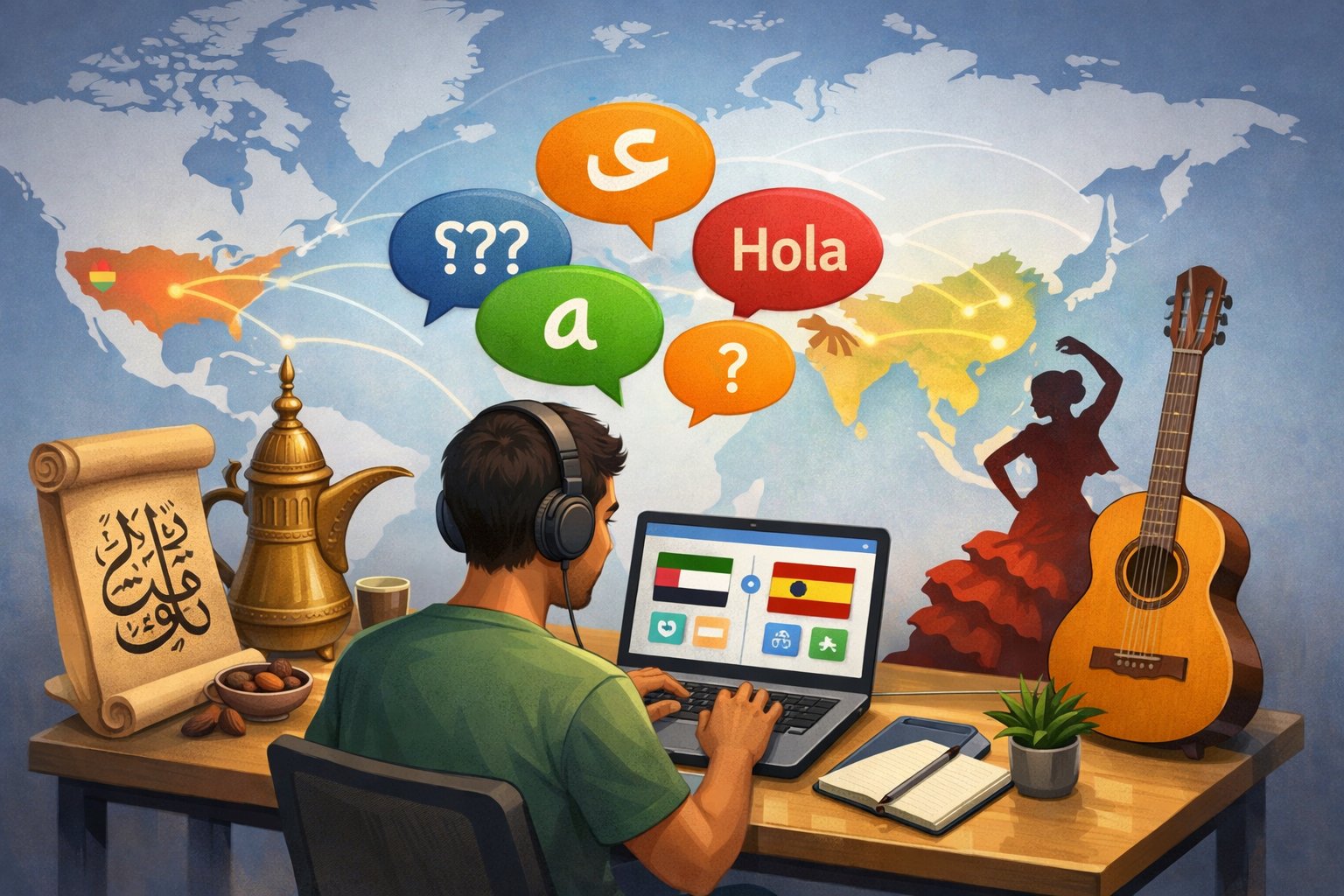
Understanding the Unique Challenges for Arabic Speakers
Arabic speakers run into some unique issues with Spanish: the writing, the sounds, and the grammar are just built differently. The gap between Arabic and Spanish means you need specific hacks for the alphabet, pronunciation, and grammar.
Alphabet and Script Differences
Script System Comparison
| Feature | Arabic | Spanish |
|---|---|---|
| Alphabet type | Arabic script (28 letters) | Latin alphabet (27 letters) |
| Writing direction | Right to left | Left to right |
| Letter forms | 4 forms per letter (isolated, initial, medial, final) | 1-2 forms per letter (uppercase, lowercase) |
| Vowel notation | Short vowels optional (diacritics) | All vowels mandatory |
| Connected letters | Most letters connect | Letters remain separate |
Key Adjustments Required
- Switch reading direction: right-to-left → left-to-right
- Learn brand-new letter shapes; nothing looks familiar
- Write every vowel, not just some
- Spot uppercase/lowercase (A/a, N/n, R/r)
- Write letters separately, not connected
Rule → Example:
"Always write Spanish from left to right." → mesa (table), not اسم (name).
Arabic speakers basically start from scratch with the Latin alphabet - no shortcuts here.
Phonological and Pronunciation Hurdles
Sounds Absent in Arabic
| Spanish Sound | Example Word | Description |
|---|---|---|
| /p/ | papa (potato) | Voiceless bilabial stop |
| /v/ | vino (wine) | Voiced labiodental fricative |
| rolled /r/ | perro (dog) | Alveolar trill |
| /ñ/ | año (year) | Palatal nasal |
| soft /d/ | nada (nothing) | Interdental approximant |
Arabic Sounds Not Used in Spanish
- ح (ḥ), ع (ʿ)
- ص (ṣ), ض (ḍ), ط (ṭ), ظ (ẓ)
- ق (q)
- ء (ʾ)
Common error: Arabic speakers swap /b/ for /p/ and /f/ for /v/. The rolled /r/ is tricky - it's not the Arabic "r," so the tongue needs retraining.
Spanish vowels are always clear and steady (a, e, i, o, u). Arabic has long/short vowels and different qualities, so holding the vowel steady in Spanish is key.
Spanish Grammar Difficulties
Gender System Challenges
- Spanish: -o (masculine), -a (feminine) endings
- Arabic: Gender not always shown by ending
- Adjectives must match noun gender: gato negro vs. gata negra
- Articles: el (masc.), la (fem.)
Verb Conjugation Differences
| Aspect | Spanish | Arabic |
|---|---|---|
| Conjugation basis | Stem + ending | Root + pattern |
| Regular patterns | 3 main groups (-ar, -er, -ir) | 10+ verb forms (أوزان) |
| Person markers | Suffix-based | Prefix and suffix |
| Tense formation | Auxiliary verbs + participles | Internal vowel changes |
Rule → Example:
"Spanish verbs change endings for each subject." → yo hablo (I speak), tú hablas (you speak).
Arabic speakers have to learn full conjugation tables - no more root-swapping.
Word Order Flexibility
- Spanish: Subject-Verb-Object is standard
- Arabic: VSO or SVO is possible
- Spanish questions flip verb and subject: ¿Hablas español?
False Cognates and Vocabulary Pitfalls
Shared Vocabulary from Historical Contact
| Spanish Word | Arabic Origin | Meaning |
|---|---|---|
| aceite | az-zayt | oil |
| azúcar | as-sukkar | sugar |
| almohada | al-mikhadda | pillow |
| alcohol | al-kuḥl | alcohol |
False Friends to Avoid
- Words that look similar but aren’t: don’t assume meaning based on looks.
Romance Language Roots
| Category | Example Spanish Words | Arabic Connection |
|---|---|---|
| Family terms | madre, padre, hijo, hija | None |
| Common verbs | ser, estar, tener, hacer | None |
| Daily objects | mesa, silla, puerta, ventana | None |
85-90% of Spanish words have no Arabic link. Focus on Latin roots and new word families.
Core Principles of Spanish Acquisition from Arabic
Arabic speakers can use shared roots and familiar sounds, but success comes from building a strong base, drilling pronunciation, and starting with the most common words.
Building a Strong Spanish Foundation
Shared Elements
| Element | Arabic Origin | Spanish Word | Meaning |
|---|---|---|---|
| Vocabulary | al-zaytūn | aceituna | olive |
| Vocabulary | al-mukhadda | almohada | pillow |
| Vocabulary | al-qāḍī | alcalde | mayor |
| Prefix pattern | al- | al- | in 4,000+ words |
Rule → Example:
"Spot the 'al-' prefix for Arabic loanwords." → almohada (pillow)
Foundation Sequence
- Match top 500 Spanish words to Arabic
- Drill present tense verbs (hablar, comer, vivir)
- Practice gender agreement with Arabic-derived nouns
- Add a new verb tense every 10–15 days
Grammar Transfer Points
- Both use gendered nouns
- Both are verb-heavy
- Arabic "al-" maps to Spanish "el/la"
Start with food, home items, admin words, and place names.
Prioritizing Pronunciation Early
Critical Sound Distinctions
| Spanish Sound | Arabic Equivalent | Common Error | Fix |
|---|---|---|---|
| /r/ (tap) | ر | over-rolling | tap tongue once |
| /rr/ (trill) | emphatic ر | not enough roll | practice "carro" vs "caro" |
| /e/ | between ِ and َ | too open | smile while saying |
| /o/ | between ُ and َ | too open | round lips |
| /v/ | none | use /b/ | bite lower lip |
Daily Drill Routine
- Listen to minimal pairs (pero/perro, baca/vaca) – 3 min
- Record yourself
- Compare with Spanish audio
- Repeat problem sounds 10x
- Use the sounds in real sentences
Practice Words
- rr: perro, carro, ferrocarril, guitarra
- v/b: vaca/baca, vino/bino, vela/bela
- vowels: mesa, todo, casa, leche
Rule → Example:
"Hold Spanish vowels steady, don’t slide between sounds." → mesa (not meesa or misa)
Daily audio drills build muscle memory. Most Arabic speakers can stabilize their Spanish accent in 30–45 days with focused practice.
Focusing on High-Frequency Spanish Words
Top 100 Spanish words: 50% of daily speech. Top 1,000: 85%.
Frequency-Ranked Learning Zones
| Word Range | % of Speech | Priority | Study Window |
|---|---|---|---|
| 1–100 | 50% | Urgent | Weeks 1–2 |
| 101–500 | 75% | High | Weeks 3–8 |
| 501–1,000 | 85% | Medium | Weeks 9–16 |
| 1,001–3,000 | 95% | Low | Months 5–12 |
First 20 Spanish Verbs to Know
- ser, estar, tener, hacer, ir
- poder, decir, dar, saber, querer
- ver, llegar, pasar, deber, poner
- hablar, comer, vivir, trabajar, estudiar
Rule → Master these verbs in present, preterite, and imperfect tenses before adding more.
Common Noun Categories
- Time: día, año, vez, hora, momento, tiempo
- People: persona, gente, hombre, mujer, niño, amigo
- Location: casa, lugar, ciudad, país, mundo, calle
- Abstract: cosa, parte, forma, manera, problema, vida
Acquisition Steps
- Study word + audio
- Review 3–5 sample sentences
- Write a personal sentence
- Recall from memory after 1 hour, 1 day, 3 days
- Use in conversation or writing within a week
Rule → Retrieval practice beats re-reading for memory. Each recall without help creates a stronger mental link.
Spanish Words With Arabic Roots (Prioritize These)
aceituna, almohada, alcalde, azúcar, barrio, hasta, ojalá, alfombra, arroz, naranja
Arabic speakers process these faster due to sound similarity.
Microlearning Strategies That Outperform Traditional Study
Short Sessions Work Best
- 5–10 minute bursts > 1-hour classes
- Daily micro-sessions fit busy schedules
Spaced Repetition for Fast Vocabulary Retention
Review Intervals
| Session | Time After Learning | Retention Rate |
|---|---|---|
| 1st review | 1 day | 85% |
| 2nd review | 3 days | 78% |
| 3rd review | 7 days | 72% |
| 4th review | 14 days | 68% |
Apps: Memrise, Duolingo (spaced repetition); Babbel (Arabic pronunciation guides)
Memory Loop
- Encoding: Learn 5–7 new words in 5 minutes
- Retrieval: Test recall after 24 hours, no notes
- Reinforcement: Review missed words next day, correct ones after 3 days
Rule → Use Busuu for corrections from Spanish speakers within 24 hours.
Leveraging Cognates with Arabic Roots
Spanish Words With Arabic Origins
| Spanish Word | Arabic Root | English |
|---|---|---|
| almohada | المخدة (al-mikhadda) | pillow |
| aceituna | الزيتون (az-zaytūn) | olive |
| azúcar | السكر (as-sukkar) | sugar |
| alfombra | الحنبل (al-ḥanbal) | carpet |
| albañil | البناء (al-bannā’) | builder |
Rule → Group cognates by topic and practice with both scripts. The "al-" prefix appears in 400+ Spanish words.
Use microlearning techniques to review these patterns in 3–5 minute sessions.
Using Set Phrases for Everyday Communication
Essential Phrases
| Spanish Phrase | Use Case | Common Reply |
|---|---|---|
| por favor | Requests | de nada |
| gracias | Thanks | de nada / no hay de qué |
| ¿cómo estás? | Greetings (informal) | bien, ¿y tú? |
| lo siento | Apologies | no pasa nada |
| dónde está el baño | Asking for bathroom | a la derecha / todo recto |
Rule → Learn full phrases, not just words, for faster recall.
Daily Practice Method
- Listen to Spanish audio 3x
- Repeat aloud (no reading)
- Write your own sentence
- Record yourself and compare to a Spanish speaker
Five-minute sessions boost fluency more than long, infrequent lessons. Apps: Duolingo, Babbel (interactive phrase practice).
Formal vs. Informal
| Phrase | Use With |
|---|---|
| ¿cómo estás? | Friends, family |
| ¿cómo está? | Strangers, elders |
Rule → Match formality to the situation, as in Arabic.
Immersive and Contextual Learning Methods
Immersion Beats Textbooks
| Method | How-To | Time Needed |
|---|---|---|
| Label household items | Sticky notes in Spanish around the home | 30 min setup |
| Change device language | Set phone, PC, apps to Spanish | 5 min |
| Spanish-only hours | Speak/think only in Spanish for a block | 1–2 hours daily |
Home immersion works without travel.
Abroad Immersion
| Option | Key Feature |
|---|---|
| Immersion programs | Live in Spanish-speaking country |
| Host family stay | Daily survival in Spanish |
Immersion programs and host families force active use.
Consuming Spanish Media Intentionally
Viewing Strategy
- Watch movies with Spanish subtitles
- Start with learner TV, then real Spanish content
- Rewatch episodes
| Content Type | Beginner Picks | Intermediate Picks |
|---|---|---|
| Movies | Animated, slow dialogue | Drama, comedy |
| TV | Kids’ shows, telenovelas | News, documentaries |
| Music | Clear lyrics, slow songs | Rap, regional styles |
| Podcasts | Easy Spanish, learner podcasts | Real Spanish podcasts |
Music: Trains rhythm and vowels.
Podcasts: Easy Spanish for controlled vocab.
Reading Integration
- Start with graded readers
- Use children’s books for vocab
- Progress to familiar genres
- Watch with Spanish subtitles
Rule → Pair audio and text for faster recognition.
Practicing with Real Spanish Conversations
Conversation Partner Types
| Partner | Find Via | Main Benefit |
|---|---|---|
| Spanish speaker | Apps, meetups | Natural corrections |
| Fellow learner | Study groups, forums | Low-pressure practice |
| Tutor | italki, Preply | Structured feedback |
Practice Progression
- Start with memorized dialogues
- Move to semi-structured topics
- Try unscripted chats
- Attempt debates or stories
Correction Loop
- Record and review errors
- List unknown but needed words
- Drill weak spots before next chat
- Gradually speed up and add complexity
Rule → Regular conversation moves words from passive to active memory.
Interactive Tools and Platforms for Arabic Speakers
Top Language Exchange Platforms
| Platform | Arabic Support Features | Cost |
|---|---|---|
| HelloTalk | Arabic UI, text/voice feedback | Free/premium |
| Tandem | Spanish-speaker match, video calls | Free/premium |
| ConversationExchange | In-person, pen pals | Free |
Practice Focus
- Drills for rolled "r," "ñ," "j"
- Verb conjugation feedback
- Idiomatic phrases not in Arabic
Rule → Partners quickly spot gender and agreement errors.
Recommended Apps and Classes
| App/Platform | Arabic Support | Focus Area |
|---|---|---|
| SpanishPod101 | Arabic explanations | Audio lessons |
| LingQ | Import Arabic texts | Reading |
| Butterfly Spanish | Arabic subtitles | Grammar |
| Preply | Arabic tutors | Structured lessons |
Key Features
- Built-in bilingual dictionaries
- Spaced repetition for verbs
- Audio samples from several dialects
Courses for Arabic speakers introduce the Latin alphabet first, then vocabulary.
Finding Tutors Specialized for Arabic Learners
Arabic-Specialized Tutor Services
| Service | What They Offer |
|---|---|
| Preply (filter for Arabic) | Tutors who speak Arabic |
| italki (language pair search) | Arabic-Spanish specialists |
| Onsanyol | Tutors in Arab countries (Egypt, Saudi, Jordan) |
What to Ask Tutors
- Experience with Arabic speakers
- Familiarity with Arabic–Spanish false friends
- Use of Arabic grammar terms to explain Spanish
Rule → Choose tutors who can map Spanish tenses and articles to Arabic grammar.
Optimizing Study Plans for Consistent Progress
Progress Tracking & Motivation
| Milestone Type | Example Target |
|---|---|
| Vocabulary | 500 words by Week 8 |
| Conversation | 10-minute chat without notes by Month 3 |
| Media | Finish a Spanish movie without subtitles |
| Writing | Write a 200-word story in Spanish by Month 4 |
Rule → Set measurable, time-bound goals to maintain momentum. If stuck, switch study methods or increase conversation frequency.
Setting Realistic Goals and Tracking Growth
Weekly Target Framework
| Time Available | Vocabulary Goal | Grammar Units | Speaking Practice |
|---|---|---|---|
| 3-4 hrs/week | 20–30 new words | 1 verb tense | 2 sessions (15 min each) |
| 5-7 hrs/week | 40–50 new words | 2 grammar topics | 3 sessions (20 min each) |
| 8+ hrs/week | 60–80 new words | 3 grammar topics | Daily (15–30 min) |
Measurable Progress Indicators
- Week 1–4: Greet, introduce yourself, ask basics
- Week 5–8: Order food, give directions, describe daily routine
- Week 9–12: Express preferences, discuss past events, make plans
Tracking Methods
- Log new words in a spaced repetition app (review: 1, 3, 7, 14 days)
- Record a 30-second Spanish voice memo weekly
- Complete a timed conversation exchange each week
Arabic Speaker Tips
- Start with cognates (universidad, teléfono, hospital)
- Track both recognition and recall skills
Overcoming Plateaus and Maintaining Motivation
Plateau Signals
- No vocab improvement for 2+ weeks
- Avoiding speaking practice
- Skipping sessions
- Conversations not getting longer
Reset Strategies
- Change input: Try podcast transcripts for a week
- Reverse task: Translate Spanish → Arabic
- Add constraint: Use only present tense for 3 days, then only past
- Raise stakes: Book a paid tutor session in 10 days
Maintenance Tactics
| Problem | Solution |
|---|---|
| Boredom | Rotate news, music, stories weekly |
| Forgetting verbs | Drill one tense daily, removing words as you go |
| Low confidence | Practice structured routines with Spanish audio |
| Unclear progress | Take DELE mock exam every 6 weeks |
Accountability Structure
- Join Spanish–Arabic exchange (at least 2 partners)
- Post weekly goals publicly
- Use an app with a streak counter (5+ days/week)
Rule → Example
Rule: Isolate one verb tense and repeat 50 times before adding another.
Example: Drill present tense with 50 sentences before trying past tense.
Consistency beats session length.
Frequently Asked Questions
What resources are recommended for Arabic speakers to learn Spanish effectively?
Digital Platforms
- Language apps with Arabic interface
- Online courses with Arabic–Spanish translation
- Voice recognition for pronunciation
- Interactive lessons (audio/video)
Traditional Materials
- Spanish–Arabic dictionaries
- Grammar workbooks comparing both languages
- Audio courses with natural pronunciation
- Vocabulary lists (cognates, frequency)
Community Resources
- Language exchange partners (Spanish/Arabic)
- Online forums for learners
- Videos with Arabic subtitles
- Spanish media with dual-language support
Talkpal: Spanish lessons for Arabic speakers - includes translation and pronunciation tools.
Are there any similarities between the Arabic and Spanish languages that can facilitate learning?
Historical Connections
- 4,000+ Spanish words from Arabic (Moorish era, 711–1492 CE)
Common Vocabulary
| Spanish | Arabic Origin | English |
|---|---|---|
| azúcar | al-sukkar | sugar |
| almohada | al-mikhadda | pillow |
| aceite | al-zayt | oil |
| azul | al-lazward | blue |
| alfombra | al-hanbal | carpet |
| naranja | naranj | orange |
Phonetic Similarities
- Both have guttural sounds
- Clear vowel pronunciation
- Emphatic consonants in some words
- Rhythm and stress patterns can overlap
Grammatical Parallels
- Gendered nouns (masc./fem.)
- Verb changes by subject
- Adjective–noun agreement
- Definite articles before nouns
Leverage similarities for faster vocab growth.
What are the best methods to practice Spanish for someone fluent in Arabic?
Daily Speaking
- Record yourself reading Spanish
- Shadow Spanish audio
- Practice rolled "r" daily
- Repeat verb conjugations with different subjects
Active Listening
- Listen to Spanish podcasts with transcripts
- Watch TV with Arabic, then Spanish subtitles
- Use news audio for drills
- Play Spanish music and read lyrics
Writing
- Translate diary entries into Spanish
- Write daily sentences using new words
- Complete verb tense exercises
- Label home items in Spanish
Conversation
- Join online language exchanges
- Video chat with Spanish speakers
- Use speech-to-text for pronunciation checks
- Attend local Spanish groups
Structured Routine
- Learn 10–15 new words daily
- Practice verbs 15 min
- Listen to Spanish 20–30 min
- Speak or write 15 min
- Review yesterday’s material before bed
Can learning Spanish through immersion improve fluency faster for Arabic speakers?
Immersion Effectiveness
- Immersion = 2–3x faster progress than classroom study
Immersion Types
| Method | Daily Exposure | Fluency Timeline |
|---|---|---|
| Living abroad | 8–12 hrs | 3–6 months |
| Virtual immersion | 3–5 hrs | 6–12 months |
| Classroom + immersion | 2–3 hrs | 12–18 months |
| Weekend programs | 15–20 hrs/mo | 18–24 months |
Home Immersion Ideas
- Change device language to Spanish
- Watch only Spanish shows
- Think/talk to yourself in Spanish
- Use Spanish recipes
Benefits for Arabic Speakers
- Forces Spanish structure use
- Trains ear for Spanish sounds
- Builds automatic responses
- Gives cultural context for words
What are common challenges Arabic speakers face when learning Spanish?
Grammar Differences
| Feature | Arabic | Spanish | Challenge |
|---|---|---|---|
| Word order | Flexible VSO/SVO | Strict SVO | Moderate |
| Verb system | Root-based | Conjugation-based | High |
| Articles | Limited | Definite/indefinite | Moderate |
| Adjective placement | Usually after noun | Before/after (meaning shift) | Moderate |
Pronunciation Obstacles
- Rolled "r" (not in most dialects)
- Soft "d" at word ends
- Pure vowels, no diphthongs
- "V" sound (Arabic uses "f"/"b")
- Silent "h" (Arabic "h" pronounced)
Verb Conjugation Complexity
- Spanish verbs change by person, tense, mood, aspect
- Arabic: root patterns; Spanish: memorize endings
False Cognates
| Word | False Friend | Actual Meaning |
|---|---|---|
| embarazada | embarrassed | pregnant |
| constipado | constipated | having a cold |
| éxito | exit | success |