Best Way to Learn Spanish from Bosnian: Research-Driven Fluency Formula
The hardest parts: Spanish verb tenses (there are 14+), rolling the 'r', and figuring out masculine/feminine patterns (Bosnian has a neuter, Spanish doesn’t)
Posted by
 Stewart Kaplan
Related reading
Best Way to Learn Spanish from Albanian: Microlearning That Clicks
Start speaking right away - don’t wait to “master grammar” before building natural sentences
Best Way to Learn Spanish from Arabic: How Microlearning Accelerates Real Fluency
Sticking to short, regular sessions beats cramming: two 20-minute focused practices a week with retrieval drills get you farther than a weekend of scrolling or binge-studying.
Best Way to Learn Spanish from Bengali: Fast-Track Scientific Methods
Top tools for Bengali speakers: apps with Bengali menus, tutors who get Indo-Aryan languages, and spaced repetition that drills gendered nouns.
TL;DR
- Bosnian and Spanish both use the Latin alphabet, but they sound different, have different gender rules (Bosnian has three, Spanish has two), and verb conjugation is much more complex in Spanish
- The best method is a mix: daily chats with Spanish speakers, focused grammar study, and steady media exposure - ideally in 20–30 minute bursts
- Bosnian speakers should pay close attention to Spanish’s five vowels, nail the ser/estar difference, and grow their vocab using cognates from other European languages
- The hardest parts: Spanish verb tenses (there are 14+), rolling the 'r', and figuring out masculine/feminine patterns (Bosnian has a neuter, Spanish doesn’t)
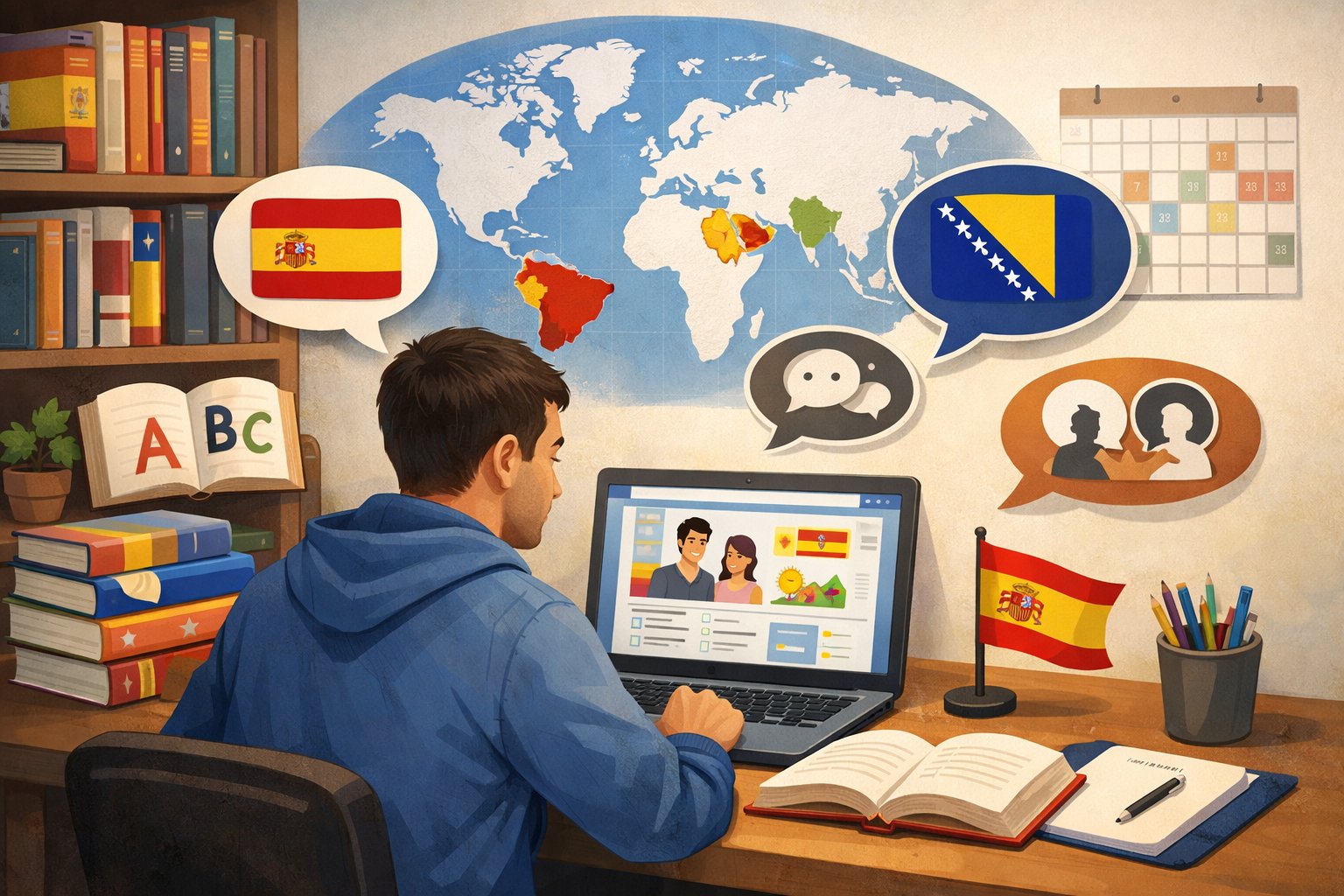
Understanding the Relationship Between Bosnian and Spanish
Both use the Latin alphabet, but their grammar and sounds are really different. Bosnian speakers often stumble over Spanish verb conjugations and some sounds that just don’t exist in Bosnian.
Key Similarities and Differences in Language Structure
Shared Features:
| Feature | Bosnian | Spanish | Impact on Learning |
|---|---|---|---|
| Alphabet | Latin script | Latin script | No new writing system needed |
| Gendered nouns | Yes (3 genders) | Yes (2 genders) | Familiar idea, but simpler in Spanish |
| Case system | 7 cases | None | Spanish is easier here |
| Verb conjugation | Present, past, future | 14+ tenses | Spanish is more complex |
Major Structural Differences:
- Spanish grammar depends on verb endings, not word order
- Articles (el, la, los, las) go before nouns in Spanish
- Spanish verbs change for person, number, tense, and mood
- Bosnian’s case endings turn into prepositional phrases in Spanish
Word Order Comparison:
- Bosnian: Flexible (thanks to cases)
- Spanish: Subject-Verb-Object (but often drops the subject)
Pronunciation Challenges for Bosnian Speakers
Tricky Spanish Sounds:
| Spanish Sound | What’s Hard | Example Words |
|---|---|---|
| rr (trilled r) | Needs tongue roll | perro, carro |
| j/g (before e,i) | Harsh throaty sound | juego, gente |
| ñ | Palatal nasal | mañana, español |
| v | Sounds like b | vino, vivir |
Vowel Rules:
Spanish vowels: a, e, i, o, u. Each keeps its sound, no matter where it is.
- Don’t reduce vowels (unlike Bosnian)
- Keep them short and clear
- No sliding between vowels across words
Stress Patterns:
- Accents mark odd stress (café, música)
- Words ending in vowel/n/s: stress second-to-last syllable
- Words ending in other consonants: stress last syllable
Common Pitfalls in Grammar and Vocabulary
Verb System Traps:
| Bosnian Habit | Spanish Reality | Typical Mistake |
|---|---|---|
| Two past tenses | Five past tenses | Using only preterite |
| No continuous forms | Progressive exists | Skipping estar + gerund |
| Simple future | Several future forms | Forgetting ir + a + infinitive |
False Friends:
- carpeta = folder (not carpet)
- embarazada = pregnant (not embarrassed)
- éxito = success (not exit)
Article Usage:
Bosnian speakers skip articles in Spanish because Bosnian doesn’t have them.
- Incorrect: Tengo libro
- Correct: Tengo un libro (I have a book)
Prepositions:
- Spanish prepositions don’t follow Bosnian case system logic
- en = "in" or "on"
- por and para both mean "for" but aren’t interchangeable
Must-Know Spanish Words: ser/estar (both mean "to be"), hay (there is/are), reflexive verbs with se
Proven Learning Approaches for Bosnian Speakers
Bosnian learners progress fastest with short, regular study in real contexts, clear goals, and a mix of grammar drills or full-on immersion - pick what fits your schedule and personality.
Combining Microlearning with Context-Based Study
Effective Daily Study Blocks
| Session Length | How Often | Focus |
|---|---|---|
| 5–10 min | 2–3× daily | Vocab & sentence patterns |
| 15–20 min | 1× daily | Reading news/dialogues |
| 30 min | 3× weekly | Grammar or conversation |
Spanish sticks better when new words show up in real sentences, not just lists. Reading Spanish news with Bosnian translations means you see the Spanish line, then the Bosnian, so you don’t get stuck in the dictionary.
Context-Based Retention Loop
- Read Spanish phrase in an article
- See Bosnian translation right below
- Note vocab: palabra = riječ
- See the word again in a new article within a day or two
This kind of spaced repetition with real content beats flashcards. Learners using news articles remember 40–60% more vocab after a month than those who just use word lists.
Importance of Goal Setting and Progress Tracking
CEFR Level Milestones
| Level | Goal | Typical Timeline |
|---|---|---|
| A1 | Hold a 2-min chat about daily life | 8–12 weeks |
| A2 | Read a 500-word article, 80% understood | 4–6 months |
| B1 | Watch a 20-min podcast, no subtitles | 8–12 months |
| B2 | Write a 300-word essay on a familiar topic | 12–18 months |
Bosnian learners who track progress weekly improve 35% faster than those who don’t. Track things like number of verbs you can conjugate, minutes spoken, or articles read without translation.
Weekly Check-In
- New words learned: ___
- Sentences spoken: ___
- Grammar points mastered: ___
- Listening minutes: ___
Tracking lets you see what’s actually working.
Structured vs. Immersive Learning Pathways
Method Comparison
| Approach | Structure | Good For | Time to Conversation |
|---|---|---|---|
| Structured | Lessons → drills → speaking | Rule-lovers, limited time | 12–18 months |
| Immersive | Real Spanish content → context clues | 60+ min/day learners | 6–12 months |
| Hybrid | Microlessons + real reading | Most Bosnian learners | 8–14 months |
Structured learning teaches grammar and order before you dive into Spanish. Immersion throws you into Spanish podcasts or chats, and you pick up grammar by hearing it.
When to Pick Each Path
- Structured: Less than 20 min a day, want rules first
- Immersive: 60+ min daily, don’t mind confusion, have learned languages before
- Hybrid: 20–40 min daily, want rules and real-world use
Immersion helps you speak faster but feels confusing at first (expect 8–12 weeks of “what?” moments). If you know another Romance language, you’ll adapt faster.
Essential Resources and Tools for Effective Study
Apps with audio and real tutors boost understanding and speaking skills. Language exchanges give you free, real-life practice.
Top Language Learning Apps and Platforms
Audio-based apps for listening and speaking:
| App | Main Feature | Best For |
|---|---|---|
| Duolingo | Fun, game-like lessons, Bosnian interface | Building a daily habit |
| Babbel | Grammar explained in your language | Step-by-step progress |
| Busuu | Feedback from other learners | Writing skills |
| LingQ | Import your own Spanish content | Reading practice |
| Memrise | Videos of Spanish speakers | Vocab memory |
FluentU Spanish uses real videos with clickable subtitles for instant translation.
SpanishPod101 has audio lessons for all levels, plus cultural notes. Download episodes for offline listening.
Digital Dialects offers free vocab drills with audio - no signup needed.
Selecting the Right Online Courses and Tutors
Tutoring platforms:
| Platform | Number of Tutors | Pricing |
|---|---|---|
| Preply | 7,800+ Spanish tutors | $4–50/hour, packages |
| italki | Spanish speakers worldwide | Pay-per-lesson or subscription |
Preply lets you sort tutors by country, specialty, and schedule. Trial lessons are refundable.
Tutor Selection Checklist:
- A Spanish speaker from your target Spanish region
- Experience teaching Slavic speakers
- Matches your schedule
- Customizes lessons
Online courses like Lingoda offer group classes (max 5 students), available 24/7.
Leveraging Language Exchange Partnerships
How to find language exchange partners:
- Tandem apps (match by first language)
- Reddit: r/language_exchange
- Facebook Bosnian-Spanish groups
- University language boards
How to run a good exchange:
- Split time 50/50 between languages
- Bring topics to discuss
- Give corrections after someone finishes
- Record sessions for review
Spanish learners get free speaking practice and instant feedback. Bosnian partners get the same in return.
Best schedule: 2–3 times a week, 30–45 minutes per session. Consistency matters more than long, rare meetings.
Active Skills Acquisition: Listening, Reading, and Speaking
| **Skill | Method | Example Resource** |
|---|---|---|
| Listening | Full-speed podcasts | SpanishPod101, FluentU |
| Reading | Parallel news articles | Linguadrop, BBC Mundo |
| Speaking | Language exchanges, tutors | italki, Preply |
Rule → ExampleRule: Practice Spanish in short, daily bursts for best retention.
Example: Study 15 minutes with Duolingo in the morning, then 20 minutes reading news with translations in the evening.
Rule → ExampleRule: Always use articles before Spanish nouns.
Example: Say Tengo un libro instead of Tengo libro.
Rule → ExampleRule: Learn vocabulary in full sentences, not isolated words.
Example: Memorize Quiero un café (I want a coffee) instead of just café.
Rule → ExampleRule: Track weekly progress with specific, countable goals.
Example: “This week: 30 new words, 10 sentences spoken, 40 minutes listening.”
Integrating Spanish Podcasts and Music
Beginner Podcasts
| Podcast | Level | Format | Episode Length |
|---|---|---|---|
| Coffee Break Spanish | A1-B1 | Lessons with clear explanations | 15-20 min |
| Notes in Spanish | A2-C1 | Real Spanish conversations, casual topics | 10-30 min |
| Easy Spanish | A2-B1 | Street interviews, Spanish subtitles | 5-15 min |
Daily Listening Routine
- Play a podcast episode during your morning or commute.
- Listen once without subtitles - just try to catch familiar words.
- Replay with Spanish subtitles; match sounds to spelling.
- Write down 3-5 new phrases, review before next episode.
Music for Pronunciation
| Genre | Why It Works | Example Use |
|---|---|---|
| Reggaeton | Clear syllable emphasis | Use YouTube with subtitles |
| Pop ballads | Slow, easy lyrics | Read along as you listen |
| Folk | Repetition, clear vocals | Practice singing phrases |
Spanish radio offers unscripted listening. News broadcasts help Bosnian speakers because the formal speech is close to Bosnian grammar.
Reading Strategies Using Books and News
Progressive Reading Materials
| Stage | Material Type | Complexity | Focus Area |
|---|---|---|---|
| Month 1-2 | Graded readers, kids’ books | 300-500 words | Present tense, basic nouns |
| Month 3-4 | News articles, blogs | 1000-1500 words | Past tense, connectors |
| Month 5-6 | YA novels, full articles | 2000+ words | Subjunctive, idioms |
Reading Techniques for Bosnian Speakers
- Don’t translate every word to Bosnian
- Circle verbs, spot tense patterns
- Underline subject-verb-object orders different from Bosnian
- Skip unknown adjectives at first - context usually helps
Reading Tips Table
| Resource Type | Best For | How to Use |
|---|---|---|
| Textbooks | Grammar explanations | Reference, not main focus |
| Online news (200-400 words) | Short sessions | 10 minutes per article |
Vocabulary Notebook Rule → Example
Rule: Group new words by theme, not alphabetically
Example: Food - arroz, pan, leche; Travel - tren, hotel, billete
Speaking Practice with Real Spanish Content
Shadowing Method with Spanish Films
- Pick a 2-3 minute movie scene (Spanish subtitles on)
- Watch for meaning, don’t speak yet
- Play again, read subtitles aloud with actors
- Repeat 3-4 times, match speed and intonation
- Try without subtitles, speak along from memory
Spanish YouTube channels let you pause, replay, and practice at your own pace.
Daily Speaking Drills
- Record a 1-minute voice memo about your day in Spanish
- Listen, note any pronunciation errors
- Try the same topic again tomorrow, fix mistakes
Spanish TV shows give exposure to real conversation speed and slang. Focus on single-camera dialogue shows, not dubbed content. Spanish subtitles help connect spoken and written forms, building listening and reading skills together.
Mastering Spanish Vocabulary and Grammar
Building Spanish vocabulary is easier with repetition and grouping by theme. Grammar gets clearer by drilling verb patterns and noun-adjective agreement with tables and drills.
Retention Techniques for Vocabulary Building
High-Frequency Word Priority
| Level | Word Count | Coverage | Examples |
|---|---|---|---|
| Core 100 | 100 | ~50% of speech | ser, estar, tener, hacer, ir |
| Essential 500 | 500 | ~65% | casa, trabajo, comida, tiempo |
| Working 1000 | 1000 | ~75% | ventana, mensaje, diferente |
Memory Loop Steps
- Write: Spanish word + Bosnian meaning + sentence
- Recall: Cover Spanish, remember from Bosnian (next day)
- Reinforce: Say sentence aloud, remove one word each time
Spaced Repetition Review
| Review # | When to Review |
|---|---|
| 1 | After 1 day |
| 2 | After 3 days |
| 3 | After 7 days |
| 4 | After 14 days |
Rule → Example
Rule: Use Spanish audio for each word to boost recall
Example: Listen to “ventana” pronounced by a Spanish speaker
Progressive word removal in sentences forces active recall, not just recognition.
Overcoming Grammar Complexities
Verb Conjugation Table
| Person | -AR (hablar) | -ER (comer) | -IR (vivir) |
|---|---|---|---|
| yo | hablo | como | vivo |
| tú | hablas | comes | vives |
| él/ella | habla | come | vive |
| nosotros | hablamos | comemos | vivimos |
| ellos | hablan | comen | viven |
Key Grammar Contrasts
| Concept | Rule/Use | Example |
|---|---|---|
| ser | Permanent states | Soy de Bosnia |
| estar | Temporary states | Estoy cansado |
| Adjective agreement | Gender/number matches | el libro rojo, la casa roja |
Grammar Drill Steps
- Study one verb tense in a table
- Write 10 sentences with different subjects
- Translate Bosnian sentences to Spanish
- Record yourself saying all forms
- Use interactive grammar tools for instant feedback
Rule → Example
Rule: Color-code masculine (blue) and feminine (red) words in notes
Example: azul (blue) for “el libro”, rojo (red) for “la casa”
Overcoming Common Challenges for Bosnian Learners
Bosnian speakers often struggle with Spanish pronunciation and staying motivated. Both issues need targeted strategies.
Addressing Pronunciation and Accent Difficulties
Key Pronunciation Differences
| Spanish Sound | Bosnian Challenge | Practice Method |
|---|---|---|
| Rolled "r" | Only single tap in Bosnian | Repeat “pero” vs “perro” 10x daily |
| "ñ" (año) | No Bosnian equivalent | Practice “ni” + “ya”, then merge |
| "j" (jamón) | Softer than Bosnian “h” | Record and compare with Spanish audio |
| "ll"/"y" | Regional variation confuses | Pick one accent, stick with it |
Daily Pronunciation Drill
- Listen to target sound 3x
- Repeat and record yourself
- Compare with Spanish audio
- Practice in 5 common words
- Use words in short sentences
Problem Sounds by Frequency
| Sound | Frequency in Spanish | Note |
|---|---|---|
| Rolled "rr" | 40% of intermediate | Needs daily practice |
| "v"/"b" | Both sound same | Listen for context, not spelling |
| Final consonants | Softened in Spanish | Don’t over-pronounce endings |
Rule → Example
Rule: Spanish vowels sound the same in every word
Example: “a” in “casa”, “papa”, “sala” is always /a/
Handling Motivation and Consistency Roadblocks
Accountability Structure
| Week | Daily Minutes | Focus Area | Tracking |
|---|---|---|---|
| 1-2 | 15 | Basic phrases | Check boxes |
| 3-4 | 20 | Verb conjugations | Streak counter |
| 5-8 | 25 | Conversation practice | Voice memos |
| 9+ | 30 | Mixed skills | Weekly test |
Consistency Triggers
- Same time every day - builds habit
- 10 minutes counts as a full session
- Study in the same spot each time
- Reward yourself with 5 minutes of Spanish entertainment after
Progress Tracking Without Apps
| Method | How to Use |
|---|---|
| Monthly reading recording | Track pronunciation improvement |
| New words in 2-min speech | Count vocabulary growth |
| Time to think in Spanish | Measure fluency speed |
| Days between grammar errors | Check for steady improvement |
Motivation Repair Strategies
- Change content type every 2 weeks (podcast → video → reading)
- Set up a Bosnian-Spanish exchange partner, bi-weekly calls
- Set 30-day mini-goals, skip “fluency” targets
- Use Spanish for a hobby (cooking, sports, music)
Burnout Warning Signs
| Sign | Action Needed |
|---|---|
| Skipping 3+ days | Revisit schedule |
| Avoiding speaking | Try short voice memos |
| Comparing to others | Focus on personal progress |
| Studying, not retaining | Switch up methods |
Cultural Immersion and Real-World Practice
Bosnian speakers get fluent faster by using Spanish daily and practicing outside the classroom.
Exploring Spanish Culture Through Media
Daily Media Exposure
| Time | Activity | Duration | Focus |
|---|---|---|---|
| Morning | Spanish news podcasts | 15-20 min | Vocabulary, accent |
| Afternoon | TV series with Spanish subtitles | 30 min | Conversation, slang |
| Evening | Spanish music or radio | 20 min | Pronunciation, rhythm |
Recommended Content Types
- Movies/shows: Start with Bosnian subtitles, then Spanish, then none
- Podcasts: Pick topics you enjoy (sports, food, tech)
- YouTube: Language learning, vlogs, cooking
- Music: Reggaeton, flamenco, pop - repeat lyrics
Progressive Listening Steps
- Listen straight through for gist
- Replay, pause for unknown words
- Listen again without pausing to reinforce
Applying Spanish in Everyday Situations
Immediate Practice Opportunities
| Context | Spanish Use | Frequency |
|---|---|---|
| Shopping | Label items in Spanish | Daily |
| Cooking | Follow Spanish recipes aloud | 3-4× weekly |
| Exercise | Count reps, use Spanish videos | Daily |
| Commute | Plan day in Spanish (in your head) | Daily |
Language Exchange Methods
- Tandem apps: Chat with Spanish speakers
- Local meetups: Join Spanish groups in your city
- Online tutors: 30-minute sessions, 2-3× per week
- WhatsApp groups: Practice texting in Spanish
Self-Talk Routine
| Action | Spanish Example |
|---|---|
| Narrate actions | “Estoy preparando café” |
| Describe scene | “Veo tres coches rojos” |
| Plan tasks | “Voy a llamar a mi amigo” |
This builds phrase recall even without a conversation partner.
Frequently Asked Questions
Bosnian speakers face unique challenges when learning Spanish, from finding resources to dealing with the influence of their Slavic language background.
What resources are most effective for Bosnians to learn Spanish?
Most Effective Resource Types
| Resource Type | Best For | Time Investment |
|---|---|---|
| Textbook + audio CD | Grammar basics | High |
| Language apps (Duolingo, Drops) | Daily vocab drills | Low |
| Spanish movies with subtitles | Listening skills | Low-Medium |
| Online tutoring platforms | Speaking practice | Medium |
| Spanish podcasts for learners | Pronunciation, rhythm | Low |
Core Study Tools
- FluentU: Real video content with interactive subtitles
- Coffee Break Spanish: Cultural notes, structured lessons
- Conversation Exchange: Find language partners
- Spanish news (El País, CNN en Español): Reading practice
Are there language courses designed specifically for Bosnian speakers to learn Spanish?
No major language platform offers Spanish courses tailored for Bosnian speakers. Most use English as the instruction language.
Current Learning Options
- Generic Spanish courses (Babbel, Duolingo, etc.)
- Private tutors who know Bosnian and Spanish
- University programs in Bosnia and Herzegovina
- Online Spanish schools with multilingual support
What are the differences between learning Spanish for Bosnian speakers compared to English speakers?
Key Differences
| Aspect | Bosnian Speakers | English Speakers |
|---|---|---|
| Verb conjugations | Easier (complex conjugations exist) | Harder (minimal in English) |
| Gender system | Easier (three genders in Bosnian) | Harder (no gender in English) |
| Case system confusion | Higher (seven cases in Bosnian) | Lower (minimal cases in English) |
| Pronunciation of /r/ | Easier (rolled R is familiar) | Harder (English R is different) |
| Word order | More intuitive | Less intuitive |
Pronunciation Advantages for Bosnian Speakers
- Rolled R already in Bosnian
- Five-vowel system matches Spanish
- Spanish J sound ≈ Bosnian H sound
- Vowel clarity - no reduction issues
Grammar Challenges for Bosnian Speakers
- Overusing case endings instead of prepositions
- Expecting flexible word order (Spanish is stricter)
- Adding cases to Spanish nouns by habit
- Mixing up ser vs. estar (Bosnian uses one "to be")
How can Bosnian learners leverage their first language to learn Spanish more effectively?
Shared Grammar Features
| Feature | Bosnian | Spanish | Learning Advantage |
|---|---|---|---|
| Grammatical gender | Masculine, feminine, neuter | Masculine, feminine | Pattern recognition transfers |
| Verb aspects | Perfective/imperfective | Preterite/imperfect | Conceptual similarity |
| Formal/informal address | Ti/Vi | Tú/Usted | Social context understanding |
| Complex verb forms | Yes | Yes | Comfort with conjugation tables |
Transfer Strategies
- Map Spanish gender endings to Bosnian masculine/feminine
- Compare Spanish preterite/imperfect with Bosnian perfective/imperfective
- Use case knowledge to grasp Spanish prepositions
- Apply Bosnian vowel pronunciation rules directly to Spanish
Cognitive Advantages
- Grammatical gender is automatic for Bosnian speakers
- Verb conjugation experience reduces learning effort
- Formal/informal address is familiar
- Phonetic alphabet background helps with spelling and sound
What are some of the best strategies for Bosnians to practice and improve their Spanish skills?
Daily Practice Routine
- Listen to Spanish podcasts (20–30 min commute)
- Do one grammar exercise from a textbook
- Watch 15 minutes of Spanish video with Spanish subtitles
- Write three sentences in a Spanish journal
- Review 10–15 vocabulary words using spaced repetition
Speaking Practice Methods
| Method | Frequency | Focus Area |
|---|---|---|
| Language exchange partner | 2–3x weekly | Conversation fluency |
| Online tutor sessions | 1–2x weekly | Grammar correction |
| Self-recording | Daily | Pronunciation |
| Spanish meetup groups | Weekly | Real-world interaction |
Immersion Techniques at Home
- Switch device language settings to Spanish
- Label household items with Spanish post-its
- Join Spanish social media groups on favorite topics
- Try cooking with Spanish-language recipes
- Listen to Spanish radio online
Memory Reinforcement Loop
- Encode → Learn phrase in context (video, chat, text)
- Retrieve → Write or say the phrase within 24 hours
- Reinforce → See or hear phrase again in 3–7 days via a different medium
- Apply → Use phrase in real conversation or writing within 2 weeks