Best Way to Learn Spanish from Portuguese: Accelerate Fluency Backed by Cognitive Science
If you learn Spanish before or alongside Portuguese, there’s barely any interference - as long as you pay attention to the 15-20% of vocabulary and grammar that don’t line up.
Posted by
 Stewart Kaplan
Related reading
Best Way to Learn Spanish from Albanian: Microlearning That Clicks
Start speaking right away - don’t wait to “master grammar” before building natural sentences
Best Way to Learn Spanish from Arabic: How Microlearning Accelerates Real Fluency
Sticking to short, regular sessions beats cramming: two 20-minute focused practices a week with retrieval drills get you farther than a weekend of scrolling or binge-studying.
Best Way to Learn Spanish from Bengali: Fast-Track Scientific Methods
Top tools for Bengali speakers: apps with Bengali menus, tutors who get Indo-Aryan languages, and spaced repetition that drills gendered nouns.
TL;DR
- Portuguese speakers instantly recognize about 89% of Spanish vocabulary, thanks to shared Latin roots. This overlap means learning Spanish takes roughly 40% less time than learning an unrelated language.
- The main hurdle isn’t vocabulary - it’s dodging false cognates (like embarazada/embaraçada) and getting Spanish pronunciation right, especially nasal sounds and the tricky "sh" vs "ch."
- Spaced repetition of core verbs (ser, estar, tener, hacer) with real Spanish audio boosts fluency way faster than just memorizing grammar rules. Most conversations rely on just 100-200 key words.
- Just 10 minutes a day of focused Spanish phrases with Spanish speakers helps your brain recall what you need, better than passive listening or endless translations.
- If you learn Spanish before or alongside Portuguese, there’s barely any interference - as long as you pay attention to the 15-20% of vocabulary and grammar that don’t line up.
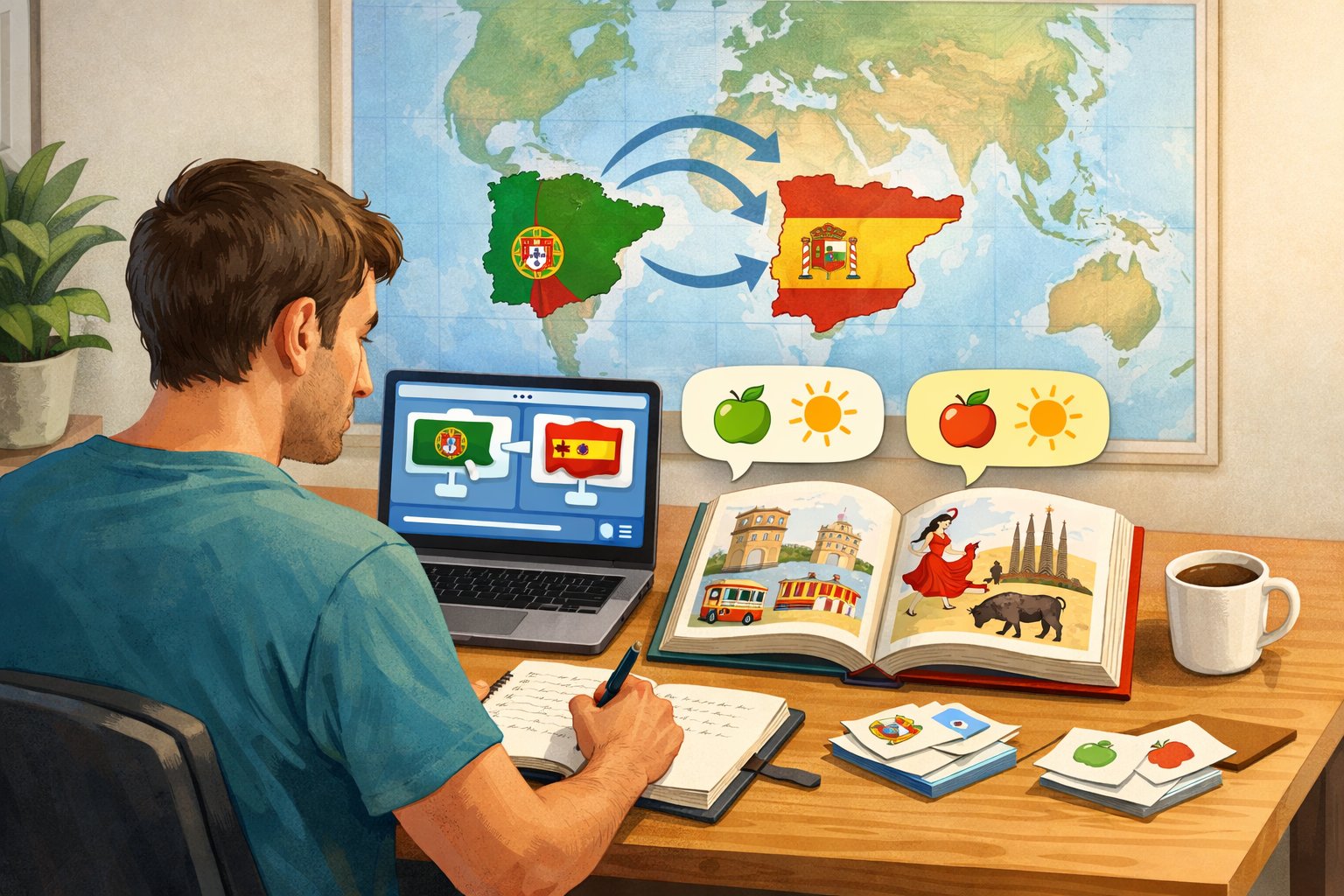
Why Portuguese Speakers Have a Unique Advantage Learning Spanish
Portuguese and Spanish share nearly 89% of their vocabulary, and their grammar rules match up enough that most knowledge transfers straight over.
Shared Foundations of Romance Languages
Both languages come from Latin and keep similar structures, which makes picking up Spanish from Portuguese way easier.
Key Shared Elements:
- Subject-verb-object word order
- Gendered nouns (masculine, feminine)
- Similar verb conjugations for most tenses
- Comparable use of articles, prepositions, pronouns
- Cognates that look and mean almost the same
Common Word Patterns Between Languages:
| Portuguese Ending | Spanish Ending | Example (PT → ES) |
|---|---|---|
| -ão | -ión | nação → nación (nation) |
| -dade | -dad | cidade → ciudad (city) |
| -ável/-ível | -able/-ible | inevitável → inevitable |
Portuguese speakers learning Spanish can spot thousands of words right away, all thanks to their shared roots.
Cognitive Benefits of Language Proximity
The brain reuses the same pathways for similar languages, so new words and grammar stick faster.
Processing Advantages:
- Phonetic knowledge carries over for Spanish pronunciation
- Minimal need to relearn grammar concepts
- Vocabulary recognition is much faster than with distant languages
- Sentence construction feels familiar
Memory Formation Benefits:
- New Spanish words link to similar Portuguese ones
- Grammar rules match up with what you already know
- Pronunciation tweaks focus on a few sounds, not everything
Transferable Grammar and Vocabulary Elements
Most grammar and thousands of words go straight from Portuguese to Spanish with just minor tweaks.
Direct Grammar Transfers:
- Present, past, and future tense structures
- Subjunctive mood in similar situations
- Reflexive verbs
- Adjective-noun agreement
- Forming questions via inversion or intonation
High-Frequency Vocabulary Cognates:
| Portuguese | Spanish | English |
|---|---|---|
| tempo | tiempo | time |
| água | agua | water |
| pessoa | persona | person |
| família | familia | family |
| importante | importante | important |
Pattern Recognition Examples:
| Portuguese | Spanish |
|---|---|
| Eu falo, tu falas, ele fala | Yo hablo, tú hablas, él habla |
Prepositions like "de" work similarly for possession, origin, or material in both languages.
Adjectives:
Rule → Adjective matches noun gender and number.
Example: Portuguese "bonita casa" and Spanish "bonita casa" both mean "beautiful house."
Key Differences: Avoiding the Pitfalls from Portuguese to Spanish
Mixing Spanish words with Portuguese grammar - aka "Portuñol" - leads to classic mistakes. The biggest problems? Words that look the same but mean something else, sounds that don’t match, and sneaky grammar differences.
False Cognates and False Friends
Critical Word Pairs to Separate
| Portuguese Word | Portuguese Meaning | Spanish Word | Spanish Meaning | Risk Level |
|---|---|---|---|---|
| embaraçado | embarrassed | embarazada | pregnant | High |
| exquisito | strange/odd | exquisito | exquisite | High |
| polvo | octopus | polvo | dust | Medium |
| taza | crack/flaw | taza | cup | Medium |
| esquisito | weird | exquisito | exquisite | High |
Common Portuñol Mistakes
- oficina (PT: workshop) vs Spanish "office"
- largo (PT: wide) vs Spanish "long"
- parentes (PT: relatives) vs parientes (ES: relatives) vs padres (parents)
Rule → Make flashcards showing both meanings side by side for look-alike words.
Pronunciation and Accent Shifts
Sound Changes Between Languages
| Portuguese Sound | Spanish Equivalent | Example Shift |
|---|---|---|
| ão ending | ón ending | mão → mano (hand) |
| lh sound | ll sound | trabalho → trabajo (work) |
| nh sound | ñ sound | vinho → vino (wine) |
| nasal vowels | clear vowels | bem → bien (well) |
Rule → Drop nasal vowels when speaking Spanish.
Example: "irmão" becomes "hermano" (brother).
Stress Pattern Differences
| Language | Stress Rule | Example |
|---|---|---|
| Portuguese | Unpredictable, must memorize | difícil, rápido |
| Spanish | Second-to-last syllable by default | fácil, rápido |
Practice tip: Record yourself reading Spanish and compare to Spanish audio for stress placement.
Grammatical Nuances to Recognize
Verb Conjugation Divergence
| Feature | Portuguese | Spanish |
|---|---|---|
| Future subjunctive | Yes (falar, fizer) | No |
| Personal infinitive | Common (para eu fazer) | Not used |
| Present perfect | Uses ter | Uses haber |
| Continuous tenses | Less frequent | More frequent (estoy hablando) |
Article and Pronoun Shifts
| Category | Portuguese | Spanish |
|---|---|---|
| Informal pronoun | você | tú |
| Formal pronoun | você | usted |
| Possessive | o meu livro | mi libro |
| Contractions | do/da/dos/das | del/al |
Rule → Drill pronoun placement and forms, as structures look similar but use different words.
Evidence-Backed Strategies for Fast Spanish Acquisition
Portuguese speakers get the best results by mixing structured daily practice with spaced repetition, focusing on overlapping vocabulary and tricky false cognates.
Structured Learning versus Immersive Techniques
Structured Learning Benefits
- Targets grammar differences (por/para, ser/estar)
- Tackles false cognates head-on (embarazada ≠ embaraçada)
- Builds verb conjugation skills with step-by-step drills
- Sets clear benchmarks for progress
Immersive Techniques Benefits
- Pushes real-time conversation skills
- Sharpens listening with everyday speech
- Grounds vocabulary in real situations
- Boosts retention through context
Comparison Table
| Method | Time to B1 Level | Retention Rate | Cost |
|---|---|---|---|
| Structured only | 6-9 months | 65-70% | Low-Medium |
| Immersion only | 3-6 months | 75-85% | High |
| Combined | 3-5 months | 85-90% | Medium-High |
Rule → Learn Spanish through real topics and conversations, not just grammar exercises.
Optimal Use of Spaced Repetition
Spaced Repetition System Steps
- Day 1, 3, 7, 14: Review Spanish-Portuguese cognate pairs
- False cognates: Review twice daily for first 30 days
- Once accuracy hits 90%: Stretch review to 30, 60, 90 days
- Focus: Top 1000 words (cover 85% of daily speech)
Memory Sequence
| Step | Action |
|---|---|
| Encoding | Link Spanish word to Portuguese and note one difference |
| Retrieval | Test without context after 24 hours |
| Reinforcement | Correct errors right away and review again in 10 minutes |
Priority Vocabulary Categories
- False cognates (pasta = paste, not pasta/massa)
- Prepositions that differ (pensar en vs pensar em)
- Irregular verbs (ir, ser, estar)
- Time expressions (hace vs há)
Spaced repetition locks words into long-term memory by spreading out reviews. Portuguese speakers need 30-40% fewer repetitions than English speakers due to all that shared vocabulary.
Progress Tracking for Adult Learners
Weekly Measurement Points
| Week | Speaking Goal | Comprehension Goal | Grammar Milestone |
|---|---|---|---|
| 1-2 | 50 high-frequency phrases | 60% of slow speech | Present tense regulars |
| 3-4 | 150 phrase variations | 70% of normal speech | Preterite vs imperfect |
| 5-8 | 10-minute conversations | 80% podcasts/shows | Subjunctive triggers |
| 9-12 | Topic-specific discussions | 90% familiar content | Conditional patterns |
Retention Indicators
- Recall practiced phrases in under 2 seconds
- Keep spontaneous error rate below 15%
- Understand 75%+ of audio without subtitles
Adjustment Triggers
- Plateau for 2+ weeks → Increase immersion hours by 30%
- Error rate over 25% → Cut new input, review more
- Listening under 70% at week 8 → Add 15 minutes daily audio-only practice
Progress Benchmarks for Adult Learners
| Marker | Frequency | Expected Outcome |
|---|---|---|
| Progress marker | Every 7–10 days | Visible skill gain to maintain motivation |
| B1 ability | 12–16 weeks | Conversational fluency using structured methods |
Effective Tools and Resources for Portuguese Speakers
Portuguese speakers make faster progress with Romance-language-focused platforms and resources that highlight key differences and similarities.
Top Apps for Accelerated Learning
| App | Best For | Key Feature for Portuguese Speakers |
|---|---|---|
| Duolingo | Daily habits | Pattern drills for -ão/-ión endings |
| Babbel | Grammar structure | Portuguese-Spanish side-by-side comparisons |
| Busuu | Speaking practice | Corrections from Spanish speakers on pronunciation |
| FluentU | Immersive content | Real Spanish videos, interactive subtitles |
| SpanishPod101 | Audio learning | Listening drills for "r" and "ch" sounds |
| LingQ | Reading comprehension | Import texts, track vocabulary |
| Preply | Tutoring | Feedback on false friends |
Practice Priorities
- Use speech recognition to reduce nasal sounds
- Focus on word endings: -dade → -dad, -ável → -able
- Spaced repetition for false friends: embarazada (pregnant) vs embaraçada (embarrassed)
Online Courses and Classes
Course Types by Goal
- Accelerated: Portuguese to Spanish courses teach only differences
- Live classes: Real-time correction stops Portuñol errors
- Self-paced: Focus on tricky issues like lo vs el
Essential Course Components
- Drills on false friends (polvo: dust vs octopus)
- Pronunciation for tip-of-tongue "r"
- Irregular verb grammar (copo → copa, not cuepo)
- Video exposure to regional dialects
Online Class Benefits
| Method | Benefit |
|---|---|
| Spanish speaker classes | Prevent misunderstandings from interference |
| Video content | Hear real accents and usage |
Best Books and Supplementary Materials
Book Categories
- Reference grammars: Conversion charts (quando → cuándo)
- Vocabulary guides: False friends lists by topic
- Workbooks: Double consonant exercises (professor → profesor)
- Readers: Graded texts with cognate markers
Supplementary Materials
| Material | Purpose | Usage Pattern |
|---|---|---|
| Pronunciation guides | Master "ch" as "tsh" | 10 min/day with audio |
| Verb tables | Learn -ue exceptions | Reference while writing |
| Cognate lists | Build 2,000+ word base | Review in spaced intervals |
- Free materials and digital courses with certificates for structured, flexible study
- Combine with conversation exchanges for real-world practice
Immersive and Real-World Spanish Practice for Portuguese Speakers
Portuguese speakers pick up Spanish faster through direct conversation, targeted audio, and real reading environments.
Language Exchange and Language Partners
| Platform | Format | Best For |
|---|---|---|
| MyLanguageExchange | Text/voice chat | Weekly structured exchanges |
| Tandem | Video calls | Daily 15–30 min sessions |
| ConversationExchange | In-person meetups | Local language pairs |
| HelloTalk | Messaging + feedback | Async practice with corrections |
How to Run a Language Exchange
- Split time: 30 min Spanish, 30 min Portuguese
- Bring 3–5 topics per session
- Ask for corrections on false cognates
- Record sessions to review pronunciation
Focus Areas
- Practice verb forms that differ from Portuguese
- Get immediate feedback on interference (e.g., "em" instead of "en")
Studying with Podcasts, Music, and Movies
Recommended Podcasts
- Duolingo Spanish Podcast: 20-min slow stories
- Coffee Break Spanish: Lessons A1–B2
- News in Slow Spanish: Current events, transcripts
Podcast Study Routine
- Listen once, no pausing
- Read transcript while listening again
- Repeat tough sentences aloud 5 times
- Next day: listen again, no transcript
Music Routine
- Read lyrics while listening
- Mark cognates and note pronunciation differences
Spanish Movie Practice Method
| Viewing | Subtitles | Focus |
|---|---|---|
| First | Portuguese | Story comprehension |
| Second | Spanish | Reading speed, vocab |
| Third | None | Listening recognition |
- Spanish movies and natural speech patterns introduce regional accents and colloquial expressions.
Authentic Reading and Conversation Environments
Daily Reading Sources
| Level | Source Examples |
|---|---|
| A2–B1 | newsinslowspanish.com, recipe blogs, product reviews |
| B1–B2 | El País, La Nación, Wikipedia, Reddit (r/es, r/Spanish) |
| B2–C1 | Literary journals, opinion columns, professional blogs |
- Seek out Spanish sources with different vocabulary for the same concept (ordenador vs computadora, coche vs carro)
- Daily news reading builds formal register and complex structure recognition
Conversation Practice Guidelines
- 3–4 video sessions per week, 30–45 min each
- Focus on active production, not just listening
Creating Conversation Environments
- Join Spanish Discord or WhatsApp groups tied to your interests
- Attend local Spanish meetups
- Volunteer with Spanish-speaking organizations
- Switch device language settings to Spanish
Key Reading Habits for Portuguese Speakers
| Focus Area | Example |
|---|---|
| Preposition differences | pensar en vs pensar em |
| Pronunciation practice | Read aloud to break old habits |
Essential Habits and Mastery Approaches for Lifelong Fluency
Fluency sticks when daily input is structured, errors get corrected, and progress is visible.
Consistent Daily Practice Methods
High-frequency exposure beats long weekly sessions
| Method | Duration | Focus Area |
|---|---|---|
| Morning phrase review | 5–10 min | High-frequency sentences, audio |
| Read aloud from books | 10–15 min | Pronunciation, rhythm, cognates |
| Spanish audio (podcast/news) | 10–20 min | Listening, intonation |
| Write in Spanish | 5 min | Grammar and vocabulary recall |
Daily Routine Structure
- Review 5–10 new phrases with Spanish audio
- Read a short text aloud and record yourself
- Listen to Spanish audio during daily tasks
- Write a brief journal or summary in Spanish
Spaced Repetition Cycle
| Day | Task |
|---|---|
| Day 1 | Learn new phrase with audio + example |
| Day 3 | Recall phrase without prompt |
| Day 7 | Reinforce via sentence or conversation |
Rule → Example
Rule: Combine input with forced output for faster fluency
Example: Listen to a podcast, then summarize out loud
Feedback Loops: Tutors and Peer Correction
Correction Sources
| Source | Strengths | Limitations |
|---|---|---|
| Spanish tutor | Grammar, pronunciation, cognates | $15–$40/hour |
| Exchange partner | Free, fluent conversation | May reinforce errors |
| Online community | Written feedback | No real-time speaking |
Correction Requests for Tutors
- Fix por/para, ser/estar, subjunctive triggers
- Drill pronunciation: j/g, r/rr, vowels
- Flag false friends: embarazada, exquisito, éxito
Peer Correction Protocol
| Step | Action |
|---|---|
| 1 | Identify error type |
| 2 | Learner self-corrects before answer |
| 3 | Repeat correct form aloud 3 times |
Rule: Immediate correction during conversation prevents fossilization
Example: Partner interrupts and models correct verb form when error occurs
Tracking Progress and Motivation
Milestones for Fluency
| Milestone | Indicator | Timeframe |
|---|---|---|
| Basic conversation | 500–1,000 words, present tense | 3–6 months |
| Intermediate fluency | 3,000 words, past/future/subjunctive | 6–12 months |
| Advanced fluency | 5,000+ words, 8,000–15,000 for fluent | 18–36 months |
Weekly Tracking Checklist
- Log speaking time (aim for 10+ hours/month)
- Record yourself: Compare Week 1 vs Week 12
- Count new words used: Target 10–15/week
- Test comprehension: Summarize 5-min podcast without subtitles
Motivation Triggers
- Watch a Spanish series episode without subtitles
- Read a full chapter in Spanish
- Hold a 10-minute all-Spanish conversation
- Navigate daily life in a Spanish-speaking region
Rule: Progress requires external validation from Spanish speakers or tutors
Example: Schedule a monthly session with a Spanish tutor for feedback
Frequently Asked Questions
Portuguese speakers face unique hurdles: false cognates, pronunciation traps, and interference from Portuguese grammar. The best strategies use similarities but directly target these common mistakes.
What are effective strategies for Portuguese speakers to learn Spanish?
Spotting patterns between Portuguese and Spanish speeds things up for learners.
Common word ending patterns:
| Portuguese ending | Spanish ending | Example (PT → ES) |
|---|---|---|
| -ão | -ión | nação → nación |
| -ável/-ível | -able/-ible | inevitável → inevitable |
| -dade | -dad | cidade → ciudad |
Key focus areas:
- Learn false cognates early to avoid awkward mix-ups
- Practice the Spanish "r" sound (tip of tongue - takes time!)
- Master "ch" as "tsh" (not "sh")
- Drop nasal vowels - Spanish doesn’t use them
- Get articles right (don’t mix up "el" and "lo")
Practice tips:
- Regular chats with Spanish speakers reveal which patterns work and which don’t.
- Find real Spanish conversation partners to move past “Portuñol.”
Are there specific online platforms recommended for Portuguese speakers to learn Spanish?
Platforms by learning goal:
| Goal | Platform Example / Type |
|---|---|
| Immersive practice | FluentU (real Spanish video, flexible schedule) |
| Language exchange | Tandem, HelloTalk (connects PT and ES speakers for conversation) |
| Structured courses | Spanish schools (grammar, vocab, assignments) |
| Community groups | Facebook, Meetup (in-person or virtual meetups for accountability and support) |
Platform use rules:
- Rule → Use language exchange apps for real conversation; skip if you want only grammar drills.
- Rule → Join local groups to stay motivated and practice regularly.
How do similarities between Spanish and Portuguese affect the learning process?
Learning advantages:
- 89% shared vocabulary
- Same Latin alphabet
- Nearly identical sentence structure
- Verb conjugation rules mostly match
Common interference points:
| Area | Portuguese habit | Spanish requirement |
|---|---|---|
| Articles | Uses "lo" for singular | Must use "el" |
| Double letters | "professor", "isso" | "profesor", "eso" |
| Q vs. C | "quando", "quanto" | "cuándo", "cuánto" |
| Vowel patterns | -ue conversion default | Many exceptions present |
Rule → Don’t assume all words transfer one-to-one.
Example: “assistir” (PT: to watch, ES: to attend)
Comprehension note:
- Portuguese speakers get Spanish more easily than Spanish speakers get Portuguese.
What beginner resources should Portuguese speakers use when learning Spanish?
Priority resources:
| Resource Type | Purpose |
|---|---|
| False cognates lists | Avoid embarrassing errors |
| Pronunciation guides | Fix PT-specific pronunciation habits |
| Pattern charts | Recognize word ending shifts quickly |
| Mistake references | Spot and correct common PT-ES errors |
Effective practice materials:
- Country-specific slang guides
- Audio drills for r- and ch- sounds
- Article usage grammar exercises
- Cognate-based vocab lists
Instituto Cervantes:
Offers events and workshops linking Spanish and Portuguese cultures.
See more
Can proficiency in Portuguese significantly reduce the time to learn Spanish?
Time-saving factors:
| Factor | Benefit |
|---|---|
| No alphabet learning | Jump straight to conversation |
| 70–80% vocab overlap | Fast reading/listening gains |
| Grammar familiarity | Less time on basics |
| Pronunciation tweaks | Adjust, don’t relearn |
Progress timeline:
| Level | Estimated Time (with focus) |
|---|---|
| Basic conversation | 1–3 months |
| Professional fluency | 6–12 months |
| Natural proficiency | 1–2 years (with immersion) |
Rule → Don’t rely only on similarities; actively study key differences.
Example: “pasta” (PT: folder, ES: pasta/noodles)
False friends and overconfidence are the main obstacles.
Learn more