Best Way to Learn Spanish from German: Brain-Based Acceleration Steps
Best results come from mixing spaced repetition, real conversation, and lots of immersion in Spanish media.
Posted by
 Stewart Kaplan
Related reading
Best Way to Learn Spanish from Albanian: Microlearning That Clicks
Start speaking right away - don’t wait to “master grammar” before building natural sentences
Best Way to Learn Spanish from Arabic: How Microlearning Accelerates Real Fluency
Sticking to short, regular sessions beats cramming: two 20-minute focused practices a week with retrieval drills get you farther than a weekend of scrolling or binge-studying.
Best Way to Learn Spanish from Bengali: Fast-Track Scientific Methods
Top tools for Bengali speakers: apps with Bengali menus, tutors who get Indo-Aryan languages, and spaced repetition that drills gendered nouns.
TL;DR
- German speakers learn Spanish faster than English speakers thanks to shared gender systems and similar formal/informal pronouns.
- 480-600 hours of study are needed for effective Spanish, with conversational fluency possible in 6-12 months if you stick to daily practice.
- One-on-one tutoring with Spanish speakers gives faster results than solo study - immediate error correction and 50-60 minutes of actual speaking per session make a big difference.
- German learners have to retrain their pronunciation - Spanish vowels are pure, and every letter is pronounced the same way every time.
- Best results come from mixing spaced repetition, real conversation, and lots of immersion in Spanish media.
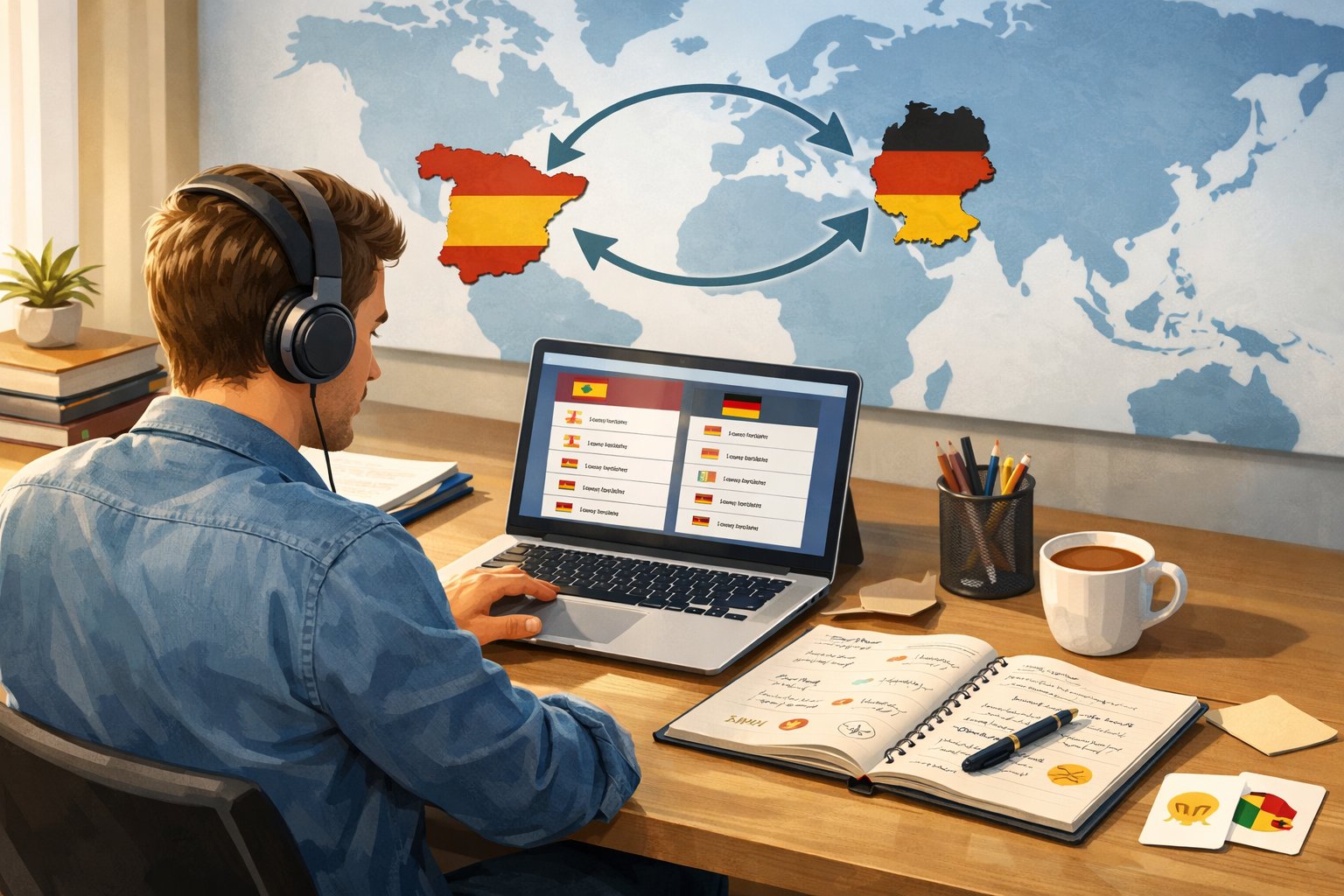
Understanding the Challenges and Advantages for German Speakers
German speakers face unique hurdles, but they also get a leg up from the shared alphabet and overlapping grammar. Pronunciation is a big difference, and vocabulary can be both a help and a trap thanks to false friends.
Common Barriers Faced by German Speakers
Grammar Structure Differences
| German Feature | Spanish Equivalent | Challenge Level |
|---|---|---|
| 3 genders (m/f/n) | 2 genders (m/f) | Moderate |
| 4 cases | No case system | Low (actually simplifies things) |
| Fixed word order | Flexible word order | Moderate |
| Separable verb prefixes | No separable prefixes | Low |
Verb Conjugation Complexity
- Six conjugations per verb in present tense alone.
- Three verb groups: -ar, -er, -ir - each with their own patterns.
- Irregular verbs like ser and estar both mean "to be" but have different uses.
- German bald ("soon") looks like English "bald," but there's no Spanish link.
Language Transfer: Positive and Negative Influences
Positive Transfer Elements
- Latin alphabet in both languages - no new script.
- SVO (Subject-Verb-Object) order in statements.
- Formal/informal pronoun distinction: Sie/du and usted/tú.
Cognates Shared Through Latin and English
| German | Spanish | English |
|---|---|---|
| Familie | familia | family |
| Musik | música | music |
| Hotel | hotel | hotel |
German speakers pick up these similarities quickly.
Negative Transfer Issues
- German’s case system makes learners focus on noun endings, but Spanish doesn’t use cases.
- German pronunciation uses throat sounds and umlauts that don’t exist in Spanish - habits can get in the way.
Unique Pronunciation and Alphabet Differences
Spanish Alphabet Specifics
- 27 letters (includes ñ); ch and ll used to be separate letters.
Sound-Letter Correspondence Challenges
| Spanish Letter | Sound (Spanish) | Common German Error |
|---|---|---|
| j | Like English "h" | Said as German "j" (y-sound) |
| ll | Like English "y" | Said as German "l" |
| r (rolled) | Trilled tongue tap | Replaced with German uvular "r" |
| v | Same as "b" | Said as German "v" (f-sound) |
Vowel Precision
- Five pure vowels, always the same sound.
- Don’t add long/short distinctions (no such thing in Spanish).
- No umlauts (ä, ö, ü) or schwa (unstressed vowel).
Stress Pattern Differences
Written accents (á, é, í, ó, ú) mark stress when words break the usual rules.
Stress matters: papa = potato, papá = dad.
The h is always silent in Spanish. German speakers often pronounce it, which can confuse Spanish-speaking listeners.
Structuring an Effective Spanish Learning Plan
Setting Measurable and Achievable Goals
Goal Framework for German Speakers Learning Spanish
| Time Frame | Vocabulary Target | Grammar Milestone | Speaking Goal |
|---|---|---|---|
| 1 Month | 300 words | Present tense verbs | Basic introductions |
| 3 Months | 800-1000 words | Past/future tenses | Short conversations |
| 6 Months | 1500-2000 words | Subjunctive basics | 10-min discussions |
| 12 Months | 3000+ words | Complex structures | B2 level fluency |
Specific vs. Vague Goals
Rule → Example: Set goals with numbers and timeframes → “Master 50 high-frequency Spanish verbs in 4 weeks using daily drills.”
- Focus on pronunciation goals too - practice the rolled r and clean vowels.
SMART Goal Components
- Specific: e.g., conjugate ser and estar
- Measurable: weekly vocab quizzes
- Achievable: aim for 20 minutes daily
- Relevant: prioritize conversation
- Time-bound: finish A1 level in 8 weeks
Creating a Day-to-Day Practice Schedule
Sample Daily Schedule (30-45 min)
| Time Block | Activity | Duration |
|---|---|---|
| Morning | Vocab with spaced repetition | 10 min |
| Midday | Grammar or verb conjugation | 15 min |
| Evening | Listening or conversation exchange | 15 min |
| Before bed | Review phrases with Spanish audio | 5 min |
Weekly Structure
- Monday/Wednesday/Friday: Grammar and writing
- Tuesday/Thursday: Listening and pronunciation
- Saturday: Conversation with a partner
- Sunday: Review and self-test
Special Focus
- Set aside extra time for false friends and verb tenses.
- Spanish uses the subjunctive more than German’s Konjunktiv II.
Study Block Distribution
Rule → Example: Use short, spaced study sessions → “15-20 minute blocks throughout the day.”
Tracking Progress and Staying Motivated
Progress Tracking Methods
| Method | What to Track | Frequency |
|---|---|---|
| Vocab log | Words learned/retained | Daily |
| Speaking journal | Minutes of active speaking | Weekly |
| Grammar checklist | Tenses/structures mastered | Bi-weekly |
| Comprehension test | % understood in content | Monthly |
Quantifiable Metrics
- Flashcard recall rate
- % of podcasts understood without subtitles
- Number of correct verb conjugations
- Weekly speaking minutes
Motivation Milestones
- Pass A1 test
- Hold a 5-minute Spanish conversation
- Watch a Spanish show without subtitles
- Read a short Spanish story
Adjusting the Plan
Rule → Example: Review every 2-4 weeks and adapt → “If vocab retention is under 70%, increase review sessions.”
Mastering Spanish Fundamentals: Vocabulary, Pronunciation, and Grammar
German speakers should focus on high-frequency Spanish words, grasping Spanish sentence structure, key grammar differences (like gender and verb endings), and nailing the pronunciation rules that trip up German locals.
High-Frequency Vocabulary Acquisition
Priority Vocabulary Sets
| Category | Essential Spanish Words | German Cognates/False Friends |
|---|---|---|
| Core verbs | ser, estar, tener, hacer | “estar” ≠ “stehen” (false friend) |
| Time expressions | hoy, mañana, ahora, nunca | ahora = now, not German “jetzt” |
| Question words | qué, quién, dónde, cuándo | dónde = where, like German “wo” |
| Common objects | casa, agua, comida, tiempo | casa ≠ German “Kasse” (register) |
Daily Routine
Learn 10-15 high-frequency words with examples.
Record Spanish audio for each word.
Make minimal pairs to see words in context.
Use spaced repetition (1, 3, 7 days).
Focus on words for daily life, not academic terms.
“Tener” (to have) and “hacer” (to do/make) show up everywhere.
Contextual Encoding
- Link new words to situations: tener hambre = to be hungry (“to have hunger”).
- Group by verb pattern, not topic.
- Always note noun gender (el agua is masculine).
Spanish Sentence and Word Order
Spanish vs. German Structure
| Component | Spanish Pattern | German Pattern | Example |
|---|---|---|---|
| Statement | SVO | SVO or V2 | Yo como pan / Ich esse Brot |
| Question | ¿VSO? or ¿SVO? | VSO | ¿Comes pan? / Isst du Brot? |
| Negative | Subject + no + Verb | Subject + Verb + nicht | No como pan / Ich esse nicht |
- Spanish word order is flexible for emphasis. German is more rigid.
Adjective Placement
| Rule | Example |
|---|---|
| Descriptive after noun | una casa grande |
| Limiting before noun | muchas casas |
| Agreement in gender/number | casas grandes, hombres altos |
Object Pronoun Placement
| Type | Spanish Position | Example |
|---|---|---|
| Direct object | Before conjugated verb | Lo veo |
| With infinitive | Attached or before verb | Quiero verlo / Lo quiero ver |
| Affirmative command | Attached to verb | Dámelo |
| Negative command | Before verb | No me lo des |
German speakers need to adjust to Spanish verb positions and pronoun placement, which are less strict than German but have their own rules.
Core Grammar Differences: Spanish vs. German
Grammatical gender comparison:
| Feature | Spanish | German | Learning Strategy |
|---|---|---|---|
| Gender types | Masculine/Feminine | Masculine/Feminine/Neuter | Learn article with noun |
| Gender markers | -o = masculine, -a = feminine | Unpredictable | Pattern recognition, exceptions |
| Article agreement | el/la, un/una | der/die/das, ein/eine | Spanish: only 2 genders |
Verb conjugation complexity:
- Spanish verbs change for person and number in every tense.
- German speakers adapt quickly to patterns, but Spanish has more irregular verbs.
Present tense regular patterns:
| Subject | -ar (hablar) | -er (comer) | -ir (vivir) |
|---|---|---|---|
| yo | hablo | como | vivo |
| tú | hablas | comes | vives |
| él/ella/usted | habla | come | vive |
| nosotros | hablamos | comemos | vivimos |
| vosotros | habláis | coméis | vivís |
| ellos/ustedes | hablan | comen | viven |
Ser vs. estar distinction (no German equivalent):
- Ser: Permanent traits, identity, time
- Rule → Use "ser" for permanent facts: Soy alemán (I am German)
- Estar: Location, temporary states, conditions
- Rule → Use "estar" for temporary states: Estoy cansado (I am tired)
Key Spanish grammar differences for German speakers:
| Rule | Example |
|---|---|
| Spanish marks gender on articles/nouns | la mesa, el coche |
| Two verbs for "to be" | ser/estar |
| More verb forms per tense | hablo, hablas, habla, etc. |
Accurate Pronunciation Strategies
Spanish alphabet and sound differences from German:
| Spanish Letter | Sound | German Comparison | Example Word |
|---|---|---|---|
| j | hard h (like "ch" in "Bach") | Similar to "ch" | jugar (hoo-GAR) |
| ll | y sound in most regions | No equivalent | llamar (ya-MAR) |
| ñ | ny sound | Like "gn" in "Gnocchi" | mañana (ma-NYA-na) |
| r (single) | soft tap | Different from German "r" | pero (PE-ro) |
| rr (double) | rolled/trilled | Stronger than German "r" | perro (PE-rro) |
| v | b sound | NOT German "v" | vaca (BA-ka) |
Critical pronunciation rules:
- All vowels are pure, single sounds.
- No diphthongs like in German.
- Stress usually falls on the second-to-last syllable unless marked.
| Rule | Example |
|---|---|
| Each vowel is pronounced clearly | casa (CA-sa), mesa |
| Double "rr" is always trilled | perro (PE-rro) |
Immersive and Interactive Learning Techniques
Spanish immersion methods for German speakers:
| Method | Description |
|---|---|
| Watch Spanish series | Start with German subs, switch to Spanish, then none |
| Listen to Spanish podcasts/music | Use during daily routines (commute, chores) |
| Change device language | Set phone/computer to Spanish |
| Read Spanish news/social media | Pick topics you already like |
| Think in Spanish | 2-5 minutes daily, describe what you're doing |
Media-Based Learning Tools
| Method | Best For | Time Required |
|---|---|---|
| Films/telenovelas | Vocabulary, culture | 30-60 min/day |
| Music with lyrics | Pronunciation, rhythm | 15-30 min/day |
| Audiobooks | Listening comprehension | 20-40 min/day |
| Radio stations | Real-time exposure | 10-20 min/day |
Cognitive retention process:
- Repeat audio exposure for pattern recognition.
- Use visuals (subtitles, images) to reinforce memory.
- Short, daily immersion (10-15 min) beats long, infrequent sessions.
Finding and Using a Language Exchange Partner
Where to Find Partners
- Tandem app
- HelloTalk
- ConversationExchange.com
- University language departments
- Spanish cultural centers in Germany
- Reddit r/language_exchange
Structured Exchange Format
| Step | Description |
|---|---|
| 1 | 50/50 split: 30 min Spanish, 30 min German |
| 2 | Prepare 3-5 topics per session |
| 3 | Correct major errors only |
| 4 | Record tricky pronunciations |
| 5 | Share corrections in a shared doc |
Effective Partnership Guidelines
- Meet same time weekly
- Use video calls for feedback
- Alternate topic selection
- Focus on high-frequency phrases
- Schedule next meeting at end
Practical Conversation Practice with Spanish Speakers
Conversation Practice Platforms
| Platform | Format | Cost Range |
|---|---|---|
| iTalki | 1-on-1 tutoring | €8-25/hour |
| Preply | Private lessons | €10-30/hour |
| Lingoda | Group classes | €6-12/class |
| Verbling | Video tutoring | €9-20/hour |
Progressive Speaking Exercises
| Weeks | Focus Area |
|---|---|
| 1-2 | Basic Q&A (name, origin, job) |
| 3-4 | Daily routines, past events |
| 5-6 | Opinions on simple topics |
| 7-8 | Abstract ideas, hypotheticals |
Error Correction Strategy
- Ask for feedback on 2-3 grammar points per session
- Note recurring pronunciation mistakes
- Review corrections right after talking
- Repeat corrected phrases 5-10 times
- Use new structures in next session
Frequency Requirements
| Activity | Minimum Frequency |
|---|---|
| Conversations | 3x per week (20-30 min each) |
| Self-practice | Daily |
| Vocab review | Within 24 hours (spaced rep) |
| Progress check | Monthly (recorded speaking) |
Leveraging Digital Tools and Research-Backed Apps
Top language learning apps for German speakers:
| App | Best For | German Interface | Key Feature | Monthly Cost |
|---|---|---|---|---|
| Duolingo | Absolute beginners | Yes | Gamified streaks | Free / $13 premium |
| Babbel | Grammar focus | Yes | Structured progression | $7-$14 |
| LingQ | Reading practice | Yes | Import real Spanish content | $13-$40 |
| Busuu | Peer correction | Yes | Feedback from Spanish speakers | $6-$10 |
| Memrise | Vocabulary | Yes | Real Spanish video clips | Free / $9 premium |
App effectiveness:
| App | Measured Outcome |
|---|---|
| Duolingo | +8 points per standardized test hour |
| Babbel | Conversational ability after 10+ hours |
| Babbel | 15 hours ≈ 1 semester of college Spanish |
Limitations for German speakers:
- Apps teach isolated sentences, not real conversations.
- Cognates (Musik/música, Telefon/teléfono) help at first, but apps rarely highlight them.
- Most apps plateau at B1 (intermediate) level.
| Rule | Example |
|---|---|
| Combine apps with real content | Watch Spanish news, read blogs after 2-3 months |
Personalized Online Tutoring and Lessons
Spanish tutor platform comparison:
| Platform | Tutor Pool | Scheduling | German-Speaking Tutors |
|---|---|---|---|
| Preply | 3,000+ | Flexible | Yes (filter) |
| italki | 2,500+ | On-demand | Yes |
| Verbling | 600+ (vetted) | Structured | Limited |
Benefits for German speakers:
- Correction of false friends (e.g., "aktuell" ≠ "actual")
- Practice with ser/estar distinction
- Real-time feedback on subjunctive errors
- Pronunciation drills for r/rr
Optimal lesson structure:
| Segment | Activity |
|---|---|
| 15 min | Spanish conversation |
| 20 min | Grammar with German support |
| 10 min | Pronunciation practice |
| 5 min | Assign homework |
- Book 2-3 sessions per week for 8-12 weeks for best results.
- Trial lessons: $5-$10/hour.
Spaced Repetition and Memory Strategies
Spaced repetition intervals:
| Review # | Time After Learning | Action |
|---|---|---|
| 1 | 1 day | Recall word from German prompt |
| 2 | 3 days | Write sentence with word |
| 3 | 7 days | Speak sentence aloud |
| 4 | 14 days | Use in conversation or writing |
| 5 | 30 days | Final review |
Implementation tools:
- Anki/AnkiDroid: Custom German→Spanish decks with audio
- Quizlet: Ready-made decks (500+ common words)
- FluentU: Video-based spaced repetition
- Memrise: Built-in spaced repetition
Memory formation steps:
| Step | Example |
|---|---|
| Encoding | "der Tisch" → "la mesa" |
| Retrieval | Prompt: "der Tisch" → recall "la mesa" |
| Reinforcement | Correct answer = stronger memory |
- Spaced repetition is 74% more effective than cramming.
- Review 15-20 new words daily for 10-15 minutes.
Context-based card creation:
| Front (Prompt) | Back (Answer) | Tag |
|---|---|---|
| German sentence with bolded word | Spanish translation + audio | Verb, false friend |
- Prevents isolated word learning; builds word order awareness.
Comprehension and Cultural Contexts: Listening, Reading, and Media
Listening resources for German speakers:
| Resource | Level | Focus |
|---|---|---|
| Coffee Break Spanish | Beginner-Intermediate | Lessons + explanations |
| SpanishPod101 | All levels | Dialogues, culture |
| News in Slow Spanish | Intermediate-Advanced | Current events, slower |
| Spanish radio | Advanced | Natural speech |
Effective listening practice:
| Step | Action |
|---|---|
| 1 | Listen to 5-10 min without pausing |
| 2 | Note familiar/repeated words |
| 3 | Replay with transcript/subtitles |
| 4 | Shadow-speak key phrases |
| 5 | Increase speed gradually |
Music learning routine:
| Step | Action |
|---|---|
| 1 | Pick songs with clear vocals (ballads>rap) |
| 2 | Read lyrics while listening |
| 3 | Listen again without text |
| 4 | Sing along |
| 5 | Extract 3-5 phrases per song |
Reading for Context and Vocabulary
Reading materials by level:
| Level | Format | Example Topics |
|---|---|---|
| A1-A2 | Graded readers, kid books | Routines, family |
| B1-B2 | News, blogs | Travel, tech, health |
| C1-C2 | Literature, technical texts | History, science |
Context-based reading strategy:
| Step | Action |
|---|---|
| 1 | Skim for main idea |
| 2 | Circle unknown words, don't stop |
| 3 | Guess meanings from context |
| 4 | Check 5-8 vital words |
| 5 | Reread for full understanding |
Cognate and false friend examples:
| Cognate | German | Spanish | Meaning |
|---|---|---|---|
| Musik | música | music | |
| Telefon | teléfono | telephone | |
| "Embarazada" | (false friend) | embarazada | pregnant |
High-value reading sources:
- Wikipedia (Spanish) on familiar topics
- Spanish versions of German news
- Amazon.es product reviews
- Spanish subtitles on German films
| Rule | Example |
|---|---|
| Cultural background speeds up comprehension | Reading about German history in Spanish |
Using Spanish Subtitles and Videos
Video progression for comprehension building:
| Stage | Audio | Subtitles | Goal |
|---|---|---|---|
| 1 | Spanish | German | Grasp plot/context |
| 2 | Spanish | Spanish | Connect spoken/written forms |
| 3 | Spanish | None | Handle natural speech speed |
- Spanish subtitles help you spot word boundaries in fast speech.
- Seeing the text boosts spelling and pronunciation links.
Optimal video formats:
- YouTube: Easy Spanish, Español con Juan (street interviews, subtitles)
- Series: La Casa de Papel, Élite (modern, real dialogue)
- Documentaries: Nature/history (familiar topics)
- News clips: Short (3–5 min), repetitive vocab
Active viewing technique:
- Watch 2 minutes with Spanish subtitles.
- Pause, repeat one sentence out loud.
- Watch 5 minutes straight, no pausing.
- Rewatch the same bit without subtitles.
- Jot down new phrases for review.
Cultural cues in Spanish videos:
- Gestures and humor are more obvious on video.
- Formal/informal (tú/usted) use is clearer when seen in context.
Frequently Asked Questions
What are the most effective resources for adults to learn Spanish if they already speak German?
Structured Learning Platforms
| Resource Type | Best For | Key Feature |
|---|---|---|
| Grammar books | Foundation building | Rules in clear order |
| Language apps | Daily practice | Spaced repetition |
| Video platforms | Listening skills | Spanish speakers |
| Online courses | Full curriculum | Cultural content |
German-Specific Advantages
- Latin-root cognates speed up vocab learning
- Both languages use gendered nouns
- Formal/informal pronouns in both systems
Priority Resources
- Textbooks with German explanations
- Podcasts made for German learners
- Spanish news sites for reading
- Exchange platforms to find Spanish partners
Rule → Example
Rule: Identify Latin-root words in both languages
Example: “Universität” (German) and “universidad” (Spanish)
How can one rapidly improve their Spanish skills as a German speaker?
High-Impact Methods
| Method | Daily Time | Main Focus |
|---|---|---|
| Audio input | 20-30 min | Listening |
| Conversation | 30-60 min | Speaking |
| News reading | 15-20 min | Vocabulary |
| Writing practice | 15-30 min | Grammar |
Acceleration Strategies
- Watch Spanish shows with Spanish subtitles
- Switch your phone to Spanish
- Think in Spanish during daily tasks
- Drill verbs with spaced repetition
Progressive Word Removal Technique
- Read a full sentence
- Remove a word, recall it
- Remove more words, repeat
- Rebuild the sentence from memory
Rule → Example
Rule: Use German knowledge of verb endings to spot Spanish patterns
Example: “hablo” (I speak) and “ich spreche” (I speak)
What online platforms are recommended for German speakers to learn Spanish proficiently?
Platform Comparison
| Platform | Style | German Support | Highlight |
|---|---|---|---|
| Babbel | Structured lessons | Yes | German-Spanish lessons |
| FluentU | Video immersion | Interface | Real-world videos |
| italki | Live tutors | Yes | Spanish speakers |
| Duolingo | Gamified app | Yes | Daily practice streaks |
Spanish ranks third on Babbel's easiest languages for English speakers.
Selection Factors
- Depth of grammar explanations
- Quality of Spanish audio
- Progress tracking
- Community features
Supplementary Tools
- Anki: Custom flashcards
- Tandem: Language exchange
- SpanishDict: Dictionary
- YouTube: German-Spanish lessons
Rule → Example
Rule: Combine listening and reading for better retention
Example: Watch a video with subtitles, then repeat phrases aloud
Can learning German and Spanish simultaneously be advantageous, and what methods are best?
Simultaneous Learning Benefits
| Benefit | How it Helps | Application |
|---|---|---|
| Metalinguistic awareness | Spot language patterns | Faster grammar learning |
| Cognitive flexibility | Switch between codes | Better memory |
| Time efficiency | Dual progress | Reach both goals |
Risk Factors
- Mixed-up vocab
- Grammar confusion
- Slower progress per language
- Mental fatigue
Separation Methods
- Study each language at different times
- Use different places for each
- Separate resources for each
- Practice one actively, one passively
Best Practices
- Start with Spanish, then add German
- Split time 60/40 for focus
- Color-code notes to avoid mix-ups
- Build 3–6 months base in one before adding the other
Rule → Example
Rule: Anchor each language to a unique context
Example: Study Spanish at home, German at a café
How much time is typically required for a German speaker to achieve fluency in Spanish?
Time Investment by Level
| Level | Hours Needed | Months (1hr/day) | What You Can Do |
|---|---|---|---|
| A2 Basic | 180-200 | 6 | Simple talk |
| B1 Intermediate | 350-400 | 12 | Everyday conversations |
| B2 Upper-Inter. | 600-750 | 20 | Handle complex topics |
| C1 Advanced | 1000-1200 | 36 | Near-real Spanish conversations |
German Speaker Advantages
- 20–30% faster vocab learning (cognates)
- Gender rules already familiar
- Verb conjugation concepts overlap
Acceleration Factors
| Factor | Time Saved | How |
|---|---|---|
| Immersion | 30–40% | Live in Spanish country |
| Daily conversation | 25–35% | Talk to locals often |
| Intensive study | 20–30% | 3+ hours per day |
| Previous language exp. | 15–20% | Use learning strategies |
Timeline Benchmarks
- Basic conversation: 6–9 months
- Professional level: 18–24 months
- Full fluency: 30–48 months
Rule → Example
Rule: Combine structured study and real-world use for best results
Example: Follow a textbook, then chat with a language partner weekly