Best Way To Learn Spanish From Croatian: Science-Backed Approaches for Adults
Getting the grammar basics down (articles, prepositions, formal/informal address) early helps avoid stubborn errors later.
Posted by
 Stewart Kaplan
Related reading
Best Way to Learn Spanish from Albanian: Microlearning That Clicks
Start speaking right away - don’t wait to “master grammar” before building natural sentences
Best Way to Learn Spanish from Arabic: How Microlearning Accelerates Real Fluency
Sticking to short, regular sessions beats cramming: two 20-minute focused practices a week with retrieval drills get you farther than a weekend of scrolling or binge-studying.
Best Way to Learn Spanish from Bengali: Fast-Track Scientific Methods
Top tools for Bengali speakers: apps with Bengali menus, tutors who get Indo-Aryan languages, and spaced repetition that drills gendered nouns.
TL;DR
- Croatian speakers have it a bit easier at first thanks to the shared Latin alphabet and familiar phonetic spelling, but Spanish verb tenses and gender rules are a hurdle.
- Immersion (media, chats, travel) works way better than just memorizing vocab lists; adults remember phrases when they’re tied to real stuff.
- Short, daily sessions with spaced repetition (10-15 min) stick best - timed reviews boost memory way more than cramming.
- Talking with Spanish speakers or partners turns passive knowledge into real skills; waiting too long to speak out loud locks in mistakes.
- Getting the grammar basics down (articles, prepositions, formal/informal address) early helps avoid stubborn errors later.
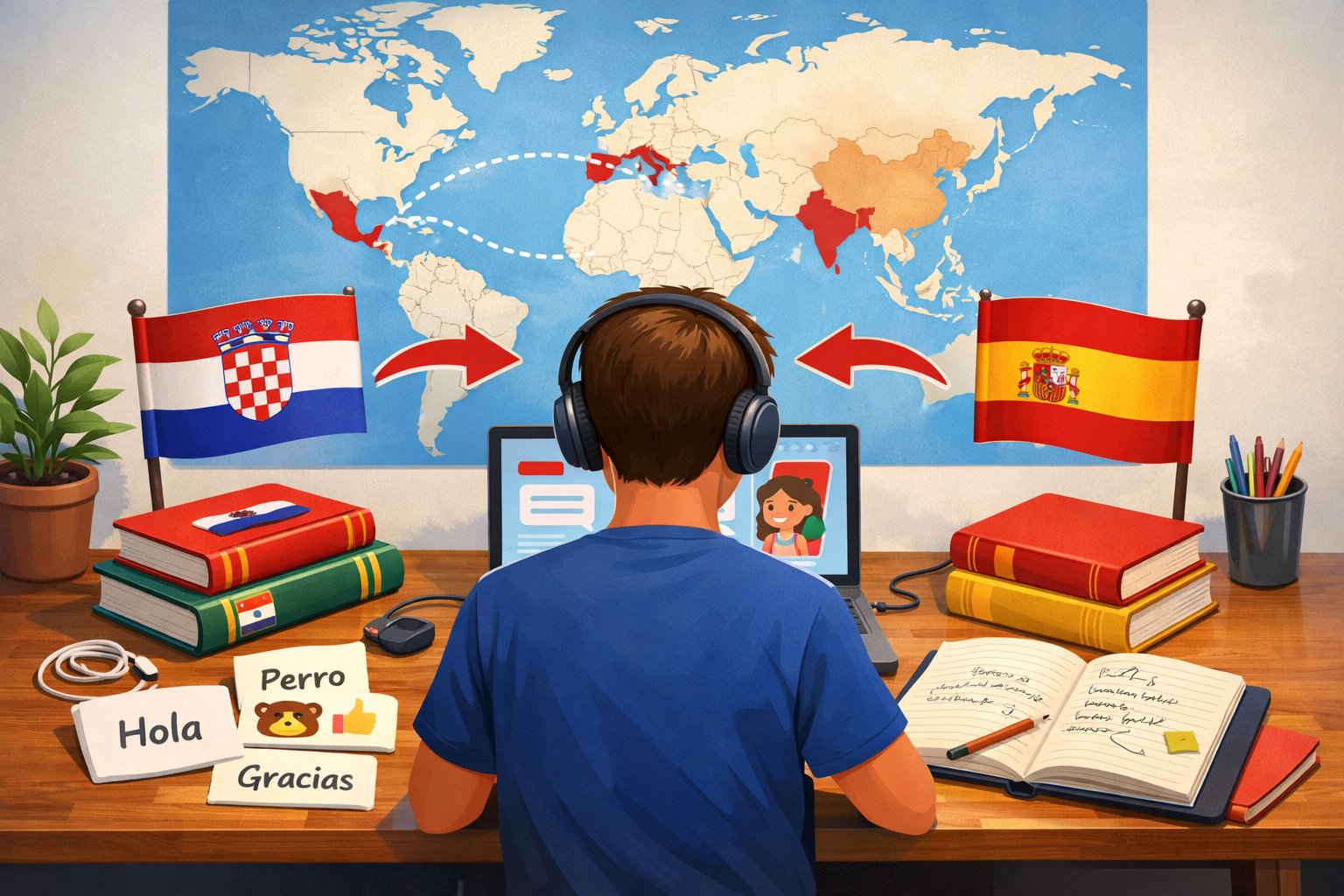
| Advantage | What It Means for Croatian Speakers |
|---|---|
| Shared alphabet & phonetics | Easier reading and pronunciation from day one |
| Slavic grammar background | Some verb and gender concepts transfer, but Spanish tenses and articles are new territory |
Key Linguistic Differences Between Spanish and Croatian
Alphabet and Sound Systems
| Feature | Croatian | Spanish |
|---|---|---|
| Alphabet | Latin, 30 letters | Latin, 27 letters |
| Special characters | č, ć, đ, š, ž | ñ, ll, rr |
| Pronunciation | Phonetic | Phonetic |
| Rolling R | Single roll | Stronger trill |
Grammar Structure
- Case system: Croatian uses 7 cases; Spanish has none.
- Word order: Croatian is flexible; Spanish sticks to subject-verb-object.
- Articles: Not used in Croatian; required in Spanish (el, la, un, una).
- Verb aspects: Croatian splits perfective/imperfective; Spanish uses tense instead.
Pronunciation Challenges
- Master the five Spanish vowels: a, e, i, o, u.
- Learn the “j” sound as in jamón.
- “b” and “v” sound almost the same in Spanish.
- Tackle the “ñ” in mañana.
Shared Features and Learning Opportunities
| Feature | Both Languages Do This |
|---|---|
| Verb conjugation | Change endings for the subject |
| Gender agreement | Masculine/feminine noun forms |
| Plural formation | Add suffixes for plurals |
| Formal/informal speech | Different pronouns |
Learning Perks
- Predictable pronunciation in both.
- Verb conjugation isn’t totally new.
- Gendered nouns make sense right away.
- Diacritical marks aren’t scary.
Cognates:
- telefon → teléfono
- restoran → restaurante
- muzika → música
- fakultet → facultad
Setting Realistic Expectations
| Level | Study Hours | Daily Practice |
|---|---|---|
| Basic conversation | 200-300 | 30 min, 6-8 months |
| Intermediate | 400-600 | 45 min, 12-18 months |
| Advanced | 800-1000 | 60 min, 24-30 months |
Typical Struggles
- Forgetting articles
- Dropping the Croatian case system
- Adjusting to fixed word order
- Subjunctive mood headaches
Milestones
- Month 1-2: Spanish alphabet, basic pronunciation
- Month 3-4: Present tense sentences, no cases
- Month 6-8: Basic chats with articles
- Month 12+: Complex tenses, subjunctive
Personalized Learning Paths
| Assessment | Measures | Time Needed |
|---|---|---|
| Vocab test | 100 common words | 10 min |
| Grammar placement | Conjugations, articles, pronouns | 15 min |
| Listening | Short dialogues | 10 min |
| Speaking | Pronunciation, fluency | 5 min |
Proficiency Levels
- A1: Total beginner
- A2: Basic present tense, 300-500 words, past tense is tough
- B1: Multiple tenses, main points, 1,500+ words
- B2: Complex grammar, detailed convos, 3,000+ words
| Level | Best Resources | Focus |
|---|---|---|
| A1 | Phrase books, beginner apps, picture dictionaries | Present tense, ser/estar, basics |
| A2 | Graded readers, easy podcasts, textbooks | Past tenses, prepositions |
| B1 | News, TV with subtitles, conversation | Subjunctive, complex sentences |
| B2 | Real Spanish content, literature, pro materials | Nuance, regional stuff |
Common Pitfalls
| Issue | Example |
|---|---|
| False cognates | "realizirati" ≠ "realizar" |
| Article usage | Spanish needs articles, Croatian doesn’t |
| Verb aspects | Croatian perfective ≠ Spanish preterite/imperfect |
| Pronoun placement | Object pronouns attach to infinitives in Spanish |
Progress Tracking
- Weekly vocab tests
- Concept-based grammar tracking
- Daily minutes of Spanish input
- Number of Spanish-only conversations
- Written texts (no Google Translate)
| Weeks | A1 Goal | A2 Goal | B1 Goal |
|---|---|---|---|
| 4 | Order food, introduce yourself | Describe past events | Share opinions |
| 8 | Handle basic transactions | Talk about plans | Understand news |
| 12 | Write short messages | 5-min conversations | Read novels with dictionary |
Tracking Tools
- Log daily study in a spreadsheet
- Record yourself speaking monthly
- Take practice tests every 6 weeks
- Track vocab with frequency lists
| Error Type | Tracking Method |
|---|---|
| Interference errors | Log separately for focused practice |
Immersion and Context-Based Learning Methods
| Media Type | How to Use | Croatian Support |
|---|---|---|
| Podcasts | Listen while commuting or exercising | Start with transcripts; move to Spanish-only |
| News sites | 10 min daily | Start bilingual, then switch to Spanish sites |
| Music | Play in the background | Check lyrics in Croatian first, then Spanish only |
| TV/films | Watch with Croatian subtitles, then Spanish | Drop subtitles over time |
Audio Immersion Schedule
- Week 1-2: Spanish audio + Croatian text
- Week 3-4: Spanish audio + Spanish text
- Week 5+: Spanish audio only
| Daily Routine | Spanish Activity |
|---|---|
| Morning | Read Spanish headlines |
| Commute | Listen to Spanish radio/podcasts |
| Meals | Watch Spanish cooking vids |
| Evening | Write 3 sentences about your day |
| Before bed | 10 min of Spanish music |
Device & Environment Tweaks
- Set phone/computer to Spanish
- Label stuff around the house (in Spanish only)
- Switch browser to Spanish region
- Follow Spanish social media
Thinking in Spanish: Progression
| Step | Example |
|---|---|
| Ask in Spanish | "¿Qué estoy haciendo?" |
| Narrate actions | "Estoy preparando café" |
| Add tenses | Use past/future after 2 weeks |
Using Real-Life Situations to Reinforce Learning
High-value practice scenarios:
| Situation | Spanish Practice Method | Vocabulary Focus |
|---|---|---|
| Grocery shopping | Make shopping list in Spanish; name items | Food, quantities, prices |
| Cooking | Follow Spanish recipes only | Verbs, measurements, ingredients |
| Exercise | Count reps in Spanish; use Spanish videos | Numbers, body parts, commands |
| Travel planning | Use Spanish sites to plan trips | Directions, accommodations, transportation |
- Practice Spanish in real-world situations that need quick understanding and response.
- Contextual recall beats direct translation - use Spanish in the moment.
Language exchange structures:
- Connect with Croatian-Spanish partners online
- Alternate 15 minutes Spanish, 15 minutes Croatian
- Talk about daily life, skip grammar drills
Hobby-based immersion:
Join Spanish forums for your hobbies
Watch Spanish how-to videos for things you like
Leave comments in Spanish on social media
Adults remember 40% more vocab when learning through real, personal activities instead of word lists.
Emotional ties to real-life moments make words stick.
Microlearning, Spaced Repetition, and Technology-Assisted Strategies
- Break Spanish vocab into quick sessions.
- Use apps with spaced repetition to review at the right time.
Spaced Repetition Systems for Vocabulary
Core Mechanism
- Learn new Spanish words
- Review after 1 day
- Review again after 3 days
- Next review after 7 days
- Then at 14, 30, and 60+ days
Algorithm Function
- Tracks right and wrong answers
- Missed words show up more often
- Mastered words reviewed less often
Optimal Daily Load
| Session Level | New Words | Review Words | Total Time |
|---|---|---|---|
| Beginner | 5-10 | 15-20 | 10-15 min |
| Intermediate | 10-15 | 25-35 | 15-20 min |
| Advanced | 15-20 | 40-50 | 20-25 min |
- Review words just before you’d forget them for best results.
The Role of Bilingual Flashcards and Apps
Essential Card Components
- Front: Croatian word or phrase
- Back: Spanish with gender (el/la)
- Audio: Natural pronunciation
- Example: Full sentence
Platform Comparison
| App | Croatian Interface | Audio Quality | Spaced Algorithm | Offline Mode |
|---|---|---|---|---|
| Memrise | No | Spanish speakers | Basic | Limited |
| Duolingo | No | Synthetic / human | Moderate | No |
| Busuu | No | Spanish speakers | Advanced | Yes |
| Babbel | No | Spanish speakers | Moderate | Yes |
Card Creation Priority for Croatian Speakers
- False friends (e.g., realizirati ≠ realizar)
- Gender patterns unlike Croatian
- Spanish words with no Croatian match
- Key verb conjugations
- Use apps like SpanishPod101 for bite-sized lessons.
Maximizing App-Based Learning Efficiency
Session Structure
- 0–3 min: Review old words
- 3–7 min: Add 3–5 new words with audio
- 7–10 min: Practice new words in sentences
- 10–12 min: Mix old and new for review
Memory Reinforcement Loop
- See Croatian word
- Try to recall Spanish (3–5 seconds)
- Check answer
- Say Spanish word out loud
- Rate how easy or hard it was
Common Mistakes to Avoid
- Studying over 20 minutes straight
- Adding too many new words at once
- Skipping audio practice
- Translating word-for-word
Combination Strategy
| Morning | Afternoon | Evening |
|---|---|---|
| 10 min review | 5 min passive listening | 10 min new vocab |
| Focus: vocab | SpanishPod101 podcast | Focus: speaking |
- Use platforms like LingQ for short, regular sessions.
- Stick to 10–15 minutes daily for best progress.
Interactive Practice: Speaking and Real Conversation
- Speak with Spanish speakers for real progress.
- Get feedback from tutors and partners to speed up learning.
Finding Language Exchange Partners and Speaking Groups
Language exchange platforms:
| Platform | Format | Cost | Best For |
|---|---|---|---|
| Tandem | Text, voice, video | Free | Casual conversation |
| HelloTalk | Messaging, corrections | Free (premium too) | Written/spoken exchange |
| ConversationExchange | Partner matching | Free | Long-term partners |
| Meetup | Local groups | Free/Paid | In-person practice |
How to maximize exchanges:
- Look for partners learning Croatian or English
- 30-minute sessions (15 min each language)
- Use video for pronunciation help
- Stick to daily topics, not grammar lectures
Exchange session structure:
- Set timer for language switch
- Prepare 3–5 topics
- Note corrections during partner’s turn
- Review notes right after session
- Language partners help with speaking, but don’t expect deep grammar explanations.
Online Tutoring and One-to-One Conversation Practice
Professional tutors:
- Find tutors online for $5–40/hr.
- One-to-one lessons offer targeted feedback.
How to pick a tutor:
- A Spanish speaker from your target region (Spain, Mexico, Argentina, etc.)
- Experience with Croatian or Slavic speakers
- Trial lessons to test fit
- Look for tutors who mention pronunciation correction
Tutor session checklist:
- Send your goals 24 hours ahead
- Ask for drills on r/rr, b/v, etc.
- Record the lesson for review
- Do homework daily (10–15 min)
- Tutors spot Croatian-specific issues (articles, ser/estar, subjunctive) and give focused practice.
Utilizing Feedback to Improve Pronunciation
Critical pronunciation targets:
| Spanish Sound | Croatian Challenge | Practice Method |
|---|---|---|
| Rolled r (rr) | Not in Croatian | Tongue-tip drills, “perro” vs “pero” |
| Single tap r | Lighter than Croatian | “caro” vs “carro” minimal pairs |
| Soft b/v | Croatian distinguishes | Listen for same sound in Spanish |
| J (jota) | Harsher than Croatian h | Practice “jamón,” “jefe” throat sounds |
How to use feedback:
- Record a 2–3 min monologue
- Compare with Spanish audio
- Mark differences
- Drill problem sounds (5x each)
- Re-record and check progress
Quick correction methods:
Ask for instant error correction
Request phonetic spellings
Use shadowing (repeat after audio)
Practice tongue placement with diagrams
Expect 40–60 hours of speaking with feedback to get clear pronunciation.
Structured Grammar and Pronunciation Foundations
- Spanish grammar is pattern-based; focus on verbs and pronunciation first.
Mastering Essential Spanish Grammar Patterns
| Grammar Element | Spanish | Croatian Contrast |
|---|---|---|
| Gender system | Masculine/feminine nouns | Masculine/feminine/neuter |
| Verb conjugation | 6 persons, many tenses | 6 persons, aspect pairs |
| Word order | SVO (flexible) | Free with cases |
| Articles | Definite/indefinite needed | No articles |
| Adjective order | Usually after noun | Before or after noun |
Essential Grammar Priorities
Present tense regular verbs (-ar, -er, -ir)
Ser vs. estar (permanent vs. temporary)
Gender agreement (adjectives and nouns)
Use of articles (el/la/los/las)
Croatian speakers know gender, but must relearn which words are masculine/feminine.
Spanish relies on articles, not cases.
Focusing on High-Impact Verbs and Sentence Structure
| Verb | Meaning | Yo Form | Usage Frequency |
|---|---|---|---|
| ser | to be (permanent) | soy | Essential daily |
| estar | to be (temporary) | estoy | Essential daily |
| tener | to have | tengo | Essential daily |
| hacer | to do/make | hago | Essential daily |
| ir | to go | voy | Essential daily |
| querer | to want | quiero | High daily |
| poder | can/to be able | puedo | High daily |
| decir | to say | digo | High daily |
- These verbs cover 60–70% of basic conversation.
Sentence Building Rule → Example
Rule: Subject pronoun (optional) + conjugated verb + object/complement + time/place
Example: (Yo) quiero café ahora.
- Irregular verbs need extra practice.
Building Pronunciation and Listening Accuracy
| Spanish Sound | IPA | Croatian Equivalent | Production Notes |
|---|---|---|---|
| r (single) | [ɾ] | Like Croatian r | Single tap |
| rr (rolled) | [r] | Croatian r | Multiple taps |
| j/g (e,i) | [x] | Like h in “aha” | Stronger friction |
| ñ | [ɲ] | Like nj | Palatal nasal |
| ll | [ʝ]/[ʎ] | Like lj | Regional variation |
| v | [b] | Soft b | No v/f distinction |
- Main challenges: b/v distinction, strong [x] sound.
Listening Training Steps
- Match written syllables to audio (10–15 min daily)
- Shadow real Spanish recordings with a 2-second delay
- Record and compare your speech
- Focus on verb endings for tense/person cues
Stress Pattern Rules → Examples
Words ending in vowel, n, or s: stress second-to-last syllable
Example: casa, hablanWords ending in other consonants: stress last syllable
Example: comer, ciudadAccent marks override:
Example: árbol, jamónDon’t assume stress from Croatian will match Spanish - study stress patterns directly.
Supplementary Techniques for Continued Progress
Real Spanish materials and consistent daily habits push learners past the basics and help build real fluency. Pairing these with routines that lock in recall? That’s where the magic happens.
Leveraging Books, Podcasts, and Other Authentic Resources
Graded Readers and Spanish Books
| Resource Type | Best For | Example Use |
|---|---|---|
| Graded readers (A1-B1) | Building vocab, simple grammar | 15 min daily, underline new words |
| Spanish novels (B2+) | Idioms, natural phrasing | Read a chapter, jot unknowns |
| Dual-language books | Comparing Spanish/Croatian | Check sentence structure side-by-side |
Top Book Picks for Croatian Speakers
- Spanish Short Stories for Beginners (A1-A2): Short tales, built-in glossaries
- Practice Makes Perfect series: Grammar drills, answers included
- El Principito (The Little Prince): Familiar story, less mental effort
- News from El País or BBC Mundo: Fresh vocab, real context
Spanish Podcasts for Active Listening
| Podcast | Level | Format |
|---|---|---|
| Notes in Spanish | A2-C1 | Chats with transcripts |
| Duolingo Spanish Podcast | B1 | Stories, slowed speech |
| Coffee Break Spanish | A1-B2 | Lessons, explanations |
| Radio Ambulante | B2+ | Documentary storytelling |
Audio-Based Programs
- Pimsleur: 30-minute audio lessons, spaced repetition, forces you to respond out loud
Retention Tactics Using Authentic Materials
- Start podcasts at 0.75x speed; speed up as you get comfortable
- Watch Spanish shows with Spanish subtitles
- Pick 5-10 new words per session, review them tomorrow
- Shadow Spanish speakers - repeat phrases out loud right after you hear them
Maintaining Consistency and Motivation Over Time
Sample Daily Recall Routine
| Time | Activity | Memory Benefit |
|---|---|---|
| 5 min | Review yesterday’s vocab | Spaced repetition |
| 10 min | Listen to podcast segment | Auditory patterning |
| 15 min | Read a page of graded material | Contextual retrieval |
| 10 min | Say 5 sentences aloud with new words | Active production |
Progress Tracking Methods
- Set weekly goals: 50 new words, 3 podcast episodes, 2 book chapters
- Use a checklist or habit tracker app
- Study at the same time each day to make it a habit
- Record yourself speaking for 2 minutes weekly - notice your progress
Reinforcement Loop
- Encoding: Find a new phrase in a podcast or book
- Retrieval: Write your own sentence with it within 24 hours
- Reinforcement: Use or hear it again in 3-5 days
Raising the Bar as You Improve
- A2: Stick to graded readers, slow podcasts
- B1: Add short real Spanish content (news, YouTube)
- B2+: Move to Spanish novels, unscripted podcasts, real conversations
Avoiding the Plateau
- Rotate reading, listening, and speaking every day
- Change podcast topics every two weeks (news, culture, interviews)
- Try different Spanish learning techniques to work all skills
- Join online language exchanges twice a week for real practice
Frequently Asked Questions
Croatian speakers learning Spanish need tools and strategies that fit their Slavic background. They also benefit from the shared Latin alphabet and phonetic spelling.
What are the top-rated language learning platforms offering Spanish courses for Croatian speakers?
Platform Comparison for Croatian Learners
| Platform | Course Type | Croatian Support | Key Feature |
|---|---|---|---|
| Duolingo | App-based | Interface in Croatian | Gamified lessons, instant feedback |
| Babbel | Structured courses | Limited | Grammar-focused, step-by-step |
| Rosetta Stone | Immersive | None | Image-based, no translation |
| Talkpal | AI conversation | Specialized | Croatian-to-Spanish paths |
Key Features to Look For
- Grammar explained in Croatian or English
- Pronunciation guides for tough Spanish sounds
- Verb conjugation drills, pattern recognition
- Progress tracking with spaced review
Are there any specialized programs designed for Croatian locals to learn Spanish effectively?
Croatian-Specific Resources
- Talkpal: Spanish courses for Croatian speakers with grammar comparisons
- Language Transfer: Free audio lessons on Spanish structure
- Dreaming Spanish: Comprehensible input, visual support
Program Features for Croatian Learners
| Feature | Benefit | How It’s Used |
|---|---|---|
| Contrastive grammar | Shows SVO similarities | Side-by-side charts |
| Gender noun practice | Uses Croatian gender knowledge | Pattern drills |
| Article training | Fills Croatian gap | Visual/contextual exercises |
| False cognate lists | Stops confusion | Paired example lists |
Which resources provide the best vocabulary training for Croatian speakers learning Spanish?
| Method | Format | Retention | Best For |
|---|---|---|---|
| Anki decks | Flashcards | High | Verb forms |
| SpanishDict | Online dictionary | Medium | Example sentences |
| Memrise | Video + flashcards | High | Natural pronunciation |
| Word lists | Text files | Medium | Reading prep |
Essential Vocab Categories
- Articles: el, la, los, las, un, una, unos, unas
- Pronouns: yo, tú, él, ella, usted, nosotros, vosotros, ellos, ustedes
- Common verbs: ser, estar, tener, hacer, ir, poder, decir, ver
- Prepositions: a, de, en, por, para, con, sin
Memory Loop for New Words
- Hear the word in context with audio
- Link the Spanish and Croatian meanings in your head
- Use the word in your own sentence within 24 hours
- Review at 1, 3, 7, and 14 days
Can you recommend any immersive Spanish language experiences available for those fluent in Croatian?
Immersion Options
| Experience | Where | Duration | Language Exposure |
|---|---|---|---|
| Language exchange apps | Online | 30-60 min/day | Guided chat |
| Spanish media at home | Home | Ongoing | Passive listening |
| Study abroad | Spain/LatAm | 2-12 weeks | Total immersion |
| Online tutoring | Virtual | 2-3x/week | Focused speaking |
Digital Immersion Tools
- Tandem: Connects Croatians with Spanish speakers
- ConversationExchange: Video language practice
- Netflix: Spanish audio + Spanish subtitles
- Spotify: Spanish music playlists
- YouTube: Comprehensible Spanish channels
Media Progression Steps
- Kids’ shows, clear speech (Pocoyo, Peppa Pig)
- Spanish-dubbed Croatian/familiar shows
- YouTube channels for learners
- Real Spanish content with Spanish subtitles
- Real Spanish content, no subtitles
What are the essential grammar focus areas for Croatians learning Spanish, considering language structure differences?
Key Grammar Contrasts
| Croatian Feature | Spanish Feature | Learning Challenge |
|---|---|---|
| No articles | Definite/indefinite | Add before every noun |
| 7 cases | 0 cases, prepositions | Must master prepositions |
| 3 genders | 2 genders | Different assignments |
| Aspect-based verbs | Tense-based verbs | Temporal thinking shift |
Article Usage: Rule → Example
- Definite: Use "el/la/los/las" for "the"
- el libro, la casa, los libros, las casas
- Indefinite: Use "un/una/unos/unas" for "a/an/some"
- un libro, una casa, unos libros, unas casas
Present Tense Conjugation: Rule → Example
- -ar verbs: hablar → hablo, hablas, habla, hablamos, habláis, hablan
- -er verbs: comer → como, comes, come, comemos, coméis, comen
- -ir verbs: vivir → vivo, vives, vive, vivimos, vivís, viven
Irregular Verbs: Rule → Example
- ser (permanent): soy, eres, es, somos, sois, son
- estar (temporary): estoy, estás, está, estamos, estáis, están
- ir (to go): voy, vas, va, vamos, vais, van
Preposition + Personal "a": Rule → Example
- Use "a" before direct object that’s a person
- Veo a María (I see María)
- Don’t use "a" before object that’s a thing
- Veo el coche (I see the car)