Best Way to Learn Spanish from Bulgarian: Research-Backed Mental Breakthroughs
Apps with spaced repetition and microlearning (5-10 minutes) help you remember between speaking sessions - no need for huge study blocks
Posted by
 Stewart Kaplan
Related reading
Best Way to Learn Spanish from Albanian: Microlearning That Clicks
Start speaking right away - don’t wait to “master grammar” before building natural sentences
Best Way to Learn Spanish from Arabic: How Microlearning Accelerates Real Fluency
Sticking to short, regular sessions beats cramming: two 20-minute focused practices a week with retrieval drills get you farther than a weekend of scrolling or binge-studying.
Best Way to Learn Spanish from Bengali: Fast-Track Scientific Methods
Top tools for Bengali speakers: apps with Bengali menus, tutors who get Indo-Aryan languages, and spaced repetition that drills gendered nouns.
TL;DR
- Bulgarian speakers get a head start thanks to 30-40% shared Latin vocabulary and similar verb conjugation patterns - makes the early stages less intimidating
- The most effective approach: combine one-on-one tutoring with Spanish speakers (aim for 50-60 minutes of real talking per session) and daily 15-30 minute bursts on apps or audio
- Keeping a steady routine (2 hours/week) is better than cramming; with structure, most Bulgarians hit conversational fluency in 6-12 months
- Bulgarian's case system and Cyrillic script can trip you up with Spanish articles and pronunciation at first, but Spanish spelling is phonetic - reading gets easier fast
- Apps with spaced repetition and microlearning (5-10 minutes) help you remember between speaking sessions - no need for huge study blocks
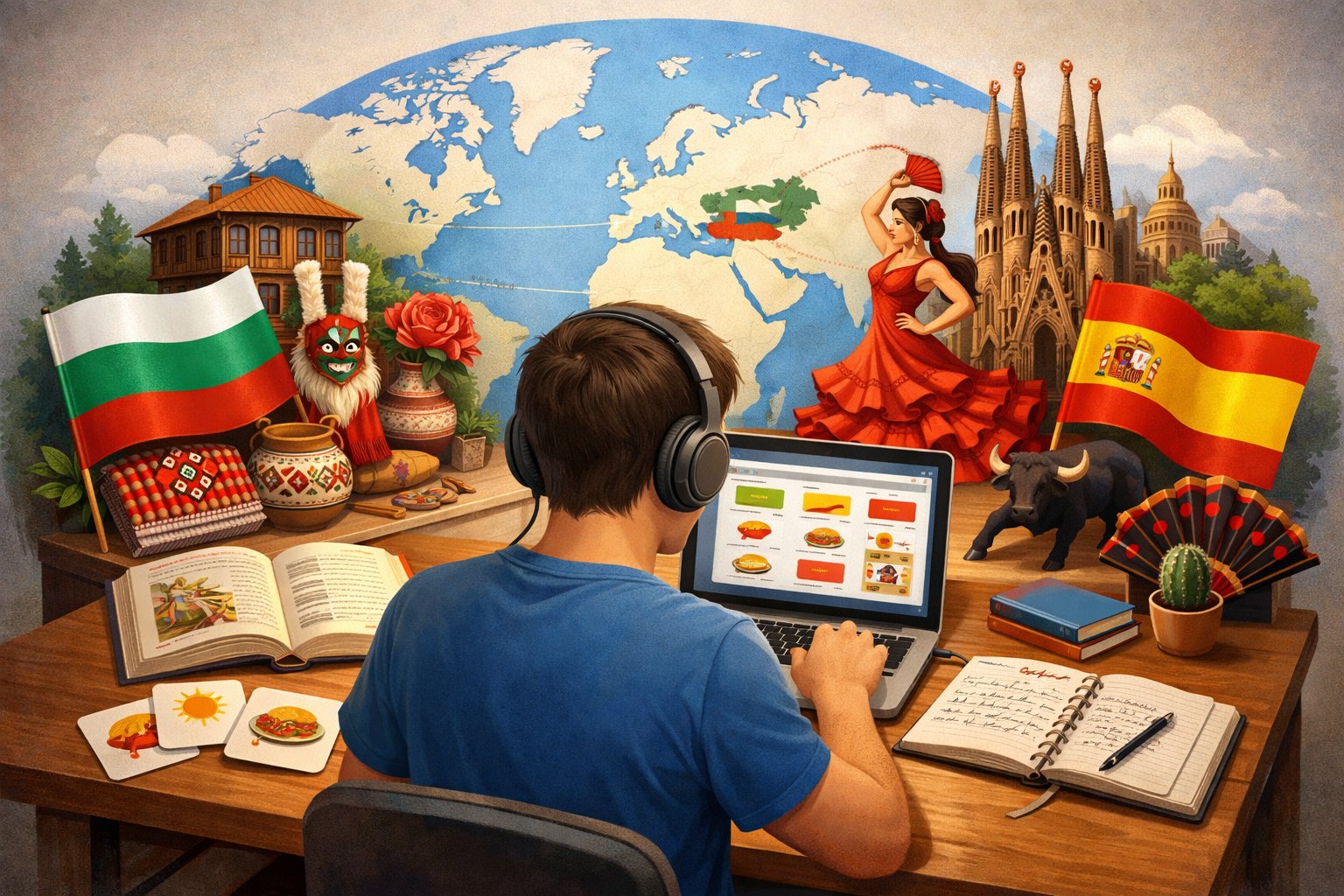
Leveraging Bulgarian to Accelerate Spanish Learning
Bulgarian speakers can use what they already know to speed things up and spot trouble spots early. Both languages are Indo-European, but their grammar splits off in key places. There are also some handy shortcuts that save time.
Key Differences Between Spanish and Bulgarian
Grammatical Structure
| Feature | Bulgarian | Spanish |
|---|---|---|
| Articles | After noun | Separate words (el, la, los, las) |
| Cases | Lost (except vocative) | None |
| Verb infinitives | Rare, replaced by constructions | Standard (-ar, -er, -ir) |
| Future tense | "ще" + present | Inflected endings or ir + a + infinitive |
| Gender agreement | Adjectives match nouns | Adjectives match nouns |
Phonetic Challenges
- Rolled R: Spanish needs a tongue trill; Bulgarian just taps
- Vowels: Spanish has 5 pure vowels; Bulgarian's 6 sound different
- J sound: Spanish "j" (jota) is missing in Bulgarian
- B/V: Bulgarians separate these sounds; Spanish speakers often don't
Rule → Example:
"Spanish requires rolled 'r' in words like 'perro'; Bulgarian only uses a tap as in 'река.'"
Bulgarian speakers have to relearn verb conjugation because Spanish uses more inflection where Bulgarian uses helpers.
Similarities and Leverage Points for Bulgarian Speakers
Shared Grammatical Features
- Gendered nouns in both languages
- Adjectives must match gender and number
- Both distinguish perfective/imperfective verbs
- Both often drop subject pronouns if context is clear
Cognates Through Greek and Latin
| Bulgarian | Spanish | English |
|---|---|---|
| филм | filme | film |
| музика | música | music |
| проблем | problema | problem |
| телефон | teléfono | telephone |
Learning Acceleration Points
- Gender sense transfers (libro/книга are both masculine)
- Aspect knowledge helps with preterite/imperfect
- Pronoun dropping is natural
- Bulgarian question formation matches Spanish (no need for do/does)
Semantic and Syntactic Contrasts Affecting Study Strategies
Word Order Flexibility
Bulgarian has more flexible word order thanks to case remnants. Spanish is usually Subject-Verb-Object, but can shift for emphasis.
Required vs. Optional Elements
| Element | Bulgarian | Spanish | Impact |
|---|---|---|---|
| Subject pronouns | Often dropped | Often dropped | Easy transfer |
| Articles | Mandatory | Mandatory | Must learn gender system |
| Auxiliary "be" | Needed for past | Not needed | Spanish past is simpler |
| Double negatives | Standard | Standard (no veo nada) | Direct transfer |
Aspect vs. Tense Priority
Rule → Example:
"In Bulgarian, aspect (completed/ongoing) is key; in Spanish, you must pick tense: 'escribí' (I wrote, finished) vs. 'escribía' (I was writing, ongoing)."
Preposition Mismatches
| Bulgarian Preposition | Spanish Equivalents | Error Risk |
|---|---|---|
| на (na) | a, en, de, para | High |
| в (v) | en, a | Medium |
| за (za) | para, por, sobre, de | High |
Rule → Example:
"Memorize Spanish verb + preposition pairs as fixed chunks: 'pensar en' (to think about), not 'pensar на.'"
Effective Learning Pathways: Choosing the Right Approach
Bulgarian speakers need study formats with clear milestones and routines that fit around work and family.
Overview of Study Formats for Bulgarians
| Format | Time Needed | Best For | Main Advantage |
|---|---|---|---|
| Online tutoring | 30-60 min, 2-3x/week | Speaking | Live correction, real practice |
| Apps | 10-20 min/day | Vocabulary | Flexible, fits busy days |
| Classes | 90-120 min/week | Grammar | Peer support, structure |
| Immersion | 2-4 weeks | Fast progress | Full exposure |
| Audio courses | 15-30 min | Pronunciation | Hands-free, on the go |
Format Selection Criteria
- Budget: Apps $10-15/mo, tutors $15-40/hr
- Schedule: Apps fit odd hours, tutors need appointments
- Learning style: Visual = apps, Auditory = talking
- Level: Beginners need structure, intermediates need more talking
Most Bulgarians mix approaches - apps for daily vocab, tutors for speaking.
Rule → Example:
"Combine an app for daily words and a weekly tutor session for conversation."
Spanish courses differ a lot - some focus on grammar, some on speaking.
Setting Realistic and Measurable Language Goals
| Timeframe | What You Can Do | Daily Practice | Word Target |
|---|---|---|---|
| 1 month | Greetings, numbers, basics | 15-20 min | 100-150 |
| 3 months | Simple chats, order food | 30 min | 500-700 |
| 6 months | Tell stories, chat casually | 45 min | 1,200-1,500 |
| 12 months | Give opinions, work talk | 60 min | 2,500-3,000 |
Progress Indicators
- Week 1-4: Order coffee, understand slow talk
- Month 2-3: Hold 5-min chats, watch kids' shows
- Month 4-6: Read news, join group talks
- Month 7-12: Share opinions, follow everyday speech
| CEFR Level | Study Hours Needed |
|---|---|
| A1 | 60-80 |
| A2 | 150-180 |
| B1 | 350-400 |
| B2 | 600-700 |
Check your progress with weekly self-checks and monthly speaking tests.
Personalized Study Routines for Adults
Daily Routine Template
- Morning (10-15 min):
- Listen to 5 common phrases with Spanish audio
- Repeat during breakfast or commute
- Review yesterday's words
- Midday (5-10 min):
- Practice phrases by removing words, recall from memory
- Use spaced repetition for weak spots
- Quick grammar drill (verbs)
- Evening (15-20 min):
- Watch a short Spanish video (news, recipes)
- Write 3 sentences with new words
- Prep next day's phrases
| Work Pattern | Best Study Time | Format Suggestion |
|---|---|---|
| Office job | Morning/lunch | App + audio in commute |
| Shift work | After shift | Flexible self-paced |
| Remote | Mid-morning | Tutor during breaks |
| Parent | Naptime/bedtime | Short videos + audio multitask |
Retention Mechanisms
- Encoding: Link Spanish to Bulgarian context (market words while shopping)
- Retrieval: Recall before checking answers
- Reinforcement: Use phrases in real life; repeat with audio
| Weekly Plan | Task |
|---|---|
| Monday | Learn 15-20 new phrases (audio) |
| Tue-Thu | Practice with word removal |
| Friday | Use vocab in 15-min talk (tutor/partner) |
| Weekend | Review weak spots, preview next week |
Best way to learn Spanish: Match your study style to your schedule and preferences.
Mastering Spanish Grammar, Pronunciation, and Vocabulary
Bulgarian speakers face unique hurdles with Spanish - verb endings, gender rules, and some vowels that just don't exist in Slavic languages.
Essential Spanish Grammar Challenges
Verb Conjugation Differences
| Bulgarian Feature | Spanish Feature | Challenge Level |
|---|---|---|
| Minimal verb endings | 6 conjugations per tense | High |
| Aspect-based system | Tense-based system | Medium |
| No subjunctive mood | Complex subjunctive | High |
| Simple future with "ще" | Irregular future stems | Medium |
Gender Agreement Patterns
- Masculine: el libro rojo (the red book)
- Feminine: la casa roja (the red house)
- Plural agreement: los libros rojos, las casas rojas
| Bulgarian Gender | Spanish Equivalent | Common Absorption |
|---|---|---|
| Masculine | Masculine | Direct |
| Feminine | Feminine | Direct |
| Neuter | Masculine/Feminine | Often masculine |
Ser vs. Estar Distinction
| Use Ser For | Use Estar For |
|---|---|
| Identity: Soy búlgaro | Location: Estoy en Madrid |
| Profession: Es médico | Temporary states: Está cansado |
| Time: Son las tres | Ongoing actions: Está comiendo |
| Origin: Es de Sofía | Results: Está roto |
| Bulgarian "to be" | Spanish Options | Usage Note |
|---|---|---|
| съм | ser / estar | New distinction needed |
Preposition Usage
| Spanish Phrase | Bulgarian Equivalent | Literal Meaning |
|---|---|---|
| pensar en | мисля за | think about |
| soñar con | мечтая за | dream about |
| depender de | зависи от | depend on |
Building Spanish Vocabulary for Bulgarian Speakers
Cognate Advantages
| Bulgarian | Spanish | English |
|---|---|---|
| проблем | problema | problem |
| телефон | teléfono | telephone |
| университет | universidad | university |
| информация | información | information |
False Friends to Avoid
| Spanish Word | Bulgarian Looks Like | Actual Meaning |
|---|---|---|
| embarazada | embarrassed | pregnant |
| constipado | constipated | has a cold |
| éxito | exit | success |
| actual | actual | current |
High-Frequency Verb Priorities
- ser/estar (to be)
- tener (to have)
- hacer (to do/make)
- ir (to go)
- poder (can/to be able)
- decir (to say)
- dar (to give)
- ver (to see)
Vocabulary Retention Methods
| Method | Example |
|---|---|
| Spaced repetition | 1d → 3d → 7d → 14d reviews |
| Contextual grouping | mesa, silla, plato together |
| Audio reinforcement | Listen to Spanish audio in 2 hrs |
| Progressive removal | Estoy muy cansado → blanks |
Effective online courses for learning Spanish grammar combine these techniques.
Techniques for Accurate Spanish Pronunciation
Vowel Sound Differences
| Spanish Vowel | Bulgarian Equivalent | Key Difference |
|---|---|---|
| a | а | Nearly identical |
| e | е | Spanish closed |
| i | и | Spanish shorter |
| o | о | Spanish pure |
| u | у | Nearly identical |
Rule → Example:
- Rule: Spanish vowels stay pure and clear, stressed or not.
- Example: casa = [ˈkasa] (not reduced to [kəsə])
Consonant Pronunciation Challenges
- pero (but): single tap r
- perro (dog): trilled rr
Practice for trilled R:
- Say "butter" quickly 10x
- Drop "bu" and "er"
- Speed up until tongue vibrates
- Try words: rojo, rosa, río
J and G sounds
- j as in jamón: strong throat friction, like Bulgarian х but harsher
- g before e/i: same as j
- g before a/o/u: hard, like Bulgarian г
Silent H
Rule → Example:
- Rule: Spanish h is always silent.
- Example: hola = OLA, not HOLA
Stress Pattern Rules
| Ending | Stress Pattern | Example |
|---|---|---|
| Vowel, n, s | Second-to-last syllable | ca-SA |
| Other consonants | Last syllable | ciu-DAD |
| Accent mark | Marked syllable | mú-SI-ca |
Common Spanish Syntax and Usage Pitfalls
Spaced Repetition, Microlearning, and Retention Boosters
| Method | Key Benefit |
|---|---|
| Spaced repetition | Moves vocab to long-term |
| Microlearning | Limits overload, boosts recall |
Spaced repetition and microlearning boost knowledge retention by spacing review and keeping sessions short.
Implementing Spaced Repetition for Vocabulary
Review Interval Structure
| Review Session | Time After Initial Learning | Retention Rate |
|---|---|---|
| First | 1 day | 85% |
| Second | 3 days | 75% |
| Third | 7 days | 70% |
| Fourth | 14 days | 65% |
| Fifth | 30 days | 60% |
Application Steps
- Learn 10–15 new Spanish words with Bulgarian translations.
- Review after 24 hours without translations.
- Test recall every 3 days; missed words go to daily review.
- Once accuracy is 90%, review weekly.
- Monthly review prevents decay.
| Rule | Example |
|---|---|
| Delay second review by 1 day | Review new words next day, not same day |
High-Priority Word Categories for Spacing
- False cognates (embarazada, actual)
- Ser vs estar forms
- Subjunctive triggers
- Preposition pairs (pensar en, pensar de)
- Gender-irregular nouns
Research-Based Microlearning Workflows
Daily Session Structure
| Component | Time | Focus |
|---|---|---|
| Audio playback | 2 min | Pronunciation |
| Active recall | 3 min | Translation |
| Gap-fill practice | 2 min | Context use |
| Speaking repeat | 3 min | Speaking patterns |
Weekly Distribution Model
| Day | Focus |
|---|---|
| Monday | New verbs + conjugations |
| Tuesday | Review verbs + new nouns |
| Wednesday | Build sentences |
| Thursday | New adjectives + agreement |
| Friday | Conversation review |
| Saturday | Audio-only passive review |
| Sunday | Written production |
| Research Finding | Impact for Bulgarians |
|---|---|
| Sessions <10 min | +50% engagement |
| Split gender memorization | Better retention than mass drill |
Phrase Café Delivery Method
- 3–5 Spanish phrases emailed daily
- Spanish audio included
- Progressive word removal for recall
- 5–7 minutes per session
Flashcard Systems and Digital Tools
Platform Comparison for Bulgarian→Spanish Learning
| Platform | Spaced Algorithm | Bulgarian Support | Audio Quality | Cost |
|---|---|---|---|---|
| Anki | Custom SM-2 | Full UI | User-dependent | Free |
| Memrise | Fixed intervals | Partial UI | Real Spanish recordings | Freemium |
| Quizlet | Basic spacing | Full UI | Synthetic + human | Freemium |
| Brainscape | Confidence-based | English only | Mixed quality | Paid |
Anki Deck Setup for Spanish from Bulgarian
- Download top 5,000 Spanish words
- Add Bulgarian translation and IPA fields
- Limit to 15 new cards/day
- Intervals: 1d → 3d → 7d → 15d → 30d
- Enable Spanish audio auto-play
- Tag by part of speech and difficulty
Memrise offers pre-made Spanish courses with Bulgarian translations, auto-spaced reviews, but fixed intervals.
Optimal Flashcard Format
| Front | Back | Extra Field |
|---|---|---|
| Spanish word + sentence | Bulgarian translation + gender + audio | Mnemonic linking sound/meaning |
| Rule | Example |
|---|---|
| Full sentence cards improve retention | "Voy a la playa" / "Отивам на плажа" > "playa = плаж" |
Physical Card Alternative
- Spanish on one side, Bulgarian + pronunciation on reverse
- Sort: known, uncertain, unknown piles
- Review uncertain daily, unknown twice daily
- Move cards based on 3-second recall
Tech-Driven Spanish Learning: Apps, Platforms, and Online Resources
Top-Rated Spanish Learning Apps for Bulgarians
Gamified Learning Apps
| App | Method | Bulgarian Interface | Price |
|---|---|---|---|
| Duolingo | Lessons, SRS | Yes | Free/$6.99/mo |
| Busuu | Video, community feedback | Yes | €5.83–6.66/mo |
| Babbel | Conversation-focused | Limited | $13.95/mo |
| Memrise | Flashcards, vocab | Yes | $13/mo |
Audio-Focused Solutions
- Pimsleur: 30-min audio lessons, builds conversation ($14.95/mo or $150/level)
- SpanishPod101: Podcasts, transcripts, cultural notes
Live Instruction Platforms
- Preply: One-on-one tutoring, flexible scheduling
- iTalki: Spanish speakers, structured or casual sessions
| Visual Vocabulary + Audio | Bulgarian Interface | Benefit |
|---|---|---|
| Duolingo, Busuu | Yes | Lowers cognitive load |
Maximizing Language Platforms for Structured Progress
Comprehensive Course Platforms
| Platform | Structure Type | Content Hours | Live Practice |
|---|---|---|---|
| LinguaLift | Real conversations | 400+ | Tutor support |
| Rosetta Stone | Immersion | Full course | Optional live |
| MosaLingua | Adaptive flashcards | Self-paced | Audio only |
Reading-Based Systems
- LingQ: Import articles, subtitles, news with instant lookup
- Beelinguapp: Parallel Bulgarian–Spanish texts, Spanish audio
Progress Tracking Methods
| Step | Tool/Method |
|---|---|
| Set CEFR targets (A1 → B1) | Platform progress tracker |
| Take placement tests monthly | Built-in or external |
| Track vocab retention | SRS review stats |
| Record weekly speaking samples | Voice recorder/app |
| Rule | Example |
|---|---|
| Comparative tables speed up conjugation | Show all present tense forms side-by-side |
Curating Digital Content for Everyday Practice
Daily Exposure Sources
- YouTube channels: Butterfly Spanish (grammar tips), Dreaming Spanish (comprehensible input by level)
- Podcast series: News in Slow Spanish (adjustable speed, transcripts included)
- Dictionary apps: SpanishDict (context examples), RAE (official definitions)
Spaced Repetition Tools
| Tool | Card Creation | Multimedia Support | Syncing |
|---|---|---|---|
| Anki | Manual/imported | Images, audio, video | Cross-device |
| Flashcards Deluxe | Custom decks | Full media support | Cloud backup |
| Brainscape | Pre-made + custom | Limited | Web + mobile |
Community Practice Platforms
- Tandem: Matches Bulgarians with Spanish speakers for language exchange
- HiNative: Ask grammar questions, get answers from Spanish speakers
Vocabulary Retention for Bulgarians
| Method | Description |
|---|---|
| Tech integration | Combine audio and written practice for stronger recall |
| Mixed-format daily sessions | 15 min: app review + podcast + flashcards beats 45 min block |
Immersive Practice: Speaking, Listening, and Real-World Interaction
Building Conversation Skills with Language Partners
Finding a Language Partner
- Online: iTalki, Tandem, HelloTalk, ConversationExchange
- Local: Sofia/Plovdiv/Varna meetups
- University language departments, cultural centers
- Spanish expat groups in Bulgaria
Practice Structure with Spanish Speakers
| Session Type | Duration | Focus Areas |
|---|---|---|
| Casual chat | 20-30 min | Daily topics, current events |
| Structured exchange | 45-60 min | 50% Spanish / 50% Bulgarian |
| Topic-based | 30 min | Pre-selected themes, vocab focus |
| Grammar correction | 30 min | Error tracking, feedback |
Conversation Practice Methods
- Do 2-3 sessions weekly with the same partners
- Record for later review
- Prep topic lists in advance
- Ask for instant corrections (especially as a beginner)
- Use video calls for pronunciation help
| Role | Benefit |
|---|---|
| Spanish tutor | Gives structured feedback |
| Conversation partner | Provides natural dialogue practice |
Active Listening: Podcasts, Movies, and Real Spanish Media
Spanish Podcasts by Level
| Level | Podcast Examples | Features |
|---|---|---|
| Beginner | Notes in Spanish, Coffee Break | Slow, clear pronunciation |
| Intermediate | Radio Ambulante, Duolingo Podcast | Real stories, moderate speed |
| Advanced | El Hilo, Caso 63 | Full speed, complex topics |
Spanish Movies and Series Progression
- Start with Bulgarian subtitles
- Switch to Spanish subtitles after 2–3 viewings
- Drop subtitles for advanced listening
- Focus on one accent region (Castilian or Latin American)
Daily Listening Schedule
| Time | Activity |
|---|---|
| Morning | 15-min podcast at breakfast |
| Commute | Spanish radio or audiobook |
| Evening | 30-min Spanish series episode |
| Any time | Spanish music, look up lyrics |
Listening Rule → Example
Rule: Listen daily for accent recognition
Example: Play Spanish radio during your commute every morning.
Participating in Language Exchange & Summer Courses
Language Exchange Formats
- Tandem partnerships: 1-on-1 Bulgarian-Spanish swaps
- Group meetups: 4–6 learners practicing together
- Online clubs: Scheduled video sessions
- Text-based exchanges: WhatsApp or Telegram daily chats
Spanish Summer School Options
| Program Type | Location | Duration | Benefits for Bulgarians |
|---|---|---|---|
| Intensive courses | Spain | 2–4 weeks | Full immersion, cultural context |
| University programs | Latin America | 4–8 weeks | Academic credit, structure |
| Private academies | Madrid/Barcelona | 1–6 weeks | Flexible, small groups |
Preparation Before Summer Programs
- Reach at least A2 level
- Decide: host family or dormitory
- Budget €800–1500 for 2 weeks
- Apply 3–4 months ahead for visas
| Benefit | Example |
|---|---|
| Daily Spanish contact | Speak Spanish with host family after classes |
| Classroom instruction | Attend structured lessons each morning |
Practical Communication through Books and Real-Life Scenarios
Spanish Books Progression Path
| Level | Material Type | Unique Words/Complexity |
|---|---|---|
| A1–A2 | Graded readers | 100–300 words |
| B1 | Young adult novels | Familiar plots |
| B2 | Contemporary fiction | Contextual clues |
| C1–C2 | Literary/non-fiction works | Full Spanish complexity |
Reading Materials by Interest
| Interest | Recommended Book | Level |
|---|---|---|
| Mystery | La sombra del viento | B2+ |
| Short stories | Cuentos de la Alhambra | B1 |
| Daily life | El País (newspaper) | B1–C1 |
| Professional | Industry journals | C1+ |
Real-Life Practice Scenarios
- Order in Spanish at restaurants
- Email Spanish-speaking colleagues
- Write shopping lists in Spanish
- Narrate your day aloud in Spanish
- Switch phone/computer to Spanish
Combining Books with Active Practice
| Activity | Action |
|---|---|
| Read and summarize | Read a chapter, then speak summary |
| Discuss with partners | Talk about book content |
| Note unknown phrases | Add to spaced repetition app |
| Compare translations | Check Bulgarian vs. Spanish originals |
| Rule → Example |
|---|
| Speak about what you read to activate vocabulary |
| "After reading a chapter, summarize it aloud." |
Frequently Asked Questions
What are effective methods for Bulgarian speakers to learn Spanish?
| Method | Focus/Benefit |
|---|---|
| Structured classroom | Systematic grammar, compare Spanish/Bulgarian |
| Language exchange | Real conversation with Spanish locals |
| Daily immersion | Spanish media, graded texts, pronunciation drills |
| Spaced repetition | Timed vocab review for long-term retention |
| Audio-focused learning | Practice rolled "r" and vowel system |
| Rule → Example |
|---|
| Focus on gendered nouns and verbs - these differ from Bulgarian. |
| Practice: "el libro" (masc.), "la mesa" (fem.) |
Which online platforms are recommended for Bulgarians to practice Spanish?
| Platform | Features | Best For |
|---|---|---|
| Duolingo | Bulgarian interface, gamified lessons | Daily habit |
| Babbel | Bulgarian-Spanish grammar courses | Grammar focus |
| Tandem | Exchange with Spanish speakers | Conversation |
| HelloTalk | Text/voice chat with Spanish speakers | Written/spoken |
| Rule → Example |
|---|
| Use platforms with Bulgarian instructions to ease early learning. |
| Example: Start Duolingo in Bulgarian, not English. |
Are there any Spanish language courses designed specifically for Bulgarian speakers?
| Course Type | Focus |
|---|---|
| Comparative textbooks | Verb systems, noun gender differences |
| Cervantes Institute (in Bulgaria) | Structured courses, cultural immersion |
| Language schools in Bulgaria | Spanish instruction by Bulgarian teachers |
| Bulgarian-Spanish platforms | Courses for this language pair |
| Rule → Example |
|---|
| Choose courses that address Bulgarian-specific issues. |
| Example: "Curso de español para búlgaros" textbook |
What are the best Spanish learning apps for someone fluent in Bulgarian?
| App | Features |
|---|---|
| Bulgarian-Spanish dictionaries | Offline, pronunciation guides |
| Duolingo | Full Bulgarian interface |
| Memrise | Bulgarian-Spanish vocab with Spanish audio |
| Anki | Custom flashcards for Bulgarians |
| Quizlet | Shared Bulgarian-Spanish sets |
| Rule → Example |
|---|
| Use apps with Bulgarian support to reduce confusion. |
| Example: Use Memrise's Bulgarian-Spanish course, not English. |
Can you recommend any comprehensive textbooks or workbooks for learning Spanish aimed at Bulgarians?
| Feature | Description |
|---|---|
| Comparative grammar | Spanish conjugation vs. Bulgarian aspects |
| Phonetic guides | Spanish sounds mapped to Bulgarian alphabet |
| Exercises | Target common Bulgarian errors |
| Vocab lists | Frequency, topic, with Bulgarian translation |
| Rule → Example |
|---|
| Pick textbooks that highlight Bulgarian-Spanish contrasts. |
| Example: Section on "ser" vs. "estar" with Bulgarian notes |