What Does the Imperfect Tense Mean in Spanish: How Mastery Finally Clicks
Mastery means spotting context clues and telling background info (imperfect) apart from main events (preterite).
Posted by
 Stewart Kaplan
Related reading
What Does Adonde Mean in Spanish? How Movement 'Clicks' for Learners
You have to know when prepositions combine with donde to show direction or position
What Does Ahi Mean in Spanish? Cognitive Mastery That Sticks
Learners mix up ahí, hay, and ay because they sound the same but mean totally different things.
What Does Aki Mean in Spanish: Unpacking Real Usage for Learners
Regional differences exist, but nearly everyone in Spanish-speaking communities gets what "aki" means in a text
TL;DR
- The imperfect tense in Spanish (pretérito imperfecto) covers ongoing past actions, habits, and background scenes - not finished events.
- Regular -ar verbs use -aba endings; -er/-ir verbs use -ía endings; only three verbs are irregular: ser, ir, ver.
- Use imperfect for repeated past actions (look for signal words like siempre, todos los días), descriptions, ages, times, and ongoing actions interrupted by preterite events.
- Imperfect sets the scene and describes conditions; preterite reports what happened as a finished action.
- Mastery means spotting context clues and telling background info (imperfect) apart from main events (preterite).
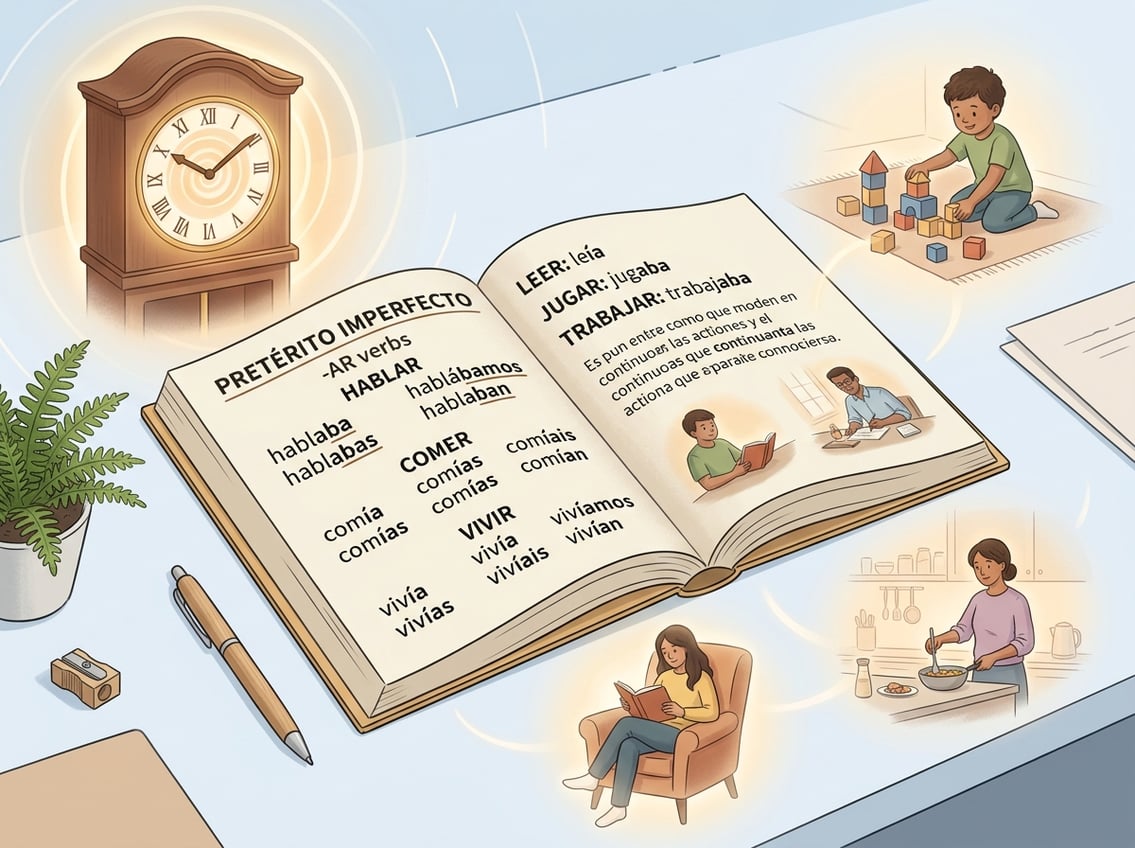
Key Differences Between Imperfect and Preterite
Spanish past tenses depend on whether the action was finished at a certain point or just going on without clear boundaries. The imperfecto is for habits or background stuff, while the pretérito is for finished events.
Understanding Imperfect vs. Preterite Tense
| Feature | Imperfect (Imperfecto) | Preterite (Pretérito) |
|---|---|---|
| Action Type | Ongoing, habitual, repeated | Completed, one-time, sequential |
| Time Frame | No defined start/end | Specific beginning and/or end |
| English Equivalent | "was doing," "used to do" | "did," "went," "saw" |
| Focus | Background description | Main storyline events |
When to use imperfect:
- Habitual actions in the past
- Physical or mental states
- Time, age, or weather descriptions
- Actions in progress (background)
When to use preterite:
- Completed actions with definite endpoints
- Specific number of repetitions
- Sequential events
- Actions that interrupt ongoing activities
Imperfect for Ongoing and Background Actions
The spanish imperfect gives context and says what was going on when something else happened.
| Use Case | Spanish Example | English Translation |
|---|---|---|
| Habitual action | Yo jugaba con muñecas | I used to play with dolls |
| Ongoing action | Los chicos hablaban en español | The boys were speaking in Spanish |
| Background setting | Estaba durmiendo | I was sleeping |
| Age in past | Tenía tres años | He was three years old |
| Physical state | Era muy pequeño | He was very small |
Common imperfect trigger words:
- siempre (always)
- todos los días (every day)
- a menudo (often)
- mientras (while)
- generalmente (usually)
- cada día (each day)
Rule → Example:
- Rule: Use imperfect for background situations.
- Example: "Cuando era niño, jugaba en el parque." ("When I was a kid, I used to play in the park.")
Preterite for Completed Events
The preterite tense tells about specific actions that started and ended at clear times.
| Use Case | Spanish Example | English Translation |
|---|---|---|
| Single completed action | Fui al baile anoche | I went to the dance last night |
| Sequential events | Caminé, compré, regresé | I walked, bought, returned |
| Specific repetition | Te llamó tres veces | He called you three times |
| Timed duration | Hablé de las dos hasta las tres | I spoke from two until three |
Time markers for preterite:
- ayer (yesterday)
- anoche (last night)
- una vez (one time)
- el año pasado (last year)
- hace dos días (two days ago)
Verbs almost always preterite:
- casarse (to get married)
- nacer (to be born)
- morir (to die)
- decidir (to decide)
- llegar (to arrive)
Rule → Example:
- Rule: Use preterite for actions with a clear start and end.
- Example: "Ayer llegué temprano." ("Yesterday I arrived early.")
Core Uses of the Imperfect Tense
The imperfect tense does four main things in Spanish: describes repeated habits, sets the background in stories, states times and ages in the past, and talks about ongoing conditions.
Describing Habits and Routines
Imperfect shows actions that happened again and again in the past - stuff people used to do regularly.
Common time markers with habits:
| Spanish | English | Example |
|---|---|---|
| cada día | every day | Caminaba cada día. (I used to walk every day.) |
| siempre | always | Siempre comía a las dos. (I always ate at 2:00.) |
| todos los días | every day | Estudiábamos todos los días. (We studied every day.) |
| a menudo | often | A menudo visitaba a mi abuela. (I often visited my grandmother.) |
| generalmente | generally | Generalmente trabajaba los sábados. (I generally worked on Saturdays.) |
Rule → Example:
- Rule: Subject + imperfect verb + frequency phrase.
- Example: "Mi padre cocinaba los domingos." ("My father used to cook on Sundays.")
Setting the Scene and Background
Imperfect paints the background, while another action (usually preterite) interrupts.
- Weather conditions
- Physical descriptions
- Emotions and mental states
- Ongoing situations
| Type | Imperfect Example | Translation |
|---|---|---|
| Weather | Hacía calor | It was hot |
| Appearance | El hombre era alto | The man was tall |
| Emotion | Me sentía triste | I felt sad |
| Existence | Había mucha gente | There were many people |
Rule → Example:
- Rule: Imperfect (ongoing) + cuando + preterite (interruption).
- Example: "Leía un libro cuando sonó el teléfono." ("I was reading a book when the phone rang.")
Note: The verb había (there was/there were) only uses the imperfect form to describe past scenes.
Telling Time and Stating Age
Times and dates in the past always use imperfect.
Time expressions:
- Eran las ocho de la mañana. (It was 8:00 in the morning.)
- Era la una y media. (It was 1:30.)
- Era medianoche. (It was midnight.)
Date expressions:
- Era el 15 de junio. (It was June 15th.)
- Era lunes. (It was Monday.)
- Era mi cumpleaños. (It was my birthday.)
| Person | Imperfect Form | Example |
|---|---|---|
| yo | tenía | Yo tenía diez años. (I was ten years old.) |
| tú | tenías | Tú tenías cinco años. (You were five years old.) |
| él/ella | tenía | Ella tenía treinta años. (She was thirty years old.) |
| nosotros | teníamos | Teníamos la misma edad. (We were the same age.) |
| ellos | tenían | Ellos tenían doce años. (They were twelve years old.) |
Rule → Example:
- Rule: Time, date, and age in the past always use imperfect.
- Example: "Era lunes y tenía ocho años." ("It was Monday and I was eight years old.")
Expressing Ongoing States
Imperfect covers conditions, feelings, and situations that lasted for a while - no clear start or end.
Mental/emotional states:
- Quería viajar. (I wanted to travel.)
- Pensaba en ti. (I was thinking about you.)
- Creía en fantasmas. (I believed in ghosts.)
- Sabía la respuesta. (I knew the answer.)
Physical conditions:
- Me dolía la cabeza. (My head hurt.)
- Estaba cansado. (I was tired.)
- Tenía hambre. (I was hungry.)
- Hacía frío. (It was cold.)
| Situation | Spanish | English |
|---|---|---|
| Ongoing residence | Vivíamos en Madrid. | We lived in Madrid. |
| Ongoing job | Trabajaba en un banco. | I worked at a bank. |
| Ongoing studies | Estudiaban medicina. | They studied medicine. |
| Ongoing habit | El perro dormía en mi cama. | The dog slept in my bed. |
Rule → Example:
- Rule: Use imperfect for ongoing states or conditions in the past.
- Example: "Estaba cansado y quería dormir." ("I was tired and wanted to sleep.")
Step-by-Step Guide: How to Form the Imperfect
The imperfect tense uses a simple pattern: drop the infinitive ending, add the right ending for -ar or -er/-ir verbs. Most verbs are regular, so it's one of the easiest Spanish tenses to learn.
Forming the Imperfect Tense with Regular Verbs
Steps:
- Start with the infinitive (hablar, comer, vivir)
- Drop the ending (-ar, -er, -ir)
- Add the imperfect ending that matches the subject
Example:
- Infinitive: hablar
- Remove -ar: habl-
- Add ending: hablaba (I was speaking / used to speak)
Regular Verb Examples:
| Verb | Stem | Example Form | English |
|---|---|---|---|
| caminar | camin- | caminaba | walked |
| comer | com- | comía | ate |
| escribir | escrib- | escribía | wrote |
| jugar | jug- | jugaba | played |
| leer | le- | leía | read |
Imperfect Endings for -AR, -ER, and -IR
-AR Verb Endings:
| Subject | Ending | Example (hablar) |
|---|---|---|
| yo | -aba | hablaba |
| tú | -abas | hablabas |
| él/ella/usted | -aba | hablaba |
| nosotros/nosotras | -ábamos | hablábamos |
| vosotros/vosotras | -abais | hablabais |
| ellos/ellas/ustedes | -aban | hablaban |
-ER and -IR Verb Endings (Identical):
| Subject | Ending | Example (comer) | Example (vivir) |
|---|---|---|---|
| yo | -ía | comía | vivía |
| tú | -ías | comías | vivías |
| él/ella/usted | -ía | comía | vivía |
| nosotros/nosotras | -íamos | comíamos | vivíamos |
| vosotros/vosotras | -íais | comíais | vivíais |
| ellos/ellas/ustedes | -ían | comían | vivían |
Accent Rules:
- All forms of -er/-ir verbs have an accent on the "í"
- Only the nosotros form of -ar verbs has an accent (á)
Recognizing Imperfect Conjugations
Recognition Patterns:
- -aba = -ar verbs (yo hablaba, ellos caminaban)
- -ía = -er/-ir verbs (yo comía, tú vivías)
- Accents: Always on -ía endings; only on -ábamos for -ar verbs
Recognition Practice:
| Spanish Form | Verb | Subject | Tense |
|---|---|---|---|
| hablaba | hablar | yo/él/ella | imperfect |
| comías | comer | tú | imperfect |
| vivíamos | vivir | nosotros | imperfect |
| trabajaban | trabajar | ellos/ellas | imperfect |
Rule → Example:
Rule: Imperfect regular verbs = stem + imperfect ending
Example: "comer" → comía (I was eating)
Irregular Verbs and Special Cases
Only Three Irregular Verbs
| Subject | Ser | Ir | Ver |
|---|---|---|---|
| yo | era | iba | veía |
| tú | eras | ibas | veías |
| él/ella/usted | era | iba | veía |
| nosotros | éramos | íbamos | veíamos |
| vosotros | erais | ibais | veíais |
| ellos/ellas/ustedes | eran | iban | veían |
Irregular Patterns:
- Ser and ir have unique stems
- Ver uses the full "ve" stem with -ía endings
- No accents on ser or ir forms
The Role of Había
| Use | Example in Spanish | English |
|---|---|---|
| Existence | Había tres casas en la calle | There were three houses |
| Atmosphere | Había mucha niebla | There was a lot of fog |
| Presence | Había mucha gente en la fiesta | There were many people |
Rule → Example:
Rule: Había always stays singular, no matter the quantity
Example: Había dos perros. (There were two dogs.)
When to Use the Imperfect
Core Uses:
| Context | Imperfect Use | Example |
|---|---|---|
| Habits | Repeated actions | Yo corría todos los días (I used to run every day) |
| Age | Stating age | Tenía 25 años (I was 25 years old) |
| Time | Telling time | Eran las tres (It was three o'clock) |
| Weather | Describing weather | Hacía frío (It was cold) |
| Interruption | Action in progress | Leía cuando llamaste (I was reading when you called) |
Signal Words:
- siempre (always)
- todos los días (every day)
- a menudo (often)
- generalmente (generally)
- de vez en cuando (once in a while)
Common Mistakes and How to Avoid Them
| Mistake | Why It Happens | Correction Strategy |
|---|---|---|
| Using preterite for habits | "Used to" feels finished in English | Look for frequency words |
| Using imperfect for single completed acts | Confusing "was doing" with "did" | Ask: did it finish at a moment? |
| Mixing both in descriptions | Not sure which action interrupted | Imperfect = background, preterite = interruption |
Rule → Example:
Rule: Use imperfect for ongoing or repeated actions; preterite for completed actions
Example: "Siempre jugaba" (I always played) = imperfect; "Jugué ayer" (I played yesterday) = preterite
Practice Steps:
- Read a past-tense English sentence
- Decide: ongoing/habitual (imperfect) or completed (preterite)?
- Check for frequency or time markers
- Use the correct tense
Practical Examples and Applications
Sample Sentences with the Imperfect
| Spanish | English | Usage |
|---|---|---|
| Yo hablaba español cada día. | I used to speak Spanish every day. | Past habit |
| Mientras yo hablaba, él llegó. | While I was speaking, he arrived. | Ongoing interrupted |
| Yo hablaba con mi abuela los domingos. | I would speak with my grandmother on Sundays. | Repeated past action |
Examples with había:
- Había mucha gente en la fiesta. (There were many people at the party.)
- Había un perro en el jardín. (There was a dog in the garden.)
- No había tiempo para comer. (There wasn't time to eat.)
More imperfect examples:
- Mis hermanos jugaban en el parque. (My brothers used to play in the park.)
- El clima era perfecto. (The weather was perfect.)
- Nosotros comíamos juntos. (We would eat together.)
Context Clues for the Imperfect
| Expression | English | Example Sentence |
|---|---|---|
| siempre | always | Siempre llegaba tarde. |
| todos los días | every day | Estudiaba todos los días. |
| de niño/a | as a child | De niña, leía mucho. |
| cada semana | each week | Visitábamos a los abuelos cada semana. |
| generalmente | generally | Generalmente trabajaba en casa. |
Descriptive Contexts:
| Description Type | Spanish Example | English |
|---|---|---|
| Age | Tenía veinte años. | She was twenty years old. |
| Time | Eran las tres de la tarde. | It was three in the afternoon. |
| Physical | Era alto y delgado. | He was tall and thin. |
| Emotion | Estaba feliz. | She was happy. |
| Weather | Hacía frío. | It was cold. |
Switching Between Tenses
| Structure | Spanish Example | English Translation |
|---|---|---|
| Background + action | Llovía cuando salí. | It was raining when I left. |
| Ongoing + interruption | Dormía cuando sonó el teléfono. | I was sleeping when the phone rang. |
| Description + event | Era tarde y decidimos irnos. | It was late and we decided to leave. |
Imperfect vs Preterite:
| Tense | Example (Spanish) | English Meaning |
|---|---|---|
| Imperfect | Comía pizza. | I was eating/I used to eat pizza. |
| Preterite | Comí pizza. | I ate pizza (finished action). |
Multiple imperfect actions:
- Mientras estudiaba, mi hermano veía la televisión y mi padre cocinaba.
Recognition Rule:
Rule: Use imperfect for ongoing states, habits, or actions without a clear endpoint
Example: "Siempre leía antes de dormir." (I always read before sleeping.)
Frequently Asked Questions
| Question | Answer |
|---|---|
| What does the imperfect tense describe? | Ongoing past actions, habits, background details (age, time, weather, descriptions) |
| How is it different from the preterite? | Imperfect = duration, ongoing/repeated; Preterite = completed action |
What does the imperfect tense express in Spanish grammar?
Ongoing actions in the past
- No clear start or end point
- Sets the scene or background
- Events happening at the same time
Habitual or repeated actions
- Regular routines
- Often with words like "siempre" (always), "cada día" (every day)
Descriptions in the past
- Ages: Tenía diez años (I was ten years old)
- Times: Eran las tres (It was three o'clock)
- Weather: Hacía frío (It was cold)
- Physical traits: Era alto (He was tall)
- Mental or emotional states: Estaba feliz (I was happy)
When should you use the imperfect tense instead of the preterite in Spanish?
| Imperfect | Preterite |
|---|---|
| Describes what was happening | States what happened |
| No clear beginning or end | Specific start/end |
| Repeated or habitual action | One-time, completed action |
| Sets the background | Interrupts the scene |
| Describes age, time, weather | Announces an event |
Combined usage pattern
- Estudiaba cuando llamaste (I was studying when you called)
- Caminábamos cuando empezó a llover (We were walking when it started to rain)
What are some clear examples of the imperfect tense used in Spanish sentences?
Habitual actions
- Comía cereal cada mañana → I ate cereal every morning
- Visitábamos a mis abuelos los domingos → We visited my grandparents on Sundays
- Jugaban fútbol después de la escuela → They played soccer after school
Background descriptions
- La casa era grande y blanca → The house was big and white
- Hacía mucho calor ese día → It was very hot that day
- Mi hermana tenía el pelo largo → My sister had long hair
Ongoing actions
- Leía un libro cuando sonó el teléfono → I was reading a book when the phone rang
- Los niños dormían mientras cocinábamos → The children were sleeping while we were cooking
Ages and times
- Tenía veinticinco años en 2010 → I was twenty-five years old in 2010
- Eran las nueve de la noche → It was nine o'clock at night
How do you conjugate regular -ar, -er, and -ir verbs in the imperfect tense?
Step 1: Remove the infinitive ending (-ar, -er, or -ir)
Step 2: Add the correct ending
| Subject | -ar verbs | -er/-ir verbs |
|---|---|---|
| yo | -aba | -ía |
| tú | -abas | -ías |
| él/ella/usted | -aba | -ía |
| nosotros/nosotras | -ábamos | -íamos |
| vosotros/vosotras | -abais | -íais |
| ellos/ellas/ustedes | -aban | -ían |
Examples with hablar (to speak):
- yo hablaba
- tú hablabas
- él/ella/usted hablaba
- nosotros/nosotras hablábamos
- vosotros/vosotras hablabais
- ellos/ellas/ustedes hablaban
Examples with comer (to eat) and vivir (to live):
- yo comía / vivía
- tú comías / vivías
- él/ella/usted comía / vivía
- nosotros/nosotras comíamos / vivíamos
- vosotros/vosotras comíais / vivíais
- ellos/ellas/ustedes comían / vivían
What is the imperfect tense equivalent in English, and how is it typically translated?
| Pattern | Example in Spanish | English Translation |
|---|---|---|
| "was/were" + verb-ing | Estudiaba | I was studying |
| "used to" + base verb | Jugaba | I used to play |
| "would" + base verb (habitual) | Visitaba a mis primos | I would visit my cousins |
| Simple past (descriptions) | Era pequeño | It was small |
Rule → Example: Rule: Choose the English translation based on context - duration, habit, or description. Example: Hacía frío → It was cold