Can You Learn Spanish in a Year? Science-Backed Language Breakthroughs
Achieve conversational Spanish fluency in one year with science-backed strategies. Learn how consistency beats intensity, what daily habits work best, and realistic milestones for your 12-month journey.
Posted by
 Stewart Kaplan
Related reading
Basic Spanish Words Every Beginner Should Learn (Organized by Category)
Master 200+ essential Spanish words organized by category: greetings, food, travel, and emergency phrases. Includes example sentences for each word. Perfect for beginners building vocabulary.
Best Apps to Learn Spanish (2026 Review): Ranked by Speed & Retention
Compare the best Spanish learning apps in 2026. Ranked by speed to fluency, retention rates, and value. Includes Duolingo, Babbel, Rosetta Stone, Pimsleur, and more.
Can You Learn Spanish in 3 Months? Reality Check + 90-Day Sprint Plan
Honest assessment of what's achievable in 3 months of Spanish learning. Includes realistic expectations, fluency levels, and a complete 90-day sprint plan.
Can You Learn Spanish in a Year? Fact-Checking the Possibility
Reaching conversational ability in Spanish within 12 months is possible with structured daily practice, but true fluency depends on how learners define the term and how consistently they engage with the language. For a shorter timeline, check learning Spanish in 6 months.
Defining Fluency and Realistic Expectations
Fluency exists on a spectrum rather than as a fixed endpoint. A learner who studies one hour daily for a year typically reaches conversational fluency, meaning they can handle everyday interactions, express needs, and understand Spanish speakers in common situations. This differs from advanced fluency, which requires mastery of complex grammar, specialized vocabulary, and cultural nuances.
Most language experts confirm that 6-12 months of focused study brings conversational proficiency. The brain consolidates new language patterns through repeated exposure in context, not through memorization alone. When learners encounter phrases in meaningful situations, they build stronger neural pathways than when drilling isolated vocabulary. For detailed hour breakdowns, see how many hours to learn Spanish.
Adults who learn Spanish effectively use spaced repetition to combat forgetting. This method presents information at increasing intervals, forcing the brain to retrieve knowledge just before it fades. Contextual recall strengthens faster when learners see phrases in real sentences rather than word lists. Spanish audio reinforcement trains the ear to recognize authentic pronunciation and rhythm, which textbooks cannot replicate.
Daily exposure through short, focused sessions creates better retention than weekend cramming. A five-minute daily routine with progressive challenges keeps the language fresh without overwhelming the learner's schedule or mental capacity.
How Time Commitment Influences Success
The difference between success and frustration often comes down to consistency over intensity. Spending 20 minutes daily produces better results than sporadic three-hour sessions because the brain needs regular activation to move information from short-term to long-term memory.
Learners who dedicate one focused hour each day typically need:
- 3-4 months to handle basic conversations
- 6-8 months to discuss familiar topics comfortably
- 10-12 months to navigate most daily situations
The quality of study time matters more than quantity. Active engagement - speaking, writing, and retrieving words from memory - builds stronger connections than passive listening or reading. When learners practice disappearing-text training, where words gradually vanish from phrases they're studying, they force their brain to fill gaps actively rather than rely on visual cues.
Auditory reinforcement through Spanish speakers helps learners distinguish between similar sounds and adopt natural speech patterns. This combination of visual fading and audio modeling trains both recognition and production simultaneously, compressing the timeline to become fluent in Spanish.
Common Myths About Fast Language Learning
Several misconceptions prevent learners from starting their language learning journey or cause them to abandon it prematurely.
Myth: Apps alone create fluency. While apps provide convenient practice, they rarely include enough speaking interaction or contextual depth. Real progress requires multiple input sources and regular conversation with Spanish speakers.
Myth: Grammar must be mastered before speaking. Adults often delay speaking until they feel "ready," but this approach slows acquisition. The brain learns grammatical patterns more effectively through use and correction than through rules and drills.
Myth: Immersion is the only path. Physical immersion accelerates learning, but daily structured exposure creates similar neural pathways. Learners who combine daily phrase practice, Spanish audio, and progressive difficulty challenges can learn Spanish effectively without traveling abroad.
Myth: Talent determines success. Consistency and method matter far more than natural ability. Research-backed routines that space review intervals, remove visual supports progressively, and reinforce through multiple channels produce measurable results for learners of all backgrounds. Small daily habits compound into significant capability over months, making the one-year goal achievable for dedicated students.
How to Structure a Yearlong Spanish Learning Plan
A successful year of language learning requires breaking down the journey into measurable phases and building habits that strengthen memory through daily practice. Adults learn best when they can track concrete progress and adjust their methods based on what actually works for their brain.
Assessing Your Starting Level
Understanding where a learner stands before starting shapes every decision in their study plan. Someone who already knows basic greetings and can read simple sentences will need a different approach than someone starting from zero.
A practical assessment involves testing four areas: speaking ability, listening comprehension, reading speed, and writing accuracy. The learner should record themselves speaking for 60 seconds about their day, listen to a short news clip and summarize it, read a page from a children's book while timing themselves, and write five sentences about their weekend.
These tests reveal specific gaps. A person might understand written Spanish well but freeze when Spanish speakers talk at normal speed. Another might speak confidently but struggle with verb conjugations in writing.
The starting level determines how quickly someone can move through early material. Complete beginners need more time on pronunciation and basic sentence patterns. Intermediate learners can skip ahead to conversational phrases and context-based learning that builds on what they already know.
Setting Monthly and Weekly Goals
Breaking the year into smaller targets prevents overwhelm and creates regular wins that keep motivation high. Each month should focus on one major skill while maintaining others through shorter daily practice.
Sample Monthly Focus Areas:
| Month | Primary Focus | Weekly Target |
|---|---|---|
| 1-2 | Pronunciation and basic phrases | 50 new phrases, 10 minutes daily audio |
| 3-4 | Present tense verbs and conversation | 3 conversation sessions, 100 vocabulary words |
| 5-6 | Past tense and storytelling | Read 2 short stories, write 5 journal entries |
| 7-8 | Subjunctive mood and preferences | Watch 4 shows, discuss opinions in Spanish |
| 9-10 | Future planning and complex sentences | 30-minute conversations weekly |
| 11-12 | Refining fluency and cultural topics | Real-world practice, media consumption |
Weekly goals work best when they're specific and tied to output. Instead of "study vocabulary," a better goal is "learn and use 15 new restaurant phrases in three practice conversations." This approach forces active recall rather than passive recognition.
Daily practice sessions of 20-30 minutes outperform weekend cramming sessions because the brain needs repeated exposure over time to move information into long-term memory. Creating a personalized Spanish study plan means designing these sessions around spaced repetition, where material reappears just before the learner would forget it.
Phrase Café builds this into a daily letter. Sara's letter comes every weekday morning, with the English under every line. After you listen, a coach gives you a line in English and you say it in Spanish, out loud, before you hear Sara say it. You pull the words out of your own head instead of reading them.
The weekly schedule should balance new input with review. Monday might introduce new material, Tuesday and Wednesday practice it through writing and speaking, Thursday reviews last week's content, and Friday applies everything in a conversation or media consumption.
Tracking Progress and Adjusting Methods
Measuring improvement keeps learners honest about what's actually working and what's wasting time. The most useful metrics focus on what someone can do with Spanish, not how many hours they studied.
Monthly Checkpoint Activities:
- Record a 3-minute monologue on a specific topic
- Have a 15-minute conversation with a Spanish speaker
- Read an article and summarize it in Spanish
- Write 200 words without using a dictionary
- Listen to a podcast episode and note comprehension percentage
These checkpoints reveal patterns. If listening comprehension stalls while reading improves, the learner needs more auditory practice. If they can understand everything but struggle to speak, they need more production exercises.
Adjusting methods means being ruthless about dropping what doesn't work. Many learners waste months on apps that feel productive but don't translate to real conversation ability. If someone can't use their app vocabulary in actual sentences after two weeks, they need a different approach.
Contextual learning outperforms isolated vocabulary drilling because the brain stores words more effectively when they connect to meaning and emotion. Learning "hambre" as part of "Tengo mucha hambre cuando me levanto" creates a richer memory trace than seeing "hambre = hunger" on a flashcard.
Phrase Café builds this principle into its daily emails by presenting complete, useful phrases with Spanish audio rather than word lists. The learner hears Sara read the letter, then says each line back with the coach. This combination of auditory reinforcement and active reconstruction produces faster retention than traditional study methods.
The learner should review their checkpoint results every four weeks and shift their focus accordingly. Someone struggling with verb conjugations might add 10 minutes of targeted grammar practice daily. Someone who reads well but can't speak fluently needs more conversation practice and less reading time.
Tracking also prevents the common mistake of staying comfortable with easy material too long. When learning Spanish in a structured way, the learner should feel slightly challenged but not overwhelmed. If everything feels easy for two weeks straight, it's time to increase difficulty.
Accelerated Methods: Microlearning and Modern Tools
Adults can compress years of study into months by focusing on high-frequency content and using microlearning languages in short daily sessions. The brain retains information better when it processes small chunks repeatedly rather than cramming during long sessions.
The 80/20 Principle for Vocabulary and Grammar
Most conversational Spanish relies on roughly 1,000 words. These high-frequency terms appear in 80% of everyday speech.
Learners should prioritize verbs like ser, estar, tener, and hacer before memorizing less common vocabulary. The present, preterite, and imperfect tenses cover the majority of conversational needs.
Spaced repetition locks these words into long-term memory. The brain strengthens neural pathways when it retrieves information at increasing intervals. Tools like Phrase Café have a coach ask you for each line of the day's letter, so you say it from memory instead of reading it.
This method works because contextual learning beats isolated vocabulary lists. When learners see tengo hambre in a real sentence rather than memorizing hambre alone, the brain creates stronger associations. Spanish audio reinforcement adds pronunciation patterns that visual-only study misses.
Grammar rules matter less than pattern recognition at first. Adults acquire verb conjugations faster through repeated exposure in context than through explicit rule memorization.
Integrating Language Learning Apps
Apps like Duolingo create 50% more engagement through gamification and short lessons. Most platforms use 5-15 minute sessions that fit into commutes or lunch breaks.
Duolingo and Babbel both teach through interactive exercises. They test reading, writing, listening, and speaking in each lesson. The immediate feedback loop helps learners correct mistakes before they become habits.
Apps work best as supplements rather than complete solutions. They excel at building recognition vocabulary but often lack depth in conversational practice. Learners need real human interaction to develop fluency.
The disappearing-text technique strengthens recall better than multiple-choice questions. When words gradually fade from sentences, the brain must generate answers from memory rather than recognize them from options. This active retrieval creates more durable learning than passive review.
Daily consistency matters more than session length. Five minutes every day beats one hour weekly because the brain needs regular exposure to move information from short-term to long-term memory.
Using Spanish Podcasts and Media Daily
Auditory input trains the ear to parse full-speed speech. Spanish podcasts expose learners to natural rhythm, intonation, and colloquial expressions that textbooks omit.
Beginners should start with content designed for learners. Intermediate students can try Spanish movies with Spanish subtitles to connect spoken words with written forms. This dual input reinforces both listening and reading skills simultaneously.
Music provides repeated exposure to phrases and pronunciation patterns. The melodic structure helps memory retention. Learners often remember song lyrics long after forgetting vocabulary from flashcards.
Spanish media offers cultural context that pure language study misses. Understanding gestures, humor, and social norms helps learners communicate appropriately in real situations.
The key is comprehensible input slightly above current level. Content that's 80% understandable pushes skills forward without causing frustration. Learners should aim for 30-60 minutes of listening practice daily, even as background noise during other activities.
Unlocking Fluency Through Real-World Practice
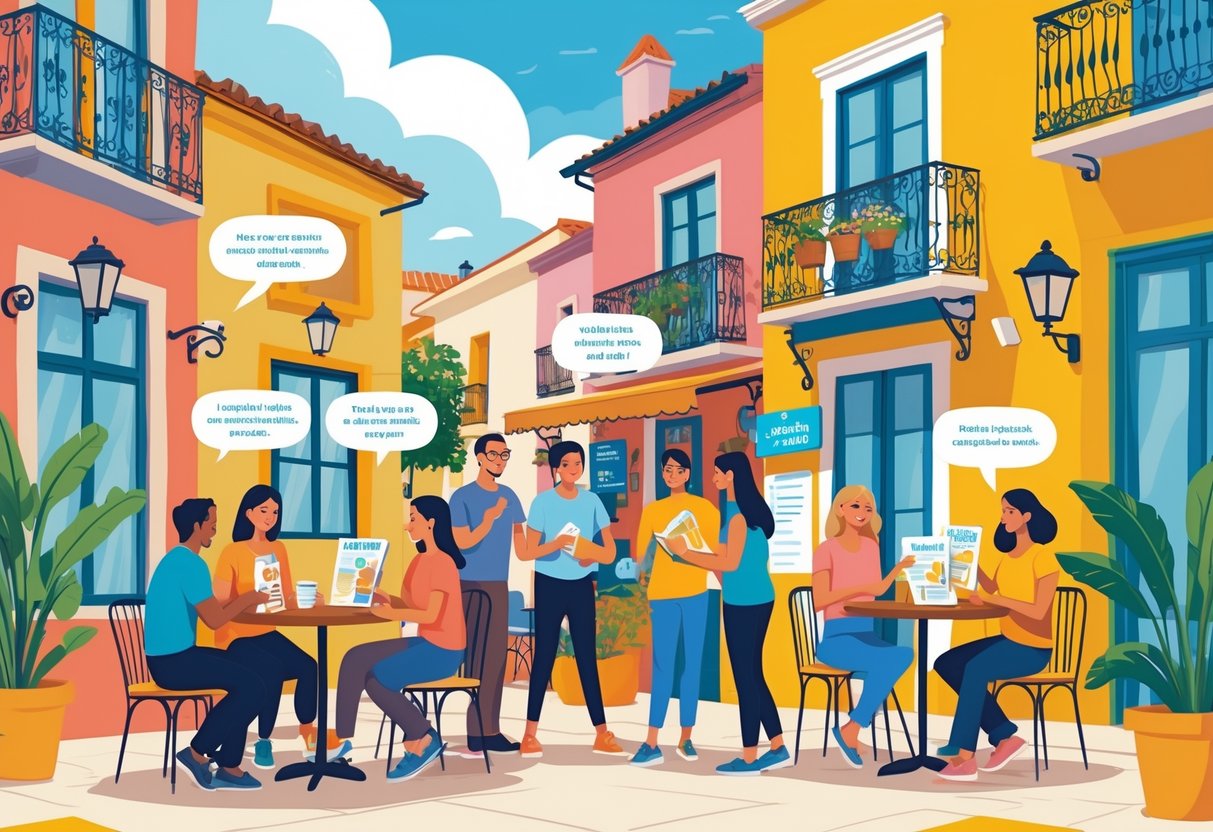
Real conversation with actual speakers builds the neural pathways that turn memorized words into automatic speech. Learners who engage in regular exchanges with Spanish speakers develop faster recall and natural rhythm compared to those who study alone.
Joining Conversation Exchange Platforms
Digital platforms connect learners with Spanish speakers who want to practice English. Apps like italki and Tandem let learners schedule video calls with partners across different time zones. These platforms offer filters for dialect preference, including Latin American Spanish options.
The structure matters for memory formation. A learner should prepare three specific topics before each session. This preparation activates contextual recall, which strengthens the brain's ability to retrieve words during spontaneous conversation.
Effective conversation exchange requires:
- 30-minute sessions twice per week minimum
- Written notes immediately after each call
- Specific vocabulary goals for each conversation
- Audio recording for later review
The repetition across multiple conversations with different speakers reinforces phrase patterns. When a learner hears the same expression from three different people, the brain stores it as a high-priority pattern rather than isolated vocabulary.
Virtual and In-Person Language Exchange
Video calls through conversation exchange platforms simulate face-to-face interaction without travel costs. The visual cues from facial expressions and gestures provide contextual anchors that strengthen memory formation. A learner sees how Spanish speakers move their mouths to form specific sounds.
Local meetup groups offer in-person practice in most cities. These gatherings create low-pressure environments where learners practice ordering food, discussing hobbies, or debating current events. The physical presence adds social accountability that keeps learners showing up week after week.
Both formats work because they force production rather than passive recognition. The brain processes language differently when it must generate sentences under time pressure versus selecting answers from multiple choices.
Speaking with Spanish Speakers from Day One
Beginning speakers often delay conversation until they feel "ready." This approach conflicts with how adults acquire language skills. Practical engagement through authentic interactions transforms passive vocabulary into active fluency faster than extended study periods.
A learner can start with five memorized phrases and build from there. Spanish speakers adjust their speed and complexity when they recognize a beginner. This natural scaffolding provides comprehensible input at the exact level needed for growth.
Daily exposure matters more than session length. A learner who speaks Spanish for 10 minutes every morning builds stronger pathways than someone who studies for two hours on weekends. The brain consolidates new patterns during sleep, so daily practice creates more consolidation cycles per week.
Cultural Immersion for Lasting Mastery

Immersion connects language patterns to real emotions, physical settings, and social expectations, which strengthens memory retrieval far better than isolated vocabulary drills. Contextual exposure activates multiple brain regions at once, creating richer neural pathways that make recall faster and more automatic.
Blending Culture and Language Study
Adults learn fastest when new words attach to sensory experiences and cultural meaning. Watching a vendor negotiate prices at a Buenos Aires market or ordering café con leche in Madrid creates memory anchors that pure translation cannot match. The brain stores these moments as episodes, not abstract lists.
Phrase Café builds this into daily practice with real Spanish in a letter from Sara every weekday morning, read in her voice. Then the coach asks for each line and you say it out loud, the same effort it takes when a taxi driver asks you for directions in fast Spanish.
Learners should pair these daily drills with cultural activities at home. Cooking paella while listening to flamenco guitar or watching Colombian telenovelas without subtitles trains the ear to parse spoken speed. Each cultural touchpoint reinforces vocabulary through emotion and repetition, the two strongest drivers of long-term retention.
Travel Opportunities and Their Impact
Travel to Spanish-speaking countries forces constant listening and response under real stakes. Miscommunication at a pharmacy or train station activates stress hormones that lock new words into memory faster than any classroom drill. The brain prioritizes survival-relevant information.
Even short trips compound learning when paired with structured daily practice. A learner using spaced repetition before a two-week trip to Mexico will recognize phrases in street signs and overheard conversations, creating instant feedback loops. Auditory reinforcement from Spanish speakers corrects pronunciation errors that apps cannot detect.
Key travel strategies for language gains:
- Stay in neighborhoods where English is rarely spoken
- Use only Spanish for transactions and navigation
- Record short voice memos summarizing each day in Spanish
- Review Phrase Café emails immediately after real conversations to cement new patterns
Adapting to Regional Variations
Spanish changes dramatically across regions. Latin American Spanish uses ustedes where Spain uses vosotros. Mexicans say computadora while Spaniards prefer ordenador. Learners must choose a target dialect early to avoid confusion.
Adults benefit from focused exposure to one accent while maintaining passive awareness of others. Phrase Café's Spanish audio provides consistent pronunciation models, preventing the mixed-accent problem common in multilingual apps. Once core grammar solidifies, learners can explore regional slang through podcasts or films from specific countries.
Regional differences to track:
| Feature | Spain | Mexico | Argentina |
|---|---|---|---|
| You (plural) | vosotros | ustedes | ustedes |
| Past tense preference | Preterite | Preterite | Preterite + vos forms |
| Common slang | tío, guay | chido, órale | che, boludo |
Contextual learning handles variation naturally. A learner who masters ¿Qué tal? through daily practice will recognize ¿Qué onda? in Mexican contexts without formal instruction. The disappearing-text method trains pattern recognition, so regional substitutions become intuitive rather than obstacles.
Overcoming Common Spanish Learning Roadblocks
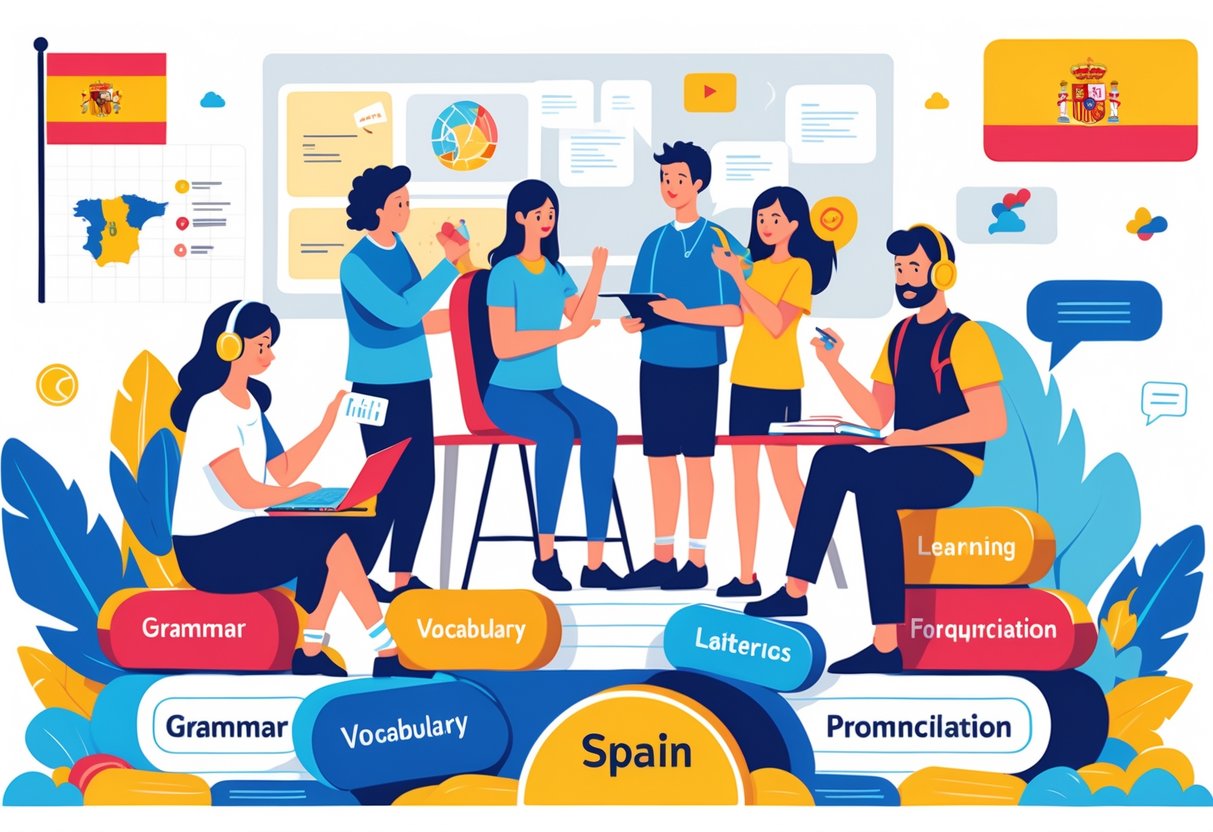
Most learners hit the same two walls during their language learning journey: ineffective study methods that waste time and motivation that fades after the first few months. Both problems stem from how memory actually works, not lack of discipline.
Why Traditional Study Methods Fail
Grammar drills and vocabulary lists feel productive but don't match how the brain stores language. The mind needs context and repetition spread over time to move words from short-term to long-term memory.
Spaced repetition solves this by reviewing material at increasing intervals. A learner might see "¿Cómo estás?" on day one, day three, day seven, and day fourteen. Each review strengthens the neural pathway before forgetting occurs.
Contextual recall works because the brain links language to situations, not isolated words. When someone learns "tengo hambre" while imagining a restaurant scenario, the phrase sticks better than memorizing "hambre = hunger" from a list.
Daily email programs that send one complete phrase with Spanish audio leverage both principles. The learner sees the phrase, hears correct pronunciation, and encounters it again naturally through progressive removal of words in follow-up emails. This disappearing-text training forces active recall rather than passive recognition.
Five-minute daily sessions outperform hour-long weekend cramming because auditory reinforcement combined with consistent micro-exposure creates stronger memory formation than sporadic intensive study.
Staying Motivated Throughout the Year
Motivation drops when progress feels invisible or when study sessions become a chore. The solution is measurable daily wins rather than distant fluency goals.
Breaking the year into 365 small achievements keeps momentum alive. Learning one phrase per day means 365 phrases by year's end - enough for basic conversations. This approach makes progress concrete and trackable.
Daily routines work better than motivation because they remove decision fatigue. When learners check email every morning and spend five minutes with that day's phrase, the habit becomes automatic. The brain stops asking "should I study today?" and simply executes the routine.
Varied content prevents boredom while maintaining structure. A Monday phrase about ordering food, Tuesday's weather expression, and Wednesday's greeting all teach different aspects of Spanish while keeping the format consistent.
Spanish audio in every lesson also sustains engagement because learners hear real pronunciation from day one. This builds confidence faster than text-only methods and helps them learn Spanish through authentic sound patterns rather than guessed pronunciation.
Measuring Progress and Redefining Success
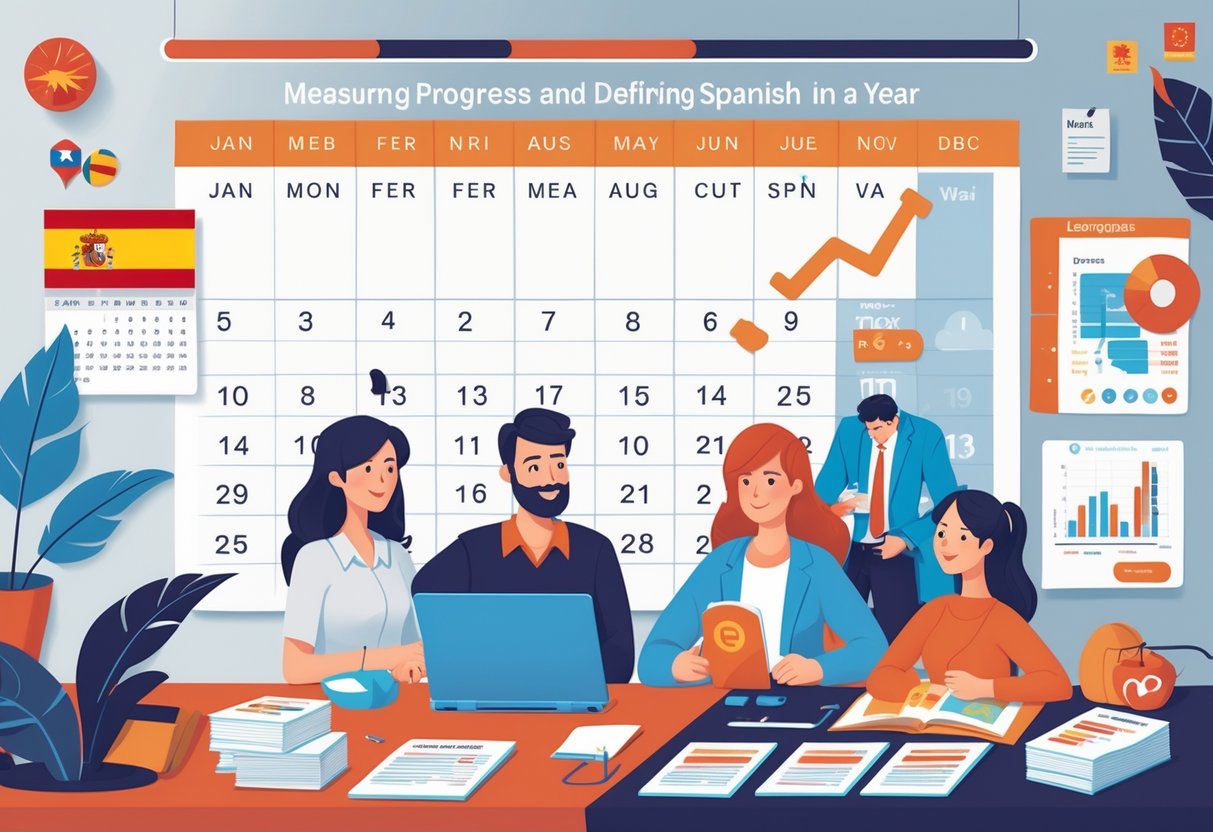
Tracking improvement requires concrete assessment methods and flexible goal-setting that accounts for real-world language use. Understanding where a learner stands after 12 months determines whether additional study builds fluency or fills critical gaps.
Assessing Your Spanish Skills Objectively
Standardized frameworks provide clear benchmarks for evaluating language ability. The Common European Framework of Reference (CEFR) offers six levels from A1 to C2, while the ACTFL Guidelines use Novice, Intermediate, Advanced, Superior, and Distinguished categories. Most learners who study consistently reach A2 or Intermediate-Low after one year.
Self-assessment reveals practical competence better than test scores alone. Recording conversations in Spanish every month creates an audio archive that shows pronunciation improvement and growing confidence. Writing a daily journal in Spanish builds a written record of expanding vocabulary and grammar control.
Objective measures include:
- Understanding everyday speech in predictable contexts
- Handling basic transactions without English
- Reading simple texts with minimal dictionary use
- Writing short messages that Spanish speakers understand
Contextual recall strengthens when learners test themselves through spaced repetition rather than passive review. Auditory reinforcement through Spanish recordings builds recognition speed that vocabulary lists cannot replicate. Daily exposure through five-minute email routines embeds phrases into long-term memory more effectively than hour-long study sessions once weekly.
Setting New Goals After One Year
The path to become fluent in Spanish extends beyond 12 months for most adults. Realistic expectations prevent discouragement and maintain momentum. A learner at A2 needs another 400-600 hours to reach B2 conversational fluency.
Next-year goals should address specific skills:
- Speaking: Hold 30-minute conversations on familiar topics without switching to English
- Listening: Follow podcast episodes at 80% comprehension
- Reading: Complete a short novel with context-based understanding
- Writing: Compose emails or social media posts without translation tools
Progressive challenge techniques build competence faster than repeating comfortable material. Disappearing-text training, where words gradually vanish from practiced phrases, forces active recall rather than recognition. This method accelerates the shift from conscious translation to automatic language production.
New goals must stay measurable and time-bound. Setting a target to watch three Spanish shows monthly with decreasing subtitle dependence creates accountability. Tracking daily phrase practice through structured email routines maintains consistency that sporadic app use cannot match.