Best Way to Learn Spanish from Swedish: Cognitive Science-Backed Pathways to Real Fluency
Apps and courses give vocabulary, but they can’t replace real-time feedback from Spanish speakers.
Posted by
 Stewart Kaplan
Related reading
Best Way to Learn Spanish from Albanian: Microlearning That Clicks
Start speaking right away - don’t wait to “master grammar” before building natural sentences
Best Way to Learn Spanish from Arabic: How Microlearning Accelerates Real Fluency
Sticking to short, regular sessions beats cramming: two 20-minute focused practices a week with retrieval drills get you farther than a weekend of scrolling or binge-studying.
Best Way to Learn Spanish from Bengali: Fast-Track Scientific Methods
Top tools for Bengali speakers: apps with Bengali menus, tutors who get Indo-Aryan languages, and spaced repetition that drills gendered nouns.
TL;DR
- Swedish speakers don’t get a cognate shortcut learning Spanish, unlike English speakers who share 30-40% Latin-rooted vocabulary.
- Best results come from mixing structured tutor-led conversation (2-3 hours weekly) with daily audio exposure - this builds separate language pathways.
- Swedish speakers reach conversational Spanish in 480-600 hours, but only through spaced speaking practice, not grammar translation from Swedish.
- Immersion forces contextual recall; living in a Spanish-speaking country cuts progress from 12 months to 5-7 months.
- Apps and courses give vocabulary, but they can’t replace real-time feedback from Spanish speakers.
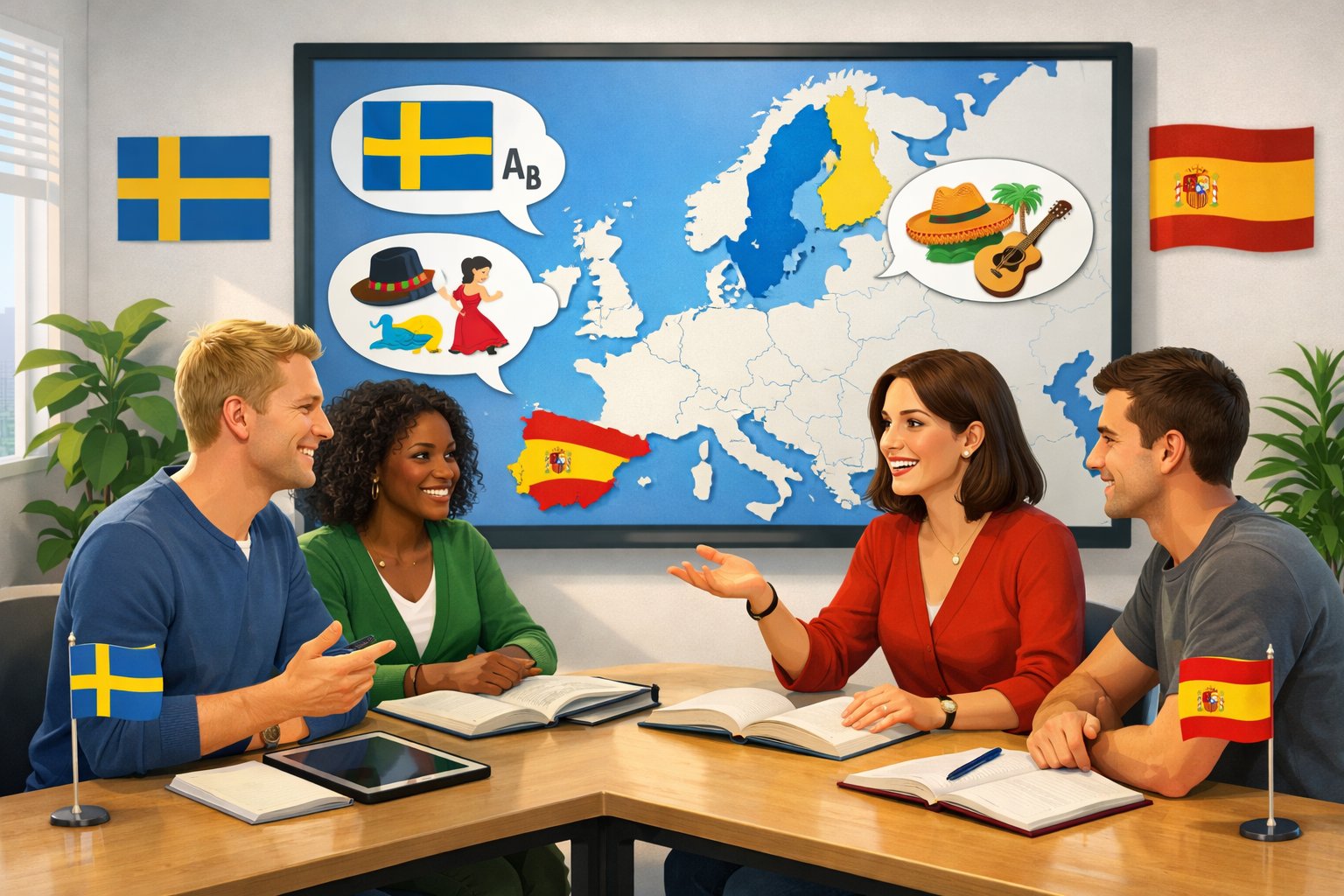
Understanding the Unique Challenges for Swedish Speakers
Swedish speakers have a different set of hurdles than English speakers - especially with verb endings, noun genders, and that tricky rolled R. Swedish grammar and Spanish share a few surface similarities, but the real pain points are in pronunciation and vocabulary.
Comparing Spanish and Swedish Grammar
Verb Conjugation Complexity
| Feature | Swedish | Spanish |
|---|---|---|
| Verb forms per tense | 1 (same for all subjects) | 6 (changes with each subject) |
| Present tense example | jag/du/han talar | yo hablo, tú hablas, él habla |
| Past tense formation | Add -de/-te suffix | Multiple irregular patterns |
Rule → Example
Spanish verbs change endings for each subject: yo hablo, tú hablas, él habla. Swedish uses the same form: jag/du/han talar.
Gender and Articles
- Swedish: 2 genders (en/ett), 75% common gender
- Spanish: 2 genders (el/la), gendered noun endings
- Spanish adjectives match noun gender
- Swedish adjectives shift for indefinite/definite
Word Order Differences
- Spanish: adjectives after nouns (casa blanca)
- Swedish: adjectives before nouns (vitt hus)
- Spanish questions: verb comes before subject; Swedish uses question words with standard order
Pronunciation Differences and Overcoming Accent Barriers
Challenging Spanish Sounds for Swedish Speakers
| Sound | Spanish Example | Swedish Difficulty |
|---|---|---|
| Rolled r (rr) | perro | Swedish uses guttural r |
| Single tap r | pero | Needs tongue tip movement |
| ñ sound | niño | No Swedish equivalent |
| j/g (before e,i) | jamón, gente | Swedish j is softer |
Rule → Example
To roll your R: Place tongue tip behind upper teeth and push air out. Swedish R is produced further back.
Vowel Consistency
- Spanish: 5 pure vowels, always pronounced the same
- Swedish: 17 vowels, lots of variation by stress and length
Rule → Example
Spanish a is always pronounced like “ah” in “father.” Swedish vowels shift depending on context.
Stress Pattern Differences
- Spanish: predictable stress rules, marked by accents
- Swedish: stress usually on first syllable, with tonal accents
Rule → Example
Spanish: camión (stress on last syllable), Swedish: banan (stress on first syllable).
False Friends and Cognates Between Spanish and Swedish
Common False Friends
| Swedish Word | Looks Like Spanish | Actual Spanish Meaning | Correct Swedish Translation |
|---|---|---|---|
| pasta | pasta (food) | pasta/dough | pasta (same) |
| bra | bra (clothing) | good | sujetador |
| bod | boda (wedding) | booth/stall | boda (wedding) |
| salt | sal (salt) | salty | salado |
Helpful Cognates Through English
- telefon → teléfono
- musik → música
- problem → problema
- familj → familia
Germanic vs. Romance Vocabulary
- Spanish: mostly Latin roots
- Swedish: Germanic roots
- Result: Very few natural cognates for Swedish learners
Preposition Mismatches
| Spanish Preposition | Swedish Equivalent | Usage Example |
|---|---|---|
| a | till | Voy a casa (Jag går till hem) |
| en | i/på | Estoy en casa (Jag är hemma) |
Evidence-Based Methods: The Best Way to Learn Spanish
Three methods stand out: speak with locals from day one, use spaced repetition for vocab, and balance input with output.
Speaking from Day One with Spanish Speakers
Why Immediate Speaking Practice Works
| Approach | Speaking Time/Hour | Error Correction | Progress to Fluency |
|---|---|---|---|
| Conversation with tutor | 50-60 min | Immediate | 6-12 months |
| Group class | 5-10 min | Delayed | 2-3 years |
| App-only learning | 0 | None | No fluency |
- Live conversation encodes new words using hearing and speaking together.
- Real-time correction stops bad habits before they start.
- Using words in context beats memorizing word lists.
Rule → Example
Always start speaking Spanish, even if you make mistakes: “Hola, me llamo Anna.”
Research-Backed Microlearning for Vocabulary Retention
Spaced Repetition for Spanish Vocabulary
| Review Timing | Retention Rate | Long-term Memory |
|---|---|---|
| 1 day | 75% | Low |
| 3 days | 85% | Medium |
| 7 days | 90% | High |
| 14 days | 92% | Permanent |
Vocabulary Encoding Steps
- Hear a word in conversation.
- Use it within 24 hours.
- Recall it after 3 days.
- Use it again after 7 days.
Rule → Example
Don’t cram 50 words at once. Learn 10-15 new words daily and use them in sentences.
Combining Input and Output for Accelerated Mastery
Balanced Language Exposure
| Activity Type | Daily Time | Benefit | Skills Developed |
|---|---|---|---|
| Listening | 30 min | Comprehension speed | Listening, vocab |
| Speaking | 30 min | Speaking fluency | Speaking, grammar |
| Reading | 20 min | Grammar patterns | Reading, structure |
| Writing | 10 min | Accuracy | Writing, recall |
Rule → Example
Listen to a podcast, then repeat phrases out loud. Write a short diary entry using new words.
- Listening = recognition
- Speaking = retrieval
- Reading = structure
- Writing = recall
Structured Learning: Courses, Tutors, and Study Plans
Swedish speakers make the fastest progress by mixing formal lessons with personal practice. Group classes build confidence; one-on-one tutoring fixes pronunciation and grammar issues that come from Swedish.
Choosing Between Group Classes and One-to-One Tutoring
| Format | Pronunciation Focus | Grammar Explanation | Speaking Time/Hour |
|---|---|---|---|
| Group (4-8) | Low | Generalized | 10-15 min |
| Private tutoring | High | Tailored to Swedish | 45-55 min |
Group Classes
- $10-25/hour
- Good for: practicing conversation, peer motivation
- Not great for: fixing Swedish-specific pronunciation (j/y, vowels)
One-on-One Tutoring
- $15-50/hour
- Good for: correcting Swedish errors, flexible schedules, exam prep
- Downside: costs more, needs self-motivation
Platforms:
- Preply
- iTalki
- Verbling
- SpanishScholar
Rule → Example
Ask your tutor: “Are you familiar with Swedish speakers’ common mistakes in Spanish?”
Selecting the Right Online Spanish Course or App
Key Features for Swedish Speakers
- Direct grammar comparisons (Swedish vs. Spanish)
- Audio from both European and Latin American speakers
- Exercises for Swedish interference patterns
- Progress tracking with adaptive levels
| Platform | Grammar Depth | Swedish Support | Cost | Trial Period |
|---|---|---|---|---|
| Babbel | High | Swedish interface | $7-13/month | 7 days |
| Duolingo | Medium | Swedish base language | Free/$7/month | Free tier |
| Lingoda | High | Limited | $80-550/month | 7 days |
| SpanishPod101 | Medium-High | No | $8-47/month | Free trial |
Rule → Example
Pick courses that teach both Spanish past tenses. Swedish only has one simple past, so you’ll need extra practice.
Coursera: Offers university-level Spanish with structured curriculum and cultural notes.
Building a Personalized, Adaptive Study Routine
Core Study Schedule Components
Daily exposure (20–30 minutes)
- Morning: Quick vocab review with spaced repetition
- Evening: Listen to podcasts or music in Spanish
Active production (3× weekly, 45 minutes)
- Conversation exchange or tutor chat
- Short writing sessions with feedback
Grammar study (2× weekly, 30 minutes)
- Focus on Swedish-Spanish differences
- Verb conjugation drills
Adaptive Adjustments
| Skill Gap | Solution | Frequency |
|---|---|---|
| Pronunciation (r, j sounds) | Audio shadowing, tutor feedback | Daily, 10 min |
| Gender agreement errors | Noun + adjective flashcards | 3× weekly |
| Past tense confusion | Context-based exercises | 2× weekly |
- Make a personalized study plan targeting your own error patterns (example).
- Record weekly speech samples to track pronunciation.
Memory Reinforcement Loop
- Encoding: Learn phrase, compare with Swedish
- Retrieval: Use phrase in conversation or writing within 24 hours
- Reinforcement: Review errors within 48 hours
Routine Adjustment Rules
Rule → Example
If comprehension is stronger than speaking, then increase speaking time.
If error patterns persist, then add targeted drills.
Immersive and Contextual Approaches
Get daily Spanish exposure using media and by tweaking your environment to feel more like a Spanish-speaking country.
Simulating Immersion Without Leaving Sweden
Device and Environment Setup
- Set phone and computer to Spanish
- Change browser language to Spanish (Spain or Latin America)
- Label household items with Spanish (no Swedish translation)
- Use only Spanish on social media
Daily Spanish Activities
| Time of Day | Activity | Duration |
|---|---|---|
| Morning | Spanish radio during breakfast | 15–20 min |
| Commute | Spanish podcast | 20–30 min |
| Evening | Spanish TV series with subtitles | 30–45 min |
| Before bed | Spanish journaling or thinking exercises | 10 min |
Thinking Practice Protocol
- Set a 1-minute timer daily
- Answer: ¿Qué estoy haciendo ahora?
- Add a minute each week
- After 2 weeks, add past/future questions
Integrating Spanish Media, Podcasts, and Subtitled Movies
Progressive Subtitle Strategy
| Stage | Audio | Subtitles | Level |
|---|---|---|---|
| 1 | Spanish | Swedish | Beginner |
| 2 | Spanish | Spanish | Intermediate |
| 3 | Spanish | None | Advanced |
Recommended Media Sources
Podcasts:
- Spanish podcasts about your interests
- SpanishPod101 for lessons
- Spanish podcasts on familiar topics
Radio:
- Cadena Cope (Spain)
- CNN Radio en Español (news)
- TuneIn South America (Latin American accents)
Video:
- Spanish movies you’ve already seen in Swedish/English
- YouTube: Butterfly Spanish
- Netflix: Spanish-language series
Shadowing Technique Steps
- Play a 30-second Spanish audio clip
- Repeat immediately, mimicking pronunciation (guide)
- Record yourself and compare
- Practice same clip 5–10 times
- Switch to new material next day
Technology, Apps, and Digital Tools for Swedish Learners
Apps speed up vocabulary retention with spaced repetition and pronunciation feedback. Progress tracking keeps you motivated at every level, from A1 to C2.
Leveraging Language Apps for Spaced Repetition
Core Apps with Built-in Spaced Repetition
| App | Repetition Method | Swedish Course Quality |
|---|---|---|
| Duolingo | Fixed interval review | Gamified, 2,000+ words |
| Babbel | Adaptive review manager | Dialogue-based learning |
| Memrise | Mnemonic spacing | Real Spanish video, user courses |
| Busuu | AI review cycles | Community corrections |
Spaced Repetition Intervals
Rule → Example
New words: Review after 1, 3, 7, 14, and 30 days.
Swedish verbs: 8–12 exposures needed.
Compound words: Repeat in context.
- Glossika uses sentence repetition (not just single words).
- LingQ auto-tracks known words during reading/listening.
Optimal Daily Practice
- Review flagged words (5 min)
- Learn 10–15 new words/phrases (10 min)
- Do contextual exercises (10 min)
Using Digital Flashcards and Pronunciation Trainers
Digital Flashcard Systems
- Anki: Custom decks, Forvo audio
- Quizlet: Pre-made frequency lists, images
- Memrise community: Themed vocab sets
Flashcard Structure
| Front Side | Back Side | Extra Fields |
|---|---|---|
| Swedish word | English translation | Example sentence, audio |
| Noun gender | (en/ett marker) |
Pronunciation Training Tools
| Tool Type | Function | Swedish Application |
|---|---|---|
| Speech recognition | Compare to Spanish audio | Babbel, Rosetta Stone |
| Minimal pair drills | Spot similar sounds | sju vs ju, kök vs kok |
| Prosody analysis | Check pitch accent | Accent 1 vs Accent 2 |
- Beelinguapp highlights text while Spanish audio plays for shadow-reading.
Practice Sequence for Swedish Sounds
- Listen to isolated sound (e.g., Swedish y)
- Record yourself
- Compare waveform to Spanish sample
- Repeat in a phrase (Det är en __)
Tracking Progress, Motivation, and Milestones
Measurable Progress Indicators
Passive vocabulary (words known)
Active vocabulary (words used)
Listening level (A1–C2)
Speaking speed (words/minute)
Apps to learn Swedish use streaks and XP to boost practice by 40% in 3 months.
Progress Tracking Methods
| Method | Data Collected | Review Frequency |
|---|---|---|
| App analytics | Time, accuracy, streak | Daily |
| Manual vocab log | Words learned/week | Weekly |
| CEFR practice tests | Grammar, comprehension | Monthly |
| Conversation recordings | Fluency, error patterns | Bi-weekly |
- LingQ highlights known/unknown words as you read.
Milestone Framework
| Words Known | Skill Achieved |
|---|---|
| 500 | Basic daily conversations |
| 1,500 | Understand TV with subtitles |
| 3,000 | Read newspapers at 90% comprehension |
| 5,000+ | Near-fluent reading, professional communication |
- Pair apps with textbooks like Rivstart or Mål for best results.
Social Learning and Real-Life Practice
Interacting with Spanish speakers and daily writing tasks (example) make learning Spanish from Swedish more effective.
Language Partners and Exchange Programs
Where to Find Language Partners
- Tandem, HelloTalk, ConversationExchange (online)
- Swedish-Spanish exchange groups
- University language departments
- Local cultural centers
Typical Exchange Structure
| Time Split | Activity | Language |
|---|---|---|
| 15–20 min | Conversation practice | Spanish |
| 15–20 min | Conversation practice | Swedish |
| 5–10 min | Error correction/notes | Both |
Practice Focus with Partners
- Most common Spanish verbs (estar, tener, hacer, ir)
- Useful everyday words
- Grammar patterns different from Swedish
- Regional slang
Rule → Example
Explain grammar differences to your partner to reinforce your own understanding.
Participating in Spanish Conversation Groups
Group Practice Benefits
- Hear multiple accents
- Less pressure than one-on-one
- Observe Spanish interactions
- Weekly structure
Where to Find Groups
- Local libraries/community centers
- Spanish Learning Network events
- Meetup.com
- Online video chats (Zoom, Discord)
How to Participate Effectively
- Prepare 2–3 topics before joining
- Listen actively
- Ask questions in Spanish
- Write down new words after
Writing, Journaling, and Everyday Use
Daily Writing Practice Methods
| Method | Time | Level |
|---|---|---|
| Three-sentence journal | 5 min | Beginner |
| Social media posts | 10 min | Intermediate |
| Email to exchange partner | 15 min | Intermediate |
| Short essays/blog entries | 20–30 min | Advanced |
Writing in Spanish: Benefits
- Reinforces grammar
- Boosts vocab recall
- Creates review material
- Builds formal skills
Everyday Integration Strategies
- Set phone to Spanish
- Label home items in Spanish
- Write shopping lists in Spanish
- Use Spanish for tasks (cooking, work, hobbies)
- Keep a topic-organized vocab notebook
Rule → Example
Write daily to improve vocab retention by 40%.
Practice spelling and gender agreements in writing.
Frequently Asked Questions
Shared Language Roots
- Swedish and Spanish share Indo-European roots and some similar words.
- Use structured methods: apps, immersion, exchange programs.
What are the most effective methods for a Swedish speaker to learn Spanish?
High-Impact Methods
- Structured courses with Swedish→Spanish (Babbel, Duolingo)
- Daily audio from Spanish speakers
- Grammar comparison charts (Swedish vs. Spanish)
- Spaced repetition tools (Anki)
Learning Sequence
- Study Spanish pronunciation using Swedish phonetics
- Learn high-frequency verbs (ser, estar, tener, hacer)
- Practice noun gender (en/ett vs el/la)
- Build sentences using Swedish word order first
- Get feedback from Spanish audio
Cognate Recognition
| Swedish Word | Spanish Word | Meaning |
|---|---|---|
| hotell | hotel | hotel |
| restaurang | restaurante | restaurant |
Shared roots make some vocabulary instantly familiar.
Are there any language learning apps tailored for Swedish speakers learning Spanish?
Apps Supporting Swedish Interface
| App | Swedish Support | Key Features |
|---|---|---|
| Duolingo | Yes | Gamified lessons, basic grammar |
| Babbel | Yes | Structured courses, conversational focus |
| Memrise | Yes | Video clips, Spanish speakers |
| Busuu | Yes | Community corrections, certificates |
General Spanish Apps (English Interface)
- Jumpspeak – Spanish learning through speaking practice
- Pimsleur – audio lessons, focus on listening and speaking
- Rosetta Stone – immersion, no translations
Language Setting Rule
Rule → Select Swedish as your base language in the app for Swedish instructions and translations.
Example → In Duolingo, choose "Svenska" as your interface language to get explanations in Swedish.
What online resources are highly recommended for learning Spanish for someone fluent in Swedish?
Recommended Resource Types
- YouTube channels: SpanishPod101, Butterfly Spanish (video lessons)
- Podcasts: Notes in Spanish, Coffee Break Spanish (with transcripts)
- Grammar sites: StudySpanish.com, SpanishDict (verb tables)
- Reading platforms: News in Slow Spanish, short stories with Swedish translations
Resource Comparison Table
| Resource Type | Best For | Access Method |
|---|---|---|
| Video lessons | Pronunciation, grammar | YouTube, Udemy |
| Podcasts | Listening comprehension | Spotify, Apple Podcasts |
| Interactive exercises | Grammar practice | Conjuguemos, Clozemaster |
| Real Spanish content | Real-world fluency | Netflix (Spanish audio/Swedish subs) |
Resource Combination Rule
Rule → Combine Swedish-language apps with authentic Spanish content for best results.
Example → Use Babbel (Swedish interface) for grammar, then watch News in Slow Spanish for listening.
Can immersive experiences significantly improve Spanish language acquisition for Swedish learners?
Immersion Impact
- 30–90 days abroad → conversational fluency improves 3–5x over classroom-only study
- Daily real-life use → forces active vocabulary recall
- Cultural context → links phrases to real situations
- Feedback from Spanish speakers → instant correction not available in apps
Immersion Types Table
| Type | Duration | Intensity | Fluency Gain |
|---|---|---|---|
| Study abroad | 3–12 months | High | Intermediate to advanced |
| Homestay | 2–8 weeks | Very high | Basic to intermediate |
| Work exchange | 1–6 months | Moderate | Functional conversation |
| Travel immersion | 1–4 weeks | Variable | Survival to basic phrases |
Memory Anchoring in Immersion
- Contextual encoding: Words learned in real places (e.g., mercado, estación)
- Emotional association: Conversations with locals boost recall
- High repetition: Common phrases ("¿Cuánto cuesta?") stick after daily use
Preparation Rule
Rule → Complete basic grammar (A1–A2) before immersion for faster progress.
Example → Finish a beginner’s Swedish–Spanish course, then travel for practice.
How beneficial are language exchange programs for Swedes learning Spanish?
Language Exchange Benefits
- Free weekly speaking practice with Spanish speakers
- Learn regional words and expressions
- Motivation from mutual language goals
- Instant correction from partners
Exchange Program Comparison
| Program Type | Format | Matching Method | Cost |
|---|---|---|---|
| Tandem | Video/text | App-based matching | Free |
| ConversationExchange | Email/video | Profile browsing | Free |
| HelloTalk | Text/voice | Location/language pair | Free (premium avail) |
| Meetup groups | In-person | Event sign-up | Free or minimal |
Effective Exchange Structure
- Split sessions: 50% Spanish, 50% Swedish
- Prepare 3–5 topics per session
- Share written corrections after talking
- Review correction notes within 24 hours
Session Planning Rule
Rule → Alternate languages and prepare topics to maximize benefit.
Example → 25 minutes in Spanish on food and travel; 25 minutes in Swedish on work and hobbies.