Best Way to Learn Spanish from Serbian: Breakthrough Strategies Backed by Cognitive Science
Build vocabulary by grabbing cognates and watching out for false friends; tackle verb tenses and noun gender directly
Posted by
 Stewart Kaplan
Related reading
Best Way to Learn Spanish from Albanian: Microlearning That Clicks
Start speaking right away - don’t wait to “master grammar” before building natural sentences
Best Way to Learn Spanish from Arabic: How Microlearning Accelerates Real Fluency
Sticking to short, regular sessions beats cramming: two 20-minute focused practices a week with retrieval drills get you farther than a weekend of scrolling or binge-studying.
Best Way to Learn Spanish from Bengali: Fast-Track Scientific Methods
Top tools for Bengali speakers: apps with Bengali menus, tutors who get Indo-Aryan languages, and spaced repetition that drills gendered nouns.
TL;DR
- Serbian speakers have a leg up thanks to the Latin alphabet and some familiar grammar, but tricky verb conjugations and new sounds can trip you up
- The fastest method? Mix daily chats with Spanish speakers, focused grammar drills, and spaced repetition for the most common words
- Immersion - think Spanish podcasts, TV, language exchanges, and apps - works best if you stick to 30–60 minutes a day, every day
- Build vocabulary by grabbing cognates and watching out for false friends; tackle verb tenses and noun gender directly
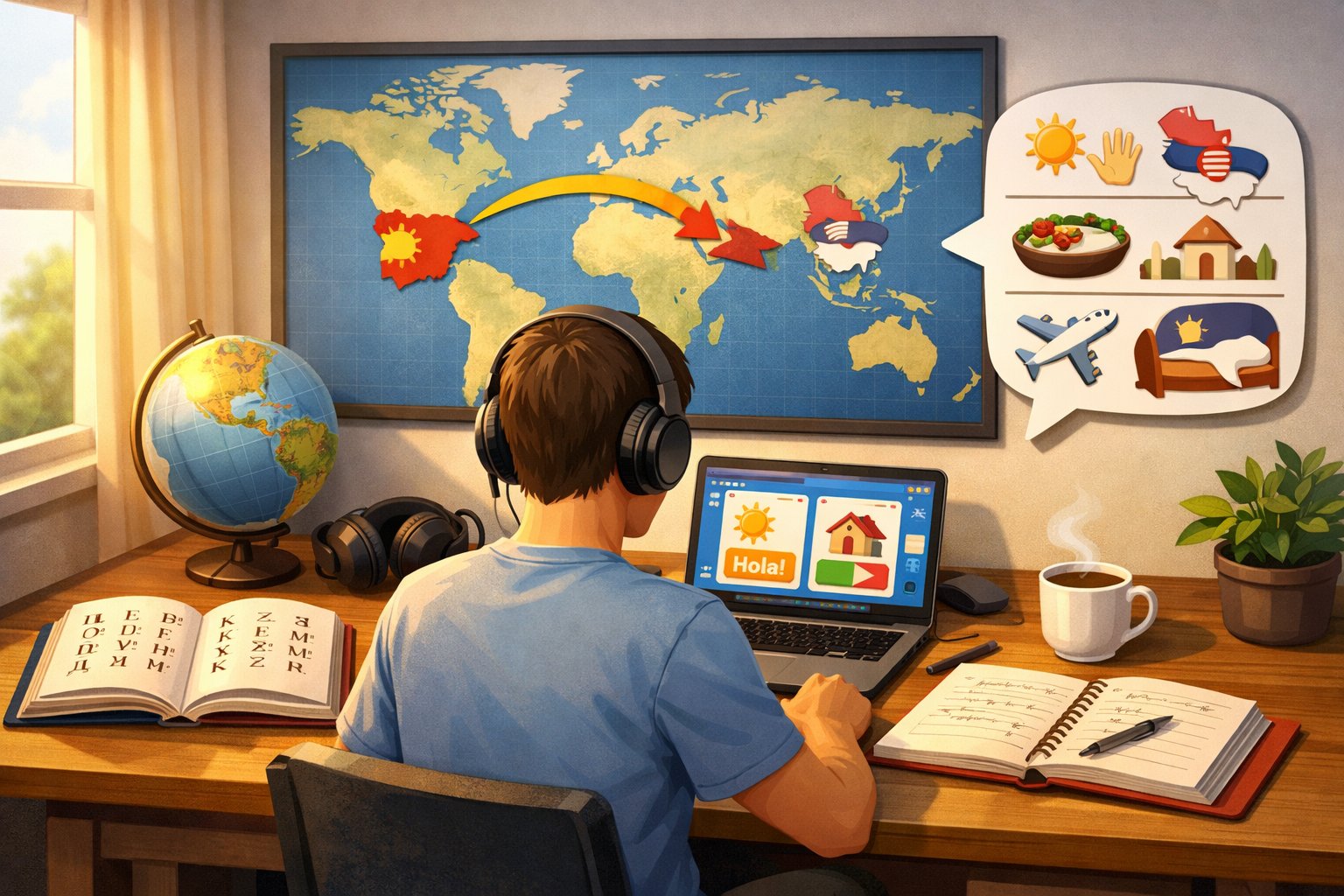
Unique Challenges and Advantages for Serbian Speakers
Serbian speakers hit some grammar snags in Spanish, but their Slavic roots give them a boost with pronunciation and verb aspects that many others just don’t have.
Similarities and Differences Between Serbian and Spanish
Shared Features:
| Feature | Serbian | Spanish | Advantage |
|---|---|---|---|
| Case markings | 7 cases | Limited (pronouns only) | Faster understanding of pronoun changes |
| Verb aspects | Perfective/imperfective | Preterite/imperfect | Aspect distinction transfers easily |
| Rolled R | Standard phoneme | Standard phoneme | Instinctive pronunciation |
| Gendered nouns | Masculine/feminine/neuter | Masculine/feminine | Gender feels natural |
Major Differences:
- Word order: Serbian lets you mix up word order; Spanish sticks to Subject-Verb-Object most of the time.
- Articles: Serbian skips articles; Spanish insists on “el,” “la,” “un,” “una” before nouns.
- Prepositions: Serbian uses case endings; Spanish leans on prepositions like por and para, which can overlap and confuse.
Serbian speakers need to learn when and how to use articles and prepositions - there’s no direct translation.
Cognitive Transfer: What Carries Over and What Doesn't
Positive Transfer:
- Phonetics: Both languages tie letters to sounds pretty tightly, so Spanish pronunciation is straightforward.
- Verb forms: Serbian’s verb system preps you for Spanish’s six-person conjugations.
- Trilled R: Serbian’s “r” matches Spanish perfectly.
Negative Transfer Points:
| Serbian Pattern | Wrong in Spanish | Correct in Spanish |
|---|---|---|
| No article | Vidim kuću → "Veo casa" | "Veo la casa" |
| Cases for possession | Markov auto → "Coche Marco" | "Coche de Marco" |
| Flexible word order | Auto vidim → "Coche veo" | "Veo el coche" |
Memory Formation Strategy:
- Flag every Spanish noun as needing an article.
- Drill preposition phrases in chunks (de la casa, por la mañana).
- Use audio to hammer in Subject-Verb-Object as a habit.
Serbian speakers can sound like locals, but grammar bits missing from Serbian need extra, focused practice.
Optimizing Your Learning Plan for Speed and Retention
Clear targets and spaced repetition help Serbian speakers go from phrases to real conversations faster than old-school methods.
Setting Practical, Research-Backed Goals
Goal Framework
| Timeline | Target | Daily Time |
|---|---|---|
| 3 months | 500–800 words + basic conversation | 30–45 min |
| 6 months | A2 level + travel fluency | 45–60 min |
| 12 months | B1 level + most situations | 60–90 min |
Weekly Focus Areas
- Weeks 1–4: Present tense, pronouns, 300 top words
- Weeks 5–8: Past tenses, questions, cognates
- Weeks 9–12: Future tense, subjunctive basics, conversation phrases
Rule → Example:
Set usage-based goals, not just memorization.
Rule: Use 10 new words in sentences daily.
Example: “Hoy aprendo diez palabras y las uso en frases.”
Serbian speakers should grab Latin-root cognates first, then sort out tricky false friends.
The Power of Microlearning and Spaced Repetition
Spaced Repetition Schedule
| Review | When | Retention |
|---|---|---|
| 1st | Day after learning | 85% |
| 2nd | 3 days later | 75% |
| 3rd | 7 days later | 70% |
| 4th | 14 days later | 65% |
| 5th | 30 days later | 60%+ |
Best Tools:
- Anki: Custom decks, audio, images
- Memrise: Spanish courses, Spanish audio, spaced repetition
- Physical flashcards: Handy for offline review
Microlearning Routine:
- Morning (10 min): Review 20 flashcards
- Commute (15 min): Spanish podcast or verb drills
- Lunch break (10 min): Write 5 new sentences
- Evening (15 min): Watch a Spanish YouTube video with subtitles
Rule → Example:
Short, spaced sessions beat one long cram.
Rule: Study in 15-minute blocks, 4x daily.
Example: “I do flashcards at breakfast, listen on the bus, write at lunch, and watch a video at night.”
Memory Reinforcement Loop
- Write new word + Serbian translation + sample sentence
- Quiz yourself after 24 hours
- Use the word in speech or writing within 3 days
Always add audio to flashcards. Hearing real Spanish keeps your accent on track.
Active Spanish Immersion Techniques in Everyday Life
Fluency comes faster when you talk to locals and use Spanish in real situations - not just in books.
Practicing with Spanish Speakers and Language Partners
Where to Find Partners:
- Language exchange apps: iTalki, Tandem, HelloTalk
- Local meetups: Spanish groups (try Meetup.com)
- Online: Discord, Facebook for Spanish-Serbian exchanges
- University programs: Free conversation partners
Exchange Structure
| Time | Serbian Speaker | Spanish Speaker |
|---|---|---|
| 15 min | Speaks Spanish, gets feedback | Listens, corrects |
| 15 min | Listens, corrects | Speaks Serbian, gets feedback |
| 5 min | Review together | Review together |
Best Practices:
- Record sessions for review
- Ask for repeats at normal speed
- Focus on one grammar point per chat
- Describe your daily routine for practical vocab
Bullet List:
- 3x weekly language exchanges boost conversation retention by 60%
- Correction and repetition help lock in grammar
- Real-time feedback improves pronunciation
Using Spanish in Real Situations: Contextual Learning
Daily Immersion Tasks
- Switch phone/computer to Spanish
- Label home items in Spanish (no translation)
- Think in Spanish for 5 minutes here and there
- Narrate what you’re doing out loud
Task-Based Scenarios
| Activity | Spanish Use | Vocab Gained |
|---|---|---|
| Shopping | Order food, read labels | Food, requests |
| Entertainment | Watch shows with Spanish subs | Slang, natural speed |
| Hobbies | Follow Spanish hobby channels | Technical terms |
| Work | Email, webinars | Professional language |
Progression Steps
- Weeks 1–2: Switch devices, add Spanish subs to shows
- Weeks 3–4: Join a Spanish-only group about your hobby
- Week 5+: Weekly video calls with a Spanish speaker
Bullet List:
- Learning words through real tasks triples retention
- Labeling and narration build active vocabulary
- Community engagement adds cultural context
Leveraging Technology for Accelerated Spanish Acquisition
Apps now offer custom learning paths and instant feedback, while online courses walk you through everything step by step.
Top Language-Learning Apps and Tools
Main Apps
| App | Best For | Feature |
|---|---|---|
| Duolingo | Daily habit | Gamified, streaks |
| Memrise | Video learning | Spanish speaker clips |
| LingQ | Reading | Import your own content |
| Anki | Vocab retention | Spaced repetition |
Specialized Tools
- HelloTalk: Chat with Spanish speakers
- Mondly AR: Point phone at stuff, get Spanish names
- Quizlet: Custom flashcards with images and audio
Memory Loop:
- Meet a new word in the app
- Review with spaced intervals (1, 3, 7, 14 days)
- Use it in conversation or reading
- Reinforce by producing it yourself
Rule → Example:
Use apps with Cyrillic-Latin support during transition.
Rule: Choose tools that show both scripts if needed.
Example: “Anki deck: Serbian (Cyrillic) – Spanish – Example sentence.”
Best Online Spanish Courses and Lessons
Course Types by Structure:
| Format | Duration | Interaction Level |
|---|---|---|
| Self-paced | 3–12 months | Low (automated feedback) |
| Live group classes | 8–16 weeks | Medium (scheduled sessions) |
| Private tutoring | Ongoing | High (personalized attention) |
Recommended Course Features:
- Grammar explanations comparing Spanish and Serbian
- Downloadable lesson PDFs or slides
- Progress tracking with built-in assessments
- Spanish-speaking instructors
- Certificate of completion
Online Spanish courses with video lessons let you replay tough topics. Programs focused on rapid language mastery blend structure and real conversation.
Weekly Time Allocation:
- 3–4 lessons (30 min each)
- 2–3 practice sessions (15 min each)
- 1 conversation exchange (45 min)
Serbian learners - look for courses with lifetime access to revisit tricky grammar like the subjunctive.
Building Core Spanish Skills: Vocabulary, Grammar, and Pronunciation
Spanish from Serbian? You’ll need to nail three things: frequent vocabulary, sentence structure differences, and new sounds.
Mastering Spanish Vocabulary with Effective Methods
High-Frequency Word Approach
| Priority | Word Count | Coverage | Focus Areas |
|---|---|---|---|
| Essential | 300–500 | 65% of daily | Verbs, pronouns, common nouns |
| Intermediate | 1,000–2,000 | 80% of talk | Adjectives, preps, connectors |
| Advanced | 3,000–5,000 | 90%+ fluency | Idioms, specialized terms |
Start with the top 500 words, then branch out.
Memory Retention Techniques
- Spaced repetition: Review at 1, 3, 7, 14 days
- Thematic sets: Group words by topic (food, travel, work)
- Audio: Hear Spanish speakers say each word
- Progressive recall: Full phrase, then with gaps, then from scratch
Serbian-Spanish Word Patterns
- Actual (Spanish) = current, not “actual” (stvaran)
- Embarazada = pregnant, not “embarrassed” (posramljen)
- Constipado = having a cold, not “constipated” (zatvoren)
Effective Spanish learning ties grammar, vocab, and regular practice.
Understanding Essential Spanish Grammar Structures
Verb Conjugation System
| Person | Present (hablar) | Preterite | Imperfect |
|---|---|---|---|
| yo | hablo | hablé | hablaba |
| tú | hablas | hablaste | hablabas |
| él/ella | habla | habló | hablaba |
| nosotros | hablamos | hablamos | hablábamos |
| vosotros | habláis | hablasteis | hablabais |
| ellos | hablan | hablaron | hablaban |
Key Grammar Differences from Serbian
- Articles: Always use el, la, los, las, un, una
- Gender agreement: Match adjectives to noun gender
- Word order: Adjective follows noun (casa blanca)
- Ser vs. Estar: Permanent vs. temporary “to be”
- Subjunctive mood: Needed after doubt, desire, emotion
Building blocks of Spanish = clear grammar + vocab drills.
Common Verb Patterns
- Spot verb ending (-ar, -er, -ir)
- Drop ending, add correct conjugation
- Apply stem changes for irregulars (e→ie, o→ue, e→i)
Improving Pronunciation for Clear Communication
Spanish Sounds Not Found in Serbian
| Spanish Sound | Example | Serbian Equivalent | Mouth Position |
|---|---|---|---|
| ñ | mañana | Like nj | Tongue to hard palate |
| rr | perro | Rolled r (strong) | Rapid tongue trill |
| j/g (e,i) | jota | Strong h | Deep throat friction |
| v | vino | Like b | Lips together (bilabial) |
Practice Drills
- Minimal pairs: pero vs. perro, caro vs. carro
- Tongue twisters: Erre con erre guitarra...
- Record yourself, compare to Spanish audio
Spanish tutors give live feedback on pronunciation.
Stress and Intonation Rules
| Ending | Stress Rule | Example |
|---|---|---|
| Vowel, n, or s | Second-to-last syllable | casa |
| Other consonant | Last syllable | hablar |
| Written accent | Overrides default | está |
Serbian speakers often stress the first syllable - Spanish rarely does. Repetition and correction fix this pattern.
Immersive Media and Cultural Integration for Authentic Language Use
Watching Spanish Movies and Using Subtitles
Subtitle Progression:
| Stage | Audio | Subtitles | Goal |
|---|---|---|---|
| 1 | Spanish | Serbian | Comprehension |
| 2 | Spanish | Spanish | Align reading/listen |
| 3 | Spanish | None | Immersion |
- 2–3 weeks per stage
- Spanish subtitles boost listening
Best film categories:
- Children’s movies (simple, clear)
- Dubbed Serbian favorites (familiar plot)
- Originals from Mexico, Spain, Argentina
Repeat viewings catch missed phrases and patterns.
Listening to Spanish Music and Podcasts
Podcast Types:
| Podcast Type | Example | Benefit |
|---|---|---|
| Structured lessons | Coffee Break Spanish | Beginner-friendly pace |
| News | Radio Nacional de España | Up-to-date vocab |
| Conversation | Spanish unscripted podcasts | Real speech patterns |
Spanish podcasts + passive listening: 5 minutes daily = 30+ hours/year.
Music Integration:
- Pick songs with clear lyrics
- Read lyrics while listening
- Sing along without text
- Note useful phrases
Spanish radio exposes you to regional accents. Apps like TuneIn stream from Madrid, Buenos Aires, Mexico City.
Exploring Spanish-Speaking Cultures through Media
Cultural Input Sources:
| Medium | Example | Benefit |
|---|---|---|
| News sites | El País | Formal, current vocab |
| YouTube | Cooking shows | Commands, food vocab |
| Social media | Instagram (Spanish users) | Slang, informal phrases |
- Spain: vosotros, ordenador
- Mexico: ustedes, computadora
- Argentina: vos, unique accent
Choose a main dialect, but sample others. Cooking videos = natural commands. Travel vlogs = situational phrases.
Frequently Asked Questions
What are the most effective methods for Serbians to learn Spanish?
High-Impact Methods:
| Method | Benefit for Serbians | Frequency |
|---|---|---|
| Daily phrase practice with audio | Builds new pronunciation habits | 10–15 min daily |
| Grammar comparison charts | Maps Spanish verbs to Serbian case system | Weekly |
| Conversation exchange | Real-time correction of first-language errors | 2–3 times weekly |
| Spaced repetition for vocab | Reduces confusion from similar words | Daily |
Practice sequence:
- Listen to phrase (Spanish audio)
- Repeat aloud (focus on vowels)
- Write from memory
- Use in a sentence within 24 hours
- Review: 1, 3, 7 days
Rule → Example:
Link new Spanish words to images, not Serbian equivalents.
"mesa" (table): picture of a table, not "sto"
Which language learning apps provide support for Serbian speakers?
Apps with Serbian support:
- Duolingo: Spanish with Serbian instructions
- Mondly: Serbian-to-Spanish path
- Memrise: Community Serbian-Spanish courses
- Babbel: Spanish via English (if needed)
Key features to look for:
- Spanish audio
- Clear grammar explanations
- Speech recognition
- Offline access
Rule → Example:
If no Serbian course exists, use English as a bridge.
"Learn Spanish from English interface in Babbel"
Are there any Spanish courses specifically designed for Slavic language speakers?
Specialized Course Types:
| Format | Slavic-Specific Features | Availability |
|---|---|---|
| Online platforms | Grammar contrasts, case-preposition work | Limited, growing |
| University | Linguistic analysis, side-by-side study | Regional |
| Private tutoring | Customized for Serbian pronunciation | Widely online |
| Community courses | Peer Slavic groups | Major cities |
Common curriculum elements:
- Article drills
- Verb tense mapping
- Preposition patterns
- Gendered noun practice
- Word order comparison
What are the linguistic challenges faced by Serbians when learning Spanish?
Primary Interference Points:
| Area | Serbian Influence | Spanish Requirement |
|---|---|---|
| Articles | None | Use el/la/los/las every time |
| Verb tenses | Fewer past tenses | Separate preterite, imperfect, perfect |
| Pronunciation | Consonant clusters | Flowing, vowel-heavy syllables |
| Word order | Flexible | SVO, less flexible |
| Gender | Three (m/f/n) | Two, adjectives must agree |
Sound Production Issues:
- Spanish /r/ and /rr/ differ from Serbian r
- Spanish vowels are pure (no diphthongs)
- Spanish /h/ (j) is silent, not like Serbian h
- /b/ and /v/ sound the same (not like Serbian)
Grammar Transfer Errors:
- Omitting articles: Tengo perro → Tengo un perro
- Using nominative word order everywhere
- Overusing subject pronouns
- Applying Serbian aspect to Spanish verbs
How important is immersion in the learning process for Serbians studying Spanish?
Immersion impact on acquisition speed:
| Immersion Type | Learning Boost | Main Benefit for Serbians |
|---|---|---|
| Living in a Spanish-speaking country | 3-4x faster fluency | Trains article and gender use automatically |
| Daily Spanish media (2+ hours) | 2x vocabulary growth | Tunes ear to natural pronunciation |
| Regular conversation practice | Fast error fixing | Breaks Serbian word order habits |
| Language exchange partnerships | Consistent practice | Builds confidence in real speaking |
Rule → Example:
- Rule: Serbian speakers need to automate articles and prepositions, since Serbian lacks these.
- Example: "Voy al mercado" (I go to the market) instead of "Voy mercado".
Top immersion substitutes for Serbians in Serbia:
- Watch Spanish TV series with Spanish subtitles
- Listen to Spanish podcasts during daily routines
- Switch phone and computer settings to Spanish
- Join online Spanish conversation groups
- Follow only Spanish-language social media accounts
Rule → Example:
- Rule: 200–300 hours of comprehensible Spanish input are needed to internalize tricky grammar.
- Example: Watching Spanish shows daily for 3–4 months.