Best Way to Learn Spanish from Persian: Science-Backed Mastery Methods
Spanish opens up job options in 20+ countries and is the world’s second most spoken first language.
Posted by
 Stewart Kaplan
Related reading
Best Way to Learn Spanish from Albanian: Microlearning That Clicks
Start speaking right away - don’t wait to “master grammar” before building natural sentences
Best Way to Learn Spanish from Arabic: How Microlearning Accelerates Real Fluency
Sticking to short, regular sessions beats cramming: two 20-minute focused practices a week with retrieval drills get you farther than a weekend of scrolling or binge-studying.
Best Way to Learn Spanish from Bengali: Fast-Track Scientific Methods
Top tools for Bengali speakers: apps with Bengali menus, tutors who get Indo-Aryan languages, and spaced repetition that drills gendered nouns.
TL;DR
- Persian speakers deal with alphabet changes (Persian script to Latin), the tricky rolled "r," and gendered nouns - none of which exist in Persian.
- The smartest method is mixing daily structured lessons on apps like Duolingo or Babbel with weekly one-on-one Spanish speaker tutoring.
- Spaced repetition systems and progressive word-removal drills boost vocab retention by 40–60% over just passive review.
- Immersing yourself in Spanish media (podcasts, movies) and using language exchanges gets you conversational faster than just focusing on grammar.
- Spanish opens up job options in 20+ countries and is the world’s second most spoken first language.
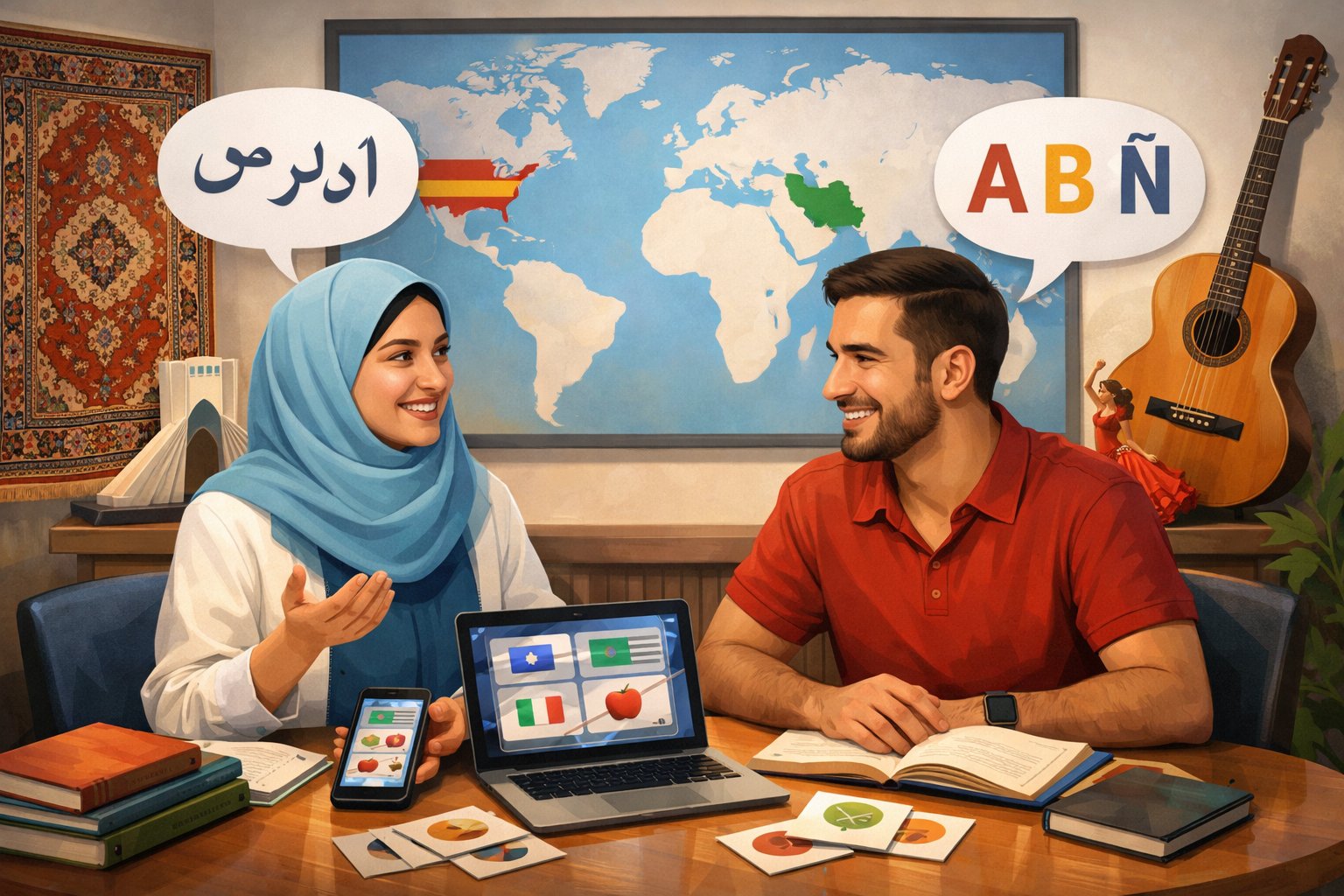
Mastering Spanish Fundamentals for Persian Speakers
Persian speakers hit some real challenges when picking up Spanish: new alphabet, unfamiliar sounds, and a totally different sentence structure. Spanish uses the Latin script, has new vowels and the infamous rolled "r," and sticks to subject-verb-object word order with gendered nouns.
Understanding Key Differences Between Persian and Spanish
| Feature | Persian | Spanish |
|---|---|---|
| Writing System | Persian script (right to left) | Latin alphabet (left to right) |
| Noun Gender | No grammatical gender | Masculine/feminine for all nouns |
| Verb Conjugation | Less complex, fewer forms | Highly inflected (6 forms per tense) |
| Word Order | Subject-Object-Verb | Subject-Verb-Object |
| Articles | No definite/indefinite articles | Required (el, la, un, una) |
| Syllable Timing | Stress-timed language | Syllable-timed language |
- Spanish vowels: 5, always pure; Persian: 6, more flexible
- Rolled "rr" sound: totally new for Persian speakers
- Spanish "j": softer than Persian خ
- Syllable timing: Spanish gives each syllable the same length
Grammar changes you need:
- Every noun has a gender and adjectives must match
- Verb endings change for who, when, and how
- Prepositions work differently than Persian postpositions
Learning the Spanish Alphabet and Pronunciation
Spanish alphabet (27 letters):
A, B, C, D, E, F, G, H, I, J, K, L, M, N, Ñ, O, P, Q, R, S, T, U, V, W, X, Y, Z
Pronunciation patterns:
| Letter | Sound | Persian Comparison | Example |
|---|---|---|---|
| r (single) | Light tap | Like ر | pero |
| rr (double) | Rolled trill | No Persian match | perro |
| j | Throaty h | Softer than خ | jamón |
| ll | Y sound | Like ی | llamar |
| ñ | ny sound | Like نی together | señor |
| h | Silent | Never pronounced | hola |
Vowel rules:
- a = ah (like آ)
- e = eh
- i = ee
- o = oh
- u = oo (like او)
Stress pattern rules:
| Rule | Example |
|---|---|
| Word ends in vowel, n, or s | Stress 2nd-to-last syllable: hablo |
| Word ends in other consonant | Stress last syllable: comer |
| Accent mark present | Stress marked syllable: camión |
Persian speakers should practice making every syllable even - no skipping or stretching.
Spanish Sentence Structure Essentials
| English | Spanish | Persian Equivalent |
|---|---|---|
| I eat bread | Yo como pan | من نان میخورم |
| The house is big | La casa es grande | خانه بزرگ است |
| She reads books | Ella lee libros | او کتابها را میخواند |
Gender & articles:
- Masculine: el libro, un gato
- Feminine: la mesa, una casa
- Plural masculine: los libros, unos gatos
- Plural feminine: las mesas, unas casas
Adjective placement:
| Rule | Example |
|---|---|
| Adjective follows noun | casa blanca (white house) |
Verb conjugation:
| Subject | Hablar (to speak) | Persian Equivalent |
|---|---|---|
| yo | hablo | من صحبت میکنم |
| tú | hablas | تو صحبت میکنی |
| él/ella | habla | او صحبت میکند |
| nosotros | hablamos | ما صحبت میکنیم |
| vosotros | habláis | شما صحبت میکنید |
| ellos/ellas | hablan | آنها صحبت میکنند |
Forming questions:
- Invert subject and verb: ¿Hablas español?
- Use question words: ¿Qué? ¿Dónde? ¿Cuándo?
- Start with an inverted question mark: ¿
Spanish often drops subject pronouns since verbs already tell you who’s doing what.
Building Effective Spanish Vocabulary
Persian speakers need a plan to grab Spanish words fast. Focused methods like learning by frequency and spotting cognates work better than just memorizing random words.
Approaching Common Spanish Words and Phrases
| Category | Example Words | Usage Context |
|---|---|---|
| Verbs | ser, estar, tener, hacer | Core conversations |
| Nouns | casa, tiempo, persona, día | Everyday stuff |
| Adjectives | bueno, grande, pequeño, nuevo | Descriptions |
| Connectors | y, pero, porque, cuando | Linking thoughts |
- Greetings: Buenos días, ¿Cómo estás?, Mucho gusto
- Requests: Por favor, ¿Me puede ayudar?, Necesito
- Responses: Sí, No, No sé, Tal vez
- Time expressions: Ahora, Mañana, Ayer, Después
Rule → Example pair:
- Rule: Learn vocab by topic, not alphabetically.
- Example: Group words for food, travel, or business together.
Leveraging Cognates for Rapid Learning
| Spanish Word | Persian Equivalent | English Meaning |
|---|---|---|
| algoritmo | الگوریتم (algōritm) | algorithm |
| álgebra | الجبر (jabr) | algebra |
| azúcar | شکر (shekar) | sugar |
| naranja | نارنج (nāranj) | orange |
False Cognates (Don’t Mix These Up):
| Spanish Word | Persian Guess | Actual Meaning |
|---|---|---|
| embarazada | embarrassed | pregnant |
| éxito | exit | success |
| constipado | constipated | has a cold |
Rule → Example pair:
- Rule: Spot Arabic-root words - they’re often shared.
- Example: azúcar = شکر (sugar)
Utilizing Vocabulary Lists and Flashcards
| Review Interval | When to Review |
|---|---|
| First | 1 day after learning |
| Second | 3 days |
| Third | 7 days |
| Fourth | 14 days |
| Fifth | 30 days |
Spanish Flashcard Setup:
- Front: Spanish word/phrase, sample sentence, audio icon
- Back: Persian translation, gender, verb group (if needed)
Vocabulary List Types:
- Frequency-based: Most-used words first
- Thematic: By topic (food, travel)
- Grammar-based: By verb tense or noun group
Tip: Add Persian script hints for tough Spanish sounds. Physical flashcards help if you remember best by writing.
Foundations of Spanish Grammar and Verbs
Spanish grammar follows patterns. Persian speakers can tackle it by learning verb conjugations and how adjectives and nouns must agree. Spanish verbs fall into three groups (-ar, -er, -ir), and tenses are marked by endings, not auxiliaries like in Persian.
Core Spanish Grammar Rules for Persian Learners
| Feature | Persian | Spanish |
|---|---|---|
| Word Order | SOV (Subject-Object-Verb) | SVO (Subject-Verb-Object) |
| Gender | No gender | Masculine/feminine nouns |
| Verb Position | End of sentence | After subject |
| Adjective Placement | Before noun | Usually after noun |
Noun Gender & Agreement Table:
| Example | Gender/Number |
|---|---|
| el libro rojo | masculine singular |
| la casa roja | feminine singular |
| los libros rojos | masculine plural |
| las casas rojas | feminine plural |
Grammar Rules:
- Articles and adjectives must match the noun’s gender and number.
- Adjectives: -o/-os (masculine), -a/-as (feminine).
- Subject pronouns usually drop: Hablo español (not Yo hablo español).
Rule → Example pair:
- Rule: Mark gender for every noun and match adjectives.
- Example: la mesa blanca (the white table)
Persian speakers need to train themselves to always note noun gender, since Persian doesn’t do this.
Mastering Spanish Verbs and Tenses
Three Verb Conjugation Families
| Infinitive Ending | Example | Present Tense (yo, tú, él) |
|---|---|---|
| -ar | hablar (speak) | hablo, hablas, habla |
| -er | comer (eat) | como, comes, come |
| -ir | vivir (live) | vivo, vives, vive |
Present Tense Formation
Remove the infinitive ending, add these endings:
Hablar (to speak)
- yo hablo
- tú hablas
- él/ella habla
- nosotros hablamos
- ellos hablan
Most Common Irregular Verbs
- ser: soy, eres, es
- estar: estoy, estás, está
- tener: tengo, tienes, tiene
- ir: voy, vas, va
Past Tense (Preterite) Regular Patterns
| Verb Type | Endings | Example: Hablar |
|---|---|---|
| -ar verbs | -é, -aste, -ó | hablé, hablaste, habló |
| -er/-ir verbs | -í, -iste, -ió | comí, comiste, comió |
Study Tips for Persian Speakers
- Use pattern drills and sentence-building, not just memorization (guide)
- Combine conjugation practice with natural usage (drills, examples)
Research-Backed Learning Strategies and Apps
Microlearning Schedule
| Time Block | Activity | Retention Rate |
|---|---|---|
| 10-15 min | Vocab review | 74% higher than cramming |
| 15-20 min | Grammar patterns | Matches 1 semester in 26-49 hrs |
| 5-10 min | Audio practice | 83% oral proficiency gain |
Daily Routine
- Morning: 10 min new vocab
- Midday: 5 min review (spaced repetition)
- Evening: 15 min listening or reading
Spaced Repetition Memory Loop
- Encode → Review after 1 day → Reinforce after 3 days → Review after 7 days
App Comparison
| App | Best For | Study Time | Cost |
|---|---|---|---|
| Duolingo | Beginners, daily | 15 min/day | Free |
| Babbel | Conversation | 10-15 min/lesson | $7-13/month |
| Memrise | Vocab building | 5-10 min/session | Free/Premium |
| FluentU | Content immersion | 20-30 min/day | $30/month |
Key App Stats
- Duolingo users gain 8 points/hr on standardized tests
- Babbel: 73% improve speaking after 3 months, 10+ hrs practice
Online Classes
- Live instruction plus app practice = best results (method guide)
- Apps with explicit grammar explanations help Persian speakers most
Immersive Practices and Real-Life Exposure
Media Consumption Tips
- Watch Spanish TV/movies daily with interactive subtitles
- Listen to music and podcasts for ear training
Watching Spanish Movies and Videos
| Stage | Audio | Subtitles | Best For |
|---|---|---|---|
| 1 | Spanish | Persian | Beginners |
| 2 | Spanish | Spanish | Intermediate |
| 3 | Spanish | None | Advanced |
Recommended Video Types
- Kids’ cartoons (Pocoyó, Dora)
- Cooking shows (MasterChef España)
- News broadcasts
- Real Spanish YouTube channels
Viewing Routine
- Watch same episode 2-3 times:
- 1st: Comprehension
- 2nd: Phrase focus
- 3rd: Pronunciation mimicry
Using Spanish Subtitles and Interactive Captions
Subtitle Types & Uses
- Spanish subtitles: Connect spoken and written forms
- Interactive captions: Tap for instant definitions
- Dual subtitles: Spanish + Persian (best for beginners)
Effective Practice
- Enable Spanish subtitles
- Pause on new phrases
- Write 3-5 new terms/episode
- Review those scenes within 24 hours
Listening to Spanish Podcasts and Music
Podcast Choices by Level
- A1-A2: Slow podcasts with transcripts
- B1-B2: Interviews, comedy, true crime
- C1+: News, technical, fast talk
Active Listening Steps
- Play Spanish podcast during routine tasks
- Note 1-2 repeated phrases
- Look up lyrics for favorite songs
- Sing along
Music and Podcasts
- Use 5-10 min daily, not occasional long sessions
- Songs help with vocab recall; podcasts build listening stamina
Active Conversation and Social Learning
Language Exchange Platforms
| Platform | Features | Best For |
|---|---|---|
| Tandem | Voice, text, video | Daily practice, corrections |
| HelloTalk | Translation, sharing | Written/spoken exchange |
| ConversationExchange | Meetups, video | Structured schedules |
Exchange Structure
- Split: 30 min Spanish, 30 min Persian
- Prep 3-5 topics/session
- Request corrections during pauses
- Focus on common phrases (greetings, routines, questions)
Formats
- Text: 10-15 min/day (quick corrections)
- Voice notes: Pronunciation practice
- Video: Full conversation, 2x/week
Partnering
- Connect with Spanish speakers learning Persian (resource)
Participating in Spanish Classes or Groups
| Format | Frequency | Group Size | Practice Type |
|---|---|---|---|
| Online group | 2-3x weekly | 4-8 | Structured convo |
| In-person class | 1-2x weekly | 6-12 | Grammar, speaking |
| Conversation club | Weekly | 5-15 | Free discussion |
Class Selection Criteria
- ≥40% speaking per session
- ≤8 students per group
- Spanish-speaking/advanced instructor feedback
- Weekly speaking homework
Practice Speaking with Tutors and Spanish Speakers
Tutor Session Structure
- Warm-up: 3-4 questions (5 min)
- Focused practice: grammar/pronunciation (15-20 min)
- Free conversation: prepared topics (10-15 min)
- Corrections: review errors (5 min)
Where to Find Tutors
- italki: $8-25/hr, country choice
- Preply: Structured courses
- Verbling: Certified teachers
Trial Session Questions
- Do you correct immediately or after?
- Can you explain grammar in English?
- Will you assign speaking homework?
Session Prep
- Review 5-10 new words
- Prepare 2-3 questions
- Record sessions for pronunciation review
Live practice>written drills. Aim for 3+ speaking sessions/week.
Overcoming Common Challenges for Persian Speakers
Adapting to Gendered Nouns and Articles
| Noun Ending | Typical Gender | Example | Exception |
|---|---|---|---|
| -o | Masculine | el libro (the book) | la mano (the hand) |
| -a | Feminine | la mesa (the table) | el día (the day) |
| -ción, -sión | Feminine | la estación (station) | - |
| -ma (Greek) | Masculine | el problema (problem) | - |
Gender Retention Routine
- Memorize nouns with articles (el libro, la mesa)
- Group by gender in color-coded lists
- Drill: See noun, produce article
- Practice adjective agreement: el niño alto / la niña alta
Improving Pronunciation and Listening Skills
Key Sound Contrasts
| Sound | Spanish Example | Persian Difference |
|---|---|---|
| Rolled R (rr) | perro | Absent in Persian; requires tongue-tip vibration |
| Single-tap R | caro | Not Persian uvular |
| B/V | bailar/vivir | Identical in Spanish, not in English/Persian |
| Pure vowels | a, e, i, o, u | No diphthongs; Persian vowels differ |
Audio Practice Steps
- Record Spanish audio (minimal pairs)
- Shadow and match rhythm/pitch
- Record and compare to a Spanish speaker
- Practice problem sounds in isolation, then in words
Rhythm Rule → Example
- Rule: Spanish is syllable-timed; every syllable gets equal time.
- Example: “Me gusta el español” (say each syllable evenly)
Build fluency with daily 10-minute mimicry sessions.
Maintaining Motivation and Tracking Progress
If you want to get good at Spanish, you’ll need clear goals and a way to hold yourself to them. "Become fluent" is too vague - it won’t push you to actually do the work each day.
Progress Benchmarks by CEFR Level
| Level | Vocabulary Size | Speaking Ability | Study Duration (approx.) |
|---|---|---|---|
| A1 | 500–750 words | Basic greetings, simple requests | 60–80 hours |
| A2 | 1,000–1,500 words | Past tense, daily exchanges | 180–200 hours |
| B1 | 2,500–3,000 words | Talk about familiar topics, share opinions | 350–400 hours |
| B2 | 4,000–5,000 words | Handle complex discussions, react on the spot | 600–650 hours |
Daily Tracking Metrics
New words learned (aim: 10–15)
Minutes speaking (aim: 15–20)
Real Spanish content watched or listened to (aim: 20–30 minutes)
Verb tenses practiced (aim: 3 per day)
Schedule weekly chats with Spanish speakers who want to learn Persian - language exchanges keep you accountable.
Mark progress on a calendar. Miss a day? Next day: double practice. Miss three days? Rethink your motivation and adjust your daily goal.
Maximizing Benefits from Learning Spanish
Spanish isn’t just another language - it’s a ticket to 20 countries, better jobs, and sharper thinking.
Unlocking Opportunities in Spanish-Speaking Countries
Professional Access Points
- International business in Spain, Mexico, Argentina, Colombia, Chile
- Tourism/hospitality jobs needing Spanish/English
- Translation/interpretation for legal, medical, corporate fields
- Remote work with Latin American companies
- Diplomatic and NGO posts in Spanish-speaking regions
Geographic Reach
| Region | Countries | Combined Population |
|---|---|---|
| Europe | Spain | 47 million |
| Latin America | Mexico, Colombia, Argentina, Peru, Chile, Venezuela | 400+ million |
| Central America | Guatemala, Honduras, Costa Rica, Panama | 50+ million |
- Persian speakers open doors in 20 official Spanish-speaking countries - great for networking and business.
Travel Benefits
- Get around without translation apps
- Find local prices and hidden spots
- Make friends with locals
- Catch on to customs and safety info
Cognitive and Professional Advantages
Mental Performance Gains
- Memory gets a boost from vocab drills
- Problem-solving speeds up when juggling two languages
- Multitasking skills improve by switching between tongues
- Bilingualism helps delay age-related mental decline
Spanish improves cognitive skills like working memory and focus.
Career Enhancement Metrics
| Skill Level | More Job Options | Salary Boost |
|---|---|---|
| Basic Spanish | 30–40% more | 5–10% higher |
| Professional Spanish | 60–80% more | 15–20% higher |
Resume Differentiators
Communicate with Spanish-speaking clients
Translate documents
Help expand into new markets
Bridge cultures at work
Persian-Spanish bilinguals fill unique roles in trade, education, and consulting - language combos matter more than just fluency.
Frequently Asked Questions
Persian speakers run into unique hurdles with Spanish: new alphabet, tricky pronunciation, and gendered nouns. The best tools target these issues head-on.
What are effective methods for speakers of Persian to become proficient in Spanish?
High-Impact Methods
| Method | Focus Area | Persian Speaker Benefit |
|---|---|---|
| Language exchange apps | Speaking practice | Fixes Persian-influenced pronunciation |
| Audio-first learning | Listening comprehension | Trains ear for Spanish rhythm |
| Verb drills | Grammar mastery | Gets you used to verb forms Persian lacks |
| Immersion content | Cultural context | Cuts down on direct translation mistakes |
Daily Practice Structure
- Listen to 10–15 minutes of Spanish
- Do verb conjugation exercises
- Speak with locals for 15–20 minutes
- Review gendered nouns
- Combine several approaches for best results.
- Practice the rolled "r" separately - it’s a sticking point for Persian speakers.
Rule → Example
Rule: Avoid direct translation from Persian to Spanish.
Example: Think "¿Dónde está el baño?" not "Baño dónde es?"
Can Duolingo effectively help Persian speakers learn Spanish?
Duolingo Capabilities for Persian Speakers
| Feature | Effectiveness | Limitation |
|---|---|---|
| Latin alphabet practice | High | Doesn’t help with Persian script transition |
| Vocabulary building | Medium | Not tailored to Persian learners |
| Verb conjugation drills | Medium | Limited for advanced forms |
| Pronunciation feedback | Low | Misses Persian-specific pronunciation issues |
- Duolingo is fine for beginners, but it’s not enough on its own.
- For rolled "r" and gendered nouns, you’ll need extra practice.
- Daily use is good, but real speaking practice is a must.
What resources are recommended for Persian speakers to learn Spanish quickly and efficiently?
Resource Categories by Learning Stage
Beginner (0–3 months)
- Language Transfer: Persian-friendly foundation
- "Easy Spanish Step-By-Step": Grammar basics
- Tandem/HelloTalk: Early chats with locals
Intermediate (3–12 months)
- "Practice Makes Perfect: Complete Spanish Grammar"
- Dreaming Spanish (comprehensible input)
- Netflix Spanish shows with subtitles
Advanced (12+ months)
- Radio Ambulante podcast
- Books by Gabriel García Márquez
- Language exchange platforms for conversation
Essential Tool Combination
| Tool Type | Resource | Primary Function |
|---|---|---|
| Grammar book | "Practice Makes Perfect" | Master verb conjugations |
| Audio practice | Coffee Break Spanish podcast | Model pronunciation |
| Speaking app | Tandem | Correct mistakes in real time |
| Vocab builder | Memrise (spaced repetition) | Lock in new words |
- Mix resources for 30–45 minutes a day to progress faster.
Is Rosetta Stone an adequate tool for Persian speakers to learn Spanish?
Rosetta Stone Feature Analysis
| Aspect | Performance for Persian Speakers |
|---|---|
| Immersion | Moderate, lacks translation support |
| Pronunciation tech | Basic, misses Persian-specific issues |
| Grammar explanation | Minimal, not enough for conjugations |
| Cost-to-value ratio | Lower than free alternatives |
Better Alternatives for Persian Speakers
Babbel: More conversation, clearer grammar
Coursera: Structured courses with teachers
Free mix: Duolingo + language exchange + grammar book
Rosetta Stone doesn’t explain grammar much - Persian speakers need resources that spell out the differences.
For a Persian speaker, what strategies enhance Spanish language retention and fluency?
Vocabulary Retention
| Technique | Application | Memory Benefit |
|---|---|---|
| Spaced repetition | Review at 1, 3, 7, 14 days | Moves words to long-term memory |
| Gendered noun colors | Blue = masculine, Red = feminine | Faster recall |
| Cognate recognition | Spot Latin-based words | Grows vocab quickly |
Pronunciation Fluency
- Record yourself speaking Spanish for 2 minutes daily
- Compare with Spanish audio
- Focus on tough sounds like the rolled "r"
- Practice tricky sounds in 5-minute bursts
Grammar Automation
- Write 10 sentences each day with new verbs
- Read them out loud
- Don’t translate from Persian or English - think in Spanish
Contextual Learning
| Rule | Example |
|---|---|
| Learn phrases in context, not isolation | Watch same Spanish show episode multiple times instead of only using flashcards |
Speaking Practice Frequency
| Practice Frequency | Fluency Timeline | Retention Rate |
|---|---|---|
| Daily (15+ min) | 12–18 months to converse | 85–90% |
| 3x per week | 18–24 months | 70–75% |
| Weekly | 30+ months | 50–60% |
- Consistency wins: shorter, regular sessions beat long, rare ones.