Best Way To Learn Spanish From Japanese: Accelerated, Evidence-Based Mastery
Short, daily sessions (20–30 mins) beat cramming or inconsistent study
Posted by
 Stewart Kaplan
Related reading
Best Way to Learn Spanish from Albanian: Microlearning That Clicks
Start speaking right away - don’t wait to “master grammar” before building natural sentences
Best Way to Learn Spanish from Arabic: How Microlearning Accelerates Real Fluency
Sticking to short, regular sessions beats cramming: two 20-minute focused practices a week with retrieval drills get you farther than a weekend of scrolling or binge-studying.
Best Way to Learn Spanish from Bengali: Fast-Track Scientific Methods
Top tools for Bengali speakers: apps with Bengali menus, tutors who get Indo-Aryan languages, and spaced repetition that drills gendered nouns.
TL;DR
- Mix daily conversation with Spanish speakers and focused grammar study, especially for Japanese-specific challenges
- Japanese speakers struggle with: the Latin alphabet, rolling R’s, gendered nouns, and SVO word order (Spanish) vs SOV (Japanese)
- Talking every day - via language exchange or a tutor - gets you fluent way faster than just using apps
- Apps like Duolingo and structured courses work best when you combine them with real conversations and Spanish media
- Short, daily sessions (20–30 mins) beat cramming or inconsistent study
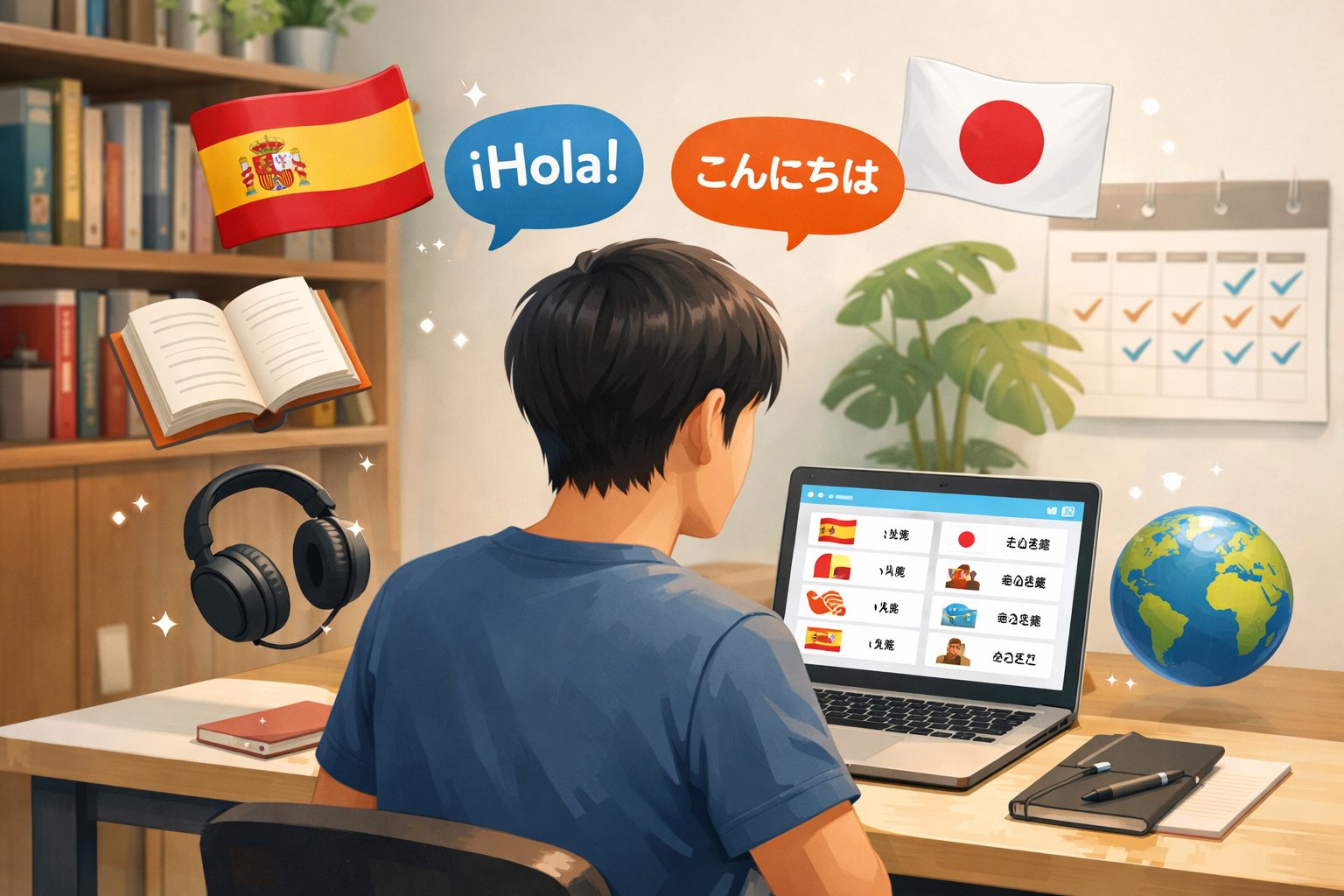
Fundamental Challenges for Japanese Speakers
Japanese learners hit some unique walls: verb-final grammar (SOV) vs Spanish SVO, a whole new gender system, sounds like rolled R’s, and the jump from three writing systems to just one.
Differences in Grammar Structures
Word Order Comparison
| Element | Japanese | Spanish |
|---|---|---|
| Basic structure | Subject-Object-Verb | Subject-Verb-Object |
| Example | 私は本を読む (I book read) | Yo leo un libro (I read a book) |
| Question formation | Particle か at end | Inversion or intonation |
| Adjective place | Before noun | Often after noun |
Verb Conjugation Contrast
- Japanese: Shows tense with helper verbs and particles
- 食べる (taberu, to eat) → 食べました (tabemashita, ate)
- Spanish: Packs tense into verb endings
- comer (to eat) → comí, comiste, comió, comimos
Spanish verbs have six forms per tense. Japanese speakers have to swap from particle-based grammar to memorizing all these endings.
Preposition Systems
- Japanese: Postpositions after nouns
- Spanish: Prepositions before nouns
This flip means you’re always mentally reversing things.
Gender and Number Agreement Issues
Gender Assignment
| Japanese | Spanish | Gender |
|---|---|---|
| 本 (hon, book) | libro | masculine |
| 机 (tsukue, desk) | mesa | feminine |
| 猫 (neko, cat) | gato/gata | depends |
Japanese nouns don’t have gender. Spanish nouns do, and adjectives/articles have to match.
Agreement Patterns
- El libro rojo (masculine)
- La mesa roja (feminine)
- Los libros rojos (masculine plural)
Spanish adjectives change for gender and number - Japanese ones don’t.
Pronunciation and Phonetic Barriers
Challenging Sounds for Japanese Speakers
| Spanish Sound | Japanese Issue | Example Word |
|---|---|---|
| Rolled R (rr) | No equivalent | perro |
| Single R tap | Rare | pero |
| L vs R | Not distinct | loro, roro |
| V | Sounds like B | vino |
| Vowel reduction | Not in Japanese | está, esta |
The rolled R is a big hurdle. Japanese has just one R-ish sound - a soft tap.
Syllable Structure Differences
- Japanese: Always consonant-vowel, no clusters
- Spanish: Allows clusters like “transporte” or “construcción”
Japanese speakers often break up Spanish words into extra syllables at first.
Latin Alphabet vs. Japanese Writing Systems
System Comparison
| Feature | Japanese | Spanish |
|---|---|---|
| Writing systems | Hiragana, Katakana, Kanji (3) | Latin alphabet (1) |
| Characters needed | ~2,000+ kanji | 27 letters + diacritics |
| Phonetic consistency | Hiragana/Katakana: yes | Mostly, some exceptions |
| Reading direction | Vertical/horizontal | Horizontal |
Alphabet Learning Demands
- 27 new letters to learn. Spanish is mostly phonetic, so once you get the letters, you’re set.
Diacritical Marks
- Acute accent: á, é, í, ó, ú (shows stress/meaning)
- Tilde: ñ (new sound)
- Dieresis: ü (rare, like in “pingüino”)
Spanish accents matter for meaning - Japanese doesn’t mark stress or tone in writing.
Key Strategies: Learning Spanish Efficiently from Japanese
Japanese learners need focused vocab, spaced repetition, and courses built for their background.
Prioritizing High-Frequency Vocabulary
Top 1,000 Spanish words = 80–85% of daily conversation
Start with:
- Core verbs: ser, estar, ir, tener, hacer
- Time words: hoy, mañana, ahora, siempre, nunca
- Everyday nouns: casa, comida, agua, libro, teléfono
- Social phrases: por favor, gracias, perdón, buenas tardes
Cognates help a ton
| Spanish | Japanese Loanword | Meaning |
|---|---|---|
| computadora | コンピュータ (konpyūta) | computer |
| restaurante | レストラン (resutoran) | restaurant |
| televisión | テレビ (terebi) | television |
Spotting these makes vocab stick faster.
Microlearning and Flashcards for Rapid Retention
Flashcard Schedule
- Day 1: 10–15 new words
- Day 2: Review + 10 more
- Day 4: Review all
- Week 2: Review last week’s cards
Best Flashcard Format
- Front: Spanish word + example sentence
- Back: Japanese meaning + pronunciation tip
Example:
- Front: hablar – "Yo hablo español"
- Back: 話す (hanasu) – Pronunciation: ah-BLAR (roll the r)
Digital flashcards beat paper - get audio for tricky sounds like trilled r and vowel combos.
Structured and Personalized Lesson Plans
Course Elements
| Component | Focus | How Often |
|---|---|---|
| Grammar drills | Verbs, gendered nouns | 3x/week |
| Speaking | Pronunciation, fluency | Daily (10–15 min) |
| Listening | Speed, rhythm, comprehension | 4x/week |
| Writing | SVO sentence structure | 2x/week |
Personalization Priorities
- Alphabet drills: Latin letters to sounds
- Pronunciation: rolling r, Spanish vowels
- Grammar: direct SOV vs SVO comparisons
Structured lessons that build step-by-step work best.
Optimized Use of Language Learning Apps
Apps make Spanish easier for Japanese speakers by gamifying, making routines, and connecting you to speakers. Choose based on your style, time, and goals.
Duolingo and Gamified Microlearning Platforms
Core Features
- 5–10 min lessons, quick to finish
- XP, streaks, leaderboards = motivation
- Speech recognition for pronunciation
- Adapts difficulty as you learn
Spanish from Japanese: Key Benefits
| Feature | Why It Helps Japanese Speakers |
|---|---|
| No grammar translation | Avoids Japanese sentence habits |
| Daily streaks | Builds verb/adjective memory |
| Visual clues | Replaces kanji memory cues |
Retention Tricks
- Spaced repetition brings back old words
- Focuses review on what you miss
- Audio-first: trains listening before reading
Gamified apps keep you practicing 37% more than old-school study.
Babbel for Conversation-Focused Routines
Lesson Style
- 10–15 min dialogues, real-life topics
- Grammar explained in context
- Old phrases cycle into new lessons
Practical Scenarios
| Scenario | Example Phrase | Time to Learn |
|---|---|---|
| Restaurant | "¿Me trae la cuenta?" | 2–3 weeks |
| Directions | Formal/informal verb forms | 3–4 weeks |
| Shopping | Number drills | 1–2 weeks |
Speech Practice
- Voice recognition checks your accent
- Instant playback shows what’s off
- Repeats tough sounds (like r/l) for Japanese speakers
Comprehensive courses like Babbel focus on real conversations.
Rosetta Stone and Immersive Contextual Learning
Immersion Method
- No translation - just images and Spanish
- Guess meaning from context, lots of repetition
- Grammar sneaks in naturally
How It Works
- See image + Spanish audio
- Pick matching image
- Repeat phrase; speech recognition checks you
- See same word in new situations
Why It Works for Japanese Speakers
- Stops you from translating Spanish to Japanese in your head
- Builds direct Spanish → meaning connections
- Gets you speaking from day one
Memory PathVisual → Audio → Recall → Context switch
Immersive learning builds real understanding, not just translation skills.
Comparing Memrise, Busuu, and Tandem
Platform Functionality Matrix
| App | Primary Method | Best For | Japanese Speaker Advantage |
|---|---|---|---|
| Memrise | Video clips from Spanish speakers | Vocabulary, listening | Real-life audio helps break textbook habits |
| Busuu | Grammar lessons + peer correction | Step-by-step learning with feedback | Community spots Japanese-style mistakes |
| Tandem | Text/voice exchange with locals | Real conversation, cultural understanding | Compare Japanese and Spanish expressions directly |
Memrise Approach
- Watch Spanish speakers for real pronunciation
- Spaced repetition sets review times
- Mnemonics and memes help memorize words
Busuu Social Learning
- Step-by-step grammar lessons
- Spanish speakers correct your writing
- Official certificates show your progress
Tandem Exchange Features
- Find Spanish speakers learning Japanese
- Built-in translation helps beginners
- Voice messages let you practice speaking anytime
Optimal Combination Strategy
- Memrise: build vocab
- Busuu: get grammar basics
- Tandem: practice with real people
See: language apps with Spanish speaker connections
Essential Practice Techniques for Speaking and Listening
- Talk with Spanish speakers for real conversation experience (source)
- Tutors give targeted corrections to stop bad habits early (source)
Finding and Working with a Language Partner
Where to find language partners:
- HelloTalk (app for text/voice)
- Tandem (video chat, texting)
- ConversationExchange.com (free matching)
- Local Japanese-Spanish meetups
- University exchange programs
Session Structure
| Time Block | Activity | Language Used |
|---|---|---|
| 15 min | Spanish conversation (partner corrects) | Spanish only |
| 15 min | Japanese conversation (learner corrects) | Japanese only |
| 10 min | Review errors and new words | Either language |
Best Practices
Record sessions to review later
Prep 3-5 topics before meeting
Ask partner to type new words in chat
Focus on one grammar point per session
Give corrections right away, not at the end
Request 70% speed from partners at first
Mexican or Spanish partners usually have clearer pronunciation
Engaging with a Spanish Tutor for Error Correction
Tutors vs. Language Partners
| Tutor | Language Partner |
|---|---|
| Tracks errors systematically | Might miss repeated errors |
| Builds personalized lesson plans | Sticks to casual conversation |
| Explains grammar deeply | Offers Spanish intuition |
| Monitors long-term progress | No formal assessment |
Key Tutor Session Elements
- Tutor logs errors in pronunciation, verbs, and word order
- Drills for specific weak points
- Explains why mistakes happen
- Reviews homework (writing, recordings)
Best Scheduling for Spanish tutors for error correction:
- 2-3 sessions per week, 30-60 minutes each
- Meet after self-study to answer new questions
- Request session recordings
- Alternate grammar and conversation focus
Active Conversation Practice Techniques
Shadowing Steps
- Play a 30-second Spanish audio clip
- Pause, repeat with same rhythm
- Play again, speak along with audio
- Record yourself without audio
- Compare your version to the original
Self-Recording Routine
- Record a 2-minute talk on a daily topic
- Listen for verb and gender mistakes
- Re-record after fixing errors
- Save both versions to track progress
Progressive Difficulty Structure
| Week | Practice Type | Duration |
|---|---|---|
| 1-2 | Repeat memorized dialogues | 5 min daily |
| 3-4 | Answer prepared questions | 10 min daily |
| 5-6 | Describe images spontaneously | 15 min daily |
| 7+ | Debate opinions, unprepared | 20 min daily |
- Repeat Spanish phrases aloud every day (source)
- Japanese speakers: practice rolled 'r' sounds 10-15 min weekly
Conversation Starters
- Talk about what you did yesterday
- Explain a Japanese tradition in Spanish
- Summarize a news story you read today
- Give directions to a place you know
- Compare Spanish and Japanese grammar
Maximizing Immersion and Real-World Exposure
- Combine structured study with active exposure: conversation, authentic media, cultural contact
Language Exchange and Community Engagement
Language Partner Platforms
| Platform | Best For | Key Feature |
|---|---|---|
| MyLanguageExchange | Structured exchanges | Message + video options |
| The Mixer | Local meetups | In-person practice |
| HelloTalk | Text practice | Correction tools |
| Tandem | Video chat | Instant matching |
Exchange Formats
50/50 split: 30 min Spanish, 30 min Japanese
Switch languages by topic
Correction windows: feedback after each turn
Look for partners interested in language exchange (not paid lessons)
Spain: vosotros for "you" (plural); Latin America: ustedes
Local Spanish Communities
- Cultural centers in Japanese cities
- University language clubs
- Conversation tables at Spanish restaurants
- Online forums for Japanese-Spanish learners
Practice Checklist
- Prep 3-5 topics before meeting
- Record conversations
- Write down new phrases right after
- Schedule weekly sessions
Spanish Media: Podcasts, Music, and News
Beginner-Friendly Podcasts
| Podcast | Level | Format |
|---|---|---|
| Notes in Spanish | A1-C2 | Conversational dialogue |
| Coffee Break Spanish | A1-B1 | Lesson episodes |
| SpanishPod101 | A1-C1 | Topic + grammar |
Daily Listening Routine
- Morning (15 min): News podcast at 0.75x speed
- Commute (20 min): Spanish music with lyrics
- Evening (10 min): Replay morning content at normal speed
Music by Genre
Pop/Reggaeton: Shakira, Bad Bunny (Caribbean Spanish)
Rock en Español: Maná, Soda Stereo (neutral accent)
Bolero/Balada: Luis Miguel (clear pronunciation)
Spanish music helps memory through rhythm and repetition
News by Difficulty
- A2-B1: BBC Mundo (simple)
- B2+: El País, CNN en Español (standard)
- Full speed: Radio Nacional de España
Active Listening Steps
- Listen once, no pausing
- Write 5 new words
- Listen again with transcript
- Shadow pronunciation
- Summarize in Spanish (1-2 sentences)
Traveling or Connecting With Spanish-Speaking Countries
Top Destinations for Japanese Learners
| Country | Accent Clarity | Japanese Community | Cost |
|---|---|---|---|
| Mexico | High | Large | Low |
| Spain | Medium | Medium | High |
| Colombia | Very High | Small | Low |
| Argentina | Low | Medium | Medium |
Pre-Travel Checklist
- Learn 20-30 survival phrases
- Download offline translation apps
- Book homestays for daily practice
- Find local language meetups
Immersion Activities
Morning shopping and chatting at markets
Cooking classes in Spanish
Volunteering in Spanish-speaking settings
Attend local events
Spanish-speaking countries have varied accents, so you'll hear more than textbook Spanish
Virtual Travel Options
- Online cultural events (film festivals, museum tours)
- Live streaming (Spanish news, YouTube cooking shows)
- VR language apps with 360° scenes
- Social media: follow and comment on Spanish accounts
Daily Connection Checklist
- Join Spanish Discord servers for voice chat
- Watch Spanish Twitch streamers, join chat
- Use VPN for Spain/Latin America Netflix
- Set phone and computer to Spanish
Immersion Tracking
| Metric | Goal/Example |
|---|---|
| Hours per week | 7-10+ |
| Activity mix | 40% listening, 30% speaking, 30% reading |
| Progress marker | Record monthly on same topic |
Systematic Approaches to Spanish Pronunciation and Grammar
- Japanese speakers face unique challenges with Spanish sounds and grammar
Mastering Difficult Sounds and Unique Letter Combinations
| Spanish Sound | Japanese Challenge | Training Method |
|---|---|---|
| /r/ (tap) | No match, often sounds like /l/ | Tap tongue behind teeth: pero, cara |
| /rr/ (trill) | Needs tongue vibration | Practice: toro, perro, carro |
| /l/ | Different tongue spot | Touch alveolar ridge: loco, malo |
| /b/ vs /v/ | Both sound the same in Spanish | Practice: vaca and baca (same sound) |
| /j/ (/x/) | Stronger than Japanese "h" | Throat sound: ajo, rojo, girar |
Vowel Precision
- Spanish vowels: a, e, i, o, u (one sound each)
- Avoid diphthongs; vowels don't change
- Practice: pero (but) vs perro (dog)
Consonant Clusters
- Initial: bl- (blanco), pr- (precio), tr- (tres)
- Final: -s (casas), -n (pan), -d (ciudad)
- Syllable-final -r vs -l must be clear
Practical Application of Grammatical Concepts
Verb Conjugation Table
| Person | -AR (hablar) | -ER (comer) | -IR (vivir) |
|---|---|---|---|
| yo | hablo | como | vivo |
| tú | hablas | comes | vives |
| él/ella | habla | come | vive |
| nosotros | hablamos | comemos | vivimos |
| ellos | hablan | comen | viven |
Gender Agreement Rules
- Nouns: masculine or feminine
- Articles match noun: el libro, la mesa
- Adjectives change: niño alto, niña alta
- Plural: los libros rojos, las mesas rojas
Subject Pronoun Dropping
Rule → Use verb endings to show subject; drop pronoun unless needed for emphasis.
Example: Hablo español (not Yo hablo español)
Ser vs Estar Table
| SER Use | Example | ESTAR Use | Example |
|---|---|---|---|
| Identity | Soy estudiante | Location | Estoy en casa |
| Origin | Es de Japón | Temporary state | Estoy cansado |
| Time | Son las tres | Progressive | Está comiendo |
| Characteristics | Es alto | Result of change | Está roto |
Overcoming Common Japanese-Speaker Errors
Phonetic interference patterns:
Japanese speakers often swap familiar sounds for Spanish ones that don't exist in Japanese. This leads to some classic mispronunciations:
- /r/ replaced with /l/: caro → calo
- Extra vowels tacked onto words: español → españolu
- Dropping final consonants: ciudad → ciuda
- Breaking up clusters: tres → teres
Grammatical transfer errors:
| Error Type | Incorrect | Correct | Rule/Example |
|---|---|---|---|
| Missing articles | Tengo libro | Tengo un libro | Use articles with nouns: Quiero una manzana |
| Wrong gender | El casa grande | La casa grande | Match article to noun gender: el libro |
| Subject retention | Yo hablo yo español | Hablo español | Drop repeated subjects: Como pan |
| Adjective order | Grande casa | Casa grande | Most adjectives follow nouns |
Particle system confusion:
| Language | Structure Example | Rule/Example |
|---|---|---|
| Japanese | Watashi wa hon wo yomimasu | Uses particles for roles |
| Spanish | Leo un libro | Uses word order and prepositions: a, de, en, con |
Tense selection difficulties:
| Japanese Habit | Spanish Tense Needed | Example |
|---|---|---|
| Present for past | Imperfect | Comía pan cada día |
| Context-based time | Explicit tense | He comido (present perfect) |
| One past form | Preterite/Imperfect | Comí (done) vs Comía (ongoing) |
Formality level mismatches:
| Language | Formality System | Rule/Example |
|---|---|---|
| Japanese | keigo (levels) | Based on hierarchy |
| Spanish | tú/usted | Use tú for friends, usted for strangers |
Frequently Asked Questions
What are effective methods for Japanese speakers to learn Spanish?
Immersion-based approaches
- Watch Spanish shows with Japanese subtitles, then switch to Spanish subs
- Join language exchanges pairing Japanese and Spanish speakers
- Travel to Spanish-speaking countries if you can swing it
- Listen to Spanish podcasts or music every day
Structured practice methods
- Enroll in courses for Japanese learners
- Use spaced repetition for vocab
- Speak with Spanish-speaking tutors 3-4 times a week
- Record yourself and listen for mistakes
Focus areas for Japanese learners
| Challenge | Solution |
|---|---|
| Rolling "r" sound | Daily tongue vibration exercises (5-10 min) |
| Gendered nouns | Always learn nouns with their articles |
| Verb conjugations | Master present tense before moving on |
| Latin alphabet | Handwrite Spanish words for muscle memory |
Which online platforms are recommended for Japanese speakers to study Spanish?
Language learning apps
- Duolingo (with Japanese interface)
- Babbel (conversation-focused)
- Rosetta Stone (image-based, no translation)
- Busuu (feedback from Spanish speakers)
Live tutoring platforms
- italki: Spanish-speaking tutors
- Preply: Personalized lesson plans for Japanese learners
- Verbling: Video lessons with certified instructors
Specialized courses
- Spanish courses for Japanese beginners with grammar and pronunciation tailored for Japanese speakers
What free resources are available for learning Spanish as a Japanese speaker?
Free apps and websites
- Duolingo (basic, with Japanese support)
- SpanishDict (dictionary/grammar)
- HelloTalk, Tandem (language exchange)
- YouTube channels with Japanese explanations
Media resources
- Spanish Netflix shows with Japanese subtitles
- Free Spanish podcasts on Spotify
- Streaming Spanish radio stations
- Spanish playlists on music platforms
Community resources
- Local language meetups in Japan
- Online forums for Japanese/Spanish learners
- Free conversation practice on exchange sites
- University sites with free Spanish materials
How can an adult Japanese speaker become proficient in Spanish?
Daily practice requirements
| Skill | Daily Time | Activity |
|---|---|---|
| Listening | 20-30 min | Podcasts, videos, music |
| Speaking | 15-20 min | Tutoring, exchanges, self-recording |
| Reading | 15-20 min | News, books, social media |
| Writing | 10-15 min | Journaling, messaging partners |
Progressive learning stages
- Build a core vocab of 500-1000 words
- Master present tense conjugation (regular verbs)
- Practice basic conversations
- Add past/future tenses gradually
- Study irregular verbs using repetition
- Try complex conversations on different topics
Retention mechanisms
| Method | Example |
|---|---|
| Contextual recall | Learn phrases, not just single words |
| Auditory reinforcement | Repeat-listen to key phrases |
| Progressive word removal | Practice sentences with missing words |
| Spaced repetition | Review before forgetting sets in |
| Proficiency Estimate | Hours Needed |
|---|---|
| Conversational Spanish | 600-750 |
| Career Benefit Example | Field |
|---|---|
| Spanish fluency | International business, tourism |
Are there any comprehensive PDF guides for Japanese speakers learning Spanish?
Available PDF resources
- Grammar comparison charts (Japanese/Spanish side-by-side)
- Verb conjugation tables with Japanese explanations
- Pronunciation guides (katakana for Spanish sounds)
- Themed vocabulary lists with Japanese translations
Where to find guides
- Language learning sites offering downloads
- Online bookstores (digital Spanish textbooks in Japanese)
- University language department websites
- Language schools (supplementary PDF materials)
Limitations of PDF-only learning
| Limitation | PDF Capability |
|---|---|
| Pronunciation | No audio feedback |
| Speaking practice | No conversation |
| Error correction | No personalized feedback |
| Listening skills | No audio, only text |
Rule → Example: PDFs are for reference and review, not for speaking or listening practice. Example: Use a PDF verb chart to study, but practice pronunciation with audio tools.