Best Way to Learn Spanish from Italian: Accelerate Fluency with Proven Science
Comprehensible input - graded reading, audio with transcripts, and conversation - builds fluency better than translation or rote memorization.
Posted by
 Stewart Kaplan
Related reading
Best Way to Learn Spanish from Albanian: Microlearning That Clicks
Start speaking right away - don’t wait to “master grammar” before building natural sentences
Best Way to Learn Spanish from Arabic: How Microlearning Accelerates Real Fluency
Sticking to short, regular sessions beats cramming: two 20-minute focused practices a week with retrieval drills get you farther than a weekend of scrolling or binge-studying.
Best Way to Learn Spanish from Bengali: Fast-Track Scientific Methods
Top tools for Bengali speakers: apps with Bengali menus, tutors who get Indo-Aryan languages, and spaced repetition that drills gendered nouns.
TL;DR
- Italian speakers share over 70% vocabulary with Spanish, thanks to Latin roots. This can cut learning time for B1 proficiency from 12-18 months down to about 6 months.
- Grammar structures are heavily similar, but it’s important to watch out for false cognates and subtle verb conjugation differences.
- Daily microlearning (15–20 minutes) and regular input from Spanish speakers give faster results than cramming.
- Comprehensible input - graded reading, audio with transcripts, and conversation - builds fluency better than translation or rote memorization.
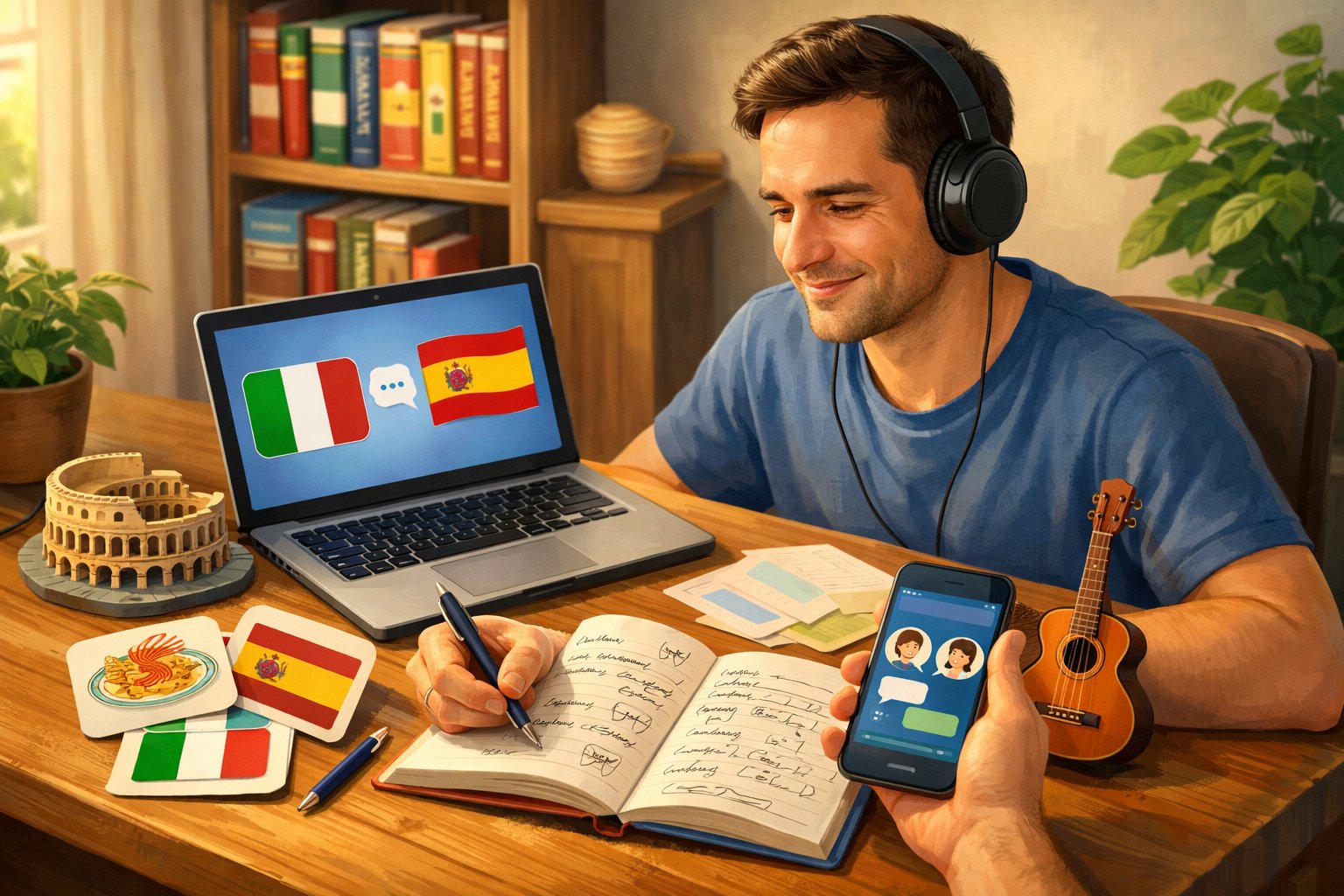
Why Italian Speakers Learn Spanish Faster
Italian speakers share about 82% of their vocabulary with Spanish and use nearly the same grammar. Pronunciation rules are similar, too, which really smooths the path for Italian learners.
Shared Linguistic Roots and Vocabulary
Vocabulary Overlap Between Italian and Spanish:
| Italian | Spanish | English | Similarity |
|---|---|---|---|
| casa | casa | house | Identical |
| parlare | hablar | to speak | Cognate |
| bello | bello | beautiful | Identical |
| famiglia | familia | family | Cognate |
| città | ciudad | city | Cognate |
| mangiare | comer | to eat | Different root |
Both languages are romance languages, so there’s 82% lexicon similarity.
High-Overlap Word Categories:
- Numbers (uno/dos/tres vs uno/due/tre)
- Family (madre/padre/hijo vs madre/padre/figlio)
- Common verbs (essere/ser, avere/haber, fare/hacer)
- Food (pizza, pasta, café/caffè)
- Time (oggi/hoy, domani/mañana)
Italian speakers can recognize over 80% of written Spanish right away, which really speeds up vocab learning.
False Friends to Watch:
- embarazada (pregnant, ES) ≠ imbarazzata (embarrassed, IT)
Similarities in Grammar and Syntax
Shared Grammatical Features:
- Subject-verb-object word order (flexible)
- Gendered nouns (masculine/feminine)
- Verb conjugation across six persons
- Similar tense structures (present, preterite, imperfect, future, conditional)
- Reflexive verbs
- Subjunctive mood
Spanish Grammar Comparison:
| Feature | Italian | Spanish |
|---|---|---|
| Articles | il, la, i, le | el, la, los, las |
| Regular -ar verbs | parlare → parlo | hablar → hablo |
| Auxiliary verbs | essere/avere | ser/estar/haber |
| Past tenses | 2 main forms | 2 main forms |
Key Differences:
- Two "to be" verbs (ser/estar) vs one (essere)
- Different prepositions
- Simpler pronoun system
- Subjunctive less frequent in Spanish
Italian speakers who know their verb charts find Spanish grammar pretty approachable.
Pronunciation Advantages for Italians
Shared Pronunciation Patterns:
- Five vowel sounds (a, e, i, o, u)
- Predictable letter-to-sound rules
- Rolled r
- Similar stress patterns
- Clear consonants
Spanish Sounds to Learn:
| Sound | Spanish | Italian Equivalent |
|---|---|---|
| j/g (e, i) | Strong h (jota) | Soft j/g |
| z/c (e, i) | th or s | ts |
| ñ | ny | gn |
| ll | y (varies) | gli |
Both languages are phonetic, so reading out loud in Spanish feels familiar. The main new trick? Mastering the jota and some regional ll/c/z sounds.
Spanish Pronunciation Perks for Italians:
- No nasal vowels
- Rolled r is already familiar
- Similar rhythm and syllable timing
Optimal Learning Path: Step-by-Step Framework
Italian speakers can speed up Spanish learning by using their first language as a base and following clear progression steps.
Leveraging Italian for Spanish Foundations
Direct Cognate Transfer (70–80% overlap)
| Italian | Spanish | English |
|---|---|---|
| importante | importante | important |
| difficile | difícil | difficult |
| famiglia | familia | family |
| scuola | escuela | school |
| tempo | tiempo | time |
False Friends to Watch
- burro = butter (IT) vs donkey (ES)
- largo = wide (IT) vs long (ES)
- salire = to go up (IT) vs salir = to leave (ES)
Focus on pronunciation differences, not just vocab. The rolled R, vowel quality, and consonant shifts matter more than memorizing word lists.
Grammar Advantages
- Gendered nouns
- Dropped subject pronouns
- Similar verb endings
- Shared subjunctive structure
Main grammar challenge: Spanish past tenses differ from Italian’s passato prossimo.
Stages of the Common European Framework
CEFR Timeline for Italian Speakers
| Level | Hours | Milestones |
|---|---|---|
| A1 | 60–80 | Basic phrases, present tense |
| A2 | 100–120 | Past tenses, simple chats |
| B1 | 180–200 | Complex sentences, clear speech |
| B2 | 350–400 | Natural talk, nuanced meaning |
Most reach B1 in 6–8 months with daily practice.
Level Focus Areas:
- A1–A2: Sound system, basic verbs
- B1: Idioms, regional forms
- B2: Advanced subjunctive, work vocab
Personalized Study Plan Development
Daily Practice (25 min minimum)
- Active study (15 min): Grammar, new vocab
- Passive input (10 min): Podcasts, music, social feeds
Pair Spanish courses with real content.
Resource Picks by Style
| Style | Main Resource | Supplement |
|---|---|---|
| Audio | Coffee Break Spanish | iTalki chats |
| Visual | Rocket Languages | YouTube tutorials |
| Interactive | Uncovered series | Language exchange |
Stick with one main resource for 30 days before switching.
Weekly Milestones
- Set specific goals: "Learn 20 food words"
- Practice all four skills: read, write, listen, speak
- Schedule iTalki sessions for feedback
- Mark study on a calendar
Start speaking early - grammar transfers, but pronunciation needs practice.
Microlearning and Daily Exposure Techniques
Italian speakers get better results by breaking study into short sessions and surrounding themselves with Spanish.
Efficient Use of Language Learning Apps
Top Apps for Italian–Spanish Learners:
| App | Strengths | Session Time |
|---|---|---|
| Duolingo | Gamified, cognates | 5–10 min |
| Babbel | Grammar, conjugation | 10–15 min |
| Busuu | Feedback from Spanish speakers, exercises | 10–15 min |
| Memrise | Spaced repetition, vocab | 5–10 min |
| LingQ | Reading, context learning | 15–20 min |
Use these for microlearning, not marathon sessions.
Daily App Routine:
- One lesson with morning coffee
- Vocab review at lunch
- Pronunciation before bed
Apps = practice coaches, not full solutions.
Daily Listening and Immersion Practices
Great Spanish Audio Sources:
- Coffee Break Spanish: Clear, beginner-friendly
- SpanishPod101: Level-based with transcripts
- Easy Spanish: Real conversations, subtitles
- Spanish podcasts: Topic-specific for intermediates
15-Minute Listening Blocks:
- Podcasts during commutes
- Easy Spanish videos at meals
- SpanishPod101 while doing chores
Immersion Stack:
- Switch phone to Spanish
- Follow Spanish social accounts
- Watch one Spanish YouTube daily
Building a Consistent Spanish Habit
Weekly Practice Table:
| Day | Activity | Time |
|---|---|---|
| Mon–Fri | App + vocab review | 15 min |
| 3x/week | Listen (podcast/video) | 10–15 min |
| 2x/week | Speaking (tutor/exchange) | 20–30 min |
| Daily | One sentence aloud | 2 min |
Habit Triggers:
- Morning coffee → 5-min Duolingo
- Lunch break → Coffee Break Spanish
- Evening walk → 10 new words aloud
Daily exposure activates passive vocab and builds recall. Short, regular practice works best.
Structured and Guided Study Methods
Structured Learning for Italian Speakers:
- Map grammar similarities directly (e.g., verb endings, gender)
- Combine professional instruction with self-study
- Use systematic drills for weak points (e.g., ser/estar, past tenses)
- Schedule regular feedback with Spanish speakers
Rule → Example:
Rule: Always double-check false cognates before using them in conversation.
Example: "Burro" in Italian means butter, but in Spanish, it means donkey.
Rule: Practice Spanish pronunciation differences daily, even if words look familiar.
Example: The Spanish j in jugar is a strong "h" sound, not soft like Italian giocare.
Online Spanish Classes and Courses
Platform comparison for Italian speakers:
| Platform | Format | Price Range | Best For |
|---|---|---|---|
| Italki | 1-on-1 video lessons | $10-30/hour | Personalized grammar comparisons |
| Preply | Private tutor matching | $5-40/hour | Flexible scheduling |
| Pimsleur | Audio-based courses | $20/month | Pronunciation drilling |
| Babbel | Interactive lessons | $7-13/month | Self-paced structure |
Online Spanish classes give you real accountability and quick feedback, especially on those tricky Italian-Spanish transfer mistakes. Group classes usually run $15-25 per session; private lessons cost $20-50 an hour.
Key features to look for:
- Spanish instructors who know the Italian crossover issues
- Curriculum that covers false cognates (like "burro" in Italian vs Spanish)
- Grammar modules that compare the subjunctive in both languages
- Regular speaking practice with live error correction
Most structured Spanish learning programs offer placement tests and step-by-step lessons. Italian speakers usually start at A2, not A1, thanks to shared vocabulary.
Working with Spanish Tutors
Tutor selection checklist:
- Language background: Tutors who know Italian help you progress 30-40% faster
- Certification: DELE or ELE certified tutors
- Specialization: Experience with Romance language learners
- Availability: At least 2 sessions per week
Spanish tutors on Italki adapt lessons to Italian speakers' common errors. Focus on pronunciation differences (Spanish "j" vs Italian "g") and tricky verb conjugations.
What effective tutor sessions include:
- Vocabulary drills - focus on cognates and false friends
- Conversation practice with instant corrections
- Grammar explained using Italian for reference
- Homework that reinforces what you covered
Trial lessons ($5-10) let you test tutor compatibility. After each session, expect written feedback on your mistakes and progress.
Balancing Self-Study and Instructor-Led Learning
Weekly time breakdown for B1 progress:
| Activity Type | Hours/Week | Main Focus |
|---|---|---|
| Tutor sessions | 2-3 | Speaking, error correction |
| Self-study apps | 4-5 | Vocabulary, grammar drills |
| Audio practice | 2-3 | Listening comprehension |
| Reading/writing | 2-3 | Text comprehension, composition |
Daily practice plan:
- Morning: 15 min vocab review (Memrise, Anki)
- Midday: 20 min audio lessons (podcasts, Pimsleur)
- Evening: 30 min tutor homework or reading
- Weekly: 2 live tutor sessions for speaking
Rule → Example
Self-study builds grammar; tutor sessions boost real conversation.
Example: Use apps for conjugation drills, then practice talking with your tutor.
Italian speakers need specific help with Spanish sounds that don't match Italian.
Rapid Vocabulary and Pronunciation Acquisition
Italian speakers pick up Spanish words faster by targeting cognates and practicing recall, while pronunciation improves by listening to Spanish audio and repeating high-frequency phrases.
Spaced Repetition Techniques for Vocabulary
Core Method
- See Spanish word + Italian equivalent
- Test recall after 1, 3, then 7 days
- Extend interval after each correct answer
- Reset to 1 day if forgotten
Platform Comparison
| Platform | Interval Algorithm | Audio Quality | Cognate Filtering |
|---|---|---|---|
| Anki | Fully customizable | User-dependent | Manual setup |
| Memrise | Fixed intervals | Spanish speaker clips | Limited |
| Phrase Café | Progressive removal | Spanish audio per phrase | Context-based |
High-Value Word Categories
- False friends: embarazada (pregnant) ≠ imbarazzata
- Irregular verbs: ir, ser, estar, tener, hacer
- Common Spanish words: que, de, el, la, en
Memory Formation Loop
- Encoding: Link Spanish word to Italian
- Retrieval: Recall before seeing answer
- Reinforcement: Correct recall = stronger memory
Mastering Pronunciation through Real Spanish Content
Key Sound Differences
| Spanish Sound | Italian Equivalent | Spanish Example |
|---|---|---|
| /θ/ (Spain) | Not in Italian | gracias, cielo |
| Trilled /r/ | Softer in Italian | perro, río |
| /x/ (jota) | Harder than Italian /k/ | jamón, jugo |
Daily Audio Practice
- Listen to 5 minutes of Spanish audio
- Repeat each sentence right after the speaker
- Record yourself saying the same lines
- Compare your recording to the Spanish speaker
- Note where your sounds don't match
Content Sources by Level
- Beginner: Kids' audiobooks, weather reports, Spanish pronunciation videos
- Intermediate: News podcasts, cooking shows, interviews
- Advanced: Debates, stand-up, regional samples
Rule → Example
Always repeat after Spanish audio and record yourself.
Example: Listen to a podcast clip, mimic it, record, and compare.
Useful Spanish Words and Common Sentences
Top 25 High-Frequency Words
el, de, que, y, a, en, un, ser, se, no, haber, por, con, su, para, como, estar, tener, le, tú, yo, todo, pero, más, hacer
Essential Sentences by Context
| Context | Spanish | Italian Cognate Notes |
|---|---|---|
| Greeting | Hola, ¿cómo estás? | stare = estar |
| Location | ¿Dónde está el baño? | dove ~ dónde |
| Cost | ¿Cuánto cuesta esto? | costare = costar |
| Help | ¿Puedes ayudarme? | aiutare = ayudar |
| Negation | No entiendo | intendere = entender |
Sentence Construction Rules
- Use present tense verbs first
- Voy a + infinitive for future meaning
- Reflexive pronouns: me, te, se, nos, os, se
Progressive Practice Steps
- Read the Spanish sentence out loud
- Write and say each word
- Read your written version aloud
- Cover one word, recall it
- Remove more words, recall full sentence
Rule → Example
Practice full sentences, not just words.
Example: "¿Dónde está el baño?" - read, write, recall, repeat.
Italian speakers recognize 70-80% of Spanish words in writing, so sentence practice is more efficient than individual word drills.
Practical Fluency: Real-World Communication Strategies
Italian speakers build conversation skills faster by practicing with locals in structured exchanges, group chats, and immersive settings that force on-the-spot speaking.
Language Exchange and Speaking Practice
How to Find Spanish Partners
- Tandem apps: Match with Spanish speakers learning Italian
- University departments: Find exchange students
- Online: Video calls with verified locals
- Local communities: Join cultural or religious groups
Structured Exchange Format
| Time Block | Language | Activity |
|---|---|---|
| 0-25 min | Spanish | Learner speaks, partner corrects |
| 25-30 min | Break | Review corrections |
| 30-55 min | Italian | Partner speaks, learner corrects |
Practice Progression
- Start with topics full of cognates (family, work, travel)
- Record sessions to catch false friends
- Ask for feedback on "r" and "j" sounds
- Practice verb conjugations in conversation
Rule → Example
Always record your speaking sessions for self-review.
Example: Use your phone to record a language exchange and listen for mistakes.
Joining Conversation Groups and Clubs
In-Person Options
- Tertulias: Weekly Spanish meetups at cafés
- Book clubs: Read and discuss Spanish books
- Cooking classes: Learn recipes, practice vocab
- Sports teams: Join teams with Spanish speakers
Online Community Formats
| Format | Frequency | Skill Level |
|---|---|---|
| Discord servers | Daily chat | All levels |
| Zoom circles | 2-3x weekly | Intermediate+ |
| WhatsApp groups | Ongoing text | Beginner-friendly |
| Virtual game nights | Weekly | Intermediate |
Group Learning Tips
- Bring prepared questions or topics
- Take turns leading discussions
- Ask for grammar corrections during feedback time
- Exchange contacts for extra practice
Rule → Example
Join groups with both Latin American and European Spanish speakers.
Example: Attend a Zoom meetup with members from Spain and Mexico.
Immersive Experiences at Home and Abroad
Home Immersion Checklist
- Switch your devices to Spanish
- Watch Spanish TV with Spanish subtitles
- Listen to Spanish podcasts while commuting
- Narrate your daily tasks in Spanish
Media Strategy Table
| Content Type | Beginner | Intermediate | Advanced |
|---|---|---|---|
| TV Shows | Kids' programs | Telenovelas | News |
| Podcasts | Slow Spanish | Interviews | Technical |
| YouTube | Lessons | Vlogs | Documentaries |
| Reading | Graded readers | Blogs | Literature |
Travel Immersion Rules
Short stays (1-4 weeks):
- Live with host families
- Take intensive conversation classes
- Avoid Italian-speaking tourists
- Set "Spanish-only" hours (8am-8pm)
Long stays (1+ months):
- Work/volunteer in Spanish
- Live in non-English neighborhoods
- Join local hobby groups
- Date Spanish speakers
Rule → Example
Choose Spain first for accent clarity; try Latin America later.
Example: Spend a month in Madrid, then travel to Colombia.
Immersion Reality Check
| Situation | Forced Output Example |
|---|---|
| Ordering food | Speak only Spanish, no gestures |
| Making appointments | Call in Spanish, no translation |
| Attending events | Participate, avoid silence |
| Volunteering | Take roles that require explanation |
Cultural Resources and Supplementary Materials
Italian learners boost Spanish skills with authentic media and podcasts for listening practice. TV shows and books help you hear real conversation and regional accents.
Spanish Podcasts, TV, and Movies
Recommended Podcasts by Level
| Level | Podcast | Format | Length |
|---|---|---|---|
| A1-A2 | Coffee Break Spanish | Structured lessons | 15-20 min |
| A2-B1 | Notes in Spanish | Conversational | 10-30 min |
| B1-B2 | Radio Ambulante | Documentary stories | 20-40 min |
| B2-C1 | El Hilo | News analysis | 25-35 min |
Easy Spanish YouTube videos offer street interviews with dual subtitles.
TV Series by Level
- A1-A2: Extra en Español, Pocoyó
- B1-B2: La Casa de Papel, Elite, Las Chicas del Cable
- C1-C2: El Ministerio del Tiempo, Merlí
Rule → Example
Always use Spanish subtitles first, not English.
Example: Watch "La Casa de Papel" with Spanish captions.
Italian speakers understand about 70% of Spanish words thanks to shared roots, so subtitles speed up comprehension.
Reading Spanish Books and Articles
Book Progression for Italian Speakers
| Italian Author Style | Spanish Author Match | Genre | Level |
|---|---|---|---|
| Andrea Camilleri | Carlos Ruiz Zafón | Historical thriller | B2 |
| Elena Ferrante | Isabel Allende | Family saga | B1-B2 |
| Italo Calvino | Jorge Luis Borges | Experimental | C1 |
Daily Reading Strategy
- Read news articles on El País or BBC Mundo for 10 minutes.
- Highlight words you don’t know, but don’t stop reading.
- Only translate words that come up at least three times.
- Review your highlighted words using Memrise spaced repetition.
- Graded readers (A2-B1) help build confidence before moving on to real Spanish texts.
Spanish Music and Authentic Materials
High-Frequency Vocabulary Through Music
Pop/Reggaeton: Shakira, Bad Bunny (everyday expressions)
Singer-Songwriter: Joaquín Sabina, Silvio Rodríguez (poetic language)
Regional Folk: Flamenco (Spain), Tango (Argentina)
Read lyrics while listening to connect spelling and sound.
Spanish vowels are similar to Italian, so understanding lyrics is less tricky for Italians.
Authentic Material Sources
- Spanish Wikipedia on familiar subjects
- Product packaging and cooking instructions
- Social media from Spanish-speaking countries
- Movie scripts with matching audio
LingQ lets you import any Spanish text and track your progress with instant word translations.
Advanced Proficiency and Specialized Goals
Italian speakers at advanced levels often need to work in Spanish, handle regional differences, and keep both languages sharp without mixing them up.
Business Spanish for Professionals
Core Professional Vocabulary Differences
| Italian Business Term | Spanish Equivalent | Context |
|---|---|---|
| colloquio | entrevista | job interview |
| curriculum | currículum/CV | resume |
| fattura | factura | invoice |
| consiglio d'amministrazione | junta directiva | board of directors |
- Specialized business Spanish terms rarely match daily vocabulary.
Essential Professional Phrases
- Le envío el informe adjunto (I'm sending you the attached report)
- Programemos una reunión (Let's schedule a meeting)
- Revisar los términos del contrato (Review the contract terms)
- Aumentar la productividad (Increase productivity)
Formal Register Rules
| Rule | Example |
|---|---|
| Use subjunctive for requests | Quisiera que revise el informe |
| Conditional for polite offers | ¿Podría enviarme el contrato? |
| Usted form in business | ¿Cómo está usted? |
Exploring European and Latin American Spanish
Major Pronunciation Variations
| Feature | European Spanish | Latin American Spanish |
|---|---|---|
| Z/C sound | th (like "think") | s sound |
| LL/Y sound | ly | y sound (yeísmo) |
| Vosotros | used | replaced by ustedes |
- European Spanish pronunciation is closer to Italian.
- The th sound in Spain is like the Italian z in some dialects.
Vocabulary Differences to Master
| Concept | Spain | Latin America |
|---|---|---|
| Computer | ordenador | computadora |
| Car | coche | carro/auto |
| Cell phone | móvil | celular |
| To catch | coger | agarrar (coger is vulgar in Latin America) |
- Italian prendere maps to different verbs depending on the region.
Verb Form Distinctions
| Subject | Spain | Latin America | Italian |
|---|---|---|---|
| "You all" | vosotros habláis | ustedes hablan | voi parlate |
- European Spanish grammar is structurally closer to Italian.
Maintaining Bilingual Fluency Long-Term
- Assign specific situations to each language.
- Use Spanish for work emails, Italian for family.
- Alternate media consumption (Spanish podcasts Mon/Wed, Italian Tue/Thu).
- Label household objects in the weaker language.
Weekly Maintenance Schedule
| Day | Spanish Activity | Italian Activity | Duration |
|---|---|---|---|
| Mon | Podcast listening | News reading | 20 min each |
| Wed | Business journal | Italian literature | 20 min each |
| Fri | Conversation exchange | Family video call | 30 min each |
Interference Prevention Techniques
- False friend drills: Use éxito (success) vs Italian esito (outcome) in sentences.
- Cognate distinction: Write sentences with largo (long in Spanish, wide in Italian).
- Code-switching check: Record yourself in Spanish and mark Italian slip-ups.
Contextual Anchoring Rules
| Rule | Example |
|---|---|
| Associate each language with a different place or routine | Spanish for work, Italian at home |
Progressive Production Practice
- Read Spanish aloud - no Italian words allowed.
- Translate advanced Italian passages into Spanish by hand.
- Give spontaneous Spanish talks on Italian cultural topics.
- This routine forces your brain to retrieve Spanish without Italian shortcuts.
Frequently Asked Questions
What are effective strategies for Italian speakers to learn Spanish?
Daily Practice Structure
| Time of Day | Activity | Duration |
|---|---|---|
| Morning | Vocabulary app (Duolingo or Memrise) | 15-20 min |
| Midday | Podcast listening | 15-20 min |
| Evening | Reading or videos | 20-30 min |
Key Learning Approaches
- Focus on differences to avoid mixing up languages.
- Practice speaking and writing from the start.
- Use spaced repetition for tricky vocabulary.
- Compare verb conjugations side-by-side.
High-Impact Activities
- Watch Spanish shows with Spanish subtitles.
- Read parallel texts in both languages.
- Practice with language exchange partners.
- Record and review your own speaking.
What are the similarities between Italian and Spanish that could facilitate language learning?
Shared Linguistic Features
| Element | Similarity | Example |
|---|---|---|
| Vocabulary | 70-80% overlap | IT: tavola / ES: tabla |
| Verb tenses | Nearly identical | Both use preterite, imperfect |
| Structure | Very similar | Subject-verb-object |
| Pronunciation | Partly similar | Five vowel sounds |
Grammar Advantages
- Both use masculine/feminine nouns.
- Similar use of definite and indefinite articles.
- Both have a subjunctive mood.
- Parallel conditional and future tense forms.
Cognate Examples
| Italian | Spanish | Meaning |
|---|---|---|
| importante | importante | important |
| famiglia | familia | family |
| città | ciudad | city |
| problema | problema | problem |
- Over 70% of vocabulary is shared (source).
Can learning Spanish simultaneously with Italian cause confusion, and how can it be avoided?
Common Confusion Points
| Issue | Example | Solution |
|---|---|---|
| False friends | IT: burro (butter) / ES: burro (donkey) | Make false friend flashcards |
| Similar verbs | IT: guardare / ES: guardar | Practice in context |
| Pronunciation | Rolling r's differ | Listen to Spanish audio |
Prevention Strategies
- Separate study sessions by 2-3 hours.
- Use different colored notebooks or apps.
- Reach B1 level in Italian before starting Spanish.
- Practice one language actively, keep the other passive.
Daily Habits to Maintain Separation
- Alternate study days for each language.
- Use language-specific music playlists.
- Join different online communities.
- Set device language to match your study focus.
What are the best resources for Italians to learn Spanish online?
Free Resources
| Platform | Best For | Key Feature |
|---|---|---|
| Burbuja del Español | Video lessons | 2,000+ lessons with exercises |
| Duolingo | Daily practice | Recognizes Italian-Spanish similarities |
| BBC Languages Spanish | Structured course | 24 multimedia lessons |
| Coffee Break Spanish | Listening skills | 300+ podcast episodes |
- Burbuja del Español gives you a huge library of video lessons, similar to Italian platforms.
Paid Resources
| Tool | Monthly Cost | Main Benefit |
|---|---|---|
| Memrise | €8.99 | Spaced repetition |
| LingQ | €12.99 | Import your own content |
| Duolingo Plus | €6.99 | No ads, offline access |
Content-Based Learning
Easy Spanish (YouTube): Real street interviews with subtitles
Netflix + Language Learning extension: Dual subtitles
Podcasts: Coffee Break Spanish, Notes in Spanish
Dictionaries: SpanishDict, WordReference
Easy Spanish on YouTube features authentic conversations, 200+ videos, and over a million subscribers.