Best Way to Learn Spanish from Greek: Cognitive Shortcuts That Work
Digital platforms with Spanish audio, word removal drills, and phrase practice boost retention by cycling you through encoding and recall.
Posted by
 Stewart Kaplan
Related reading
Best Way to Learn Spanish from Albanian: Microlearning That Clicks
Start speaking right away - don’t wait to “master grammar” before building natural sentences
Best Way to Learn Spanish from Arabic: How Microlearning Accelerates Real Fluency
Sticking to short, regular sessions beats cramming: two 20-minute focused practices a week with retrieval drills get you farther than a weekend of scrolling or binge-studying.
Best Way to Learn Spanish from Bengali: Fast-Track Scientific Methods
Top tools for Bengali speakers: apps with Bengali menus, tutors who get Indo-Aryan languages, and spaced repetition that drills gendered nouns.
TL;DR
- About 85% of Spanish vocabulary shares Latin and Greek roots, so Greek speakers can quickly spot familiar words - especially in technical, medical, and academic terms.
- The most effective method mixes structured grammar study, daily listening to Spanish, spaced repetition of high-frequency phrases, and real conversation with Spanish speakers.
- Immersion tools (language exchange apps, Spanish media, clear milestones) speed up progress more than grammar drills alone.
- Key differences: Spanish verb conjugations, pronunciation (especially rolled r’s), and the ser/estar split. These need extra attention.
- Digital platforms with Spanish audio, word removal drills, and phrase practice boost retention by cycling you through encoding and recall.
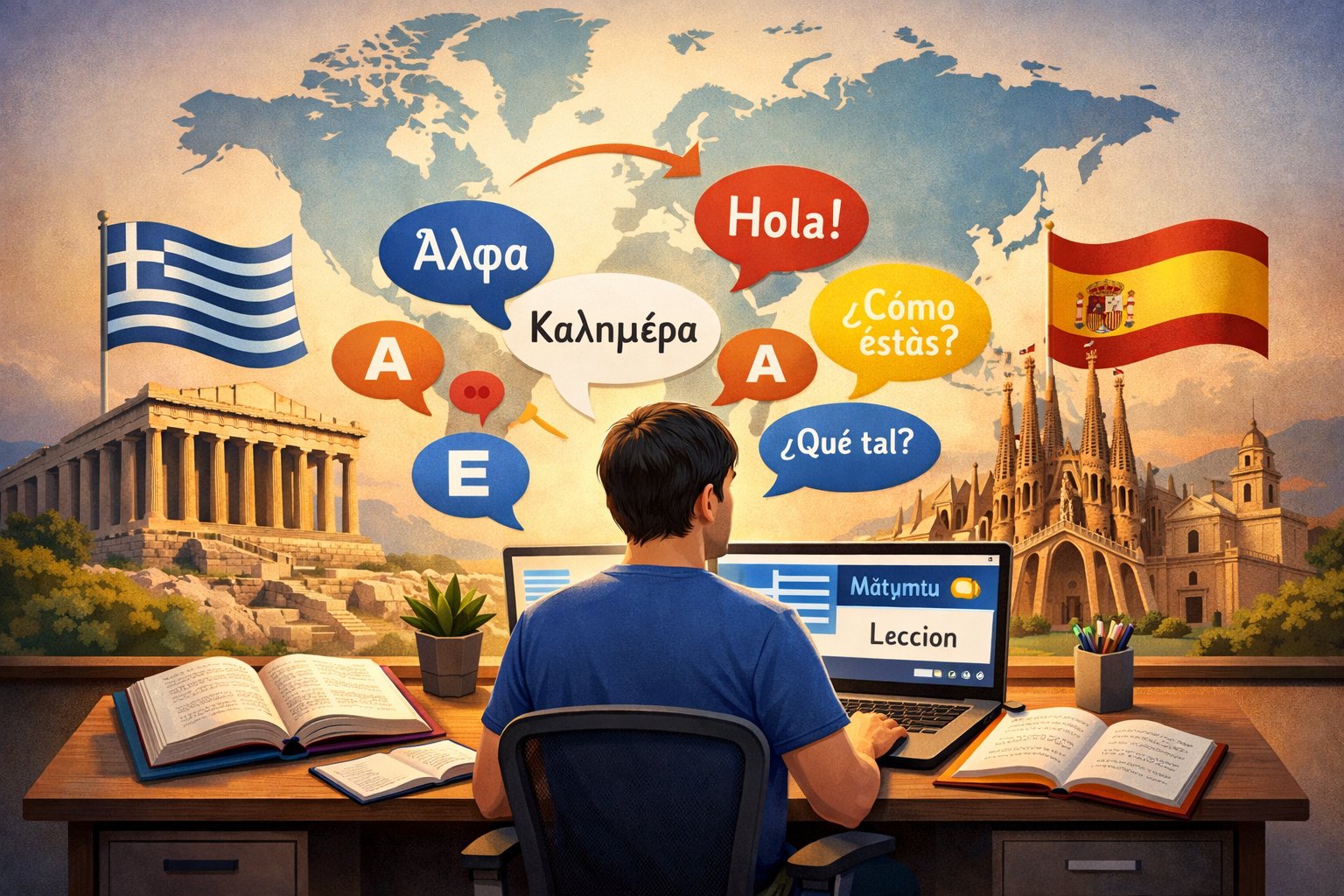
Key Differences and Similarities Between Greek and Spanish
Both Greek and Spanish have some familiar sounds, but their alphabets and grammar are pretty different. Still, if you’re used to Greek, you’ll find some pronunciation habits and verb logic carry over.
Alphabets and Pronunciation Challenges
Writing System Differences
| Feature | Greek | Spanish |
|---|---|---|
| Alphabet | 24-letter Greek alphabet (Α, Β, Γ, Δ…) | 27-letter Latin alphabet (A-Z plus Ñ) |
| Script origin | Hellenic | Latin/Roman |
| Reading curve | Steep for outsiders | Easy for English speakers |
Greek speakers must pick up a new alphabet for Spanish. Spanish uses Latin letters, while Greek sticks to its own set (Ω, Φ, Θ, etc.).
Shared Vowel Sounds
Both languages use /a/, /e/, /i/, /o/, /u/. Spanish pronunciation is actually easier for Greek speakers than for most Europeans.
Consonant Patterns
- Both have rolled R’s.
- K and G are pronounced the hard way in both.
- No gnarly Germanic clusters.
- Syllable rhythm and timing feel pretty similar.
If you’re used to Greek, Spanish pronunciation feels natural.
Overview of Grammar Systems
Sentence Structure Comparison
| Element | Greek | Spanish |
|---|---|---|
| Word order | SVO (flexible) | SVO (somewhat flexible) |
| Case system | Four cases | None |
| Articles | Three genders, with cases | Two genders, no cases |
| Verb complexity | High (aspects, moods, tenses) | High (moods, tenses, persons) |
Both use SVO order, but Greek marks cases on words, while Spanish relies on position and prepositions.
Verb Conjugation Patterns
- Greek: λέω, λες, λέει (I say, you say, he/she says)
- Spanish: hablo, hablas, habla (I speak, you speak, he/she speaks)
Spanish verbs change for:
- Person (yo, tú, él/ella, etc.)
- Tense (present, past, imperfect, future, conditional)
- Mood (indicative, subjunctive, imperative)
Gender Agreement
Both require adjectives to match noun gender and number. Greek speakers already get this.
Cognates and Shared Vocabulary
Direct Greek Loanwords in Spanish
| Greek Origin | Spanish Word | English Meaning |
|---|---|---|
| φιλοσοφία | filosofía | philosophy |
| τηλέφωνο | teléfono | telephone |
| θέατρο | teatro | theater |
| μουσική | música | music |
| γεωγραφία | geografía | geography |
Spanish borrows heavily from Greek, especially for academic/scientific vocab.
Recognition Advantages
Greek speakers quickly spot Spanish words in:
- Science
- Medicine
- Academia
- Technical fields
- The arts
False Friends
| Spanish Word | Greek/English Meaning | Actual Spanish Meaning |
|---|---|---|
| actual | real/true | current/present |
| éxito | exit | success |
Transferrable Language Learning Skills
Phonetic Reading Skills
- Each letter = one sound (mostly)
- Syllables build predictably
- Stress marks help with emphasis
- No silent letters (in Greek)
Spanish is also phonetic, so Greek speakers adapt fast.
Verb Conjugation Logic
| Skill | Greek | Spanish |
|---|---|---|
| Regular verb patterns | Yes | Yes |
| Irregular verbs | Yes | Yes |
| Person/number agreement | Yes | Yes |
| Multiple tenses/moods | Yes | Yes |
Grammatical Gender Memory
- Pair nouns with articles (el/la/lo)
- Match adjectives
- Keep agreement consistent
- Build gender intuition by exposure
Stress and Intonation Patterns
- Predictable stress
- Rising pitch for questions
- Emphasis through pitch
- Syllable timing
Spanish and Greek both use these features, so Greek speakers sound more natural in Spanish.
Building Core Spanish Skills as a Greek Speaker
Greek speakers should focus on: the Latin alphabet, high-frequency Spanish words that aren’t Greek-based, and the two-gender noun system.
Mastering the Spanish Alphabet and Sounds
Spanish Alphabet (27 letters): Key Points
| Letter | Sound | Greek Speaker Note |
|---|---|---|
| a | "ah" | Like Greek α |
| e | "eh" | Like Greek ε |
| i | "ee" | Like Greek ι |
| o | "oh" | Like Greek ο |
| u | "oo" | Like Greek ου |
| ñ | "ny" | New for Greeks |
| j | "h" | New, harsh sound |
| r | rolled | Needs extra practice |
| rr | very rolled | More intense than Greek r |
Tricky sounds for Greek speakers:
- ll/y: "y" in most places, "zh" in Argentina
- h: always silent
- v: sounds like "b"
- z/c (before e,i): "th" in Spain, "s" elsewhere
Spanish is phonetic, so once you learn the letters, reading is a breeze.
Establishing a Vocabulary Base
Essential Spanish words for Greek speakers:
| Spanish | English | Notes |
|---|---|---|
| ser/estar | to be | Two verbs: permanent vs. temporary |
| tener | to have | Used for age, hunger, thirst, etc. |
| hacer | to do/make | Weather expressions too |
| ir | to go | Irregular, but super common |
| poder | can | Modal verb |
Common false friends:
- éxito = success (not "exit")
- embarazada = pregnant (not "embarrassed")
- carpeta = folder (not "carpet")
Daily vocabulary routine:
- Pick 10 new nouns (with gender)
- Add 5 present-tense verbs
- Practice 3 phrases
- Review yesterday’s words
Focus on Latin-based cognates, but watch out for meaning shifts.
Fundamental Grammar: Gender, Plurals, and Articles
Gender assignment:
| Greek | Spanish | Key Difference |
|---|---|---|
| 3 genders | 2 genders | No neuter in Spanish |
| Endings help | Endings help | More regular in Spanish |
Spanish articles:
| Type | Masculine | Feminine |
|---|---|---|
| Definite singular | el | la |
| Definite plural | los | las |
| Indefinite singular | un | una |
| Indefinite plural | unos | unas |
Plural rules:
- Vowel ending → add -s (casa → casas)
- Consonant ending → add -es (ciudad → ciudades)
- Ends in -z → change to -ces (luz → luces)
Gender patterns:
- -o endings: masculine (el libro)
- -a endings: feminine (la casa)
- Exceptions: el día, la mano, el problema
Greek speakers already match articles and adjectives by gender. Spanish has two genders; the logic is similar but more regular. Sentence structure is SVO, like Greek, but Spanish articles are used more strictly.
Optimized Study Methods Backed by Language Science
- Use spaced repetition for vocabulary and grammar drills.
- Mix short daily sessions with frequent recall.
- Listen to Spanish audio every day.
- Practice speaking with real people or language partners.
- Track milestones (words learned, hours practiced, conversations held).
Rule → Example: Rule: Review new words in spaced intervals for best retention. Example: Learn "hablar" on Monday, review it again on Wednesday and Saturday.
Rule: Practice speaking out loud, not just reading or listening. Example: Say "¿Dónde está el baño?" instead of just reading it in your head.
Spaced Repetition and Memory Techniques
Core Memory Loop
- Encoding: Review new Spanish words with Greek translation
- Retrieval: Test recall at increasing intervals (1 day → 3 days → 7 days → 14 days)
- Reinforcement: Correct mistakes and reset interval for missed items
Spaced Repetition Tools
| Tool | Function | Greek Speaker Advantage |
|---|---|---|
| Anki flashcards | Customizable intervals | Add Greek on reverse side |
| Physical cards | Manual sorting by mastery | Full control of review pace |
| Notebook system | Written recall practice | Reinforces spelling patterns |
- Review vocabulary before sleep to boost long-term memory.
- Focus on the top 1,000 Spanish words for 85% of daily conversation.
Microlearning and Daily Practice
Daily Practice Structure
- Study 10–15 new words each morning (5–10 min)
- Review yesterday’s words at lunch (3–5 min)
- Practice speaking phrases before bed (5 min)
Why Short Sessions?
| Practice Type | Retention Rate | Example |
|---|---|---|
| Daily 15-min sessions | High | 10–15 new words/day |
| 2-hr weekly blocks | Low | 50 words/week |
High-Frequency Practice Priorities
Present tense verbs: ser, estar, tener, hacer, ir
Connectors: pero, porque, aunque, cuando
Question words: qué, dónde, cuándo, cómo, por qué
Speak Spanish out loud daily. Hearing yourself triggers auditory memory - silent reading just can’t do that.
Leveraging Online Courses and Textbooks
Recommended Spanish Textbooks for Greek Speakers
| Resource Type | Best Options | Key Feature |
|---|---|---|
| Grammar reference | Practice Makes Perfect: Complete Spanish Grammar | Systematic rule explanations |
| Workbook | Easy Spanish Step-by-Step | Progressive levels |
| Reading material | Graded readers (A1–B2) | Context-based learning |
- Full-immersion Spanish courses speed up learning - no Greek, no English, just Spanish.
Study Plan Framework
- Weeks 1–4: 100 most common words + present tense
- Weeks 5–8: Past tenses + 200 more words
- Weeks 9–12: Subjunctive mood + conversational phrases
Study Method Rule → Example
Rule: Alternate digital and handwritten practice
Example: Use an app in the morning, write words by hand at night
Accelerating Fluency with Real Spanish Input and Interactive Tools
Real Spanish Input Methods
- Pronunciation drills
- Spanish speaker podcasts
- Speed reading strategies
Prioritizing Speaking Practice and Pronunciation
Pronunciation Targets for Greek Speakers
| Greek Tendency | Spanish Correction | Practice Method |
|---|---|---|
| Rolling ρ too heavily | Softer single-tap /r/ | Repeat "pero, caro, durante" lightly |
| Pronouncing β as [v] | Use [b] or [β] | Listen to "vino, beber" from Spanish audio |
| Dropping final -s | Keep consonants clear | Record "más, dos, tres" and compare |
Speaking Practice Routine
- Record 5 sentences daily with target sounds
- Compare to Spanish audio (SpanishPod101, etc.)
- Repeat, removing words, then reconstruct from memory
Rule → Example
Rule: Force retrieval by reconstructing sentences from memory
Example: Say a full phrase, remove a word, fill in the blank aloud
Listening Comprehension: Podcasts, Music, and TV
Listening Progression Table
| Weeks | Content Type | Example Source |
|---|---|---|
| 1–4 | Learner podcasts | SpanishPod101, Notes in Spanish |
| 5–8 | Slow real Spanish content | News podcasts at 0.75x speed |
| 9+ | Full-speed TV, movies, music | Spanish TV shows, films, songs |
Podcast Listening Steps
- Listen for gist
- Replay with transcripts
- Listen again without text
- Final listen at normal speed
Watching Spanish TV and Movies
| Content Type | Best For | Example Approach |
|---|---|---|
| Telenovelas | High-frequency phrases | 15 min daily, Spanish subs |
| News | Formal vocab, clear speech | Replay, note anchor phrases |
| Music | Rhythm, colloquial expressions | Read lyrics, sing along |
Rule → Example
Rule: Repetition with the same speaker builds accent familiarity
Example: Watch the same news anchor daily for a week
Reading Strategies for Fast Comprehension
Reading Speed Targets
| Level | Words/Minute |
|---|---|
| Beginner | 50–80 |
| Intermediate | 100–150 |
| Advanced | 200+ |
Graduated Reading Steps
- Graded readers (A2–B1)
- YA literature
- Newspapers, novels
Context-Based Vocabulary Acquisition
- Read chapter twice: first for story, second for unknown words
- Circle only words that block understanding or repeat 3+ times
- Guess meaning from context before using a dictionary
- Review circled words next day via spaced repetition
Cognate Examples for Greek Speakers
| Spanish Word | Greek Equivalent | Memorization Needed |
|---|---|---|
| filosofía | φιλοσοφία | None |
| matemáticas | μαθηματικά | None |
| democracia | δημοκρατία | None |
Best Digital Tools and Resources for Greek Speakers
Top Language Learning Apps and Platforms
| App | Best For | Greek Support | Key Feature |
|---|---|---|---|
| Duolingo | Daily practice | Yes | Gamified lessons |
| Babbel | Grammar focus | Limited | Structured courses |
| Busuu | Community feedback | Yes | Corrections from Spanish speakers |
| LingQ | Reading | Yes | Import custom content |
Specialized Spanish Programs
- Rocket Spanish: Audio lessons with culture
- Pimsleur: 30-min pronunciation sessions
- Rosetta Stone: Immersion, no translation
Media-Based Learning
- FluentU: Real videos, click for definitions/examples
- Easy Spanish: Street interviews, Greek/English subs, natural conversation
Effective Use of Online Tutoring and Language Exchange
| Platform | Session Length | Price Range | Scheduling |
|---|---|---|---|
| Preply | 50–60 min | $5–40/hour | Flexible |
| italki | 30–60 min | $4–30/hour | 24/7 available |
| Verbling | 30–60 min | $10–35/hour | Teacher-set |
Rule → Example
Rule: Choose tutors who speak Greek or English for grammar support
Example: Filter for "Greek-speaking" on Preply
Language Exchange Platforms
- HelloTalk: Text/voice chat with Spanish learners of Greek
- Tandem: Video calls, built-in corrections
- ConversationExchange: Schedule video or in-person meetups
Optimal Exchange Structure
- 50/50 time split: Greek ↔ Spanish
- Prepare 3–5 topics per session
- Use shared Google Docs for corrections
- Record sessions for review
Cultural Insights and Real-Life Immersion Tactics
Exploring Spanish Culture through Media and Events
| Media Type | Approach | Greek Learner Benefit |
|---|---|---|
| Films/Series | Spanish subtitles only | Connects written/spoken español |
| Music | Listen to regional artists, read lyrics | Trains ear to accents/rhythm |
| Podcasts | Beginner shows at 0.75x speed | Builds listening stamina |
| YouTube | Spanish travel vlogs | Real-life expressions/culture |
Local Cultural Engagement
- Attend Spanish film festivals (Athens, Thessaloniki, or online)
- Join Spanish conversation meetups
- Cook recipes in Spanish
- Follow Spanish-speaking social media
Rule → Example
Rule: Use authentic content for vocabulary in context
Example: Watch a Spanish movie, write down 5 new phrases
Integrating Immersion into Daily Life
15-Minute Daily Immersion Routine
- Morning: Set phone language to Spanish
- Commute: Play a Spanish podcast or music playlist
- Lunch: Read 5 min of Spanish news (El País, BBC Mundo)
- Evening: Watch 10 min of a series with Spanish subs
- Before bed: Write 2–3 sentences about your day in Spanish
Home Environment Modifications
- Label items: la puerta, el refrigerador, la ventana
- Set devices/apps to Spanish
- Join online Spanish classes with Spanish-speaking teachers
- Use Tandem/HelloTalk for 10-min daily chats
Memory Reinforcement Table
| Exposure Type | Retrieval Point | Example |
|---|---|---|
| Visual | Subtitles, labels | TV, sticky notes |
| Auditory | Podcasts, music | Commute listening |
| Written | Notes, news, journaling | 2–3 sentences nightly |
| Conversational | Exchanges, classes | 10-min chats |
Rule → Example
Rule: Multiple daily exposures compound retention
Example: Listen to a podcast, then use a new word from it in your journal
Setting Achievable Goals and Tracking Progress
Goal-Tracking Table
| Milestone | Tracking Method | Greek Advantage |
|---|---|---|
| Alphabet mastery | Weekly writing test | Leverage Greek script skills |
| Verb conjugation | Daily drills | Transfer from Greek patterns |
| Vocabulary growth | Anki/flashcard stats | Focus on cognates |
Creating Personalized Milestones
Timeline-Based Targets by Proficiency Level
| Timeline | A1 Goal | A2 Goal | B1 Goal |
|---|---|---|---|
| Month 1 | Master 300 core words + present tense -ar verbs | Hold 5-minute conversations on familiar topics | Discuss past experiences using preterite and imperfect |
| Month 3 | Navigate travel situations + ser/estar distinction | Read simplified news articles | Watch Spanish shows with Spanish subtitles |
| Month 6 | Complete basic transactions + regular verb conjugations | Write 200-word texts about daily life | Participate in 30-minute unrehearsed conversations |
Weekly Practice Breakdown
- Grammar drilling: 45 minutes (3 × 15 min)
- Vocabulary building: 30 minutes (5 min daily)
- Speaking practice: 60 minutes (2 sessions)
- Listening immersion: 90 minutes (while doing other things)
| Cognate Type | Repetitions Needed for Retention |
|---|---|
| Latin-root (cognate) | 2–3 exposures |
| Unrelated (non-cognate) | 7–10 repetitions |
Measurable Progress Indicators
- Verb tenses mastered (80%+ accuracy)
- Minutes of Spanish understood without translation
- Paragraphs written without grammar checker
- Conversations held entirely in Spanish
Overcoming Common Challenges for Greek Learners
Alphabet Transition Timeline
| Week | Focus Area | Expected Mastery |
|---|---|---|
| 1-2 | Reading fluency (all letters except ñ, ll, rr) | 90% recognition speed |
| 3-4 | Accent mark rules + stress patterns | 70% correct placement |
| 5-6 | Double consonants + h-silence | 85% pronunciation accuracy |
Common Plateau Points and Solutions
| Plateau | Solution |
|---|---|
| Articles (el/la confusion after 3 months) | Group nouns by ending patterns (-o masculine, -a feminine, exceptions listed) |
| Subjunctive mood resistance | Drill 10 trigger phrases daily (es importante que, ojalá, cuando + future) |
| Listening comprehension lag | Raise audio input to 2 hours/day with Greek-Spanish podcasts |
| Adjustment Rule | Example |
|---|---|
| Update study plan every 4–6 weeks based on conjugation transfer success | If Greek verb mapping is 60% accurate, increase focus on exceptions |
Progress Tracking Methods
- Record weekly 2-minute monologues on the same topic
- Count grammatical errors per 100 words written
- Time needed to understand 5-minute audio clips
- Log new words retained after 1 week and 1 month
| Rule | Example |
|---|---|
| Set realistic, structured Spanish goals | Reach conversational ability 40% faster (reference) |
Frequently Asked Questions
What resources are recommended for Greek speakers starting to learn Spanish?
Bilingual dictionaries and apps
- Greek-Spanish dictionaries (digital or print)
- Language exchange apps pairing Greek and Spanish speakers
- Translation tools with Greek interface
Structured learning platforms
- Online courses in Greek
- Spanish grammar books translated into Greek
- Podcasts explaining Spanish in Greek
Practice materials
- Spanish news sites with adjustable reading levels
- Greek-Spanish parallel texts
- Audio lessons with Greek explanations
| Rule | Example |
|---|---|
| Use materials that explain Spanish grammar using Greek terminology | Greek speakers learning Spanish prefer resources tailored to their background |
Can speaking Greek provide an advantage in learning Spanish?
Shared linguistic features
| Feature | Greek | Spanish | Advantage |
|---|---|---|---|
| Verb conjugation | Complex | Complex | Familiar concept |
| Gender assignment | Three genders | Two genders | Gender awareness |
| Case system | Yes (4 cases) | No | Grammatical roles understood |
| Pronunciation | Consistent | Mostly consistent | Phonetic awareness |
Cognitive benefits
- Optional subject pronouns in both languages
- Similar stress and rhythm
- Shared Latin/international vocabulary
| Rule | Example |
|---|---|
| Use Greek knowledge of verb endings for Spanish conjugations | "hablo, hablas, habla" mirrors Greek person endings |
What are the fundamental steps for a beginner learning Spanish from Greek?
Phase 1: Foundation (Weeks 1–4)
- Learn Spanish alphabet and pronunciation
- Master basic greetings and introductions
- Study present tense of ser, estar, tener
- Build 200–300 core vocabulary
Phase 2: Structure (Months 2–3)
- Practice regular present tense verb conjugations
- Learn noun gender patterns and agreement
- Study basic sentence structures
- Add questions and negation
Phase 3: Expansion (Months 4–6)
- Introduce past tenses: preterite, imperfect
- Practice conversations with Spanish speakers
- Read simple texts, children’s books
- Write short paragraphs daily
| Rule | Example |
|---|---|
| Practice speaking from day one - don’t wait for perfect grammar | Say "Me llamo Giorgos" early, even if unsure about articles |
Are there online courses specifically designed for Greek speakers to learn Spanish?
Available platforms
| Platform | Greek Interface | Greek Instructions | Bilingual Support |
|---|---|---|---|
| Duolingo | Yes | Partial | Basic |
| Babbel | Limited | No | No |
| Preply | Yes (teachers) | Yes (tutors) | Full |
| italki | Yes | Yes | Full |
| Rule | Example |
|---|---|
| Use AI-powered tools for Greek-Spanish learning | Talkpal.ai |
Alternative approaches
- Hire Greek-speaking Spanish tutors (italki, Preply)
- Use Spanish courses with Greek subtitles
- Join Greek-Spanish online exchange groups
- Follow Greek polyglots teaching Spanish
| Rule | Example |
|---|---|
| Use English-based Spanish courses if intermediate English is available | Take Duolingo Spanish for English speakers |
What are the common challenges Greek speakers face when learning Spanish?
Pronunciation difficulties
| Spanish Sound | Greek Challenge | Practice Method |
|---|---|---|
| /r/ (single tap) | Not like Greek rho | Tongue between teeth, quick tap |
| /rr/ (trill) | Stronger than Greek | Sustained vibration |
| /j/ (jota) | Harsher than Greek chi | Throat-based friction |
| /b/ and /v/ | Both become /v/ in Greek | Lips together for /b/ |
Grammar confusion points
- Ser vs. estar (Greek: one verb for "to be")
- Subjunctive mood (exists but used differently)
- Por vs. para
- Preterite vs. imperfect
False friends
| Spanish Word | Greek Mistake | Actual Meaning |
|---|---|---|
| carpeta | carpet | folder |
| éxito | exit | success |
| constipado | constipated | having a cold |
| Rule | Example |
|---|---|
| Practice minimal pairs to distinguish /b/ and /v/ | "vaca" vs. "baca" |
Greek speakers often transfer the /v/ sound to Spanish /b/, so focus on listening and speaking drills to reduce this accent.