Best Way to Learn Spanish from Farsi: Breakthrough Methods for Adult Mastery
Common mistakes: translating word-for-word from Farsi and skipping verb conjugation practice
Posted by
 Stewart Kaplan
Related reading
Best Way to Learn Spanish from Albanian: Microlearning That Clicks
Start speaking right away - don’t wait to “master grammar” before building natural sentences
Best Way to Learn Spanish from Arabic: How Microlearning Accelerates Real Fluency
Sticking to short, regular sessions beats cramming: two 20-minute focused practices a week with retrieval drills get you farther than a weekend of scrolling or binge-studying.
Best Way to Learn Spanish from Bengali: Fast-Track Scientific Methods
Top tools for Bengali speakers: apps with Bengali menus, tutors who get Indo-Aryan languages, and spaced repetition that drills gendered nouns.
TL;DR
- Farsi speakers have to handle a new alphabet (Latin), rolled R’s, and gendered nouns in Spanish
- Mixing structured grammar study with regular speaking (2 hours/week) works better than cramming
- Language exchanges connect Farsi and Spanish speakers; apps help with pronunciation
- Watching Spanish media (movies, podcasts, songs) boosts listening and exposes you to real speech
- Common mistakes: translating word-for-word from Farsi and skipping verb conjugation practice
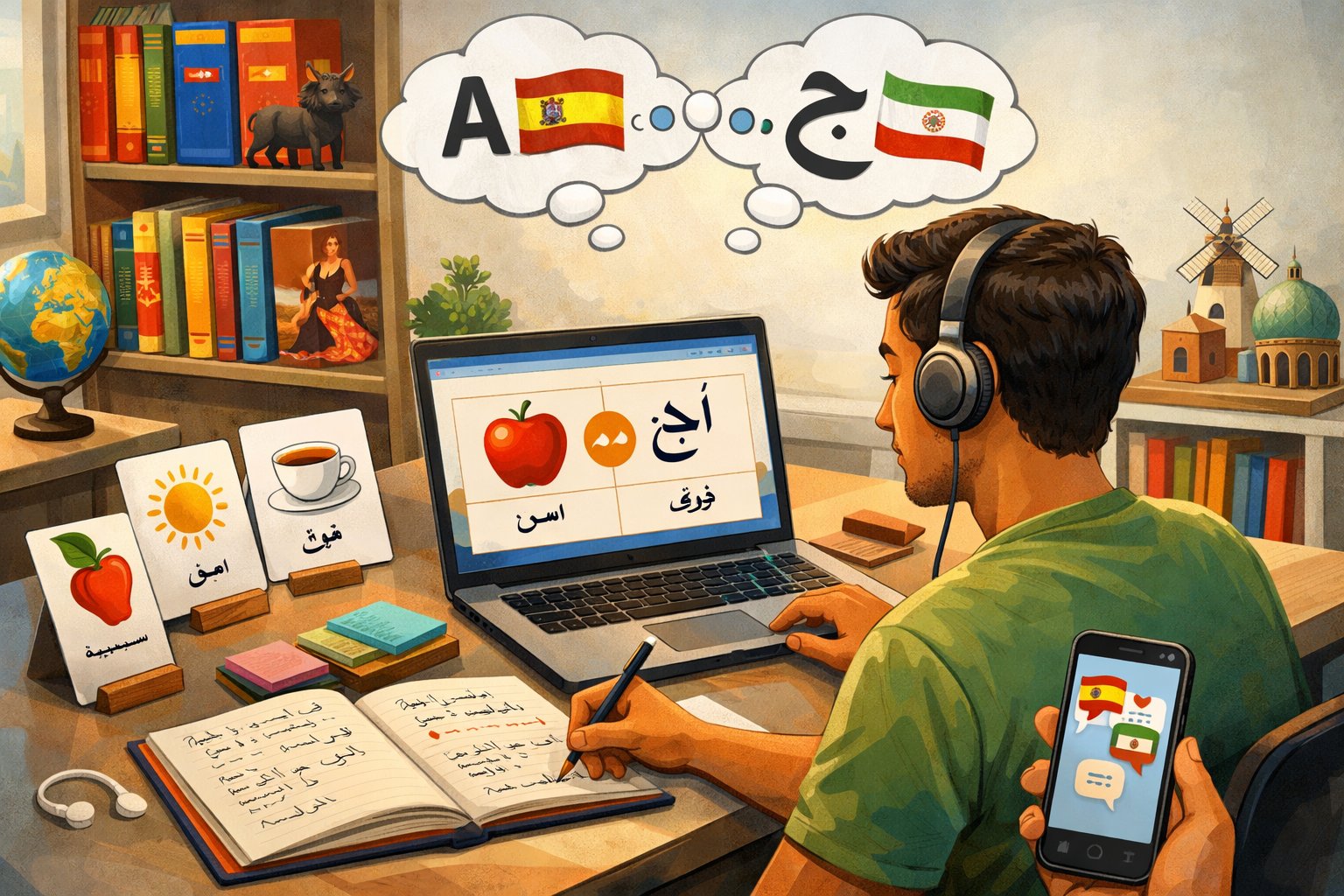
Understanding Key Differences Between Farsi and Spanish
Farsi uses a version of Arabic script, right-to-left. Spanish? Latin alphabet, left-to-right. Pronunciation, verbs, and sentence building are all different.
Alphabet and Script Challenges
| Feature | Farsi | Spanish |
|---|---|---|
| Script System | Persian-Arabic (RTL) | Latin (LTR) |
| Number of Letters | 32 | 27 |
| Vowel Representation | Short vowels often omitted | All vowels written |
| Special Characters | پ، چ، ژ، گ | ñ, ll, rr |
Key Script Differences:
- Farsi connects letters; Spanish letters are separate
- No capitals in Farsi; Spanish uses them for names and sentence starts
- Spanish has accent marks (á, é, í, ó, ú)
- Farsi letters change shape depending on where they are in the word
Reading Direction Impact:
- Farsi speakers have to flip their reading habits
- Numbers in Farsi are left-to-right, even though the text is right-to-left
- Spanish uses punctuation like English
- Spanish puts ¿ and ¡ at the start of questions and exclamations
Pronunciation and Accents
| Sound Type | Farsi | Spanish | Learning Challenge |
|---|---|---|---|
| Vowels | 6 sounds | 5 sounds | Spanish is simpler |
| Trilled R | Not present | Needed (perro) | New motor skill |
| Guttural | غ، خ، ح | Not present | Not transferable |
| J Sound | ژ (soft) | j (hard, jamón) | New articulation |
Spanish Pronunciation Patterns:
- Each vowel is always pronounced the same way
- Double r (rr) means tongue trill
- B and v sound the same in most places
- D gets softer between vowels (nada sounds like "natha")
- Z and c (before e/i): "th" in Spain, "s" in Latin America
Spanish accents by region:
- Castilian: s vs th sounds
- Latin American: all s sounds
- Caribbean: often drops final s
- Argentina: ll and y sound more like "sh"
Farsi Transfer Challenges:
- No rolled r in Farsi
- Farsi p/b isn’t the same as Spanish
- Spanish h is always silent
- Stress patterns are totally different
Grammar and Sentence Structure
| Element | Farsi | Spanish |
|---|---|---|
| Basic Order | S-O-V | S-V-O |
| Adj. Placement | After noun | Usually after noun |
| Questions | Add آیا or intonation | Invert verb/subject or intonation |
| Negation | Before verb | Before verb |
Spanish Verb Conjugation:
- Verbs change endings for who/when
- Three regular patterns: -ar, -er, -ir
- Six forms per tense (yo, tú, él/ella, nosotros, vosotros, ellos/ellas)
- Even just present tense: 18 endings, plus irregulars
Verb Conjugation Example (hablar):
- yo hablo
- tú hablas
- él/ella habla
- nosotros hablamos
- vosotros habláis
- ellos/ellas hablan
Spanish grammar complexity:
- All nouns have gender (masculine/feminine)
- Articles match gender and number (el, la, los, las)
- Two verbs for "to be" (ser/estar)
- Subjunctive mood for doubt/wishes
- Object pronouns come before verbs
Farsi vs Spanish:
- Farsi has no gendered nouns; Spanish does
- Farsi uses ezāfe for possession; Spanish uses "de"
- Farsi plurals use -hā; Spanish uses -s/-es
- Spanish matches verb and subject in number/person
- Both have formal/informal, but they work differently
Principles of Efficient Language Acquisition From Farsi
Cognitive Science and Adult Learning
Key Advantages for Farsi Speakers:
- Metalinguistic awareness: Adults analyze grammar patterns
- Cross-linguistic transfer: Farsi’s verb complexity helps with Spanish verbs
- Explicit memory: Adults link Farsi and Spanish consciously
- Pattern recognition: Mature learners spot rules fast
Memory Formation Loop:
- Encoding: Link new Spanish to Farsi knowledge
- Retrieval: Practice recall to strengthen memory
- Reinforcement: Repeat at intervals to lock it in
| Farsi Feature | Spanish Equivalent | Advantage |
|---|---|---|
| SOV word order | SVO, but flexible | Easier to adapt |
| Ezāfe construction | de + noun phrases | Similar possession concept |
| Formal/informal | tú/usted | Politeness mapping |
Rule → Example
- Rule: Connect new Spanish words to familiar Farsi concepts for better retention.
- Example: Link "amigo" (friend) to the Farsi word "دوست".
Microlearning and Spaced Repetition
Optimal Review Schedule:
| Day | Action | Retention Boost |
|---|---|---|
| Day 1 | Learn new phrase | – |
| Day 3 | First review | +50% |
| Day 7 | Second review | +70% |
| Day 14 | Third review | +85% |
| Day 30 | Final review | +90% |
Daily Microlearning:
- Study 5–10 new phrases (5–7 min)
- Review yesterday’s material with audio (3–4 min)
- Practice week-old phrases in writing (2–3 min)
- Recall month-old vocab (2 min)
| Method | Daily Time | Retention | Fluency Timeline |
|---|---|---|---|
| Microlearning + spacing | 15 min | 85–90% | 6–9 months |
| Traditional study blocks | 60 min | 60–70% | 12–18 months |
| Immersion only | Varies | 75–80% | 3–6 months |
| Apps, no spacing | 30 min | 40–50% | 18–24 months |
Rule → Example
- Rule: Break study time into short, daily sessions for higher retention.
- Example: Study Spanish 5 minutes, 3–4 times a day.
Why Immersive Practice Outperforms Memorization
Communication-First Benefits:
- Words move from recognition to automatic use
- Grammar feels natural through repetition
- Pronunciation improves with practice
- Listening skills grow in real conversations
| Stage | Farsi Speaker Example | Spanish Recall Speed |
|---|---|---|
| Intellectual | Knows "necesitar" means need | 3–5 sec delay |
| Practiced | Used in 10 conversations | 1–2 sec recall |
| Second nature | Used in 50+ conversations | Instant |
Skills Built Through Conversation:
- Speaking speed
- Active vocabulary
- Grammar on autopilot
- Confidence
- Listening to fast speech
| Method | Input | Output | Retention/Progress |
|---|---|---|---|
| Memorization only | 100% | 0% | Low retention |
| Spanish immersion | 40% | 60% | High skill transfer |
| Textbook study | 80% | 20% | Slow progress |
Mastering Spanish Basics for Farsi Speakers
- Farsi speakers need to learn a new alphabet, gendered nouns, and different verb conjugations.
- Focus first on Spanish pronunciation, high-frequency words, and present tense verbs.
Spanish Alphabet and Sound System
Spanish uses 27 letters, each with its own sound. The rules are pretty regular, so Farsi speakers can pick them up fast.
Key pronunciation differences for Farsi speakers:
| Spanish Sound | Letter(s) | Persian Equivalent | Example |
|---|---|---|---|
| /r/ (trilled) | r, rr | Not in Farsi | perro (dog) |
| /ɲ/ | ñ | Like نی | niño (boy) |
| /x/ | j | Like خ | hijo (son) |
| /θ/ (Spain) | c, z | Not in Farsi | cinco (five) |
Vowel system (simpler than Farsi):
- a = /a/ as in casa (house)
- e = /e/ as in peso (weight)
- i = /i/ as in niño (boy)
- o = /o/ as in gato (cat)
- u = /u/ as in mundo (world)
Rule → Example:
Spanish vowels stay the same, stressed or not.
Example: peso (weight), mundo (world)
Stress patterns:
| Ending | Stress Placement | Example |
|---|---|---|
| vowel, -n, -s | Second-to-last syllable | hablan |
| consonant (not n, s) | Last syllable | hablar |
| Accent mark present | Marked syllable | está, música |
Rule → Example:
Accent marks beat default stress rules.
Example: música (music), está (is)
To roll the /r/, vibrate your tongue against the roof of your mouth. Try saying pero (but) and perro (dog) and listen for the difference.
Building Core Vocabulary and Phrases
Start with the 500 most common Spanish words - they cover most daily conversations.
Essential greetings and responses:
| Spanish | English | Formality |
|---|---|---|
| Hola | Hello | Neutral |
| Buenos días | Good morning | Formal/Neutral |
| ¿Cómo estás? | How are you? | Informal (tú) |
| ¿Cómo está? | How are you? | Formal (usted) |
| Bien, gracias | Fine, thanks | Universal |
| Adiós | Goodbye | Neutral |
High-frequency verbs in present tense:
| Infinitive | Yo | Tú | Él/Ella |
|---|---|---|---|
| ser | soy | eres | es |
| estar | estoy | estás | está |
| tener | tengo | tienes | tiene |
| hacer | hago | haces | hace |
| ir | voy | vas | va |
Cognates for Farsi speakers:
- hospital (hospital) = هسپیتال
- universidad (university) = دانشگاه (concept)
- familia (family) = فامیل
- música (music) = موزیک
Basic question words:
| Spanish | English |
|---|---|
| ¿Qué? | What? |
| ¿Dónde? | Where? |
| ¿Cuándo? | When? |
| ¿Por qué? | Why? |
| ¿Quién? | Who? |
- Group vocabulary by topic: food, travel, work.
- Prioritize high-frequency words for faster progress.
See this guide for more on why frequency matters.
Essential Grammar for Communication
Spanish grammar uses gender and verb conjugation, which Persian doesn’t.
Gender system (every noun has gender):
| Masculine | Feminine | Rule |
|---|---|---|
| el libro | la mesa | -o = masculine, -a = feminine (usually) |
| el día | la mano | Exceptions: memorize with article |
| un gato | una gata | Articles/adjectives match gender |
Rule → Example:
Always learn nouns with their article.
Example: el problema (the problem), la mano (the hand)
Present tense regular verb patterns:
| Type | Infinitive | Yo | Tú | Él/Ella | Nosotros | Ellos |
|---|---|---|---|---|---|---|
| -ar | hablar | hablo | hablas | habla | hablamos | hablan |
| -er | comer | como | comes | come | comemos | comen |
| -ir | vivir | vivo | vives | vive | vivimos | viven |
Subject pronouns (often dropped):
| Pronoun | Example Phrase |
|---|---|
| Yo | (Yo) hablo español |
| Tú | (Tú) hablas español |
| Usted | (Usted) habla español |
| Él/Ella | (Él/Ella) habla español |
Rule → Example:
Subject pronouns are optional unless you need emphasis.
Example: Hablo español (I speak Spanish)
Basic sentence structure:
| Structure | Example |
|---|---|
| Subject + Verb + Object | Yo como pan |
| Adjective after noun | Casa grande |
| Question (verb before subject) | ¿Hablas español? |
Ser vs. estar (both mean "to be"):
| Use SER for | Example | Use ESTAR for | Example |
|---|---|---|---|
| Identity | Soy profesor | Location | Estoy en casa |
| Origin | Es de Irán | Condition | Está cansado |
| Time | Son las tres | Ongoing action | Está comiendo |
Practice ser/estar differences with focused grammar drills.
Try these exercises.
Leveraging Technology and Modern Tools
Apps with speech recognition and spaced repetition help Farsi speakers grow their Spanish vocabulary. Online tutoring platforms connect you with Spanish-speaking tutors for real-time practice.
Top Language Learning Apps for Spanish
| App | Farsi Interface | Key Feature for Farsi Speakers |
|---|---|---|
| Duolingo | Yes | Gamified lessons, Persian translation |
| Babbel | Limited | Structured grammar courses |
| Memrise | Yes | Spanish speaker video clips |
| Rosetta Stone | No | Immersive, no translation |
Recommended App Combinations
- Duolingo: daily vocabulary (15-20 min)
- HelloTalk: text exchange with locals
- LingQ: read Spanish with instant translation
| App Feature | Benefit for Farsi Speakers |
|---|---|
| Spaced repetition | 50% higher retention vs. old methods |
| Review intervals | 1, 3, 7, then 14 days |
Audio-First Practice
- FluentU: Spanish videos with interactive subtitles and Farsi translation on tap.
Online Tutoring and Personalized Classes
| Platform | Farsi-Speaking Tutors | Price Range | Session Length |
|---|---|---|---|
| Preply | Yes | $5-40/hour | 50-60 minutes |
| iTalki | Yes | $4-30/hour | 30-60 minutes |
| Verbling | Limited | $10-45/hour | 30-60 minutes |
What to Request from Tutors
- Drills for sounds missing in Farsi (ñ, j, rr)
- Spanish vs. Farsi sentence structure comparison
- Practice switching from SOV (Farsi) to SVO (Spanish)
- Focused verb conjugation practice
| Platform | Farsi-Speaking Tutors | Scheduling |
|---|---|---|
| Preply | Yes | Flexible |
| iTalki | Yes | Flexible |
Adaptive Platforms and Feedback Systems
Immediate Correction Features
| Feature | Function |
|---|---|
| Speech recognition | Checks pronunciation vs. model recordings |
| Grammar checker | Flags verb errors instantly |
| Writing correction | Real-time agreement feedback |
Progress Tracking Metrics
| Metric | What It Measures | Weekly Target |
|---|---|---|
| Streak days | Consistency | 6-7 days |
| Words mastered | Vocabulary size | 50-75 new words |
| Speaking minutes | Production practice | 90-120 minutes |
| Accuracy rate | Error frequency | 75-85% |
Rule → Example:
Miss gender agreement 3 times? The app gives you more noun drills.
Spaced Repetition Algorithms
| Step | Description |
|---|---|
| 1 | Show new Spanish word with Farsi translation |
| 2 | Review after 10 minutes |
| 3 | Next review based on recall speed |
| 4 | Hard words repeat more until mastered |
| LingQ Vocabulary Stage | Requirement to Advance |
|---|---|
| New → Known | 7-9 correct recalls |
Active Practice: Speaking and Listening Strategies
Speaking practice means talking with real people. Listening skills grow with exposure to natural speed and real Spanish pronunciation - very different from Farsi.
Language Exchange with Spanish Speakers
| Platform Type | Best For | Time Commitment |
|---|---|---|
| Tandem/HelloTalk apps | Daily casual practice | 15-30 min/day |
| Conversation Exchange | Scheduled calls | 1-2 hrs/week |
| Local meetup groups | Face-to-face | Weekly sessions |
Effective Exchange Structure
- Split time: 30 min Spanish, 30 min Farsi
- Prepare 3-5 topics per session
- Ask for correction only on major mistakes
- Record sessions for review
Common Challenges for Farsi Speakers
| Challenge | Example |
|---|---|
| Rolled "r" | perro vs. pero |
| Gender agreement | el libro, la mesa |
| Verb conjugation complexity | hablo, hablas |
Language exchange partners catch errors Farsi speakers often miss, especially with vowels not in Persian.
Using Spanish Tutors for Real-Time Feedback
Tutor Session Priorities
| Focus Area | Example Drill |
|---|---|
| Pronunciation | b/v, j, rr distinction |
| Grammar | Fix ser/estar mix-ups |
| Conversation practice | Respond without translating |
| Listening | Hear different Spanish accents |
| Learning Goal | Recommended Frequency | Session Length |
|---|---|---|
| Basic conversation | 2x/week | 30 minutes |
| Intermediate fluency | 3x/week | 45 minutes |
| Advanced practice | 2x/week | 60 minutes |
Tutors spot fossilized errors caused by Persian grammar transfer. Speaking Spanish well needs regular correction.
Effective Conversation Practice Methods
Progressive Practice Sequence
| Weeks | Practice Focus |
|---|---|
| 1-2 | Simple Q&A (¿Cómo estás? ¿De dónde eres?) |
| 3-4 | Daily routines, present tense |
| 5-6 | Past tense stories |
| 7-8 | Opinions, debate |
Daily Speaking Drills
- Narrate your day in Spanish for 5 minutes
- Shadow Spanish audio, mimic rhythm
- Record yourself, compare to Spanish speakers
- Practice conversation starters until fluent
Listening Practice Framework
| Material Type | Speed | Daily Time |
|---|---|---|
| Podcast for learners | 0.75x | 10 minutes |
| TV shows (with subtitles) | Normal | 20 minutes |
| YouTube interviews | Normal | 15 minutes |
Rule → Example:
Start with slower audio.
Example: Podcast at 0.75x speed for first two weeks.
Tips for improving Spanish listening: increase speed as you get comfortable.
Immersing in Spanish Language and Culture
| Method | Benefit |
|---|---|
| Watch Spanish TV/movies | Trains listening and cultural understanding |
| Listen to Spanish music | Builds vocabulary in real-world context |
| Follow Spanish creators | Exposes you to slang and regional phrases |
Watching Spanish Movies with Subtitles
Subtitle progression for Farsi speakers:
| Stage | Audio | Subtitles | Purpose |
|---|---|---|---|
| 1 | Spanish | Farsi/English | Connect sounds to meaning |
| 2 | Spanish | Spanish | Link spoken words to text |
| 3 | Spanish | None | Check real comprehension |
- Watch the same movie several times, moving through the stages above.
- Don’t jump to new content too soon - repetition helps.
Top Spanish movies for language learners:
Children’s movies (Coco, Encanto): simple words, clear speech
Telenovelas: lots of repeated phrases
Regional films: hear different accents
Rewatch English movies dubbed in Spanish. You already know the plot, so you can focus on the language.
Listening to Music and Podcasts
Audio input by level:
Beginner: Coffee Break Spanish, kids’ songs
Intermediate: Spanish pop with lyrics, news podcasts (slow speed)
Advanced: Interview podcasts, audiobooks, talk radio
Read lyrics while listening to Spanish music to learn words faster.
Daily listening routine:
| Step | Action |
|---|---|
| 1 | Play Spanish audio during daily activities |
| 2 | Repeat 2-3 minute segments until you get ~80% |
| 3 | Write down new phrases, look up meanings |
| 4 | Listen again - no pausing |
- Pick Spanish podcasts on topics you already know in Farsi. It makes understanding easier.
Exploring Spanish Culture through Media
Media types for cultural context:
| Format | Cultural Value | Language Benefit |
|---|---|---|
| Cooking shows | Food words, commands | Recipe language |
| Sports commentary | Regional slang, fast talk | Reaction phrases |
| YouTube vlogs | Everyday life | Filler words, casual speech |
| News broadcasts | Formal style | Past tense, narration |
Cultural knowledge to learn:
Formal vs. informal (usted vs. tú)
Regional vocabulary (Spain vs. Latin America)
Gestures and non-verbal cues
Meal times, social habits
Change device settings to Spanish.
Follow Spanish social media accounts.
Join Spanish forums about your hobbies.
Overcoming Common Challenges for Persian Speakers
Persian speakers run into issues like gendered nouns, tricky pronunciation, and keeping up practice across writing systems.
Adapting to Gendered Nouns and Articles
Spanish nouns have gender - masculine or feminine. Articles and adjectives match the noun’s gender.
Gender patterns:
| Ending | Gender | Example |
|---|---|---|
| -o | Masculine | el libro |
| -a | Feminine | la casa |
| -ción | Feminine | la canción |
| -dad | Feminine | la ciudad |
| -ma | Masculine | el problema |
Common exceptions:
- el día (masculine, ends in -a)
- la mano (feminine, ends in -o)
- el agua (feminine, uses el for sound)
Retention tips:
- Always learn nouns with their article (el/la)
- Say noun-adjective pairs aloud: el gato negro, la casa blanca
- Use color codes: blue for masculine, red for feminine
Rule → Example:
- Rule: Learn noun + article as a unit.
- Example: "la mesa" not just "mesa"
Managing Pronunciation Pitfalls
Persian learners of Spanish struggle with certain sounds.
Sounds to practice:
| Spanish Sound | Persian Speakers’ Issue | Example |
|---|---|---|
| r (tap) | Needs new tongue movement | pero |
| rr (trill) | Not in Persian | perro |
| v | Mixed up with b | vino |
| ñ | New sound | mañana |
| j | Not like Persian ژ | jardín |
Syllable timing:
- Spanish: every syllable equal (ca-sa, co-mi-da)
- Persian: stress is heavier
- Practice with a metronome
Daily drill:
| Step | Task |
|---|---|
| 1 | Listen to minimal pairs (pero/perro) |
| 2 | Record your own voice |
| 3 | Compare to Spanish audio |
| 4 | Repeat problem sounds 10x, exaggerate |
| 5 | Use new sounds in sentences |
Motivation and Consistency
Short, daily practice is better than long, rare sessions. New writing systems and grammar need steady exposure.
Practice schedule:
| Time | How Often | Focus |
|---|---|---|
| 15 min | Daily | Verb drills |
| 10 min | Daily | Vocab with audio |
| 20 min | 3x week | Conversation |
| 30 min | 2x week | Grammar exercises |
Short-term goals:
- 10 new words daily (with articles)
- Master one verb tense per week
- Hold a 5-minute conversation using learned words
- Write 5 sentences a day without translating
Accountability:
- Schedule language exchanges
- Track daily streaks in apps
- Record yourself weekly for pronunciation
- Test comprehension monthly with Spanish media
Rule → Example:
- Rule: Review new material within 24 hours for better memory.
- Example: Listen to yesterday’s vocabulary list again today.
Frequently Asked Questions
What are effective methods for Farsi speakers to learn Spanish?
Skill area methods:
| Skill | Method | Frequency |
|---|---|---|
| Alphabet | Latin script drills, Persian cognates | Daily, 10-15 min |
| Pronunciation | Rolled "r", vowel contrasts | 3-4x/week |
| Grammar | Verb tables, Persian comparisons | Daily |
| Listening | Podcasts + transcripts | 20-30 min/day |
Learning order:
- Master Latin alphabet with familiar words
- Present tense verbs first, then past
- Use color-coded lists for gender
- Learn words by theme
Grammar focus:
- Gendered nouns
- Verb conjugations
- Definite/indefinite articles
- Subject pronoun placement
Which online platforms are recommended for learning Spanish if you speak Farsi?
| Platform | Focus | Persian Support | Cost |
|---|---|---|---|
| Duolingo | Vocab, grammar | Persian interface | Free w/ads |
| Babbel | Conversation | Limited | $7-13/mo |
| Coursera | Academic courses | Subtitles | Free to audit |
| Memrise | Vocab | Community content | Free tier |
Platform features:
- Duolingo: bite-sized, script transition help
- Babbel: speech recognition for pronunciation
- Coursera: structured university courses
- Memrise: spaced repetition
Selection checklist:
- Good audio quality
- Detailed grammar tips
- Progress tracking
- Mobile-friendly
How can Persian-speaking individuals practice Spanish conversation?
| Platform | Exchange Type | Features |
|---|---|---|
| Tandem | Text, voice, video | Translations, corrections |
| HelloTalk | Text, voice | Translation, pronunciation guides |
| ConversationExchange | Video, in-person | Match by goals |
Steps to start:
- Make a profile (Persian speaker, Spanish learner)
- Find Spanish speakers learning Persian/English
- Alternate 15 min in each language
- Record calls to catch errors
- Log new words after each chat
Beginner conversation topics:
Daily routine
Food and cooking
Family
Work/study
Travel
Focus on active conversation, not just listening.
What resources are available for easy learning of Spanish for Farsi speakers?
Books:
- "Practice Makes Perfect: Complete Spanish Grammar"
- "Spanish Vocabulary for Persian Speakers"
- "Easy Spanish Step-By-Step"
Digital tools:
| Type | Tools | Use |
|---|---|---|
| Translation | Google Translate, Farsi-Spanish dictionaries | Quick lookups |
| Flashcards | Anki, Quizlet | Vocab practice |
| Video | YouTube, Netflix (with subtitles) | Context, accents |
| Podcasts | Coffee Break Spanish, Radio Ambulante | Listening skills |
Content sequence:
- Watch Spanish shows with Persian subtitles
- Switch to Spanish subtitles after a few episodes
- Watch again, no subtitles
- Listen to podcasts during daily tasks
Apps for daily practice:
- Speech recognition for pronunciation
- Grammar quizzes
- Picture-based vocab builders
- Conversation simulators
What are the advantages of learning Spanish for someone fluent in Farsi?
| Area | Benefit |
|---|---|
| Business | Access to 20+ Spanish-speaking markets |
| Tourism | Serve Spanish visitors in Iran |
| Translation | Demand for Persian-Spanish translators |
| Diplomacy | Jobs in international relations |
Cognitive perks:
- Better memory from using two alphabets
- Problem-solving boost via grammar contrasts
- Slower cognitive decline with age
- Sharper Persian skills through comparison
Cultural access:
Read Spanish literature (García Márquez, Cervantes)
Watch films without subtitles
Enjoy Spanish/Latin music (flamenco, salsa)
Travel in Spain/Latin America and connect with locals
Bilingual Persian-Spanish speakers have extra job options with multinational firms.
Personal growth:
- Wider global network
- Greater cultural sensitivity
- Improved first language awareness
- More confidence with new languages