Best Way to Learn Spanish from Dutch: Science-Backed Paths to Rapid Progress
Mixing structured lessons with real conversations, language exchanges, and tools that force you to recall (not just review) speeds up fluency
Posted by
 Stewart Kaplan
Related reading
Best Way to Learn Spanish from Albanian: Microlearning That Clicks
Start speaking right away - don’t wait to “master grammar” before building natural sentences
Best Way to Learn Spanish from Arabic: How Microlearning Accelerates Real Fluency
Sticking to short, regular sessions beats cramming: two 20-minute focused practices a week with retrieval drills get you farther than a weekend of scrolling or binge-studying.
Best Way to Learn Spanish from Bengali: Fast-Track Scientific Methods
Top tools for Bengali speakers: apps with Bengali menus, tutors who get Indo-Aryan languages, and spaced repetition that drills gendered nouns.
TL;DR
- Dutch speakers get a head start with Spanish's clear pronunciation and familiar Latin words, but need to tackle gendered nouns, the subjunctive, and that tricky rolled R
- The most effective path focuses on listening and reading that you actually understand, spaced repetition for common words, and speaking early - mistakes and all
- Dutch learners should pick resources that break down Spanish grammar using familiar Germanic ideas, use European Spanish audio, and give daily Spanish speaker phrases
- Mixing structured lessons with real conversations, language exchanges, and tools that force you to recall (not just review) speeds up fluency
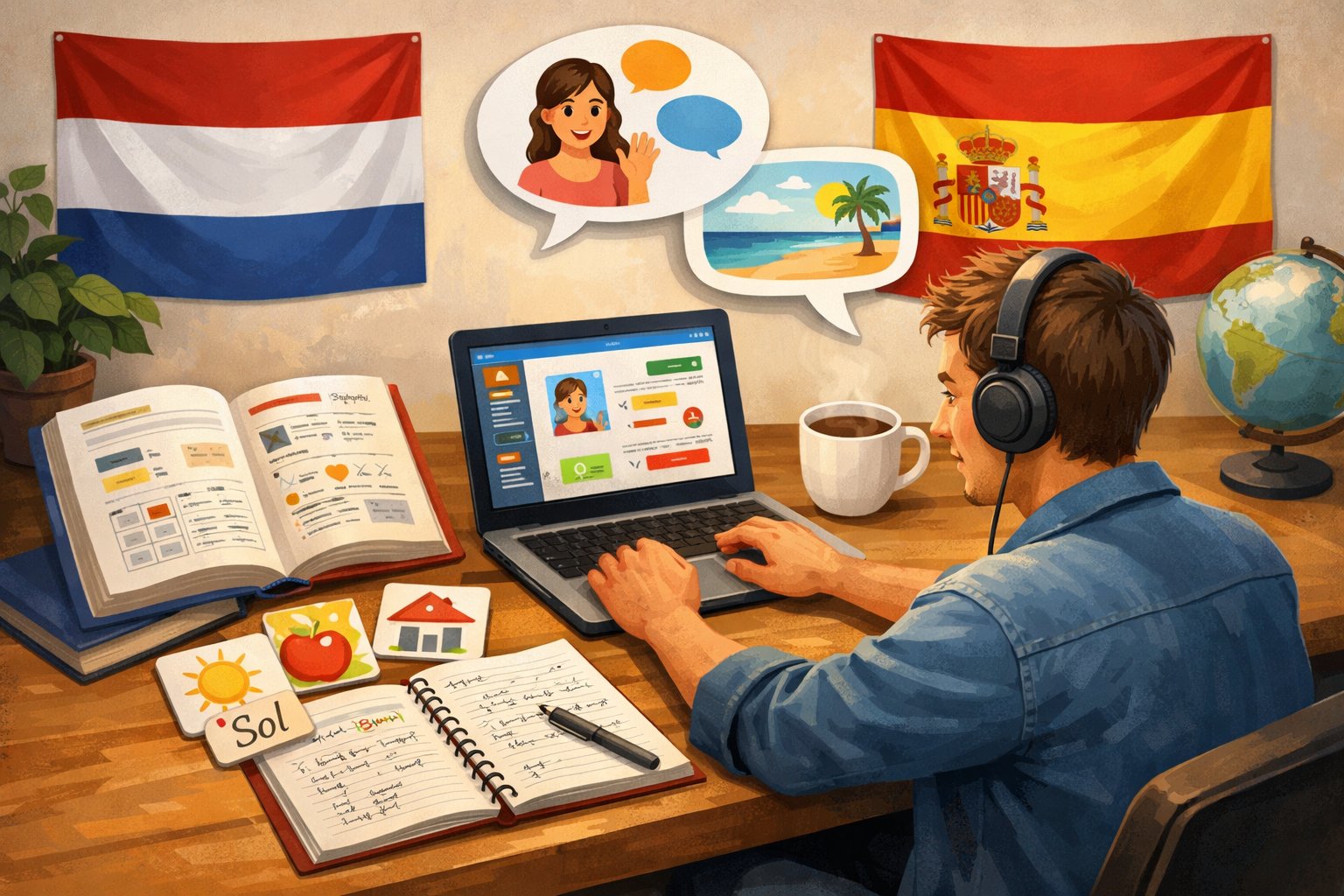
Understanding the Unique Challenges for Dutch Speakers
Dutch speakers run into specific issues with Spanish, mostly around sounds, verbs, and gender. The problems show up most in pronunciation and verb rules.
Linguistic Differences Between Dutch and Spanish
Sound System Gaps
| Dutch Feature | Spanish Feature | Learning Impact |
|---|---|---|
| Germanic stress patterns | Syllable-timed rhythm | Needs rhythm retraining |
| 16 vowels | 5 pure vowels | Dutch adds extra variations |
| Guttural 'g'/'ch' | Soft 'j'/rolled 'r' | No direct match |
| Final consonant clusters | Open syllables | Dutch keeps heavy endings |
Grammatical Structure Conflicts
- Word order: Dutch = V2 word order; Spanish = strict SVO
- Gender: Dutch has common/neuter; Spanish uses masculine/feminine and different agreements
- Verbs: Spanish has six forms per tense; Dutch uses fewer, often with auxiliaries
- Tense: Dutch present perfect doesn’t always line up with Spanish preterite/imperfect
Estimated time to conversational Spanish: 600–750 hours.
Common Obstacles in Pronunciation and Grammar
Spanish Pronunciation Pitfalls
- Rolled 'r': Not found in Dutch
- 'ñ': Missing in Dutch
- 'j': Dutch 'j' = English 'y'; Spanish 'j' is throaty
- Vowels: Dutch makes diphthongs; Spanish keeps vowels short and pure
Spanish Grammar Complications
| Grammar Point | Dutch Approach | Spanish Requirement | Difficulty |
|---|---|---|---|
| Subjunctive | Rare | Needed for doubt, desire, emotion | High |
| Ser/Estar | One verb 'zijn' | Two verbs for 'to be' | High |
| Personal 'a' | Not used | Required before people | Medium |
| Double negatives | Avoided | Required | Medium |
Gender Agreement Errors
Dutch speakers often forget to match adjectives, articles, and participles to noun gender, since Dutch articles don’t always give clear gender clues for Spanish.
Typical Mistakes Dutch Learners Make
Pronunciation Errors
- Pronouncing 'v' and 'b' as different, when Spanish makes them almost the same
- Adding schwa to the end ("gracias-uh" instead of "gracias")
- Using a flat 'a' instead of open Spanish 'a'
- Dropping final 's', copying some Dutch dialects
Grammar Transfer Mistakes
- "Yo soy caliente" (means "I am horny") instead of "Tengo calor" ("I am hot/warm")
- Confusing "Hace tres años" and "Desde hace tres años" because of Dutch tense use
- Leaving out pronouns where Spanish needs them: "Es importante que tú vengas"
- Using "muy" with verbs: "Me gusta muy" instead of "Me gusta mucho"
False Cognates That Trap Dutch Speakers
| Dutch Word | Looks Like Spanish | Means | Correct Spanish |
|---|---|---|---|
| constipatie | constipado | Having a cold | estreñimiento |
| prettig | pretencioso | Pretentious | agradable |
| red | red | Net/network | rojo |
| succes | suceso | Event | éxito |
Dutch learners also use too many definite articles with abstract nouns and miss the personal 'a', thanks to systematic interference.
Core Principles of Effective Spanish Learning
Three approaches get real results: real-world exposure, memory science, and adult-focused strategies.
Immersion Versus Traditional Study Methods
Immersion
- Daily Spanish from media, conversation, and your environment
- Learn vocab in context, not as random word lists
- Recognize patterns by hearing them over and over
- Get corrected naturally
Traditional Study
- Grammar rules first, memorized directly
- Vocab as translation pairs
- Lessons move simple → complex
- Focus on accuracy in tests
Hybrid Model → Best Results
- Conversational practice with locals beats grammar books alone
- Use what you know from Dutch, but practice Spanish every day
Effective Immersion Techniques
- Watch Spanish shows with Spanish subtitles
- Listen to Spanish podcasts at 0.8x speed to start
- Switch your phone/computer to Spanish
- Narrate your day in Spanish, even in your head
Microlearning and Spaced Repetition Systems
Spaced Repetition Timing
| Review | Memory Strength | Gap |
|---|---|---|
| 1st | Weak | 1 day |
| 2nd | Initial | 3 days |
| 3rd | Moderate | 7 days |
| 4th | Strong | 14 days |
| 5th | Long-term | 30 days |
- Spaced repetition reviews words at growing intervals. If you mess up, it comes back sooner.
- This cuts total study time by almost half compared to cramming.
Microlearning Sessions
- Length: 5–15 min
- How often: 2–4 times a day
- Scope: 3–7 new bits per session
- Style: One idea or phrase group at a time
Research backs this: short, regular practice beats long, rare sessions. Dutch learners remember verb forms better with daily bursts.
Cognitive Strategies for Adult Language Acquisition
Adult Advantages
- Can analyze patterns consciously
- Bring Dutch grammar knowledge to the table
- Know why they want to learn, so stay motivated
- Reading skills help with written Spanish
Memory Formation Steps
| Step | Description |
|---|---|
| Encoding | See/hear new Spanish phrase in context |
| Consolidation | Brain processes during sleep/rest |
| Retrieval | Recall phrase from memory |
| Reinforcement | Correct recall = stronger memory |
- Connect new Spanish words to Dutch cognates or vivid images for better retention.
- Example: "la mesa" - picture a table in your kitchen, not just a translation.
Progressive Difficulty Technique
- See full Spanish sentence
- Remove one word, recall it
- Remove two, fill them in
- Try to say the whole thing from just a prompt
Rule → Example:
Active recall beats passive review.
Example: Instead of just reading "tengo hambre," try to say it aloud when you want to express "I am hungry."
Choosing Methods and Resources Tailored to Dutch Learners
Dutch speakers do best with structured apps that explain grammar in familiar terms, audio courses for listening, and podcasts that go from easy to harder.
Top Language Learning Apps and Their Features
| App | Features for Dutch Learners | Price |
|---|---|---|
| Duolingo | Gamified, Dutch interface, daily streaks | Free/Plus |
| Babbel | Dutch-focused grammar, dialogues | Subscription |
| Busuu | Feedback from Spanish speakers, offline mode | Free/Premium |
| Memrise | Spaced repetition, real Spanish videos | Free/Pro |
| Rosetta Stone | No translation, speech recognition | One-time/subscription |
| LingQ | Import texts, vocab tracking | Free/Premium |
- Duolingo: Great for daily quick sessions. Easy to stick with, especially for beginners.
- Babbel: Explains Spanish grammar using Dutch-friendly terms. Focuses on real conversations.
- Busuu: Lets you get corrections from Spanish speakers. Good for pronunciation and grammar.
- Memrise: Uses Spanish speaker videos and spaced review for memory.
- Rosetta Stone: Immersive, no translation, strong for pronunciation.
- LingQ: Lets you read/listen to real content and tracks vocab.
Best Online Spanish Courses for Dutch Speakers
| Platform | Structure | Best For |
|---|---|---|
| StudySpanish | Free grammar, verb drills | Reference, self-study |
| FluentU Spanish | Real videos, interactive subtitles | Intermediate listening/reading |
| SpanishPod101 | Audio/video by level, transcripts | Audio learners |
- StudySpanish: Deep grammar explanations and exercises. Good for tricky topics like subjunctive.
- FluentU: Turns real Spanish videos into lessons. See phrases in real use.
- SpanishPod101: Step-by-step lessons from basics to advanced, with transcripts and vocab.
Rule → Example:
Mix structured courses and conversation for best results.
Example: Use Babbel for grammar, then practice speaking with a language partner.
Dutch speakers should not stick to just one method - combining apps, courses, and real conversation is the fastest way forward.
Effective Use of Audio Lessons and Podcasts
Audio-focused learning options:
- Pimsleur: 30-minute audio lessons using spaced recall
- Coffee Break Spanish: Podcast series, beginner to intermediate
- Spanish podcasts: Real Spanish content for listening practice
Pimsleur teaches by ear, no visual aids. Each lesson brings in 30-40 new words and circles back to old ones with recall prompts.
Coffee Break Spanish walks you through real conversations, with English explanations. Episodes start with greetings and work up to trickier grammar.
Listening routine for retention:
- Play lessons while commuting or doing chores
- Speak out loud during pause prompts
- Shadow Spanish speaker, don’t pause
- Replay tough parts at 0.75x speed
- Review the same lesson after 24 hours, then again after 7 days
Podcast progression path:
- Weeks 1-4: Coffee Break Spanish Season 1 (beginner phrases)
- Weeks 5-12: News in Slow Spanish (current events, simplified)
- Week 13+: Spanish podcasts with transcripts
Audio Exposure Tips:
- Listen to Spanish podcasts before you understand every word
- Focus on recognizing word boundaries and familiar phrases
Building Core Skills: Vocabulary, Grammar, and Pronunciation
Dutch speakers need focused ways to learn Spanish vocabulary, spot grammar patterns, and improve pronunciation - especially where Dutch and Spanish differ.
Learning Spanish Vocabulary Effectively
High-Frequency Word Priorities
| Priority | Word Type | Example Words | Usage |
|---|---|---|---|
| Week 1-2 | Core verbs | ser, estar, tener, hacer, ir | Existence, possession, movement |
| Week 3-4 | Essential nouns | agua, comida, casa, tiempo, persona | Needs, scheduling |
| Week 5-6 | Common adjectives | bueno, malo, grande, pequeño, nuevo | Descriptions |
| Week 7-8 | Transition words | pero, porque, cuando, donde, también | Sentence building |
Cognate Advantages for Dutch Speakers
- Direct matches: hotel → hotel, taxi → taxi, familie → familia
- Pattern: -tie endings become -ción (informatie → información)
- False friends: embarazada means pregnant, not embarrassed
Memory Reinforcement Methods
- Group vocabulary by gender, use color coding
- Pair Dutch cognates with Spanish, then add non-cognates
- Practice themed word clusters (restaurant, travel, work)
- Use spaced repetition: review after 1, 3, and 7 days
Rule → Example:
- Use vocabulary in context, not isolated lists → "Tengo una casa nueva" (I have a new house)
Mastering Spanish Grammar as a Dutch Speaker
Verb Conjugation Comparison
| Feature | Dutch | Spanish | Learning Focus |
|---|---|---|---|
| Present tense | 2-3 forms | 6 forms | Start with -ar, -er, -ir verbs |
| Past tense | Compound | Preterite & imperfect | Learn preterite first |
| Word order | V2 | SVO flexible | Practice standard Spanish word order |
Gender System Navigation
- Masculine: -o endings (libro, vaso, perro)
- Feminine: -a endings (casa, mesa, ventana)
- Exceptions: el agua, la mano, el día
- Always memorize article with noun: el libro
Key Grammar Differences
- Subject pronouns often dropped in Spanish (Hablo vs Ik spreek)
- Adjectives come after nouns (coche rojo vs rode auto)
- Subjunctive is used for doubt, wishes, emotions (no Dutch equivalent)
Progressive Learning Sequence
- Present tense regular verbs
- Irregular verbs (ser, estar, ir, tener)
- Past tenses with clear time markers
- Subjunctive after mastering indicative
Rule → Example:
- In Spanish, drop subject pronoun unless needed for clarity → "Hablo español" (I speak Spanish)
Pronunciation Techniques That Work
Critical Sound Differences for Dutch Speakers
| Spanish Sound | Dutch Equivalent | Articulation | Example |
|---|---|---|---|
| /r/ (single) | Softer than Dutch | Single tongue tap | pero, caro |
| /rr/ (trilled) | Absent | Multiple tongue taps | perro, carro |
| /j/ (jota) | Like 'g' in goed | Throat friction | hijo, jefe |
| /ñ/ | Like 'nj' | Tongue against palate | mañana, niño |
| /ll/ | Varies | Y or zh sound | llama, calle |
Vowel Precision Drills
- a: Open, like 'ah' in father
- e: 'e' in bet
- i: 'ee' in see
- o: 'o' in note, short
- u: 'oo' in boot
Stress Pattern Rules
| Rule | Example |
|---|---|
| Ends in vowel, n, s: stress second-to-last syllable | ca-SA, ha-BLAN |
| Ends in other consonant: stress last syllable | ha-BLAR, ciu-DAD |
| Accent marks override all | es-ta-CIÓN, MÚ-si-ca |
Daily Practice Routine
- Record 5 Spanish words, play back, compare to Spanish audio
- Practice trilled /r/ 10 times
- Read 3 sentences out loud, focus on vowels
- Shadow Spanish audio for 2-3 minutes
Rule → Example:
- Practice pronunciation daily to avoid fossilized accent → Record and compare "perro" (dog)
Developing Listening and Speaking Fluency
Dutch speakers need regular audio input and active speaking to move from reading to real conversation.
Practicing with Real Spanish Content and Materials
High-Priority Listening Sources
| Content | Frequency | Skill |
|---|---|---|
| Spanish radio | Daily 15-20 min | Fast speech recognition |
| Learner podcasts | 3-4× weekly | Controlled vocab |
| News broadcasts | Daily 10 min | Formal register |
| YouTube conversation | Daily 10-15 min | Casual speech |
Progressive Listening Steps
- Listen once without pausing (get the gist)
- Replay, pause for unknown words
- Shadow speak after each phrase
- Record yourself, match full speed
Rule → Example:
- Listen to different Spanish accents → Alternate between Spain and Latin America podcasts
Leveraging Spanish Subtitles and Authentic Media
Subtitle Progression
| Stage | Subtitle | Goal |
|---|---|---|
| Week 1-2 | Dutch | Match sounds to meaning |
| Week 3-4 | Spanish | Link spelling/pronunciation |
| Week 5+ | None | Pure listening practice |
Recommended Media Types
- Interview shows (clear speech)
- Cooking programs (visual support)
- Kids’ content (simple grammar)
- News (predictable vocab)
Rule → Example:
- Watch 20-minute segments repeatedly, not entire films → Rewatch a single news clip
Speech Recognition and Feedback Tools
Technology-Assisted Practice
| Tool | Function | Usage |
|---|---|---|
| Speech apps | Pronunciation feedback | 10 min daily |
| Language exchange | Live talk | 2-3× a week, 30 min |
| Voice recording | Self-check | After practice |
| AI bots | Low-pressure speaking | 15 min daily |
Conversational Spanish Development
- Speak in full sentences, not just words
- Use sentence frames with new vocab
- Record answers to common questions
- Drill high-frequency phrases until automatic
Rule → Example:
- Use Spanish for everyday tasks → Narrate making coffee in Spanish
Interaction and Personalization: Tutors, Partners, and Communities
Live practice boosts confidence more than solo study. Tutors correct errors in real time, partners give cultural context, and communities make Spanish part of daily life.
Working with Online Tutors and Language Partners
Tutoring Platforms
| Platform | Session Length | Price | Feature |
|---|---|---|---|
| Preply | 50-60 min | $10-40 | Trial lessons |
| italki | 30-60 min | $8-30 | Community + pro tutors |
| Verbling | 30-60 min | Sub or per lesson | Video session recording |
Tutor Selection:
- Choose Spanish speakers from target region
- Ask for Dutch/English fluency if needed
- Book 2-3 sessions per week
Language Partners
- Exchange: Dutch for Spanish, 30-minute video calls (split 15/15)
- Tandem: Matches by language/goals
- HelloTalk: Text/voice chat
- ConversationExchange: By city or online
Participating in Language Exchange Platforms
Platform Types
| Type | Format | Time | Best For |
|---|---|---|---|
| App (Tandem, HelloTalk) | Text/voice | 10-30 min daily | Flexible |
| Video (Speaky) | Live calls | 30-60 min | Speaking |
| Forums (Reddit r/language_exchange) | Written/calls | Variable | Long-term partners |
Session Structure
- Equal time splits (15/15 or 30/30)
- First half: Only Spanish, partner corrects
- Second half: Only Dutch, you correct partner
- Note 3-5 corrections per session
Common Topics
- Daily routines, weekend plans
- News from Spain/Latin America
- Hobbies, work, family
- Cultural differences
Rule → Example:
- Match with partners of similar level → A2 with A2, B1 with B1
Joining Spanish Classes and Online Communities
Online Spanish classes give you a structured way to learn, plus you get to interact with others:
| Class Type | Group Size | Schedule | Cost Range |
|---|---|---|---|
| Group tutoring (Preply Groups) | 4-6 students | Weekly, fixed time | €15-30/class |
| Virtual classroom (Lingoda) | 3-5 students | Flexible booking | €8-12/class |
| University extensions | 10-15 students | Semester-based | €200-500 total |
Online communities help you get daily Spanish exposure:
- Discord servers (Spanish Learning Lounge, Español): channels by CEFR level, voice chats, weekly events
- Facebook groups (Dutch speakers learning Spanish): ask questions, share resources, find meetups
- Reddit communities (r/Spanish, r/learnspanish): grammar help, translation, feedback from Spanish speakers
Community participation strategies:
- Post daily in Spanish; mark errors for correction
- Join a weekly voice chat (30–60 min)
- Share your writing for Spanish review
- Answer beginner questions to reinforce your own skills
| Recommendation | Benefit for Dutch Learners |
|---|---|
| Spanish-only channels | Forces practice and immersion |
Frequently Asked Questions
| Level | Hours Needed | Source |
|---|---|---|
| Conversational | 600–750 hours | Phrase Cafe blog |
What resources are recommended for Dutch speakers to effectively learn Spanish?
Digital platforms for Dutch-Spanish learners:
- ComprendoAI: Spanish courses for Dutch speakers
- Talkpal: Interactive Dutch–Spanish practice
- Duolingo: Dutch–Spanish course
- Babbel: Dutch interface, Spanish lessons
Traditional materials:
- Van Dale Spanish-Dutch dictionaries
- Prisma grammar guides (in Dutch)
- Spanish podcasts with Dutch transcripts
- Netflix: Dutch and Spanish subtitles
Structured learning path:
- Use a Dutch-interface app for 3 months
- Add Spanish content after basics
- Move to Spanish-only resources at intermediate level
How can Dutch speakers leverage online courses to learn Spanish?
| Course Feature | Why It Matters for Dutch Speakers |
|---|---|
| Dutch explanations | Easier grammar understanding |
| Pronunciation guides | Tackles Dutch accent issues |
| Verb conjugation focus | Spanish verbs are more complex than Dutch |
| Progress tracking | Helps reach 600–750 hour target |
Recommended course structure:
- 30-minute daily lessons for 6 months
- Video lessons with Dutch subtitles
- Interactive exercises with instant feedback
- Live tutoring in Dutch or Spanish
| Rule | Example |
|---|---|
| Grammar is best taught using Dutch terms | Use Dutch explanations for Spanish grammar |
Are there any specific strategies Dutch speakers should adopt when learning Spanish?
Pronunciation strategies:
- Practice rolling R (not in Dutch)
- Master short Spanish vowels
- Pronounce J like a guttural H (close to Dutch G)
- Record and compare your voice to locals
Grammar focus:
| Dutch Feature | Spanish Equivalent | Approach |
|---|---|---|
| Two genders | Two genders | Transfer directly |
| Simple past tense | Multiple past tenses | Study differences |
| Fixed word order | Flexible word order | Practice variety |
| No subjunctive | Complex subjunctive | Drill with triggers |
Vocabulary tactics:
- Learn cognates first (taxi, hotel, chocolate)
- Watch for false friends (largo = long, not large)
- Focus on high-frequency words
- Group vocabulary by theme
| Daily Practice Plan | Time |
|---|---|
| Verb conjugation | 15 min AM |
| Listening practice | 15 min PM |
| Speaking practice | 10 min eve |
Could you suggest any free apps or websites for learning Spanish as a Dutch speaker?
Free apps:
- Duolingo (Dutch–Spanish)
- Memrise (community Dutch–Spanish courses)
- Anki (Dutch–Spanish flashcards)
- HelloTalk (Dutch–Spanish chat partners)
Free websites:
- SpanishDict.com (dictionary, grammar)
- BBC Languages Spanish (basic audio courses)
- YouTube: Spanish with Paul, Easy Spanish
- Conjuguemos.com (verb drills)
| Resource | Best For | Time Needed |
|---|---|---|
| Duolingo | Daily habit | 10–15 min |
| HelloTalk | Speaking practice | 20–30 min |
| YouTube | Listening | 15–20 min |
| Anki | Vocabulary | 10 min |
| Rule | Example |
|---|---|
| Combine 2–3 free resources | Use Duolingo + Anki + YouTube |
What common challenges might Dutch speakers face while learning Spanish, and how can they be overcome?
Pronunciation obstacles:
- RR sound: Practice "perro" and "carro" daily
- Five vowels: Record and compare weekly
- Silent H: Flashcards for words like "hijo"
Grammar difficulties:
| Challenge | Why It Happens | Solution |
|---|---|---|
| Ser vs estar | Dutch uses just "zijn" | Use context flashcards |
| Subjunctive mood | Not in Dutch | Drill with trigger phrases |
| Por vs para | Dutch uses "voor" | Learn set expressions |
| Gender agreement | Less consistent in Dutch | Review gender with every noun |
Verb tense confusion:
- Dutch simple past = Spanish preterite or imperfect
- Use comparison charts for tense usage
- Practice timeline exercises for actions
False cognates:
| Spanish Word | Actual Meaning | False Friend |
|---|---|---|
| embarazada | pregnant | embarrassed |
| constipado | has a cold | constipated |
| largo | long | large |
| sensible | sensitive | sensible |