How long does it take to learn Spanish?
For English speakers, reaching conversational Spanish takes 6-12 months with consistent daily practice. The FSI estimates 600-750 hours for professional proficiency. Read our full fluency timeline guide →
What's the best way to learn Spanish for beginners?
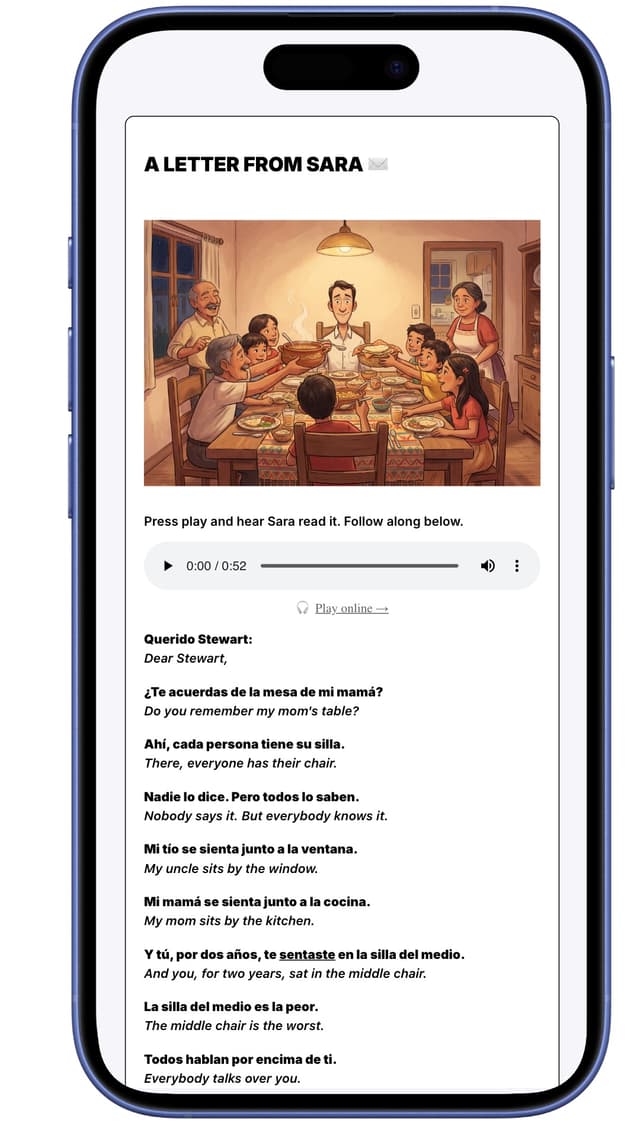
The best approach combines daily exposure, Spanish audio, and real-world phrases - not isolated vocabulary lists. Start with pronunciation, then high-frequency words, then basic verb conjugations. Phrase Café sends a short letter from Sara every morning, with the English under every line and Sara reading it to you. See our complete beginner roadmap →
Can I learn Spanish in 5 minutes a day?
Yes - consistency beats intensity. Each morning takes 5 to 15 minutes, and Sara reads the letter to you, so it fits before work. Learn our micro-learning method →
How often will I get emails?
A letter from Sara every morning. On day six you say the week back. On day seven you hear one saying in five countries.
What makes this different from other apps?
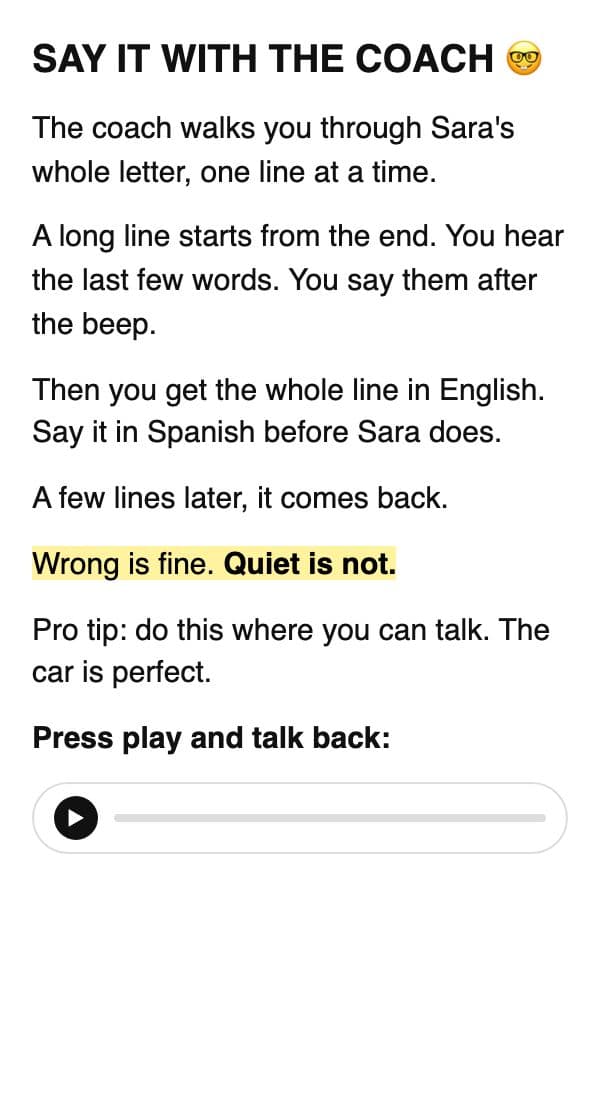
Apps focus on gamification and isolated vocabulary. Phrase Café focuses on speaking: a real letter every morning, Sara’s voice reading it, a coach who has you say it back, and a saying from real family life. It all comes to your inbox. Compare all methods →
What if I miss a day?
No problem. There’s no streak. Just open the next letter.
Is Spanish hard to learn for English speakers?
Spanish is one of the easiest languages for English speakers. The FSI ranks it as a Category I language - the fastest to learn. You share thousands of cognates (words that look similar), and Spanish pronunciation is consistent. With daily practice, you'll progress faster than you expect. Start with our beginner guide →
Can I learn Spanish on my own without a tutor?
Absolutely. Millions of people reach conversational fluency through self-study. The key is consistent daily exposure and practicing with Spanish audio. Phrase Café delivers both to your inbox - no tutor, no app, no schedule to keep. Just open your email and learn.
What Spanish words should I learn first?
Start with high-frequency words: greetings (hola, buenos días), common verbs (ser, estar, tener, ir), numbers, and everyday nouns. The 100 most common words cover ~50% of spoken Spanish. Phrase Café teaches these in context so you remember them. See our essential vocabulary list →
How do I say common phrases in Spanish?
Start with greetings and essentials: "Hola" (hello), "Buenos días" (good morning), "Gracias" (thank you), "¿Cómo estás?" (how are you?). Phrase Café teaches you these phrases with natural pronunciation and cultural context. Learn Spanish greetings →
What's the best app to learn Spanish?
Popular apps like Duolingo and Babbel work for basics, but most learners plateau because apps focus on gamification over fluency. For real-world Spanish, combine apps with contextual learning like Phrase Café's email method - Spanish audio, cultural context, and active recall. See our full app comparison →
Can I become fluent in Spanish in 3 months?
Fluent? No. Conversational? Yes. With 1-2 hours daily, you can handle basic conversations, travel situations, and understand slow Spanish in 90 days. True fluency takes 1-2 years. Set realistic expectations and you won't burn out. See our 90-day sprint plan →
How do I learn Spanish verb conjugations?
Start with present tense of the 5 most common verbs: ser, estar, tener, ir, hacer. Then learn the regular patterns (AR, ER, IR verbs). Don't memorize tables - learn conjugations in real sentences. Phrase Café teaches verbs in context so they stick. Master present tense conjugation →
Should I learn Spanish or Mexican Spanish?
Start with neutral Latin American Spanish - it's understood everywhere. Regional differences (Spain vs Mexico vs Argentina) are mostly vocabulary and accent, not grammar. Once you're conversational, you'll naturally pick up regional variations. Phrase Café teaches universally understood Spanish.
How do I improve my Spanish pronunciation?
Listen to Spanish speakers daily. Spanish pronunciation is consistent - each letter makes the same sound. Focus on rolling your R's, the Spanish "J" sound, and vowel clarity. Phrase Café includes Spanish audio with every letter so you hear correct pronunciation from day one. Learn pronunciation rules →
Can I learn Spanish by watching TV shows?
Yes - but passively watching won't make you fluent. Use the "active watching" method: Spanish audio + Spanish subtitles, pause to study phrases, repeat out loud. Shows like "La Casa de Papel" and "Élite" are great for intermediate learners. See our TV learning guide →