What Does Granada Mean in Spanish: Linguistic Patterns That Click
Context tells you if someone’s talking about the fruit, the weapon, or the city
Posted by
 Stewart Kaplan
Related reading
What Does Adonde Mean in Spanish? How Movement 'Clicks' for Learners
You have to know when prepositions combine with donde to show direction or position
What Does Ahi Mean in Spanish? Cognitive Mastery That Sticks
Learners mix up ahí, hay, and ay because they sound the same but mean totally different things.
What Does Aki Mean in Spanish: Unpacking Real Usage for Learners
Regional differences exist, but nearly everyone in Spanish-speaking communities gets what "aki" means in a text
TL;DR
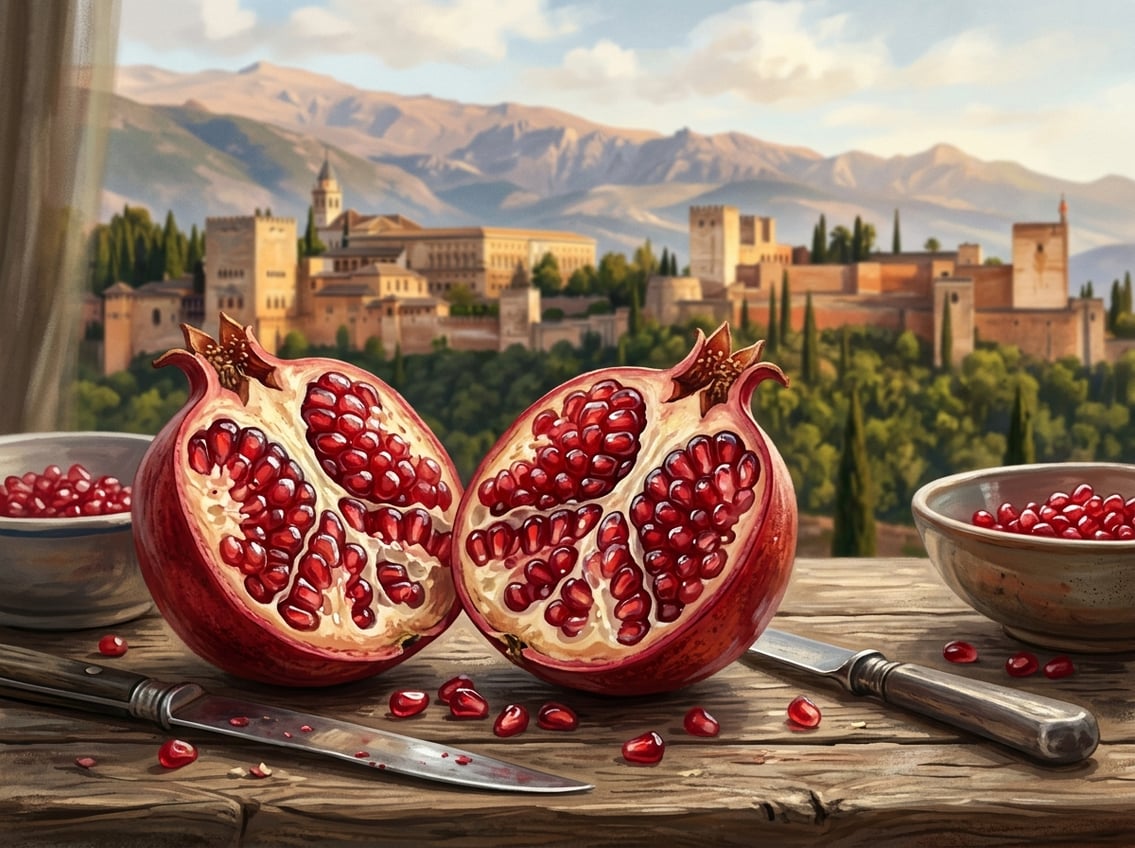
- Granada in Spanish means both "pomegranate" (fruit) and "grenade" (weapon); they’re spelled and said the same way
- The word comes from Latin "granatum," meaning "seeded," because pomegranates are packed with seeds
- Granada is also a city in southern Spain, named after the fruit - pomegranates used to grow everywhere around there
- Pomegranate symbols pop up in Granada’s architecture, emblems, and culture
- Context tells you if someone’s talking about the fruit, the weapon, or the city
| Usage | Meaning | Example Phrase |
|---|---|---|
| Fruit | pomegranate | "Me gusta la granada" |
| Weapon | grenade | "Lanzó una granada" |
| Place | city of Granada | "Viajo a Granada" |
Multiple Meanings and Usage in Modern Spanish
The Spanish word granada can mean a fruit, a military explosive, or a famous city. Each meaning comes with its own set of words.
Granada as Pomegranate
Primary Definition
| Spanish | English | Context |
|---|---|---|
| granada | pomegranate | fruit/food |
| granado | pomegranate tree | plant/agriculture |
Related Vocabulary
- la granada – the pomegranate (feminine noun)
- el granado – pomegranate tree
- semillas de granada – pomegranate seeds
- jugo de granada – pomegranate juice
Rule → Example:
- Rule: Use "granada" for the fruit in food settings.
- Example: "Quiero jugo de granada."
Granada as Grenade and Related Terms
| Spanish Term | English | Usage |
|---|---|---|
| granada | grenade/shell | military |
| granada de mano | hand grenade | weapon |
| granada aturdidora | stun grenade | riot control |
Common Phrases
- lanzar una granada – to throw a grenade
- granada de fragmentación – fragmentation grenade
- granada de humo – smoke grenade
Rule → Example:
- Rule: In military or police contexts, "granada" means an explosive.
- Example: "La policía usó granadas aturdidoras."
City and Region References
| Phrase | Meaning |
|---|---|
| la ciudad de Granada | the city of Granada |
| la provincia de Granada | the province of Granada |
| natural de Granada | person from Granada |
Rule → Example:
- Rule: Capitalize "Granada" for the city or province.
- Example: "Estudio en la Universidad de Granada."
Etymology and Linguistic Origins
"Granada" comes from Latin granatum ("seeded"), influenced by Arabic during Spain’s medieval period. The word stuck because of the fruit’s seeds.
Latin and Arabic Influences
| Term | Meaning | Note |
|---|---|---|
| granum | grain, seed | Latin root |
| granatum | seeded | pomegranate |
| غرناطة (Ġarnāṭa) | Granada | Arabic name |
Possible Arabic meanings:
- "Hill of strangers"
- "Hill of pilgrims"
- Berber origin
- Adaptation of Latin grana
Evolution of the Word in Spanish
| Stage | Development |
|---|---|
| Latin granatum | pomegranate |
| Old Spanish granado | tree |
| Feminine granada | fruit, city, explosive |
Rule → Example:
- Rule: "Granada" is both a common noun (fruit) and a proper noun (city).
- Example: "Comí una granada en Granada."
Association With the Pomegranate
| Symbol | Connection |
|---|---|
| Pomegranate | City’s name and emblem |
| Red seeds | Local soil/buildings |
| Multiple seeds | Symbol of abundance |
Rule → Example:
- Rule: The pomegranate is Granada’s main symbol.
- Example: "El escudo de Granada tiene una granada."
Granada as a Place: City and Cultural Identity
| Location | Details |
|---|---|
| Southern Spain | Andalusia region |
| Elevation | 2,260 feet above sea level |
| Rivers | Genil, Darro, Monachil, Beiro |
| District | Notable Features |
|---|---|
| City center | Historic sites |
| South Granada | Admin/commercial |
| West Granada | Residential |
The city produces farm goods, liqueurs, soap, paper, textiles, metals, and machine parts.
Historical Neighborhoods
| Neighborhood | Features |
|---|---|
| Albaicín | Oldest, narrow streets, cármenes, UNESCO site |
| Sacromonte | Cave homes, flamenco, Roma culture |
| Realejo | Old Jewish quarter |
| Zaidín | Modern, parks |
Rule → Example:
- Rule: "Albaicín" refers to the oldest Moorish quarter.
- Example: "Paseé por el Albaicín."
Cultural Symbols and Traditions
| Symbol/Tradition | Description |
|---|---|
| Pomegranate | On coat of arms, local fruit |
| Granadino | Person from Granada |
| Festivals | International music and dance |
| Attraction | Note |
|---|---|
| Alhambra | Moorish palace |
| Generalife | Gardens |
| Cathedral of Santa María | Royal Chapel inside |
Rule → Example:
- Rule: People from Granada are called "granadinos."
- Example: "Los granadinos celebran muchas fiestas."
Historical Context and Architectural Significance
| Monument | Period | Features |
|---|---|---|
| Alhambra | 13th-14th c. | Tile work, fortress walls |
| Generalife | 14th c. | Gardens, courtyards |
| Albaicín | Medieval | Narrow streets, cármenes |
| Distinctive Element | Description |
|---|---|
| Horseshoe arches | Common in Moorish sites |
| Arabesque stucco | Decorative detail |
| Reflecting pools | Water features |
| Azulejos | Glazed tiles |
Rule → Example:
- Rule: The Alhambra is the most famous Nasrid monument in Granada.
- Example: "Visité la Alhambra y sus jardines."
The Nazarí Kingdom and Catholic Monarchs
The Reino Nazarí de Granada ruled from 1238 to 1492 as the last Muslim kingdom in Spain. Boabdil, the final Nasrid sultan, handed over Granada to Ferdinand and Isabella in January 1492.
Architectural Transitions:
| Era | Rulers | Major Construction |
|---|---|---|
| Nasrid | Moorish sultans | Alhambra palace complex, defensive alcazaba |
| Post-1492 | Catholic Monarchs | Granada Cathedral, Royal Chapel, Emperor Charles V palace |
The Gothic Cathedral of Santa María de la Encarnación was built from 1523 to 1703. Inside, the Royal Chapel (Capilla Real) holds the tombs of Ferdinand and Isabella.
The 16th-century Renaissance palace of Emperor Charles V sits right next to the Alhambra. This spot really shows the mix of Roman, Islamic, and Gothic influences that make Granada’s architecture stand out.
Granada's Strategic Importance
Geographic Advantages:
- Elevation: 2,260 feet (689 meters) above sea level
- Natural defenses: Sierra Nevada mountain range
- Water sources: Four rivers (Darro, Genil, Monachil, Beiro)
- Agriculture: Pomegranate groves and fertile land
| Location Feature | Benefit |
|---|---|
| Rocky hill terrain | Hard to attack Alhambra |
| River access | Supports farming, trade |
Historical Role:
- Last Moorish stronghold in Iberia
- Trade center for farm goods
- Cultural crossroads of Islam and Christianity
Institutions, Language, and Local Life
Granada’s university crowd shapes how people talk, and local sports and media help define modern cultural life for both learners and longtime residents.
Universidad de Granada and University Life
The Universidad de Granada enrolls about 47,000 undergrads across five city campuses. This student mix creates a unique language vibe - Castilian Spanish with a strong Andalusian twist.
Key Campus Locations:
- Centro (historic downtown)
- Cartuja (sciences and tech)
- Fuentenueva (humanities and social sciences)
- Ciencias de la Salud (health sciences)
- Ceuta and Melilla (satellite campuses)
| Student Areas | Typical Activity |
|---|---|
| Realejo, Centro | Spanish practice, casual meetups |
| Cafeterias, libraries | Immersive language exposure |
The academic calendar runs September to June. Intensive language courses run in July and August.
Learning Spanish in Granada
Granada has structured programs for adults at both university and private academies. The main language spoken is Spanish (Castellano) with a local Andalusian accent.
Andalusian Speech Patterns in Granada:
| Feature | Standard Castilian | Granadan Variation |
|---|---|---|
| Final -s | pronounced clearly | often dropped/aspirated |
| -d- between vowels | nada (clear d) | naá (d dropped) |
| c before e/i | theta sound | often s sound |
- Private academies: Plaza Nueva, Gran Vía
- University language center: A1–C2 courses
- Language exchanges: Tues/Thurs evenings, Centro & Realejo bars
Media, Sports, and Modern Granadino Culture
- National newspapers: El País, Público (regional editions)
- Local daily: Ideal (standard Spanish)
- Football: Granada CF (Segunda División), home games at Nuevo Estadio de Los Cármenes
- Radio: Radio Granada (98.5 FM), news/music/call-in shows
- "¿Qué pasha?" (What's up? - from pasa)
- "No te ralles" (Don’t worry)
- "Vamos pa'llá" (Let’s go there - contracted)
granadino is the word for people and things from Granada, used as both noun and adjective.
Frequently Asked Questions
The Spanish word "granada" has several meanings, and the city’s name has roots in Arabic and Latin history.
Is the Spanish word "granada" used to mean a pomegranate, a grenade, or both?
| Spanish Word | English Meaning | Context |
|---|---|---|
| granada | pomegranate | Fruit, food, agriculture |
| granada | grenade | Military, weapons |
| granada de mano | hand grenade | Military (specific term) |
Rule → Example:
Military context → "granada" = "grenade"
Fruit context → "granada" = "pomegranate"
English meanings include pomegranate, grenade, shell, hand grenade.
How do you pronounce "granada" correctly in Spanish?
| Syllable | Sound Description |
|---|---|
| gra | hard "g" as in "grab" |
| na | "nah" |
| da | soft "d" (like "th" in "the") |
- IPA: [gɾaˈnað̞a]
- Stress: Second syllable (gra-NA-da)
- "r" is tapped once
What is the most accurate English translation of "granada" depending on context?
| Spanish Context | English Translation | Example |
|---|---|---|
| Market, fruit stand | pomegranate | "Compré granadas" = "I bought pomegranates" |
| Military, weapons | grenade | "Lanzó una granada" = "He threw a grenade" |
| Historical warfare | shell | "Granada de artillería" = "Artillery shell" |
| City name | Granada | "Vivo en Granada" = "I live in Granada" |
| Caribbean country | Grenada | Context: nation reference |
Rule → Example:
Always check context to choose the right English word.
Does "granada" have any slang meanings in Spanish, and where is it commonly used?
| Region | Common Meanings | Slang Use |
|---|---|---|
| Spain | pomegranate, grenade | No major slang |
| Latin America | pomegranate, grenade | No major slang |
| Mediterranean | pomegranate (frequent) | Standard use |
Rule → Example:
"granada" keeps standard meaning; not used as slang.
Why is the city of Granada in Spain called Granada, and is the name related to the fruit?
| Theory | Name Origin | Evidence/Notes |
|---|---|---|
| Latin granata | Pomegranate | Arab chronicler Al-Maqqari’s view |
| Arabic Ġarnāṭa | "Hill of strangers/pilgrims" | 9th–10th century Arabic sources |
| Latin granum | "Seed" or "scarlet color" | Refers to red soil/buildings |
| Berber origin | Unknown | Linguistic analysis suggests possible link |
- The pomegranate appears on Granada’s coat of arms.
- Name predates the 11th-century Zirid era.
- Early records: Gárnata, Karnata in Arabic texts.