What Does Es in Spanish Mean? Microlearning for Rapid Clarity Gains
"Es" pairs with adjectives for traits (alto, inteligente) and nouns for identity or profession
Posted by
 Stewart Kaplan
Related reading
What Does Adonde Mean in Spanish? How Movement 'Clicks' for Learners
You have to know when prepositions combine with donde to show direction or position
What Does Ahi Mean in Spanish? Cognitive Mastery That Sticks
Learners mix up ahí, hay, and ay because they sound the same but mean totally different things.
What Does Aki Mean in Spanish: Unpacking Real Usage for Learners
Regional differences exist, but nearly everyone in Spanish-speaking communities gets what "aki" means in a text
TL;DR
- "Es" is the third-person singular form of the verb "ser," meaning "is" in English
- Use "es" for permanent traits, identity, origin, time, and definitions (e.g., "Él es doctor" = He is a doctor)
- "Es" describes lasting characteristics; "está" covers temporary states or locations
- Common expressions: "es que" (the thing is), "así es" (that's right), "es decir" (that is to say)
- "Es" pairs with adjectives for traits (alto, inteligente) and nouns for identity or profession
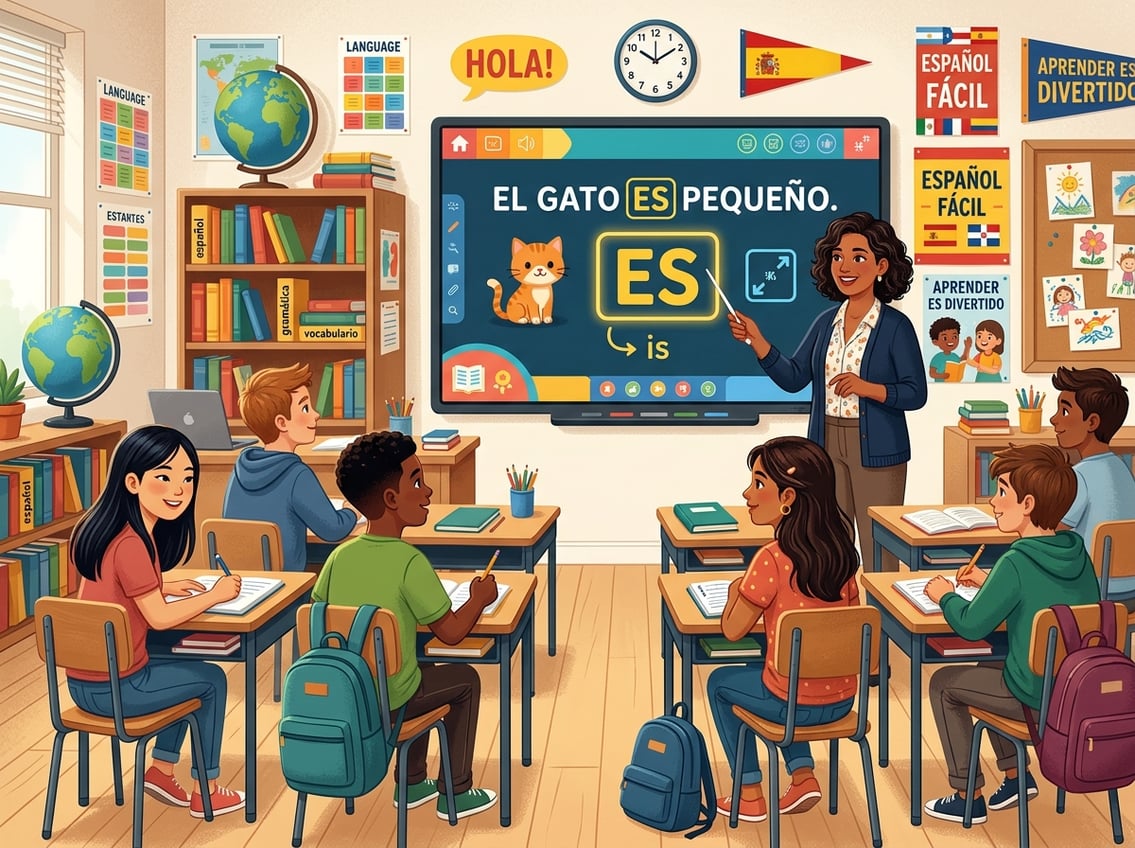
Core Meaning of "Es" and Its Grammatical Roots
"Es" is the third person singular present tense form of "ser," meaning "is" and used for permanent states, identities, and essential traits.
The Verb Ser and Its Conjugations
| Person | Spanish | English |
|---|---|---|
| yo | soy | I am |
| tú | eres | you are (informal) |
| él/ella/usted | es | he/she is, you are (formal) |
| nosotros/nosotras | somos | we are |
| vosotros/vosotras | sois | you all are (Spain) |
| ellos/ellas/ustedes | son | they are, you all are |
Primary Functions of Ser
- Identity: Ella es doctora (She is a doctor)
- Origin: Él es de México (He is from Mexico)
- Characteristics: El libro es interesante (The book is interesting)
- Time: Son las tres (It is three o'clock)
- Possession: Es de María (It is María's)
Rule → Example
Rule: Use "es" for permanent traits, professions, and identity.
Example: Es ingeniero (He is an engineer)
Third Person Singular Forms Explained
"Es" applies to these subjects:
- él (he)
- ella (she)
- usted (you, formal)
- it (implied in Spanish)
| Pattern | Example | Translation |
|---|---|---|
| Es + adjective | Es importante | It is important |
| Es + noun | Es profesor | He is a teacher |
| Es + de + place | Es de España | She is from Spain |
| Es posible | Es posible ganar | It is possible to win |
Rule → Example
Rule: Use "es" with adjectives for traits, nouns for professions or identity, and "de" for origin.
Example: Es de Argentina (He/She is from Argentina)
Etymology and Linguistic Background
| Latin Form | Spanish Form | Meaning |
|---|---|---|
| esse (infinitive) | ser | to be |
| est (3rd person) | es | is |
| sum | soy | I am |
| sumus | somos | we are |
Practical Usage Scenarios for "Es" in Spanish
Identifying People and Objects
| Spanish | English | Usage |
|---|---|---|
| Es mi hermano | It's my brother | Person |
| Es un libro | It's a book | Object |
| Esto es importante | This is important | Significance |
| Es Juan | It's Juan | Name |
Common phrases:
- Es mi amigo/amiga (It's my friend)
- Es una mesa (It's a table)
- Es el profesor (It's the teacher)
- Esto es un problema (This is a problem)
Q&A Pairs
- ¿Qué es? → Es una computadora (What is it? → It's a computer)
- ¿Quién es? → Es María (Who is it? → It's María)
Nationality and Origin Statements
| Person/Object | Spanish | English |
|---|---|---|
| Male from Mexico | Él es mexicano | He is Mexican |
| Female from Spain | Ella es española | She is Spanish |
| Object from Italy | Es de Italia | It's from Italy |
| Food from Japan | Es comida japonesa | It's Japanese food |
Other examples:
- Es de Madrid (from Madrid)
- Es de Nueva York (from New York)
- Es de madera (made of wood)
- Es de metal (made of metal)
Describing Characteristics and Professions
| Spanish | English | Type |
|---|---|---|
| Es alto | He is tall | Trait |
| Es inteligente | She is intelligent | Trait |
| Es generoso | He is generous | Personality |
| Es grande | It is big | Size |
Professions:
- Es doctor/doctora (He/She is a doctor)
- Es ingeniero/ingeniera (He/She is an engineer)
- Es estudiante (He/She is a student)
- Es profesor/profesora (He/She is a teacher)
Personality:
- Es amable (kind)
- Es serio/seria (serious)
- Es divertido/divertida (funny)
- Es trabajador/trabajadora (hardworking)
Rule → Example
Rule: Use "es" for professions with no article.
Example: Es arquitecto (He is an architect)
Defining Time, Dates, and Facts
| Spanish | English | Context |
|---|---|---|
| Es la una | It's one o'clock | Time |
| Son las dos | It's two o'clock | Time |
| Es mediodía | It's noon | Time |
| Es medianoche | It's midnight | Time |
Dates and seasons:
- Es lunes (It's Monday)
- Es enero (It's January)
- Es el 24 de mayo (It's May 24th)
- Es primavera (It's spring)
Factual phrases:
- Es verdad (It's true)
- Es mentira (It's a lie)
- Es posible (It's possible)
- Es necesario (It's necessary)
- Es importante (It's important)
Clarification:
Rule → Example
Rule: Use "es decir" to clarify a statement.
Example: Es estudiante, es decir, va a la universidad (He's a student, that is to say, he goes to university)
Essential Differences Between "Es" and "Está"
| Use "Es" for... | Example | Translation |
|---|---|---|
| Identity | Él es profesor | He is a teacher |
| Origin | Soy de España | I am from Spain |
| Physical traits | Es alto | He is tall |
| Truth | Es verdad | It is true |
| Importance | Es importante estudiar | It's important to study |
| Material | Es de roble | It's made of oak |
| Time | Son las siete | It's seven o'clock |
| Use "Está" for... | Example | Translation |
|---|---|---|
| Location | Está en el baño | He's in the bathroom |
| Temporary condition | Está cansada | She is tired |
| Current state | Está enfermo | He is sick |
| Marital status | Está casada | She is married |
| Position | Está en la mesa | It's on the table |
| Broken/functioning | Está roto | It's broken |
Rule → Example
Rule: "Es" expresses essence or definition; "está" shows state or location.
Example:
- Es importante (It's important)
- Está cansado (He is tired)
Fixed expressions with "es":
- Es verdad (It's true)
- Es importante (It's important)
- Es necesario (It's necessary)
- Es posible (It's possible)
Fixed expressions with "está":
- Está bien (It's okay/fine)
- Está claro (It's clear)
- Está listo (It's ready)
- Está cerca (It's close)
Context Switching Steps:
- Identify if the sentence is about essence (use "es") or a current state/location (use "está")
- Look for location or condition clues
- Apply the correct verb form
- Listen to everyday usage and review mistakes within a day for better recall
Common Expressions, Idioms, and Phrases with "Es"
Spanish learners bump into "es" all the time in set phrases - stuff that helps clarify, show possibility, or just underline what’s true or important. These pop up everywhere: in formal writing, casual chats, even at work.
Frequent Idiomatic Expressions
Core Clarifying Expressions
| Expression | Literal Translation | Function | Formality |
|---|---|---|---|
| es decir | that is to say | clarify/rephrase | formal/neutral |
| esto es | this is | introduce explanation | formal |
| es verdad | it's true | confirm statement | neutral |
| es importante | it's important | emphasize significance | neutral/formal |
Usage Patterns
- Es decir comes after a statement to clarify or get more specific
- Esto es introduces a definition or restates something simply
- Es verdad confirms or agrees with what someone said
- Es importante highlights actions or facts needing attention
Common Examples with Translations
- Trabajo en tecnología, es decir, desarrollo software. - I work in technology, that is to say, I develop software.
- Es verdad que llegó tarde. - It's true that he arrived late.
- Es importante estudiar cada día. - It's important to study every day.
- Necesitas tres cosas: esto es, tiempo, dinero y esfuerzo. - You need three things: this is, time, money, and effort.
Meaning and Usage of "es posible" and Related Phrases
Possibility and Probability Expressions
| Phrase | English Equivalent | Certainty Level | Example Context |
|---|---|---|---|
| es posible | it's possible | 40-60% likelihood | Es posible que llueva mañana. |
| es probable | it's probable | 60-80% likelihood | Es probable que vengan. |
| es imposible | it's impossible | 0% likelihood | Es imposible terminar hoy. |
| es necesario | it's necessary | required action | Es necesario confirmar. |
Grammatical Pattern
- Use subjunctive mood after these: "es" + adjective + que + verb
- Es posible que llegue tarde. - It's possible that he arrives late.
- Es importante que estudies. - It's important that you study.
Formality Comparison
- Written/Formal: Es posible que se requiera documentación adicional.
- Spoken/Casual: Es posible que necesites más papeles.
Advanced Structures and Nuanced Use Cases
"Es" shows up in passive and impersonal statements - no clear subject, just a general truth or emphasis. You'll also see it in patterns like "esto es" for highlighting or clarifying.
Passive Voice and Impersonal Use
Impersonal "Es" Constructions
| Structure | English Equivalent | Example |
|---|---|---|
| Es + adjective + infinitive | It is [adjective] to [v] | Es importante estudiar |
| Es + noun + infinitive | It is [noun] to [v] | Es necesidad trabajar |
| Es + adjective + que + clause | It is [adj] that... | Es obvio que es tarde |
Common Impersonal Phrases
- Es posible que (It is possible that)
- Es difícil entender (It is difficult to understand)
- Es fácil aprender (It is easy to learn)
- Es mejor esperar (It is better to wait)
Rule → Example
Rule: No subject is needed; "es" points to a condition or quality.
Example: Es necesario dormir. (It is necessary to sleep.)
Emphasis, Questions, and Definition Patterns
"Esto es" for Emphasis and Introduction
| Usage | Translation | Context |
|---|---|---|
| Esto es importante | This is important | Highlighting info |
| Esto es lo que necesito | This is what I need | Pointing to something |
| Esto es así | This is how it is | Confirming situation |
"Es decir" for Clarification
- Used as "that is to say" or "in other words"
- Goes between clauses to rephrase or specify
Rule → Example
Rule: Use "es decir" to clarify a statement.
Example: Es estudiante, es decir, no trabaja.
Question Formation with "Es"
- ¿Es verdad? (Is it true?)
- ¿Es tuyo? (Is it yours?)
- ¿Qué es esto? (What is this?)
Rule → Example
Rule: In questions, the verb "es" comes before the subject.
Example: ¿Es tu amigo? (Is he your friend?)
Teaching, Translation, and Modern Communication Insights
Learning Strategies and Common Errors
Most Frequent Mistakes with "es"
| Error Type | Incorrect | Correct | Why It's Wrong |
|---|---|---|---|
| Confusing with "está" | El libro es en la mesa | El libro está en la mesa | "Es" is not for locations |
| Using with "I" | Yo es estudiante | Yo soy estudiante | "Es" is only for he/she/it |
| Omitting in translation | Mi hermano doctor | Mi hermano es doctor | Spanish needs the verb |
| Wrong permanent/temporary | La sopa es fría | La sopa está fría | "Está" for temporary states |
Learning Sequence for "es"
- Memorize: subject + es + noun/adjective
- Practice with "es importante" in 5 daily sentences
- Record Spanish audio, replay while doing daily stuff
- Gap-fill: remove a word, fill it back in
- Switch between Spanish–English and English–Spanish every 48 hours
High-Frequency Phrases for Daily Practice
- Es verdad (It's true)
- Es necesario (It's necessary)
- Es posible (It's possible)
- Es difícil (It's difficult)
- No es justo (It's not fair)
| Study Method | Effectiveness for "es" | Example Activity |
|---|---|---|
| Writing phrases | High | Copy "es" sentences |
| Speaking with gaps | High | Say phrases, pause for "es" |
| Listening to Spanish audio | High | Replay podcasts with "es" phrases |
Translation Comparisons and Digital Age Context
How Translation Tools Handle "es"
| Tool Type | Accuracy with "es" | Context Recognition | Best Use Case |
|---|---|---|---|
| Google Translate | 95% | Weak with ser/estar | Quick lookups |
| DeepL | 98% | Good with context | Full sentences |
| SpanishDict | 100% | Shows both options | Learning differences |
Modern Communication Contexts for "es"
- Text: Es tarde (It's late) - common in evening chats
- Social: Es increíble (It's incredible) - reactions on posts
- Email: Es importante - marks priority
- Video call: ¿Es correcto? (Is it correct?) - for checking understanding
| Digital Scenario | Sample "es" Phrase | Typical Use |
|---|---|---|
| Messaging | Es urgente | Flagging importance |
| Social media | Es genial | Expressing excitement |
| Work email | Es necesario | Requesting action |
Frequently Asked Questions
How is "es" translated into English in different contexts?
| Spanish Context | English Translation | Example |
|---|---|---|
| Identity | is | Es mi hermano (He is my brother) |
| Profession | is | Es doctor (He is a doctor) |
| Origin | is from | Es de México (She is from Mexico) |
| Material | is made of | Es de metal (It is made of metal) |
| Time | it is | Es la una (It is one o'clock) |
| Date | it is | Es lunes (It is Monday) |
| Characteristics | is | Es alto (He is tall) |
| Possession | belongs to | Es de Ana (It belongs to Ana) |
Rule → Example
Rule: Use "is" or "is from" in English, depending on the Spanish context.
Example: Es de España → She is from Spain.
When do Spanish speakers use "es" instead of "está"?
Use "es" for:
- Permanent traits: Es inteligente (She is intelligent)
- Identity: Es mi coche (It is my car)
- Origin: Es de Brasil (He is from Brazil)
- Time: Es medianoche (It is midnight)
- Material: Es de madera (It is made of wood)
- Profession: Es profesor (He is a teacher)
Use "está" for:
- Location: Está en casa (He is at home)
- Temporary state: Está cansado (He is tired)
- Emotion: Está feliz (She is happy)
- Ongoing action: Está corriendo (He is running)
Rule → Example
Rule: "Es" for what something is; "está" for where or how it is.
Example: La casa es grande (The house is big) vs. La casa está limpia (The house is clean).
Why do Spanish speakers say "es" so frequently in conversation?
| Situation | Example Phrase | Function |
|---|---|---|
| Telling time | Es la hora | Give the time |
| Describing people | Es amable | Character description |
| Explaining things | Es importante | Highlight importance |
| Making definitions | Es un libro | Define something |
| Expressing opinions | Es verdad | State opinion/truth |
Rule → Example
Rule: "Es" is used whenever stating facts, definitions, or essential qualities.
Example: Es mi amigo (He is my friend).
Does "es" have any slang meanings in Spanish?
- No slang meanings for "es" itself.
- Only pronunciation, speed, or context varies by region.
| Variation Area | What Changes | "Es" Meaning |
|---|---|---|
| Spain | Speed, accent | Same |
| Mexico | Phrasing | Same |
| Argentina | Intonation | Same |
How does "es" differ from "estoy" and "somos" in Spanish grammar?
| Form | Person | Number | Example | Translation |
|---|---|---|---|---|
| es | 3rd person | singular | Ella es médica | She is a doctor |
| estoy | 1st person | singular | Estoy cansado | I am tired |
| somos | 1st person | plural | Somos amigos | We are friends |
Rule → Example
Rule: "Es" = he/she/it is (permanent); "estoy" = I am (temporary); "somos" = we are (permanent group).
Example: Somos estudiantes (We are students).