What Does Encanto Mean in Spanish: Unlocking True Fluency Fast
The word pops up in Latin American magical realism and in sweet, everyday phrases
Posted by
 Stewart Kaplan
Related reading
What Does Adonde Mean in Spanish? How Movement 'Clicks' for Learners
You have to know when prepositions combine with donde to show direction or position
What Does Ahi Mean in Spanish? Cognitive Mastery That Sticks
Learners mix up ahí, hay, and ay because they sound the same but mean totally different things.
What Does Aki Mean in Spanish: Unpacking Real Usage for Learners
Regional differences exist, but nearly everyone in Spanish-speaking communities gets what "aki" means in a text
TL;DR
- Encanto means charm, spell, enchantment, or magic in Spanish - it’s that quality that just grabs you, fascinates, or delights
- It’s a masculine noun, and you’ll see it in phrases like "ser un encanto" (to be charming) or with the verb "encantar" (to enchant/love)
- Different Spanish-speaking countries use it a bit differently - sometimes it’s about people, sometimes about magical stuff in stories
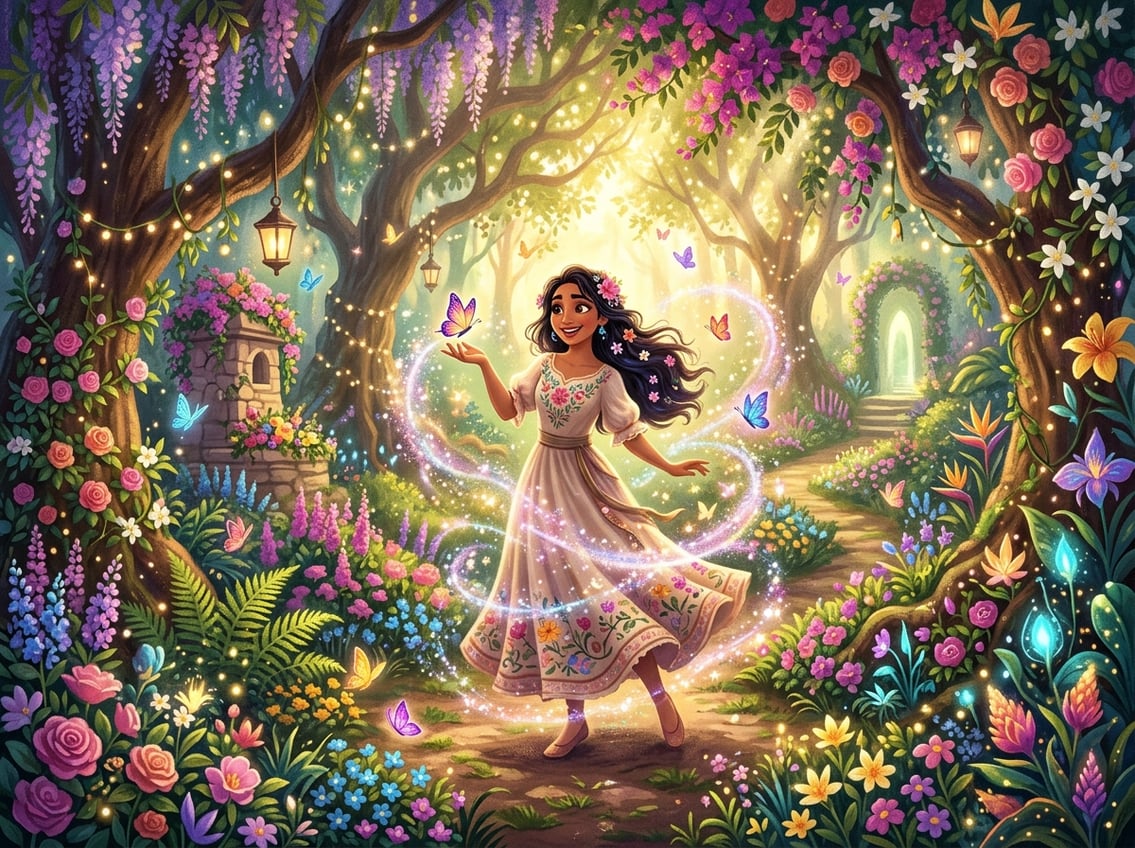
- Disney’s movie title nods to both the family’s magical spell and Colombia’s cultural charm
- The word pops up in Latin American magical realism and in sweet, everyday phrases
| Usage | Meaning |
|---|---|
| Fairy tales | Spell, magic |
| Everyday talk | Charm, delightful quality |
- Links to the verb "encantar" (to love/enchant)
- Used in daily speech, literature, media, and regional slang
- Essential for moving past basic Spanish vocabulary
Core Meanings and Nuances of Encanto
Spanish speakers use encanto for everything from describing a magical spell to talking about someone’s lovely personality. Related words like encantar and me encanta show up all the time to express strong affection or pleasure.
Charm, Enchantment, and Delight
Translations and Contexts:
| Spanish | English | Usage |
|---|---|---|
| encanto | charm | Describing people, places |
| encanto | spell | Fairy tales, magic |
| encanto | enchantment | Captivating quality |
| encanto | delight | Pleasant experience |
| un encanto | a darling | Affection for a person |
Common Phrases:
- Qué encanto – What a delight!
- Tiene mucho encanto – Has a lot of charm
- Es un encanto de persona – He/she is a charming person
Related adjectives:
- Encantador (m) / Encantadora (f): charming, delightful
- Encantado/encantada: enchanted, delighted, or "pleased to meet you"
Emotional and Cultural Resonance
Verb Forms and Usage:
| Expression | Literal | Meaning |
|---|---|---|
| me encanta | it enchants me | I love it |
| te encanta | it enchants you | you love it |
| le encanta | it enchants him/her | he/she loves it |
| les encanta | it enchants them | they love it |
Examples:
- Me encanta bailar – I love dancing
- Les encanta la playa – They love the beach
- ¿Te encanta este restaurante? – Do you love this restaurant?
Similar Words:
| Spanish | English | Note |
|---|---|---|
| carisma | charisma | Magnetic personality |
| atractivo | attractiveness | Physical or general appeal |
| encanto | charm | Emotional warmth + captivating quality |
Rule → Encanto is used for gentle, intimate appeal; carisma is used for leadership or strong presence.
Example: “Ella tiene mucho encanto” vs. “Él tiene carisma.”
Common Scenarios of Usage
Places:
- Este pueblo tiene mucho encanto – This town is so charming
- La ciudad vieja es un encanto – The old city is delightful
People:
- Tu abuela es un encanto – Your grandma is a sweetheart
- Conocí a un encanto de niño – I met a charming little boy
Activities:
- Me encanta cocinar – I love cooking
- A mi hermana le encanta leer – My sister loves reading
Greetings:
- Encantado (male) / Encantada (female) – Pleased to meet you
Rule → Me encanta is more common in daily talk than the noun encanto.
Example: “Me encanta este lugar” (I love this place).
Grammatical Insights and Word Formation
Encanto is a masculine noun; encantar is the verb form meaning "to charm" or "to delight." Both trace back to Latin incantare.
Parts of Speech: Noun and Verb Forms
| Form | Type | Meaning | Example |
|---|---|---|---|
| encanto | noun (m) | charm, spell | El encanto de la ciudad |
| encantar | verb | to charm, to love | Me encanta la música |
Verb Conjugation Examples:
| Conjugation | Spanish | English |
|---|---|---|
| Present (tú) | encantas | you charm |
| Preterite (tú) | encantaste | you charmed |
| Preterite (él/ella) | encantó | he/she charmed |
| Present (ellos) | encantan | they charm |
| Present (nosotros) | encantamos | we charm |
| Preterite (ellos) | encantaron | they charmed |
Phrase: romper el encanto – to break the spell
Gender and Pluralization
| Rule | Example |
|---|---|
| Encanto is masculine | el encanto, un encanto |
| Plural form | los encantos (the charms) |
| Adjective agreement | Estoy encantado (male), Estoy encantada (female) |
Etymology
| Root | Parts | Meaning |
|---|---|---|
| Latin: incantare | in- (in, upon) + cantare (to sing) | To chant a magical formula; later, to enchant or charm |
Related Spanish words:
- encanto (noun) – result of enchanting
- encantar (verb) – act of enchanting
- encantado/encantada – enchanted, delighted
Key Phrases and Verb Conjugations for Real-Life Use
The verb encantar follows regular conjugation patterns. "Me encanta" means "I love it," and "encantado" is what you say when meeting someone for the first time.
Forms Like 'Me Encantó,' 'Nos Encanta,' and More
Present Tense:
| Spanish | Literal | Natural Translation |
|---|---|---|
| Me encanta | It enchants me | I love it |
| Te encanta | It enchants you | You love it |
| Le encanta | It enchants him/her | He/She loves it |
| Nos encanta | It enchants us | We love it |
| Os encanta | It enchants you all | You all love it |
| Les encanta | It enchants them | They love it |
Past Tense:
| Spanish | English | When to Use |
|---|---|---|
| Me encantó | I loved it | One completed thing |
| Me encantaron | I loved them | Multiple things, past |
| Nos encantó | We loved it | One group experience |
| Te encantó | You loved it | Ask about a past experience |
Rule → Use "encanta" for singular, "encantan" for plural. Use "encantó" (accent) for past events.
Example: “Me encanta la música” (I love music); “Me encantaron los perros” (I loved the dogs).
Expressing Likes and Affection
Everyday Expressions:
- Me encanta cocinar – I love cooking
- Nos encanta bailar – We love dancing
- Le encanta leer – He/She loves reading
- ¿Te encanta viajar? – Do you love traveling?
As a Term of Endearment:
| Spanish | Context | English Equivalent |
|---|---|---|
| Eres un encanto | Compliment | You’re a sweetheart |
| Para ti, encanto | Giving a gift | For you, dear |
| Gracias, encanto | Thanking | Thanks, love |
Rule → "Eres un encanto" can refer to anyone, regardless of gender.
Example: “Gracias, encanto” (Thanks, sweetheart).
Intensity Comparison:
| Phrase | Preference Level |
|---|---|
| Me gusta | Like (mild) |
| Me encanta | Love (strong) |
| Me fascina | Fascinated (very strong) |
Introductions: 'Encantado de Conocerte'
Formal vs. Informal Greetings
| Situation | Male Speaker | Female Speaker |
|---|---|---|
| Informal introduction | Encantado de conocerte | Encantada de conocerte |
| Formal introduction | Encantado de conocerle | Encantada de conocerle |
| Very formal setting | Encantado | Encantada |
Rule → Example
Ending of "encantado/encantada" matches the speaker’s gender.
Example: A woman says "Encantada de conocerte."
Response Options
- Igualmente - Likewise
- El placer es mío - The pleasure is mine
- Encantado/a también - Pleased to meet you too
- Mucho gusto - Nice to meet you
Past Tense in Introductions
Rule → Example
"Encantaste" (you charmed) is for describing someone's effect, not greetings.
Example: Me encantaste con tu historia.
Encanto in Spanish-Speaking Cultures and Regions
"Encanto" pops up all over Spanish affection and charm, and you’ll find it in names of places with cultural weight.
Endearments, Compliments, and Idiomatic Expressions
Common Phrases with Encanto
| Expression | Literal Translation | Actual Meaning | Context |
|---|---|---|---|
| ¡Qué encanto! | What charm! | How lovely/delightful! | Reacting to something pleasant |
| Eres un encanto | You are a charm | You're so sweet | Complimenting personality |
| Me encantó | It charmed me | I loved it | Showing strong appreciation |
| Encantador/encantadora | Charming one | Charming person | Describing someone appealing |
Related Words in Use
- Encantó: He/she/it charmed or delighted
- Encantador: Charming (male/masculine noun)
- Encantadora: Charming (female/feminine noun)
Rule → Example
Use "encantadora" for feminine, "encantador" for masculine.
Example: "Tu sonrisa es encantadora."
Example: "Ese lugar me encantó."
Place Names and Popular References
- Isla del Encanto: Puerto Rico’s nickname since mid-20th-century tourism campaigns
- Island of Enchantment: English version in tourism
- Un encanto: Used for delightful places or people
Rule → Example
"Encanto" as a place name highlights beauty or cultural significance.
Example: Puerto Rico, Isla del Encanto.
The Disney movie Encanto (2021) spread the word worldwide, tying it to magic, family, and Colombian charm.
Encanto in Literature and the Arts
"Encanto" runs deep in Latin American literature, especially magic realism.
Magic Realism and Enchantment in Stories
| Spanish Term | English Translation | Literary Function |
|---|---|---|
| realismo mágico | magic realism | The genre itself |
| encanto | charm, spell, enchantment | Describes magical quality |
| magia | magic | Supernatural force in narrative |
| hechizar | to bewitch, to enchant | Casting spells/action |
Rule → Example
Magic realism treats magical events as normal.
Example: A character floats while doing chores.
Influence of Gabriel García Márquez
Essential Magic Realism Authors:
- Gabriel García Márquez - Cien años de soledad
- Isabel Allende - La casa de los espíritus
- Jorge Luis Borges - Historia universal de la infamia
- Laura Esquivel - Como agua para chocolate
Rule → Example
García Márquez’s work blends magic and reality in Colombian settings.
Example: Magical events happen in everyday life.
The Disney film Encanto draws from García Márquez’s style, setting magic within a Colombian family.
Encanto and Modern Media Usage
The Disney movie shot "encanto" into global pop culture in 2021. Now, you’ll spot it everywhere online, in both Spanish and English.
Disney's Encanto and the Madrigal Family
In the film:
- "Encanto" = miracle or spell giving magical abilities
- Also means Colombia’s unique charm
Lyric Example:
"Colombia, te quiero tanto. Que siempre me enamora tu encanto."
Translation: "Colombia, I love you so much. Your charm always makes me fall in love with you."
Rule → Example
"Encanto" in the film refers to both magic and the country’s appeal.
Cross-Influences: Spanish and English
| Context | Example | Meaning |
|---|---|---|
| Compliment | "Eres un encanto" | You're a darling/charm |
| Describing places | "Qué encanto de ciudad" | What a charming city |
| Term of endearment | "Gracias, encanto" | Thanks, sweetheart |
Rule → Example
English speakers often connect "encanto" to the Disney movie’s magic, not its full Spanish range.
Related Words, Synonyms, and Contrasts
"Encanto" links to words for charm, magic, and attraction. Here’s how they line up:
Encantador, Encantadora, and Carisma
| Term | Gender | Meaning | Example |
|---|---|---|---|
| Encantador | Masculine | Charming, delightful | Un hombre encantador |
| Encantadora | Feminine | Charming, delightful | Una mujer encantadora |
Carisma
- Means charisma or personal magnetism
- Focuses on influence, not magic
| Term | Scope |
|---|---|
| Encanto | Charm, magic, beauty |
| Carisma | Personal charisma, influence |
| Encantador/a | Describes someone/something as charming |
Variations: Encantó, Encantan, and Hechizar
| Form | Tense | Meaning | Example |
|---|---|---|---|
| Encantó | Preterite | Charmed, delighted | Me encantó la película |
| Encantan | Present | Charm, delight | Me encantan los gatos |
Rule → Example
"Encantar" works like "gustar": subject is the thing causing delight.
Example: "Me encantan los gatos" (I love cats).
Hechizar
- Means to bewitch or cast a spell
- Stronger magical sense than encantar
| Verb | Meaning | Usage |
|---|---|---|
| Encantar | To charm/delight | Literal or figurative |
| Hechizar | To bewitch/cast a spell | Emphasizes supernatural |
Contrasts With Similar Terms
| Word | Meaning | Usage Context |
|---|---|---|
| Encanto | Charm, enchantment | Positive qualities, magic, appeal |
| Magia | Magic | Supernatural powers, tricks |
| Belleza | Beauty | Physical appearance only |
| Gracia | Grace, wit | Elegance, humor |
| Vulgaridad | Vulgarity | Opposite of charm |
Rule → Example
"Vulgaridad" is the opposite of "encanto."
Example: "Ese comentario fue pura vulgaridad."
Key Distinctions
- Encanto: covers magical and non-magical charm
- Magia: only magic or supernatural
- Carisma: charisma, no magic
- Hechizar: spell-casting, supernatural
Unique Regional and Colloquial Uses
| Region | Typical Use of "Encanto" |
|---|---|
| Colombia | Strong cultural, affectionate, poetic uses in daily speech |
| Other areas | Romantic, casual praise, local place names, poetic expressions |
Romantic, Friendly, and Playful Contexts
Common Colloquial Phrases
| Spanish Phrase | English Translation | Context |
|---|---|---|
| Me encanta | I love it / It delights me | Showing real excitement or joy |
| Te encanta | You love it | Pointing out someone’s preference |
| Eres un encanto | You're a sweetheart | Sweet way to compliment someone |
| Qué encanto de persona | What a charming person | Praising someone's character |
Regional Preferences by Setting
- Romantic: "Eres un encanto" pops up a lot in dating and flirty talk across Latin America.
- Friendship: In Colombia, folks use "encanto" often to show warmth or affection to friends.
- Everyday praise: "Me encanta" is one of the go-to phrases in daily chats everywhere Spanish is spoken.
Formal vs. Informal Distinctions
| Register | Example in Spanish | English Translation |
|---|---|---|
| Informal | Me encanta tu casa | I love your house |
| Formal | Es un lugar lleno de encanto | It's a place full of charm |
| Country/Region | Frequency of "encanto" |
|---|---|
| Colombia | High |
| Other regions | Moderate |
El Encanto del Invierno and Poetic Expressions
Artistic and Literary Uses
| Expression | Meaning | Usage Context |
|---|---|---|
| El encanto del invierno | The charm/magic of winter | Poetry, travel, seasons |
| Bajo su encanto | Under its spell | Romance, mystery, stories |
| Perder el encanto | To lose its charm | Criticism, nostalgia |
Geographic and Cultural Applications
- Tourism ads use "encanto" for beautiful spots in Spain and Latin America.
- Writers and journalists mention "encanto" when talking about cultural heritage.
- Some communities only use "encanto" for truly special occasions.
Poetic Patterns
| Pattern | Example Phrase |
|---|---|
| Paired with seasons or landscapes | el encanto del invierno |
| Signals emotional or magical transformation | bajo su encanto |
Frequently Asked Questions
The word "encanto" can mean charm, spell, enchantment, or darling. It covers magical vibes and appealing traits in people or places.
How is "encanto" commonly translated into English?
| Spanish | English Translation | Usage Context |
|---|---|---|
| encanto | charm | Describing appeal of a person/place |
| encanto | spell | Talking about magic |
| encanto | enchantment | Romantic or literary situations |
| encanto | lovely | Complimenting someone’s nature |
| encanto | darling | Sweet nickname or endearment |
Rule → Example:
Rule: Use "charm" for natural appeal, "spell" for magic.
Example: "Esta ciudad tiene mucho encanto." → "This city has a lot of charm."
Examples:
- Esta ciudad tiene mucho encanto. → This city has a lot of charm.
- El hechicero lanzó un encanto. → The wizard cast a spell.
- Tu hermana es un encanto. → Your sister is lovely/a darling.
What does "encanto" mean in the context of the Disney movie title?
| Reference | Meaning in "Encanto" |
|---|---|
| Primary | Spell/miracle granting magic |
| Secondary | The charm of Colombia |
Rule → Example:
Rule: In the film, "encanto" refers to both the magical spell and Colombia’s charm.
Example: The final song uses "tu encanto" to mean Colombia’s unique appeal.
How do you pronounce "encanto" in Spanish?
| Syllable | Sound | Stress |
|---|---|---|
| en- | ehn | unstressed |
| -can- | kahn | stressed |
| -to | toh | unstressed |
Rule → Example:
Rule: Stress the second syllable.
Example: ehn-KAHN-toh
- The "c" is pronounced as a hard "k" before "a."
What does "le encantó" mean in Spanish, and when is it used?
| Phrase | Translation | Subject |
|---|---|---|
| Le encantó | He/she/it loved it | Third person singular |
- Verb: encantar (to delight, to love)
- Tense: preterite (past)
- Indirect object pronoun required
Examples:
- Le encantó la película. → He/She loved the movie.
- Le encantó tu regalo. → He/She loved your gift.
- A María le encantó la sorpresa. → María was delighted by the surprise.
Rule → Example:
Rule: Always use an indirect object pronoun with "encantar."
Example: "Le encantó la comida." → "He/She loved the food."
Does "encanto" imply "miracle" in Spanish usage?
| Spanish Word | Meaning | Usage |
|---|---|---|
| milagro | miracle | Religious/extraordinary |
| encanto | spell/charm/enchantment | Magic or appealing quality |
Rule → Example:
Rule: Use "milagro" for miracle, "encanto" for spell or charm.
Example: "Fue un milagro." → "It was a miracle."
Example: "Vivían bajo un encanto." → "They lived under a spell."