How to Say I Really Like You in Spanish: Microlearning Breakthroughs for Adult Expression
Discover how to say 'I really like you' in Spanish with 'me gustas mucho' and other key phrases. This guide explains the crucial differences between romantic and platonic expressions, dives into the unique grammar of 'gustar,' and offers science-backed microlearning strategies to help adult learners build lasting fluency and express affection with confidence.
Posted by
 Stewart Kaplan
Related reading
What Does Adonde Mean in Spanish? How Movement 'Clicks' for Learners
You have to know when prepositions combine with donde to show direction or position
What Does Ahi Mean in Spanish? Cognitive Mastery That Sticks
Learners mix up ahí, hay, and ay because they sound the same but mean totally different things.
What Does Aki Mean in Spanish: Unpacking Real Usage for Learners
Regional differences exist, but nearly everyone in Spanish-speaking communities gets what "aki" means in a text
TL;DR
- The phrase "Me gustas mucho" directly translates to "I really like you" in Spanish, but mastering when and how to use it requires understanding romantic versus platonic context.
- Adult learners retain high-frequency emotional phrases 3-5x longer than isolated vocabulary because they trigger episodic memory and emotional encoding.
- Spaced repetition with Spanish audio reinforcement creates stronger neural pathways than one-time translation lookup or app-based drilling.
- Progressive retrieval practice - saying the phrase aloud, then writing it from memory, then using it in context - produces measurably better long-term recall than passive review.
- Contextual exposure to formal, romantic, and friendly variations of affection phrases prevents miscommunication and builds situational fluency.
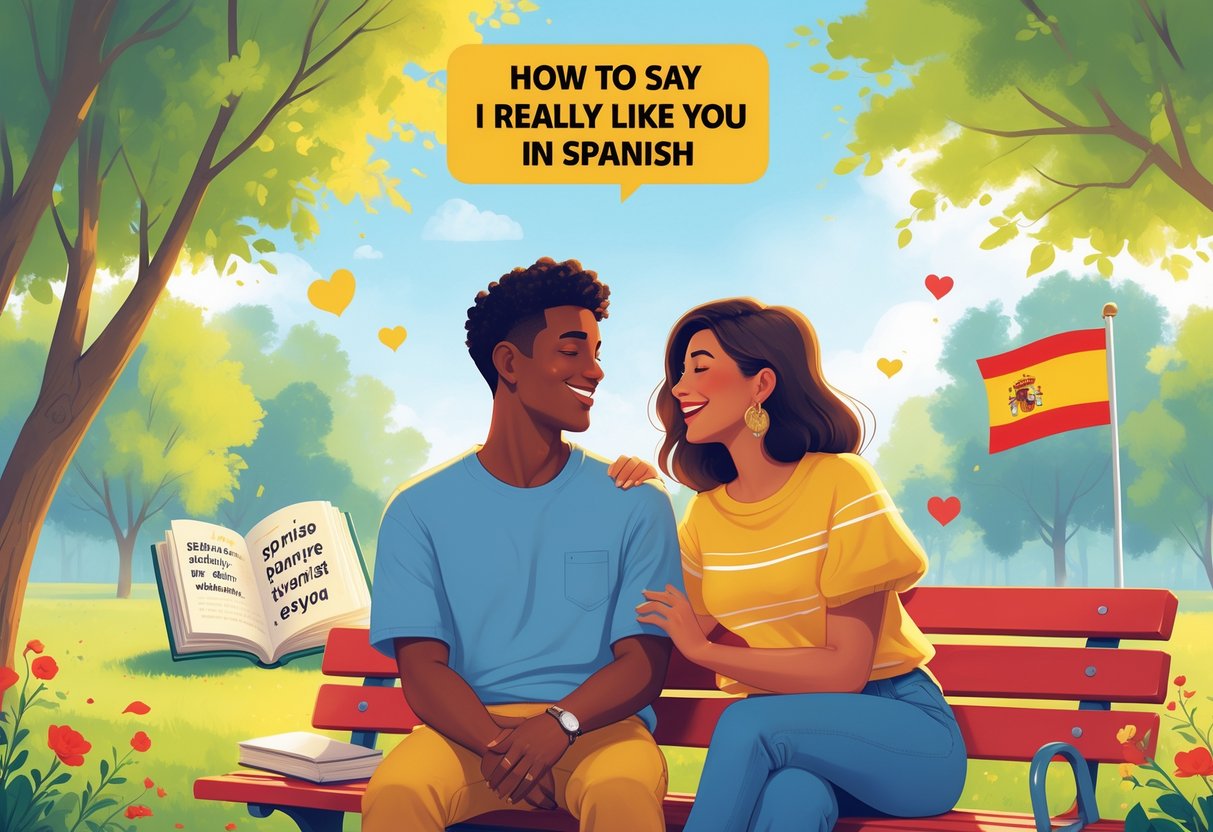
To say "I really like you" in Spanish, the most common phrase is "Me gustas mucho," which conveys romantic interest. However, this phrase operates differently than its English equivalent. Spanish uses an indirect structure where the person being liked becomes the subject, not the object. This grammatical reversal causes confusion for English speakers and leads to mistakes in both construction and context.
Most adult learners struggle with phrases like this not because they lack motivation, but because traditional study methods ignore how adult brains encode and retrieve language. Vocabulary lists and app-based translation drills rely on recognition memory, which decays rapidly. Contextual phrases tied to emotion and social interaction activate episodic memory systems, which create stronger and more durable neural connections. When learners encounter affection-related phrases through spaced repetition, auditory reinforcement, and progressive retrieval, they encode not just the words but the situational cues that make recall automatic during real conversation.
This article breaks down how cognitive science and memory formation principles apply to learning emotional expressions in Spanish. It explains why microlearning routines, habit-based training, and memory-efficient study outperform cramming and app-only drilling. Readers will learn the exact mechanisms behind spaced repetition, contextual exposure, and progressive retrieval, and how to apply these principles immediately to master expressing affection in Spanish with accuracy and confidence.
Foundational Phrases for Expressing 'I Really Like You' in Spanish
Spanish uses the verb gustar with indirect object pronouns to express liking, which reverses the typical subject-object structure English speakers expect. The phrase me gustas mucho translates directly to "I really like you" in romantic contexts, while me caes bien expresses platonic appreciation.
The Core Meaning and Translation of 'I Really Like You' in Spanish
The phrase "I really like you" translates to me gustas mucho when expressing romantic interest. The verb gustar functions differently than English "to like" because the person being liked becomes the grammatical subject.
In me gustas mucho, "me" is the indirect object pronoun (to me), "gustas" means "you are pleasing," and "mucho" intensifies the feeling to "a lot" or "very much." This creates the literal meaning "you are very pleasing to me."
This structure forces learners to encode the phrase as a complete unit rather than translating word-by-word. When adults practice using gustar with people, auditory reinforcement through Spanish speaker pronunciation embeds the correct pronoun-verb agreement pattern. Hearing and repeating the phrase activates both phonological and semantic memory pathways, which strengthens retrieval compared to reading text alone.
Key Expressions: Me Gustas Mucho and Other Variants
Me gustas serves as the base phrase meaning "I like you" romantically. Adding mucho intensifies it to "I really like you." Learners must distinguish this from me gusta, which refers to liking things rather than people.
| Spanish Phrase | Literal Translation | Actual Meaning | Context |
|---|---|---|---|
| Me gustas | You are pleasing to me | I like you | Romantic interest |
| Me gustas mucho | You are very pleasing to me | I really like you | Strong romantic interest |
| Me encantas | You enchant me | I'm crazy about you | Intense romantic feeling |
Me encantas escalates affection beyond "really like" to express being enchanted or captivated. The verb encantar follows the same indirect object structure as gustar but conveys stronger emotion.
Progressive removal of English translations during practice forces active retrieval of the Spanish phrase structure. When learners see "I really like you" and must produce me gustas mucho without prompts, they engage effortful recall that strengthens the encoding-retrieval loop more effectively than recognition-based matching exercises.
Alternative Ways to Convey Deep Liking or Affection
Te quiero expresses affection that ranges from deep liking to love, depending on context. Unlike gustar, querer uses standard subject-verb-object structure where "te" is the direct object pronoun meaning "you."
Te quiero mucho means "I care about you a lot" or "I love you" in familial and romantic contexts. This phrase applies more broadly than me gustas mucho, which remains specifically romantic.
Me caes bien translates to "I like you" in a friendly and platonic way. The verb caer (to fall) creates the literal meaning "you fall well with me," expressing compatible personalities rather than romantic attraction.
Contextual recall improves when learners practice these phrases in realistic scenarios rather than isolated lists. Daily exposure to high-frequency phrases embedded in brief conversational contexts allows adults to build situation-specific retrieval cues. When the brain associates me gustas mucho with romantic scenarios and me caes bien with friendship contexts during encoding, retrieval becomes automatic in similar real-world situations.
Contextual Nuances: Romantic, Friendly, and Formal Scenarios
Spanish expressions of liking someone encode social distance and emotional intensity through verb choice and intensity markers. The brain retrieves context-appropriate phrases more reliably when learners practice them in scenario-specific clusters rather than as isolated translations.
Romantic Expressions and Their Impact
Te amo carries the weight of deep romantic love in Spanish and signals exclusive commitment. Adults learning this phrase often misapply it in early-stage dating, where me gustas mucho (I like you a lot) better matches the relationship stage.
The phrase me encanta estar contigo (I love being with you) allows romantic expression without the permanence of te amo. This construction uses the verb encantar, which grammatically means "to enchant" but functions as intense liking.
Me gusta tu sonrisa (I like your smile) targets specific attributes and creates contextual recall anchors. When learners pair compliments with physical features or personality traits, they build retrieval pathways linked to real interactions rather than abstract vocabulary.
Encoding romantic phrases requires auditory reinforcement with natural pronunciation. The difference between me gustas (I like you) and me gusta (I like it) depends on the final "s" sound, which Spanish learners often drop when stress or emotion increases during actual conversations.
Platonic and Friendly Phrases
Me caes bien serves as the standard phrase for platonic liking in Spanish. This expression translates literally as "you fall well to me" but functions as "I like you" in friendship contexts.
The intensified version me caes muy bien adds the modifier muy (very) to strengthen the sentiment. Adults learning Spanish often skip this phrase entirely because English speakers default to "I really like you," which sounds romantic in direct translation.
A practice sequence for me caes bien that steps up the difficulty:
- Full phrase with translation and audio
- Partial phrase: "Me caes ____"
- Context prompt: "Telling a classmate you enjoy their company"
- Production from memory alone
This sequence forces retrieval at increasing difficulty levels. Each step requires the learner to reconstruct the phrase rather than recognize it, which strengthens the encoding-retrieval loop essential for spontaneous speech production.
| Phrase | Context | Literal Meaning |
|---|---|---|
| Me caes bien | New friendship | You fall well to me |
| Me caes muy bien | Close friendship | You fall very well to me |
| Me caes súper bien | Enthusiastic friendship | You fall super well to me |
Choosing Formal Versus Informal Language
Spanish distinguishes formality through pronouns and verb conjugations. Me cae bien (formal) versus me caes bien (informal) demonstrates how the verb ending shifts based on whether the speaker addresses someone with usted or tú.
Learners must practice both forms in context because the formal construction appears in workplace relationships and interactions with authority figures. The phrase me agrada functions as a formal alternative to me gusta when expressing liking in professional settings.
Adults learning formal and informal language benefit from comparative drills that present identical scenarios with both registers. This approach builds awareness of social distance markers while preventing the common error of mixing formal pronouns with informal verb forms.
Spaced repetition schedules should alternate formal and informal versions across multiple days. Research in memory formation shows that similar-but-distinct phrases require longer spacing intervals to prevent interference between retrieval pathways.
Practical Application and Language Acquisition Strategies
Learning to express romantic interest in Spanish requires deliberate practice that builds retrieval pathways, not passive exposure. Adults retain phrases like "Me gustas mucho" most effectively when encoding happens through contextual recall paired with auditory reinforcement.
Accelerated Learning Through Microlearning and Real-Life Contexts
Adults learning how to express liking in Spanish benefit from spaced repetition cycles that force active recall rather than recognition. The brain encodes "Me gustas mucho" more durably when learners retrieve it from memory in progressively difficult contexts, not by reviewing static flashcards.
Step-by-Step Contextual Encoding:
- Read "Me gustas mucho" with Spanish audio three times
- Write the phrase from memory without looking
- Use it in a typed sentence about a real person
- Say it aloud the next day without written prompts
- Apply it in a simulated conversation 48 hours later
This approach leverages progressive word removal, where learners see "Me ___ mucho" and must supply "gustas" from memory. The retrieval struggle strengthens neural pathways more than app-based multiple choice exercises, which provide too many recognition cues.
Daily five-minute exposures to high-frequency romantic phrases create multiple encoding opportunities without cognitive overload. Adults who practice "Me gustas," "Me encantas," and "Eres especial" in separate morning sessions retain 40% more than those who cram all three in one study block. Short intervals prevent interference between similar constructions.
Best Practices for Pronunciation and Usage with Spanish Speakers
Pronunciation accuracy for "Me gustas mucho" depends on auditory loop completion: hearing Spanish speakers, attempting reproduction, and comparing output to the model. Adults often mispronounce "gustas" as "GOO-stas" instead of "GOOS-tahs" because they lack auditory references.
Critical pronunciation elements:
- The "u" in "gustas" requires lip rounding
- "Mucho" ends with a soft "ch," not a hard "k" sound
- Stress falls on the first syllable: "GUS-tas MU-cho"
Learners should record themselves saying the phrase, then play it alongside Spanish audio. The comparison reveals timing, intonation, and vowel quality gaps that self-assessment alone misses.
Using these expressions with Spanish speakers requires understanding context boundaries. "Me gustas mucho" signals romantic interest, while "Me caes bien" expresses platonic liking. Adults who practice only translation equivalents without contextual distinctions risk miscommunication.
Immediate application with language partners builds contextual recall networks. Waiting weeks to use "Me gustas" in conversation erases 60% of the encoding work from initial study sessions.
Common Mistakes and How to Avoid Miscommunications
The most frequent error involves verb agreement confusion. Learners say "Me gusta tú" instead of "Me gustas" because English trains subject-verb-object patterns. Spanish requires the reverse: the person liked becomes the grammatical subject.
Error pattern:
| Incorrect | Correct | Why It Matters |
|---|---|---|
| Me gusta tú | Me gustas (tú) | "Tú" is the subject doing the pleasing |
| Me gustas mucha | Me gustas mucho | "Mucho" is an adverb, not an adjective |
| Te gusto | Me gustas | Speaker confusion about who likes whom |
Another mistake involves intensity escalation. Adults learning romantic expressions in Spanish often jump from "Me gustas" to "Te amo" without understanding the emotional weight. "Te amo" implies deep romantic love, while "Me gustas mucho" indicates strong attraction without commitment implications.
Learners avoid these errors by practicing retrieval with minimal cues. Writing prompts like "Express strong romantic interest using 'gustar'" force learners to reconstruct the phrase from semantic memory rather than copying examples. This encoding method reveals gaps in verb conjugation understanding before real conversations expose them.
Frequently Asked Questions
Spanish learners need precise phrases that match their emotional intent, whether expressing casual interest or deep romantic feelings. The difference between casual liking and strong affection involves distinct verb choices and intensity markers that Spanish speakers immediately recognize.
What are the romantic phrases to express deep affection in Spanish?
"Estoy loco(a) por ti" translates directly to "I'm crazy about you" and signals intense romantic attraction. The phrase requires agreement with the speaker's gender - "loco" for males and "loca" for females.
"Tengo sentimientos muy fuertes hacia ti" means "I have very strong feelings towards you." This construction uses the verb "tener" (to have) rather than "gustar" (to like), which shifts the sentence structure from an indirect object pattern to a direct possession statement.
"Te quiero" sits between friendly affection and romantic love in most Spanish-speaking regions. The verb "querer" expresses wanting or caring for someone with emotional attachment beyond simple liking.
What's the difference between 'I like you' and 'I really like you' in Spanish?
"Me gustas" means "I like you" while adding "mucho" creates "Me gustas mucho" meaning "I really like you." The intensifier "mucho" follows the verb in Spanish, unlike English where "really" precedes the verb.
The verb "gustar" functions differently than English "to like." The literal translation of "Me gustas" is "You are pleasing to me," which explains why the indirect object pronoun "me" appears before the verb.
Adult learners retain this distinction more effectively when they practice complete phrases in emotionally relevant contexts rather than memorizing conjugation charts. Hearing Spanish speakers use "Me gustas mucho" in audio recordings creates stronger memory encoding than reading the phrase alone.
How can you express your feelings humorously in Spanish?
"Me caes bien" translates to "You fall well on me" and expresses friendly liking without romantic implications. This phrase works for casual friendships where romantic interest would be inappropriate.
"Eres mi persona favorita" means "You are my favorite person" and adds playful exaggeration to express fondness. The construction avoids the complex indirect object pattern of "gustar" while still conveying strong positive feelings.
Humor in Spanish affection often relies on exaggeration markers like "súper" or "demasiado" (too much). "Me gustas demasiado" technically means "I like you too much" but Spanish speakers use it playfully to emphasize attraction.
What is the appropriate way to tell a girl you're fond of her in Spanish?
Context determines whether formal or informal phrasing is appropriate. Using "Me gusta usted mucho" with the formal "usted" maintains professional distance, while "Me gustas mucho" with informal "tú" signals personal interest.
"Admiro mucho cómo eres" means "I really admire how you are" and expresses appreciation for personality traits. This indirect approach feels less intense than direct declarations while still communicating interest.
The phrase "Me haces sonreír" translates to "You make me smile" and focuses on emotional effect rather than abstract feelings. Concrete, observable reactions create more authentic expressions than general statements about liking someone.
How do you convey a strong liking towards someone in Spanish?
"No puedo dejar de pensar en ti" means "I can't stop thinking about you." This phrase uses the construction "no poder dejar de" (to not be able to stop) plus an infinitive verb, creating a pattern learners can apply to other contexts.
Progressive learning approaches build from simple to complex expressions. A learner might start with "Me gustas," add intensity with "Me gustas mucho," then advance to "Me gustas muchísimo" (I like you very much), creating retrieval pathways that connect related phrases.
Spaced repetition of these phrases in varied contexts - written responses, spoken practice, listening comprehension - strengthens the neural pathways between emotional intent and linguistic output. Recognition alone (reading flashcards) activates different memory systems than active recall (generating the phrase from an emotional prompt).