How to Say I Don’t Understand in Spanish: Fast-Track Comprehension Methods
Other handy phrases: "¿Puede repetir?" (Can you repeat?), "¿Qué significa?" (What does it mean?)
Posted by
 Stewart Kaplan
Related reading
What Does Adonde Mean in Spanish? How Movement 'Clicks' for Learners
You have to know when prepositions combine with donde to show direction or position
What Does Ahi Mean in Spanish? Cognitive Mastery That Sticks
Learners mix up ahí, hay, and ay because they sound the same but mean totally different things.
What Does Aki Mean in Spanish: Unpacking Real Usage for Learners
Regional differences exist, but nearly everyone in Spanish-speaking communities gets what "aki" means in a text
TL;DR
- The two main phrases are "no entiendo" and "no comprendo" - both mean "I don't understand" but get used a bit differently
- "No entiendo" is for when you don't catch what someone said or don't understand a language
- "No comprendo" is for when you don't get a concept, idea, or the deeper meaning
- Both come from "entender" and "comprender" and you can swap them in most situations
- Other handy phrases: "¿Puede repetir?" (Can you repeat?), "¿Qué significa?" (What does it mean?)
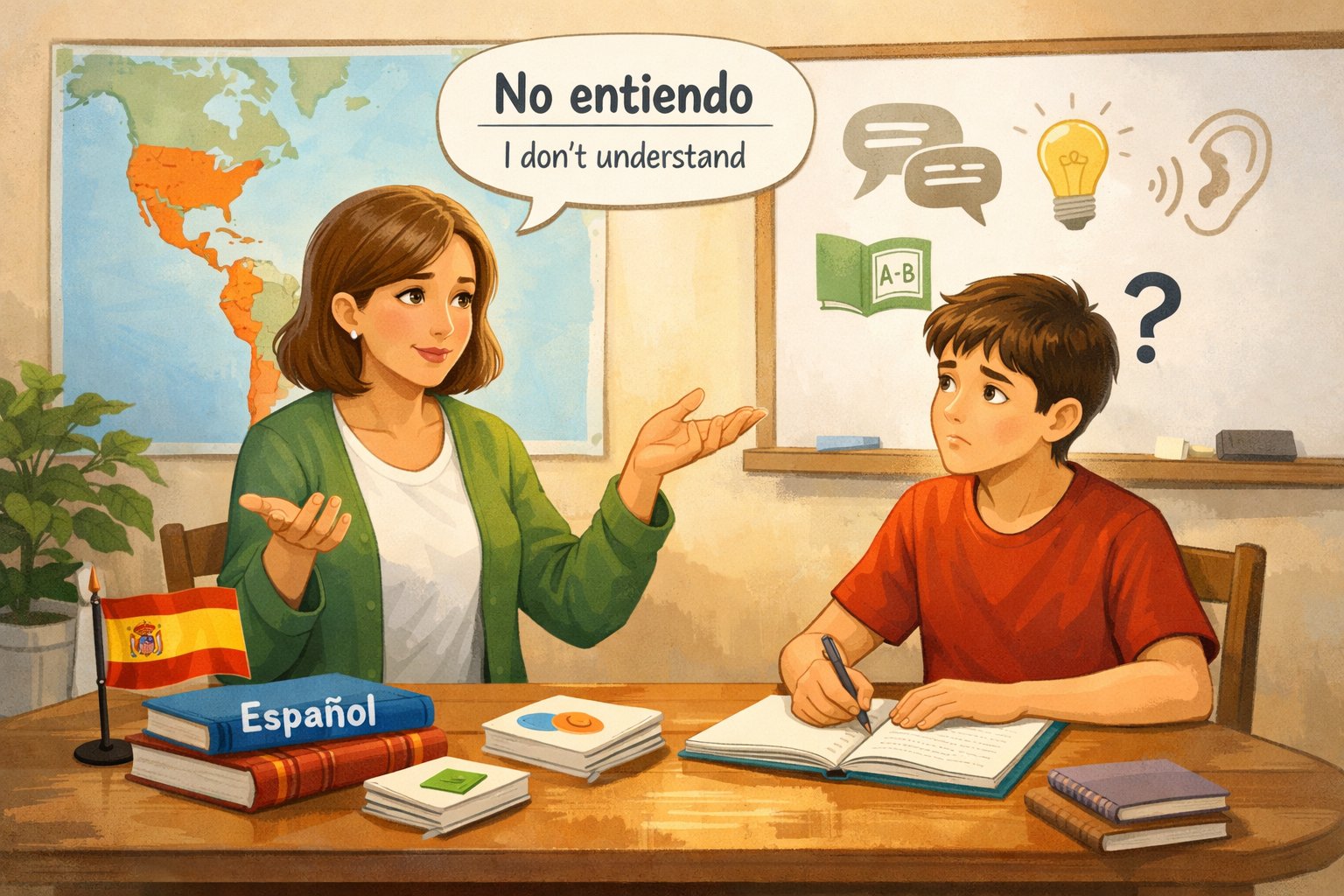
Essential Spanish Phrases and Meanings
Spanish has a bunch of ways to show you’re confused, and some are more formal or regional than others. The ones you’ll use most are no entiendo (everyday), no comprendo (a bit more formal), and no me queda claro (when something’s just not clicking).
No Entiendo and Its Variations
Basic Structure
| Spanish | English | Formality |
|---|---|---|
| No entiendo | I don't understand | Neutral |
| No entendí | I didn't understand | Neutral |
| No lo entiendo | I don't understand it | Neutral |
Usage Patterns
- No entiendo + noun: No entiendo los verbos (I don't understand the verbs)
- No entiendo + question word: No entiendo qué pasó (I don't understand what happened)
- No entendí + context: No entendí el final (I didn't understand the ending)
Common Conjugations
- Yo no entiendo (I don't understand)
- Tú no entiendes (You don't understand)
- Él/Ella no entiende (He/She doesn't understand)
- Nosotros no entendimos (We didn't understand)
No Comprendo: When and Why to Use It
Formality Comparison
| Context | No Entiendo | No Comprendo |
|---|---|---|
| Friends/Family | ✓ Primary | ✓ Acceptable |
| Workplace | ✓ Acceptable | ✓ Preferred |
| Academic | ✓ Acceptable | ✓ Preferred |
| Casual | ✓ Primary | Less common |
Example Applications
- No comprendo a mi profesor (I don't understand my teacher)
- No comprendí la lección (I didn't understand the lesson)
- Sigo sin comprender (I still don't understand)
No comprendo pops up more in writing and formal talk, but people swap it with no entiendo all the time.
No Me Queda Claro and Similar Alternatives
Clarity-Based Phrases
| Spanish | Literal Translation | When to Use |
|---|---|---|
| No me queda claro | It's not clear to me | Need explanation |
| No te sigo | I'm not following you | In conversation |
| No capto | I don't get it | Informal |
| No sé | I don't know | Missing info |
Structure Variations
- No me queda claro cómo funciona (It's not clear to me how it works)
- El subjuntivo no me queda claro (The subjunctive isn't clear to me)
- ¿No te quedó claro qué hacer? (Wasn't it clear to you what to do?)
No sé means "I don't know" - use it when you just don't have the info, not when you didn't understand.
Contextual Mastery: Adapting Responses and Understanding
Expressing Misunderstanding During Spoken Spanish
Immediate confusion phrases:
| Spanish | English | Formality |
|---|---|---|
| No entiendo | I don't understand | Neutral |
| No te sigo | I'm not following | Informal |
| No capto | I don't get it | Informal |
| No lo pillo | I don't catch it | Very informal (Spain) |
| No comprendo | I don't comprehend | Formal |
Quick spoken responses:
- ¿Cómo? - What? (neutral, just raise your voice a bit)
- No capto - I don't get it (casual, Latin America)
- No te sigo - I'm not following you (conversational)
Rule → Example:
- Rule: Use "no entiendo" for general confusion, "no te sigo" when you lost the thread.
- Example: No entiendo lo que dices (I don't understand what you're saying); No te sigo, ¿puedes explicar? (I'm not following you, can you explain?)
Requesting Repetition and Clarification
Repetition Requests
| Spanish | English | Context |
|---|---|---|
| ¿Me lo puedes repetir, por favor? | Can you repeat that for me, please? | Polite, general |
| ¿Qué dijiste? | What did you say? | Informal |
| Otra vez, por favor | One more time, please | Neutral |
| Una vez más | One more time | Formal/neutral |
| Más lento, por favor | Slower, please | Learning/classroom |
Speed Modification
- Más lento, por favor - Slower, please
- ¿Puedes hablar más despacio? - Can you speak more slowly?
- Repite, por favor - Repeat, please
Rule → Example:
- Rule: Use "¿qué dijiste?" for friends, "¿qué dijo?" for formal settings.
- Example: ¿Qué dijiste? (What did you say?); ¿Qué dijo? (What did you say? - formal)
Regional and Colloquial Expressions
Spain
- No lo pillo - I don't catch it
- No me entero - I don't get it/I'm not aware
- No me aclaro - I'm not clear on this
Latin America
- No capto - I don't get it
- No le entiendo - I don't understand you (formal, "usted")
- No agarro - I don't catch it (Mexico, Central America)
Formal alternatives by region:
| Region | Phrase | Literal Meaning |
|---|---|---|
| Mexico | No logro comprender | I don't manage to understand |
| Argentina | No me queda claro | It's not clear to me |
| Colombia | No caigo | I don't get it (lit. I don't fall) |
Rule → Example:
- Rule: "Otra vez" is neutral, "una vez más" is a bit more formal.
- Example: ¿Puedes decirlo otra vez? (Can you say it again?); ¿Puede repetirlo una vez más? (Can you repeat it one more time?)
Frequently Asked Questions
What is the direct translation of 'I don't understand' in Spanish?
| Spanish | English | Formality |
|---|---|---|
| No entiendo | I don't understand | Neutral |
| No comprendo | I don't understand | Slightly formal |
How can I express confusion politely in Spanish when I haven't grasped what's been said?
Formal:
- ¿Me lo puede repetir, por favor?
- No entendí su pregunta
- ¿Me da un ejemplo, por favor?
Informal:
- ¿Me lo puedes repetir, porfa?
- No entendí tu pregunta
- ¿Me das un ejemplo?
Rule → Example:
- Rule: Use "puede/su" for formal, "puedes/tu" for informal.
- Example: ¿Me lo puede repetir, por favor? (formal); ¿Me lo puedes repetir, porfa? (informal)
What are the different ways to indicate a lack of understanding in Spanish?
Direct statements:
- No entiendo (I don't understand)
- No entendí (I didn't understand)
- No me queda claro (It's not clear to me)
Questions for clarification:
- ¿Cómo? (What?)
- ¿Qué dijiste? (What did you say?)
- ¿Qué dijo? (What did he/she say?)
Requests for repetition:
- Otra vez (Again)
- Una vez más (One more time)
- Más lento, por favor (More slowly, please)
Rule → Example:
- Rule: "No entendí" = missed something already said; "no entiendo" = still confused.
- Example: No entendí la última parte (I didn't understand the last part); No entiendo lo que pasa (I don't understand what's happening)
In Mexican Spanish, how would you say you don't comprehend something?
| Phrase | Context | Usage Frequency |
|---|---|---|
| No entiendo | Any situation | Very high |
| ¿Mande? | Informal, mainly in Mexico | High (Mexico) |
| ¿Cómo? | Quick clarification | High |
| No le entendí | Formal, didn't understand | Medium |
Rule → Example:
"¿Mande?" is used in Mexico to ask someone to repeat, but younger people often just say "¿cómo?".
What phrase should be used in Spanish to indicate that you don't get the question?
| Formal (stranger) | Informal (friend/familiar) |
|---|---|
| No entendí su pregunta | No entendí tu pregunta |
| No entiendo su pregunta | No entiendo tu pregunta |
| ¿Me puede reformular la pregunta? | ¿Cómo? |
Rule → Use "su" for formal situations; use "tu" for informal ones.
Example: "No entiendo su pregunta" (formal), "No entiendo tu pregunta" (informal).