Best Way To Learn Spanish From Hindi: Rapid Acquisition That Clicks
Research says adults remember Spanish phrases best with audio-first learning, real usage examples, and retrieval practice - not just translation drills.
Posted by
 Stewart Kaplan
Related reading
Best Way to Learn Spanish from Albanian: Microlearning That Clicks
Start speaking right away - don’t wait to “master grammar” before building natural sentences
Best Way to Learn Spanish from Arabic: How Microlearning Accelerates Real Fluency
Sticking to short, regular sessions beats cramming: two 20-minute focused practices a week with retrieval drills get you farther than a weekend of scrolling or binge-studying.
Best Way to Learn Spanish from Bengali: Fast-Track Scientific Methods
Top tools for Bengali speakers: apps with Bengali menus, tutors who get Indo-Aryan languages, and spaced repetition that drills gendered nouns.
TL;DR
- Hindi and Spanish have big differences in verb conjugation, rolled consonants, and gendered nouns, but both use Subject-Verb-Object sentence order.
- The most effective approach: daily microlearning (15-20 min), Spanish audio, and spaced repetition of high-frequency phrases - before digging into grammar rules.
- Hindi speakers tend to get stuck on Spanish rolled "r" sounds, subjunctive mood, and ser/estar distinctions - these need phonetic drills and lots of real-life examples.
- Immersing yourself in Spanish media, talking with Spanish speakers, and building vocabulary every day boost fluency way more than just memorizing grammar.
- Research says adults remember Spanish phrases best with audio-first learning, real usage examples, and retrieval practice - not just translation drills.
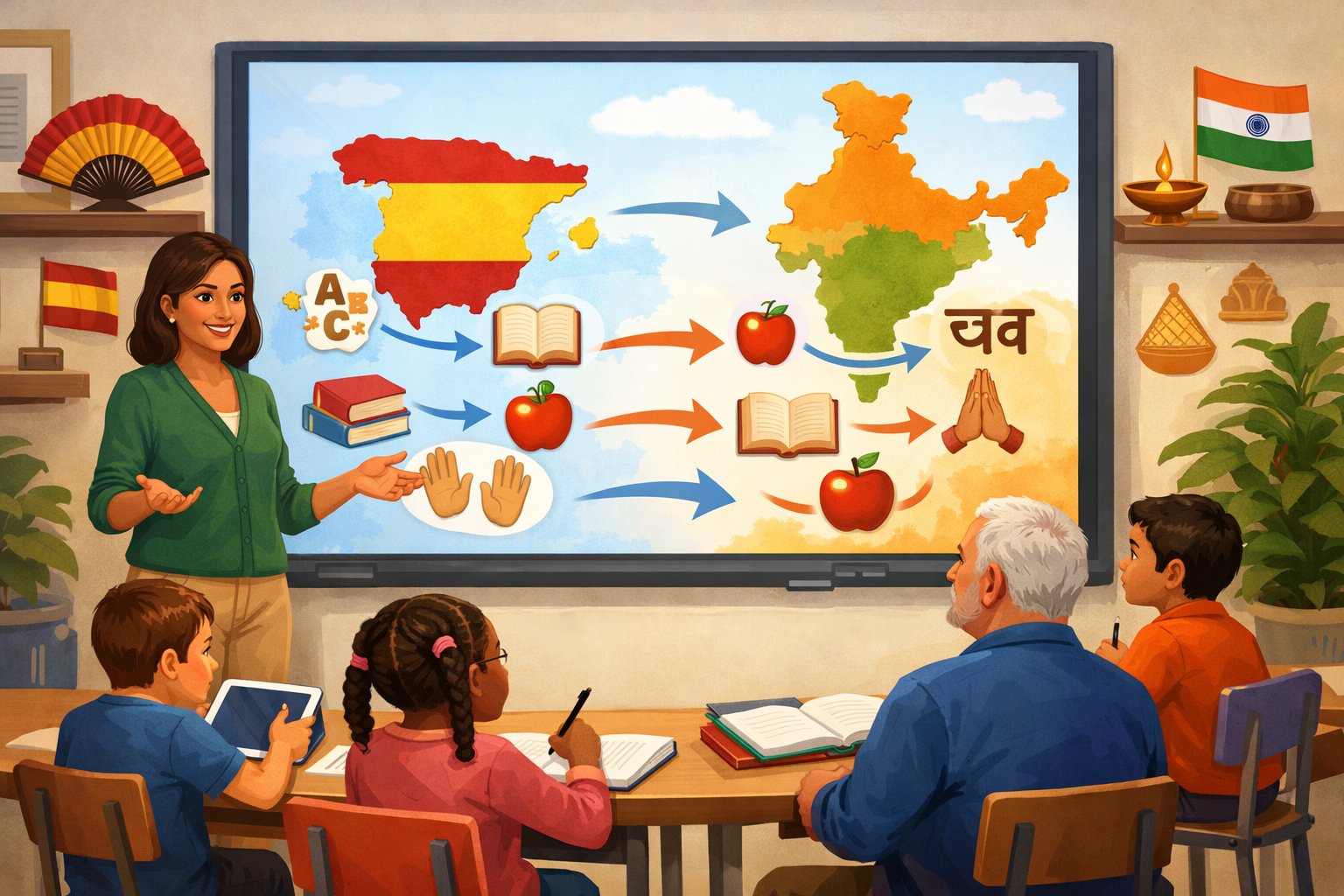
Fundamental Differences Between Hindi and Spanish
Hindi uses Devanagari script (46 characters). Spanish sticks to the Roman alphabet (27 letters). Spanish grammar depends on verb endings and noun gender. Hindi marks grammar mostly with word endings.
Alphabet and Pronunciation Contrasts
Script Systems
| Feature | Hindi | Spanish |
|---|---|---|
| Writing System | Devanagari script | Roman alphabet |
| Number of Basic Characters | 46 (11 vowels, 35 consonants) | 27 letters |
| Reading Direction | Left to right | Left to right |
| Phonetic Consistency | Highly phonetic | Highly phonetic |
Key Sound Differences
- Hindi has aspirated consonants (kh, gh, ch, etc.), retroflex sounds (ṭ, ḍ, ṇ), and nasal vowels.
- Spanish uses fewer sounds, but keeps vowels and consonants clear.
- Both languages are pretty true to their spelling.
Vowel Systems
- Spanish: 5 vowels (a, e, i, o, u)
- Hindi: 11 vowels (short and long)
Grammar and Syntax Comparisons
Word Order Patterns
| Language | Basic Word Order | Example |
|---|---|---|
| Hindi | Subject-Object-Verb (SOV) | Ram seb khata hai (Ram apple eats) |
| Spanish | Subject-Verb-Object (SVO) | Ram come manzana (Ram eats apple) |
Noun Gender Systems
- Hindi: Masculine/feminine, but not always strict
- Spanish: Every noun is masculine (el) or feminine (la)
Articles and Inflection
| Language | Articles | Inflection |
|---|---|---|
| Hindi | None | High (word endings change) |
| Spanish | Definite (el, la, los, las); Indefinite (un, una, unos, unas) | Moderate (verb endings, articles) |
Hindi uses postpositions (ne, ko, se) instead of prepositions.
Verb Conjugations and Sentence Structure
Spanish Verb Conjugation Structure
Spanish verbs change for:
- Person (I, you, he/she, etc.)
- Number (singular/plural)
- Tense (present, past, future, etc.)
- Mood (indicative, subjunctive, imperative)
Present tense of hablar (to speak):
| Person | Conjugation | Translation |
|---|---|---|
| yo | hablo | I speak |
| tú | hablas | you speak |
| él/ella | habla | he/she speaks |
| nosotros | hablamos | we speak |
| vosotros | habláis | you all speak |
| ellos/ellas | hablan | they speak |
Hindi Verb Structure
- Conjugates by gender, number, formality, tense, aspect
- Verb stem is more stable than in Spanish
Sentence Building Differences
- Hindi: Verb at the end
- Spanish: Verb after subject, before object
Question Formation
| Language | Method |
|---|---|
| Spanish | Inverts verb-subject or uses question words |
| Hindi | Adds "kya" or question word, keeps SOV order |
Why Hindi Speakers Should Learn Spanish
Spanish gives Hindi speakers access to 460+ million people, new jobs, and brain benefits from juggling two languages.
Career Advantages and Global Opportunities
High-Demand Markets
- Mexico, Spain, Argentina, Colombia, Chile: fast-growing business centers
- Tourism, hospitality, translation, trade: Spanish-English-Hindi speakers in demand
- Remote work options in Latin America and Europe
Salary and Mobility Impact
| Skill Level | Avg. Salary Increase | Job Market Access |
|---|---|---|
| Basic Spanish | 10-15% | Regional |
| Intermediate | 20-30% | International |
| Advanced | 35-50% | Executive/specialist |
Top Industries
- Customer service, BPO
- Translation/interpretation
- Export-import
- International education
- Digital marketing for Spanish markets
| Advantage | Example |
|---|---|
| Multilingual hiring | Firms in Spain/Latin America prefer Spanish-Hindi speakers |
| Market access | Connects South Asia with Spanish-speaking economies |
Cognitive and Cultural Benefits
Brain Function Improvements
- Memory boost from switching languages
- Faster problem-solving
- Delayed cognitive decline
- Better multitasking
Phonetic Advantage
Rule → Example
Words are pronounced as written.
Example: "hablar" (to speak) is pronounced exactly as spelled.
Cultural Access Points
- Read García Márquez in Spanish
- Explore Picasso, Frida Kahlo, and Latin American art
- Enjoy flamenco, salsa, reggaeton music
- Watch films/TV from 21 Spanish-speaking countries
Shared Linguistic Features
| Feature | Hindi | Spanish |
|---|---|---|
| Verb conjugation by subject | Yes | Yes |
| Phonetic writing | Yes | Yes |
| Noun gender | Partial | Full |
| Sentence stress | Similar | Similar |
Exploring Spanish-Speaking Countries
Top Destinations
| Category | Destinations |
|---|---|
| Cultural | Spain (festivals), Mexico (ruins), Peru (Machu Picchu) |
| Nature | Argentina (Patagonia), Costa Rica (rainforests), Chile (Atacama) |
| Urban | Barcelona, Buenos Aires, Mexico City |
Travel Benefits Table
| Without Spanish | With Spanish |
|---|---|
| Tourist-only areas | Access to local spots |
| Fixed prices | Can bargain |
| Group tours | Travel independently |
| Surface-level chats | Real local connections |
Spanish lets you talk to locals, use public transport, read signs, and join community events - no translation app needed.
Effective Methods for Learning Spanish from Hindi
Hindi speakers learn best with structured practice, real-life exposure, and tools that tackle tricky pronunciation and verbs.
Immersive Techniques and Contextual Learning
Daily Exposure
- Watch Spanish TV shows with Hindi subs, then Spanish subs
- Listen to Spanish podcasts while commuting (15-20 min)
- Stick Spanish labels (with gender) on stuff at home
- Narrate your day in Spanish in your head
Language Exchange
- Use chat apps to find Spanish speakers learning Hindi
- Do 30-min weekly video calls, switch languages halfway
- Join online Spanish-Hindi groups
- Send voice messages for pronunciation practice
Contextual Vocabulary
| Hindi Phrase | Spanish Equivalent | Tip |
|---|---|---|
| बाजार जाना | ir al mercado | Use "al" for masculine places |
| खाना बनाना | cocinar | One verb covers it |
| काम पर जाना | ir al trabajo | Learn prepositions early |
Rule → Example
Connect new words to routines, not random lists.
Example: Use "cocinar" while making dinner.
Multimedia and Interactive Resources
Apps and Tools
- Learn Spanish from Hindi apps: phrase-by-phrase with audio
- Talkpal: Interactive chat practice and voice feedback
- YouTube playlists: 237 Spanish lessons in Hindi
Audio Reinforcement
- Spanish music with lyrics (reggaeton, ballads)
- Audiobooks at slower speeds (0.75x)
- News podcasts in simple Spanish
Interactive Practice
- Voice recording apps to match Spanish speakers
- Vocabulary games with spaced repetition
- Chatbots for real-time Spanish practice
| Tool Type | Daily Time | Best For |
|---|---|---|
| Apps | 15-30 min | Grammar, vocab |
| Video lessons | 20-40 min | Visual learners |
| Audio | Flexible | Pronunciation |
| Conversation | 30+ min/week | Fluency |
Grammar progression sequence:
- Present tense regular verbs (-ar, -er, -ir patterns)
- Gender agreement rules with common nouns
- Past tense formation (preterite vs imperfect)
- Subjunctive mood for doubt or wishes
- Future and conditional tenses
Weekly study framework:
- Monday-Wednesday: Introduce new grammar concept, create 10 example sentences
- Thursday-Friday: Learn 25-30 related vocabulary words
- Saturday: Verb conjugation drills (all persons)
- Sunday: Practice conversation using the week's material
Verb conjugation mastery table:
| Spanish Verb | Hindi Meaning | Present (yo) | Past (yo) | Future (yo) |
|---|---|---|---|---|
| hablar | बोलना | hablo | hablé | hablaré |
| comer | खाना | como | comí | comeré |
| vivir | रहना | vivo | viví | viviré |
Phonetic focus areas for Hindi speakers:
- Rolled "r" (try "perro" vs "pero")
- The ñ sound (año, mañana)
- Vowel sounds (keep them crisp, avoid nasalizing)
- Stress rules (watch endings: vowels, n, s)
Assessment checkpoints:
- Week 4: Speak for 2 minutes in present tense
- Week 8: Write 10 past tense sentences on daily routine
- Week 12: Discuss future plans using future tense and subjunctive
Rule → ExampleRule: Study grammar before conversation for faster Spanish pattern recognition.
Example: Learn verb endings, then try a dialogue.
Research-Backed Tools and Microlearning Platforms
Microlearning platforms for Spanish (Hindi speakers):
| Platform | Session Length | Hindi Support | Key Feature |
|---|---|---|---|
| Duolingo | 5-10 minutes | Interface available | Gamified lessons, instant feedback |
| Babbel | 10-15 minutes | Limited | Dialogues for real situations |
| Memrise | 5-15 minutes | Interface available | Spanish speaker video clips |
- Duolingo: Gamified lessons, interface in Hindi, prizes for progress.
- Babbel: Lessons focus on conversations, not just words.
- Memrise: Spaced repetition, natural pronunciation videos.
Microlearning benefits:
- Engagement: 50% more engagement than old-school methods
- Recall: Retention jumps 15-20% with small info chunks
- Mobile: Practice during commutes or breaks
- Flexible: Go at your own pace, no deadlines
Daily practice checklist:
- 10-minute lesson in your main app
- Review 5-10 flashcards
- Drill 2-3 new verb conjugations
- Record 3-5 spoken phrases
Spanish learning tools work as main resources or side support. Hindi speakers should aim for daily practice, not long cramming sessions.
Listening and Speaking with Podcasts
Recommended podcast types:
- Slow Spanish (50-60% speed)
- Short stories with repeated vocab
- 10-15 min grammar episodes
- Hindi-Spanish comparison shows
Listening practice steps:
- Listen to a 5-minute segment straight through
- Jot down 3-5 words you catch
- Replay, add 3-5 more
- Follow transcript while listening again
- Listen one more time, no transcript
Rule → ExampleRule: 20-30 hours of Spanish podcast listening needed for automatic word recognition.
Example: Listen to Spanish news daily for a month.
Overcoming Common Challenges for Hindi Learners
Mastering Pronunciation and Accent
Challenging Spanish sounds for Hindi speakers:
| Spanish Sound | Description | Hindi Equivalent | Practice Word |
|---|---|---|---|
| Rolled R (rr) | Alveolar trill | None | perro (dog) |
| Single R | Single tap | Like ड़ (ṛ) | pero (but) |
| V sound | Same as B | None | vaca (cow) |
| J sound | Guttural friction | Similar to ख (kh) | hijo (son) |
| Ñ sound | Palatal nasal | Like ञ (ñ) | año (year) |
Pronunciation training routine:
- Listen to Spanish audio of target sounds
- Repeat immediately after
- Record yourself, compare to a Spanish speaker
- Adjust tongue and airflow as needed
- Repeat daily with 5-10 words
Rule → ExampleRule: Spanish "v" and "b" sound the same; Hindi speakers often mix them up.
Example: "vaca" and "baca" both sound like /baka/ in Spanish.
Handling Gendered Nouns and Articles
Spanish vs Hindi noun gender:
| Feature | Spanish | Hindi |
|---|---|---|
| Noun genders | Masculine/Feminine | Masculine/Feminine |
| Article agreement | Every noun | No articles |
| Adjective match | Must match noun gender/number | Limited agreement |
| Gender markers | -o (masc), -a (fem) usually | Various endings |
Common gender patterns:
- Masculine (-o): el libro, el gato
- Feminine (-a): la casa, la mesa
- Exceptions: el día (masc), la mano (fem)
Article practice table:
| Singular | Plural | Example |
|---|---|---|
| el | los | el niño → los niños |
| la | las | la niña → las niñas |
High-frequency noun groups by gender:
- Masculine: days, months, colors, numbers, languages
- Feminine: alphabet letters, islands, most cities
Rule → ExampleRule: Always learn Spanish nouns with their articles.
Example: Memorize "el perro" not just "perro".
Building Core Spanish Skills Step by Step
Essential Vocabulary Acquisition
Most Common Spanish Words by Category
| Category | Spanish Words | English Translation |
|---|---|---|
| Time | hoy, mañana, ayer | today, tomorrow, yesterday |
| Food | agua, pan, carne | water, bread, meat |
| Movement | ir, venir, salir | to go, to come, to leave |
| Family | madre, padre, hijo | mother, father, son |
| Numbers | uno, dos, tres, diez | one, two, three, ten |
Daily vocabulary routine:
- Learn 10-15 new words
- Review yesterday's words first
- Group by theme (food, emotions, weather)
- Write each word in a sentence
Spaced repetition intervals:
| Review Day | Action |
|---|---|
| 1 | Learn new words |
| 3 | Review words |
| 7 | Review again |
| 14 | Final review |
Practical Conversational Phrases
Essential greetings:
| Spanish | English | When to Use |
|---|---|---|
| ¿Cómo estás? | How are you? | Informal |
| ¿Cómo está usted? | How are you? | Formal |
| Mucho gusto | Nice to meet you | First meetings |
| Hasta luego | See you later | Casual goodbye |
Basic question patterns:
- ¿Dónde está...? (Where is...?)
- ¿Cuánto cuesta...? (How much is...?)
- ¿Puede ayudarme? (Can you help me?)
- ¿Habla inglés? (Do you speak English?)
Common responses to "¿Cómo estás?":
- Bien, gracias (Good, thanks)
- Muy bien (Very good)
- Más o menos (So-so)
Rule → ExampleRule: Practice phrases aloud for faster recall.
Example: Say "¿Dónde está el baño?" every day.
Using Spanish Verbs Correctly
Present tense regular verb endings
| Subject | -AR (hablar) | -ER (comer) | -IR (vivir) |
|---|---|---|---|
| yo | hablo | como | vivo |
| tú | hablas | comes | vives |
| él/ella | habla | come | vive |
| nosotros | hablamos | comemos | vivimos |
| ellos | hablan | comen | viven |
Essential irregular verbs:
- ser (to be, permanent): soy, eres, es, somos, son
- estar (to be, temporary): estoy, estás, está, estamos, están
- tener (to have): tengo, tienes, tiene, tenemos, tienen
- ir (to go): voy, vas, va, vamos, van
Verb practice steps:
- Memorize endings for one verb type
- Write 5 sentences with different subjects
- Say each one aloud
- Move to next verb type after you get them right
Rule → ExampleRule: Master present tense verbs before learning past or future.
Example: Use "hablo" before "hablé" or "hablaré".
Making Progress Through Cultural Immersion
Engaging with Spanish Media in Hindi
Media types for listening skills:
| Format | Benefit | How to Access |
|---|---|---|
| Spanish podcasts (Hindi) | Contextual vocab | Spotify, Apple Podcasts |
| Bollywood songs in Spanish | Familiar tunes, new words | YouTube |
| Spanish TV, Hindi subs | Real speech patterns | Netflix, dual subs |
| Bilingual news apps | Current vocab, context | BBC Mundo, DW Spanish |
Daily exposure plan:
- Listen to 10 minutes of Spanish podcasts on commute
- Watch one show with Spanish audio, Hindi subtitles
- Switch to Spanish subtitles after three episodes
- Watch again, no subtitles
Regional Spanish content:
| Region | Example Shows/News |
|---|---|
| Mexico | La Casa de las Flores |
| Spain | Money Heist, Elite |
| Argentina | El Marginal, Buenos Aires news |
Rule → ExampleRule: Pair new Spanish words with images or familiar context for faster recall.
Example: Watch a cooking show in Spanish and match ingredients to visuals.
Learning from Spanish Speakers
Conversation Exchange Formats
| Method | Time Investment | Skill Focus |
|---|---|---|
| Language exchange apps | 30 min/session | Speaking fluency |
| Online tutors from Spanish-speaking countries | 1 hour/week | Grammar correction |
| WhatsApp groups | 15 min/day | Written practice |
| Virtual cultural events | 2 hours/month | Listening comprehension |
High-Value Platforms
- italki: Tutors from Mexico, Colombia, Spain
- Tandem: Spanish speakers learning Hindi
- HelloTalk: Real-time text correction
- Meetup: Local Spanish conversation groups
Dialogue Progression Structure
- Week 1-2: Greetings, self-introductions
- Week 3-4: Daily routines, hobbies
- Week 5-6: News, culture from each country
- Week 7+: Debates, sharing opinions
- Spanish speakers introduce informal expressions and regional slang that textbooks skip.
- Regular conversation pushes you to recall words actively.
Frequently Asked Questions
What are effective methods for Hindi speakers to master Spanish as a beginner?
High-frequency phrase practice
- Focus on 300–500 common Spanish phrases
- Practice greetings, requests, survival language daily
- Use Spanish audio for pronunciation
Structured exposure routine
| Time | Activity | Purpose |
|---|---|---|
| 10 min | Listen to Spanish phrases | Auditory recognition |
| 10 min | Repeat phrases aloud | Pronunciation practice |
| 10 min | Write target phrases | Spelling reinforcement |
Cognate recognition
- familia (family)
- importante (important)
- hospital (hospital)
Gender agreement practice
| Spanish | Hindi Parallel |
|---|---|
| la casa blanca (the white house) | safed ghar (gender varies) |
| el libro rojo (the red book) | laal kitaab |
Verb conjugation drills
- Learn present tense -ar, -er, -ir endings
- Master one verb before moving on
- Use fill-in-the-blank retrieval
Where can one find online resources to facilitate Spanish learning for Hindi-speaking individuals?
Dedicated Hindi-Spanish platforms
- Talkpal: Interactive conversation, personalized lessons
- Learn Spanish From Hindi app: Categorized vocabulary (animals, colors, numbers)
- YouTube playlists: 237 videos, grammar and vocabulary in English/Hindi
Structured course options
| Platform | Format | Focus |
|---|---|---|
| Indian Institute of Foreign Language Studies | Online courses, certification | Comprehensive Spanish |
| Udemy Spanish basics | Video lessons (Hindi/English) | Beginner fundamentals |
| Class Central Spanish course | Free curriculum | Grammar, vocabulary, DELE prep |
Reference tools
- LanguagesHome: Hindi-Spanish translations
- WordReference: Quick lookups
- SpanishDict: Sentence examples, conjugations
Can you suggest comprehensive guides or PDFs for learning Spanish if my first language is Hindi?
Structured PDF content areas
| Component | Elements Needed |
|---|---|
| Phonetics guide | IPA symbols, Hindi sound equivalents |
| Verb tables | All tenses, Hindi translations |
| Gender rules | Noun endings, article agreement charts |
| Common phrases | 500 phrases, Hindi meanings |
Essential sections for Hindi speakers
- Spanish sounds missing in Hindi: rolled r, ñ, soft g/j
- Gender agreement with Hindi comparison
- Verb conjugation for 6 subjects
- Preposition differences (por vs. para)
Custom reference sheet steps
- List 50 common Spanish verbs with conjugations
- Add Hindi translations
- Example sentences in both languages
- Mark English cognates
- Most in-depth guides are found in full language course platforms, not as standalone PDFs.
What are the challenges faced by Hindi speakers when learning Spanish, and how can they overcome them?
Pronunciation obstacles
| Spanish Sound | Hindi Equivalent | Practice Method |
|---|---|---|
| Rolled r (perro) | None | Tap tongue on alveolar ridge quickly |
| ñ (mañana) | Similar to ज्ञ | Tongue like "ny" in "canyon" |
| v sound (vaca) | Often "w" | Bite lower lip, vibrate vocal cords |
Gender agreement complexity
Rule → Noun, article, and adjective must agree in Spanish
Example: la casa blanca (not el casa blanco)
Solution steps
- Memorize noun gender with article (la casa)
- Learn adjective endings: -o (masculine), -a (feminine)
- Practice phrases, not just single words
Verb conjugation density
Rule → Spanish verbs change for 6 subjects and many tenses
Example: hablo, hablas, habla, hablamos, habláis, hablan
Spaced retrieval method
- Day 1: Present tense of hablar
- Day 2: Recall present, add preterite
- Day 4: Retrieve both tenses
- Day 7: Full conjugation test
Stress pattern unpredictability
| Ending | Stress Rule | Example |
|---|---|---|
| Vowel/n/s | Second-to-last syllable | casa, hablan |
| Consonant | Last syllable | papel, Madrid |
| With accent mark | Accented syllable | teléfono, inglés |