Best Way to Learn Spanish from Danish: Science-Based Methods That Work
Most people stall out by using apps alone - real fluency needs live speaking, with someone correcting your mistakes as you go.
Posted by
 Stewart Kaplan
Related reading
Best Way to Learn Spanish from Albanian: Microlearning That Clicks
Start speaking right away - don’t wait to “master grammar” before building natural sentences
Best Way to Learn Spanish from Arabic: How Microlearning Accelerates Real Fluency
Sticking to short, regular sessions beats cramming: two 20-minute focused practices a week with retrieval drills get you farther than a weekend of scrolling or binge-studying.
Best Way to Learn Spanish from Bengali: Fast-Track Scientific Methods
Top tools for Bengali speakers: apps with Bengali menus, tutors who get Indo-Aryan languages, and spaced repetition that drills gendered nouns.
TL;DR
- Danish speakers can reach conversational Spanish in 6–12 months with steady practice - Spanish pronunciation and grammar really do get easier with regular exposure.
- Fastest progress comes from mixing three things: weekly chats with Spanish speakers, daily listening to real Spanish, and structured vocab drills using spaced repetition.
- Danish learners often trip up on the rolled R, gendered nouns, and verb endings - these take targeted speaking practice, not just passive study.
- Most people stall out by using apps alone - real fluency needs live speaking, with someone correcting your mistakes as you go.
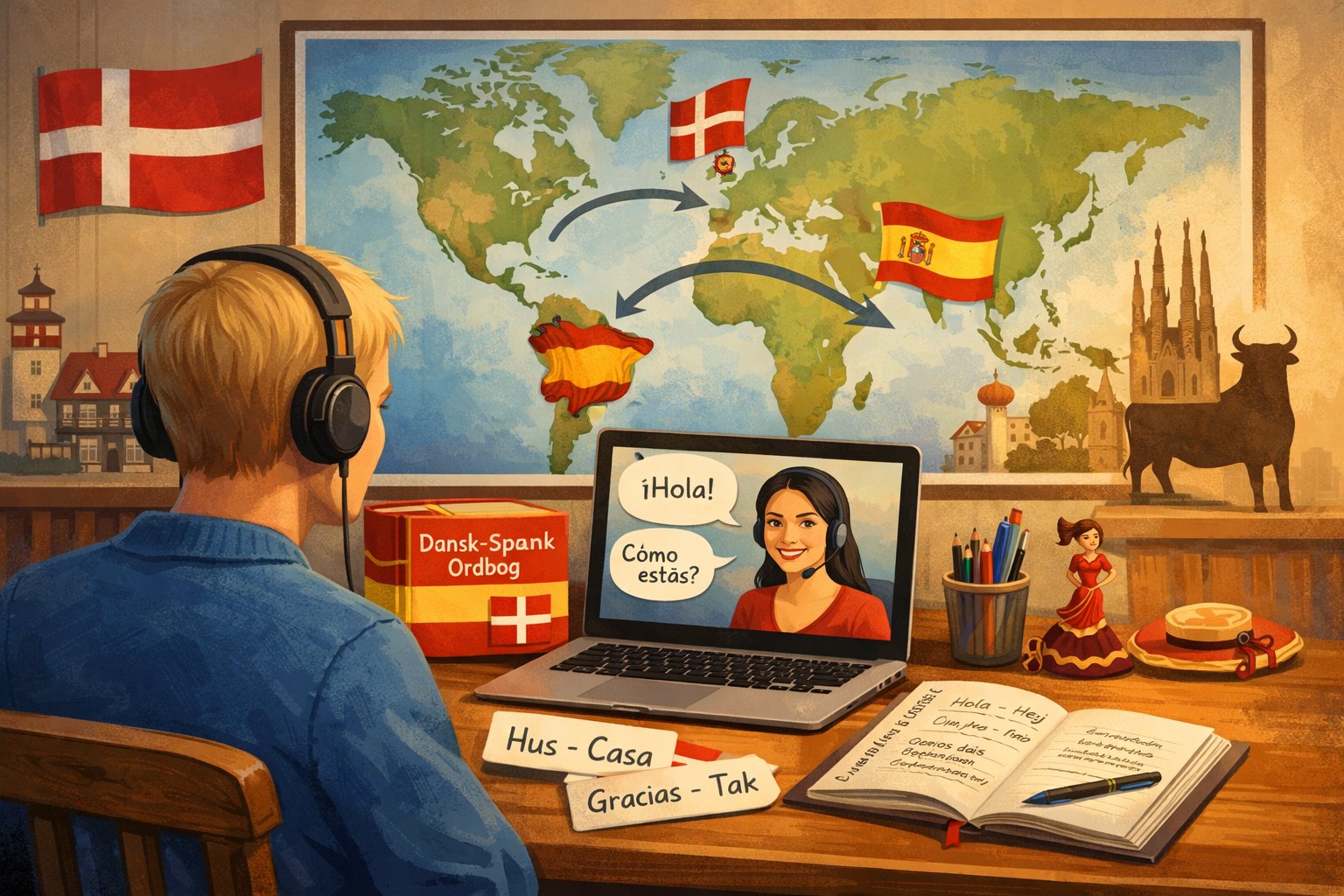
Decoding the Spanish Learning Process for Danish Speakers
Danish speakers run into some structural differences when learning Spanish, but also bring over language skills that make a few things easier.
How Danish and Spanish Differ in Structure
Grammatical Gender System
| Feature | Danish | Spanish |
|---|---|---|
| Noun genders | 2 (common/neuter) | 2 (masculine/feminine) |
| Gender markers | Limited, mostly articles | Extensive: articles, adjectives, pronouns |
| Gender agreement | Minimal | Required for whole noun phrase |
Danish uses en (common) and et (neuter). Spanish needs el/la and full agreement. Every adjective has to match: el carro rojo (the red car) vs la casa roja (the red house).
Verb Conjugation Complexity
- Danish verbs: Same present tense form for all subjects (jeg/du/han spiser)
- Spanish verbs: Six different forms per tense (yo como, tú comes, él come, nosotros comemos, vosotros coméis, ellos comen)
Spanish conjugations are the biggest grammar headache for Danish learners.
Word Order Flexibility
Danish sticks with SVO (subject-verb-object) order. Spanish can flip things for emphasis: María compró el libro or El libro lo compró María (both mean "María bought the book").
Transferable Skills from Danish
Shared Latin Alphabet
Both use the same alphabet, though Spanish adds ñ and accent marks. Danish speakers already read left-to-right and recognize most letters.
Cognates and Borrowed Words
| Danish | Spanish | English |
|---|---|---|
| universitet | universidad | university |
| telefon | teléfono | telephone |
| musik | música | music |
| intelligent | inteligente | intelligent |
Existing Article System
Danish speakers already get definite/indefinite articles (en bog/bogen = un libro/el libro). This transfers straight into Spanish.
Complex Vowel Experience
Danish has tricky vowels and the stød (glottal stop). This helps Danish learners pick up Spanish sounds and new Spanish pronunciation patterns faster than folks with simpler home languages.
Common Challenges for Danish Learners
The Rolled R Sound
Spanish uses the alveolar trill (perro) and tap (pero). Danish R is in the throat, not the mouth.
Practice steps:
- Tongue behind upper teeth
- Exhale with tongue relaxed
- Start with -r- in middle: caro, pero
- Try starting words: rojo, rápido
Pronunciation of J and G
| Letter | Spanish Sound | Danish Equivalent |
|---|---|---|
| J (jota) | Strong /x/ like German "ch" | Closest to soft D |
| G before e/i | Same as J | Hard G sound |
jamón and gente use a fricative sound Danish doesn’t have.
Gender Assignment Memory Load
Danish gender is predictable. Spanish gender often isn’t - memorize with each noun.
Memory tricks:
- Learn article + noun together: el problema, la mano
- Group by ending: -o (mostly masculine), -a (mostly feminine)
- Watch for exceptions: el día, la mano, el mapa
Listening Comprehension Speed
Spanish speakers talk at 7–9 syllables per second. Danish speakers process slower speech - so they need to train their ears for fast syllables.
Setting Realistic Goals and Tracking Progress
Danish speakers learning Spanish need clear targets and ways to check progress. Good goals and tracking keep you moving forward.
SMART Goal Setting for Language Learning
The SMART framework breaks Spanish goals into five parts:
| Component | What It Means | Danish Learner Example |
|---|---|---|
| Specific | Clear and focused | Master present tense conjugations for 50 common verbs |
| Measurable | Trackable | Complete 20 Duolingo lessons weekly |
| Achievable | Realistic for your schedule | Study 15 minutes a day, not 3 hours |
| Relevant | Useful to you | Learn restaurant vocab before Barcelona trip |
| Time-Bound | Has a deadline | Reach A2 level in 6 months |
Rule → Example:
- Rule: Make language goals specific and measurable.
- Example: "Hold a 5-minute conversation on daily routines using present tense by March 15."
Set separate goals for:
- Listening: Understand podcast episodes
- Speaking: Record 2-minute voice notes
- Reading: Finish one news article per week
- Writing: Write error-free emails
Break big goals into weekly steps. A study plan might be: 10 new words per weekday, 30-minute conversation on weekends.
Understanding Fluency Benchmarks
| Level | Hours Needed | Timeline (Danish Learner) | What You Can Do |
|---|---|---|---|
| A1 | 80–100 | 2–3 months (daily) | Basic phrases, present tense |
| A2 | 180–200 | 4–6 months | Simple conversations, past tense |
| B1 | 350–400 | 8–12 months | Travel fluency, complex sentences |
| B2 | 600–750 | 18–24 months | Work talk, understand media |
| C1 | 900+ | 3+ years | Near-full fluency |
Danish speakers benefit from:
- Germanic sentence patterns
- Latin loanwords in academic vocab
- English study (lots of shared words with Spanish)
Progress indicators:
- A2: Understand slow, clear speech on familiar topics
- B1: Get main points in standard Spanish without subtitles
- B2: Chat spontaneously with Spanish speakers
Tools for Motivation and Accountability
| Tool Type | Method | How Often to Update |
|---|---|---|
| Vocabulary logs | Spreadsheet with dates | Daily |
| Speaking recordings | 3-minute audio journal | Weekly |
| Comprehension tests | DELE practice | Monthly |
| Conversation hours | Track on Tandem/iTalki | Each session |
Digital apps:
- Todoist for daily study tracking
- Anki for spaced repetition
- Apps with SMART goal features
Accountability:
- Schedule weekly language exchanges
- Share progress reports with a study buddy
- Join Danish–Spanish groups online
Track what counts:
- Words used correctly in speech
- Minutes of Spanish consumed without translation
- Grammar used spontaneously
Rule → Example:
- Rule: Review and adjust your goals every 4 weeks.
- Example: If you finish tasks early, raise your targets; if you keep missing them, scale back.
| Achievement | Reward |
|---|---|
| Complete A1 | Watch Spanish film, no subtitles |
| 30-day streak | Buy Spanish cookbook, try a recipe |
| First real conversation | Book a weekend trip to Spain |
Accelerating Vocabulary and Pronunciation Acquisition
Danish speakers can speed up Spanish by focusing on high-frequency words, using cognates, and practicing pronunciation early. These three tactics turn months of random study into weeks of real progress.
High-Impact Spanish Words and Phrases
Master the 300 most common Spanish words first - they cover about 65% of daily conversations.
| Spanish Phrase | English | When to Use |
|---|---|---|
| Buenos días | Good morning | Until noon, any setting |
| ¿Cómo estás? | How are you? | Informal, friends |
| Mucho gusto | Nice to meet you | First meetings |
| Me llamo... | My name is... | Introductions |
| Gracias | Thank you | Always handy |
| Por favor | Please | Before requests |
| Lo siento | Sorry | Any apology |
| Salud | Cheers/Bless you | Toasts, sneezes |
| ¿Dónde está...? | Where is...? | Directions |
| ¿Cuánto cuesta? | How much? | Shopping |
Drill these until they’re automatic - usually takes 7–10 days of spaced repetition.
| Verb Category | Examples |
|---|---|
| State verbs | ser, estar, tener, haber |
| Action verbs | hacer, ir, venir, poder |
| Daily routines | comer, beber, dormir, trabajar |
Rule → Example:
- Rule: Spanish adjectives follow nouns.
- Example: "casa roja" (red house), not "roja casa."
Leveraging Cognates and Mnemonics
Danish doesn’t share a ton of cognates with Spanish, but if you know English, it can really help bridge the gap.
Cognate patterns Danish speakers spot:
| Spanish Word | Danish Word | English Cognate | Meaning |
|---|---|---|---|
| familia | familie | family | family |
| música | musik | music | music |
| universidad | universitet | university | university |
| hotel | hotel | hotel | hotel |
| problema | problem | problem | problem |
Mnemonic tricks for non-cognate Spanish words:
- escoba (broom): "Es-COBA" - picture a cobra sweeping with a broom
- manzana (apple): "man-ZAH-na" - imagine a man saying "nah" to an apple
- perro (dog): "PEAR-oh" - see a dog munching a giant pear
Flashcards with images beat text-only cards by 40-60% in Spanish vocab retention tests. Best results: cards with the Spanish word, a pronunciation hint, a picture, and a sample Spanish sentence.
Mastering Pronunciation Early
Spanish pronunciation is pretty regular, but Danish speakers need focused practice to avoid ingrained mistakes.
Key Spanish pronunciation contrasts for Danish speakers:
| Spanish Sound | How to Produce | Typical Danish Error |
|---|---|---|
| r (single) | Quick tongue tap | Guttural Danish r |
| rr (rolled) | Multiple tongue taps | Skipped or replaced with r |
| j, g (before e/i) | Harsh [x] sound | Too soft or skipped |
| ñ | Palatal [ɲ] | "n" + "y" substitution |
| v | Bilabial [b] | Danish "v" instead |
Daily pronunciation drill:
- Listen to Spanish audio 3x without speaking
- Shadow the audio as you read along
- Record yourself and compare to the Spanish version
- Drill tricky sounds on their own
- Return to full phrases, focus on improved sounds
Spanish vowel guide:
- a = "ah" (like "father")
- e = "eh" (like "bet")
- i = "ee" (like "feet")
- o = "oh" (like "boat")
- u = "oo" (like "boot")
Rule → Example:
- Rule: Spanish vowel sounds are always clear and pure.
- Example: “Me llamo Ana” (say every vowel fully, no blending).
Spanish verbs change meaning with stress - “hablo” (I speak) vs. “habló” (he/she spoke). Mark stress in your vocab lists until it sticks.
Personalized Practice: Speaking and Listening for Real Communication
Speaking and listening practice is essential for real-world Spanish. Use language partners, tutors, and audio tools for targeted improvement.
Speaking from Day One: Overcoming Inhibition
Why start speaking early?
- Builds correct pronunciation habits
- Trains recall of vocabulary
- Lowers anxiety through repetition
Daily speaking practice options:
| Method | Time Needed | Focus |
|---|---|---|
| Self-recording | 5-10 minutes | Pronunciation, feedback |
| Shadowing audio | 10-15 minutes | Rhythm, intonation |
| App practice | 15-20 minutes | Sentence building |
Speaking progression:
- Read scripted dialogues out loud
- Answer common questions (no script)
- Describe your daily routine
- Share opinions on familiar topics
Spanish speaking apps offer structured practice and instant feedback. Some even use AI to simulate conversations.
Finding a Language Partner or Tutor
Language partner vs. tutor:
| Option | Cost | Structure | Best For |
|---|---|---|---|
| Language exchange | Free | Informal | Conversation practice |
| Spanish tutor | $10-40/hr | Structured | Beginners |
| Group classes | $15-25/class | Semi-structured | Community learning |
Finding a partner:
- Use platforms like Tandem, HelloTalk, ConversationExchange
- Find Danish learners of Spanish at local universities
- Set 30-minute sessions: 15 min Danish, 15 min Spanish
Working with a tutor:
- Ask for error correction
- Target weak spots (verbs, questions)
- Record sessions for review
Rule → Example:
- Rule: Partners give informal practice, tutors give structured correction.
- Example: Use language exchange for chatting; book a tutor for grammar help.
Active Listening through Podcasts and Audio
Podcast choices by level:
| Level | Podcast Style | Speed | Example |
|---|---|---|---|
| Absolute beginner | Danish + Spanish phrases | Slow | Study Spanish intro |
| Early beginner | Simple Spanish, repetition | 0.75x | Easy Spanish conversations |
| Intermediate | Full speed, clear topics | Normal | Spanish learner podcasts |
Listening practice steps:
- Listen once, no transcript (overall idea)
- Listen again, with transcript (find new words)
- Listen again, no transcript (see if you improved)
- Shadow tough parts (repeat out loud)
Audio retention tips:
- Loop short segments on your commute
- Write down repeated phrases
- Pause and mimic speaker’s tone
- Listen to the same episode several times a week
Immersion Techniques Beyond the Classroom
Home immersion swaps out study time for real Spanish input. Danish learners can get daily Spanish exposure without traveling.
Immerse at Home with Spanish Media
Device Language Settings:
- Set your phone, computer, browser, and TV to Spanish
Digital immersion:
- Switch social media to Spanish
- Follow Spanish-speaking accounts you like
- Join Spanish Reddit groups
- Read Spanish blogs about your hobbies
Label your space:
| Room | Labels to Add |
|---|---|
| Kitchen | nevera (fridge), taza (mug) |
| Bathroom | espejo (mirror), jabón (soap) |
| Office | escritorio (desk), ordenador |
Think in Spanish:
- Start with 1 minute a day
- Ask yourself: "¿Qué estoy haciendo?" (What am I doing?)
- Move to: "¿Qué hice ayer?" (What did I do yesterday?)
- Try future tense: "¿Qué haré mañana?" (What will I do tomorrow?)
Write in Spanish daily to boost recall.
Practical Exposure: Music, TV, and Movies
Spanish music:
- Listen to Spanish radio (Cadena Cope, Amor 92.1)
- Use Spotify playlists from Spain/Latin America
- Check YouTube music channels
- Aim for 5+ minutes daily
Spanish movie watching steps:
| Stage | Audio | Subtitles | Level |
|---|---|---|---|
| 1 | Spanish | Danish | Beginner |
| 2 | Spanish | Spanish | Intermediate |
| 3 | Spanish | None | Advanced |
Recommended content:
- Telenovelas for conversational Spanish
- Spanish Netflix series
- Spanish-dubbed versions of movies you know
- YouTube by Spanish speakers
Audio learning methods:
- Podcasts about your interests
- Audiobooks like El poder de ahora
- Spanish radio for different accents
- Shadowing: listen, repeat instantly
Rule → Example:
- Rule: Always read Spanish subtitles while watching to match sound and text.
- Example: Watch “La Casa de Papel” with Spanish subtitles.
Optimizing Your Learning with Modern Tools and Course Options
Targeted apps, live classes, and multimedia resources give Danish learners a real boost moving from Germanic languages to Spanish.
Selecting Apps for Danish Learners
Best apps with Danish support:
| App | Danish Interface | Main Features | Best For |
|---|---|---|---|
| Duolingo | Yes | Gamified, bite-sized lessons | Daily habit, beginners |
| Babbel | Yes | Danish grammar tips, dialogues | Conversation skills |
| Busuu | Yes | AI feedback, community corrections | Practice with locals |
| Memrise | Yes | Spaced repetition, real Spanish videos | Vocabulary |
| LingQ | Partial | Reading library, context learning | Intermediate vocabulary |
Duolingo and Babbel use Danish menus and explanations, so beginners don’t get lost. Memrise uses spaced repetition to time reviews for max memory.
Flashcard tips:
- Make cards: Danish → Spanish → example sentence
- Add audio for each word
- Review both directions (Danish ↔ Spanish)
- Flag false friends (e.g., embarazada = pregnant, not embarrassed)
Online and Offline Spanish Classes
Live class formats:
| Type | Format | Providers/Examples | Scheduling |
|---|---|---|---|
| 1-on-1 tutoring | Video call | Preply, italki | Flexible |
| Group classes | Live online | Verbling | Fixed weekly |
| Self-paced | Pre-recorded | Rocket Spanish, EdX | Anytime |
| Local classes | In-person | Language schools, community centers | Evenings/weekends |
Preply tutors tailor lessons for Danish speakers - tricky bits like gendered nouns and the subjunctive. Lessons usually last 30-60 minutes, with homework.
- Danish explanations for grammar
- Interactive exercises (not just videos)
- Progress tracking with spaced review
- Audio from Spanish speakers (pick your region)
Choosing Effective Books and Video Lessons
Book types:
| Book Type | Use Case | When to Use |
|---|---|---|
| Grammar workbook | Learn rules systematically | Early levels (A1-B1) |
| Graded reader | Build vocab in context | Daily reading |
| Verb guide | Master tenses | Reference anytime |
| Phrasebook | Quick expressions | Before traveling |
Best Spanish books should have answer keys and step-by-step levels.
Video lesson workflow:
- Butterfly Spanish YouTube for grammar
- Structured video lessons with transcripts
- Watch a short segment
- Pause and shadow pronunciation
- Hide subtitles, repeat sentences
- Record yourself saying examples
Rule → Example:
- Rule: Keep video lessons under 10 minutes for best focus.
- Example: Watch a 7-minute grammar video and practice after.
Danish learners remember 40% more vocab when videos have both visuals and written Spanish.
Community, Motivation, and Long-Term Mastery
- Join Spanish learner groups (online or local)
- Set weekly or monthly goals
- Track milestones (number of conversations, hours studied)
- Celebrate progress, not perfection
- Find a study buddy for accountability
Joining Language Meetups
Finding Danish-Spanish learner groups:
- Online communities: Tandem, HelloTalk, ConversationExchange (filter for Danish locals learning Spanish)
- Local meetups: Meetup.com, Facebook groups (search "Spanish Danish language exchange" + city name)
- University clubs: Danish universities often have language learning community groups open to everyone
- Spanish cultural centers: Instituto Cervantes Copenhagen, regular conversation tables
Meetup formats that work:
| Format | Best For | Time Commitment |
|---|---|---|
| 50/50 language exchange | Balanced Danish/Spanish practice | 1–2 hours weekly |
| Spanish-only conversation | Immersion, quick gains | 1 hour weekly |
| Online video sessions | Remote or busy learners | 30–60 minutes flexible |
Benefits of meetups:
- Exposure to regional accents and slang
- Instant error correction from locals
Building Sustainable Habits
Daily minimum effective dose:
- 15 min: Verb conjugation drills (present, preterite, imperfect)
- 10 min: Spanish audio (podcasts, YouTube)
- 5 min: Review yesterday’s vocab
Weekly study plan:
| Day(s) | Focus Area |
|---|---|
| Mon/Wed/Fri | Grammar (one tense per session) |
| Tue/Thu | Conversation or language exchange |
| Weekend | Immersion (film, articles) |
Consistency rules:
Rule → Schedule Spanish sessions as calendar events, not “when you feel like it.”
Example → Book classes every Monday at 7pm.
Habit anchors for Danish speakers:
- Practice during morning coffee
- Review flashcards on the commute
- Listen to Spanish podcasts while cooking
Celebrating Progress and Milestones
Measurable milestones by CEFR level:
| Level | Can Do Statement | Test It With |
|---|---|---|
| A2 | Order food, give directions | Restaurant role-play |
| B1 | Discuss past experiences | 10-min conversation on vacation |
| B2 | Debate, follow news | Watch news without subtitles |
Progress tracking:
- Record 2-min self-intros monthly (track fluency)
- Take quarterly DELE practice tests
- Log vocab growth (Anki, notebook)
Motivation rule:
Rule → Track specific improvements for visible progress.
Example → Retake the same grammar quiz every 8 weeks; aim for score jump.
Reward ideas:
- Book a trip after reaching B1
- Buy a Spanish novel after finishing a textbook
- Join advanced group after a 100-day streak
Frequently Asked Questions
What resources are recommended for a Danish speaker to learn Spanish effectively?
| Resource Type | Best Options | Key Benefit |
|---|---|---|
| Bilingual dictionaries | Danish-Spanish (Gyldendal, Ordbogen) | Direct translation, skips English |
| Grammar guides | Spanish explained in Danish | Familiar terms, clear explanations |
| Online tutoring | Spanish tutors | Real conversation, correction |
| Audio courses | Spanish podcasts in Danish | Easy passive learning |
| Language exchanges | Tandem partners (Spanish-Danish) | Free, mutual practice |
Effective combinations:
- Weekly tutoring + daily audio
- Grammar book + conversation app
- Reading + writing feedback
Are there any free tools available for learning Spanish if you are fluent in Danish?
Free learning tools:
- YouTube: Spanish taught in Danish
- Tandem, HelloTalk, ConversationExchange
- Public library Spanish resources
- DR (Danish Broadcasting) language programs
- Community meetups in Danish cities
- Online grammar guides
| Feature | Free Tools | Paid Services |
|---|---|---|
| Grammar explanations | Available | More depth |
| Speaking practice | Limited | Regular, scheduled |
| Error correction | None/delayed | Immediate |
| Structured curriculum | Self-directed | Personalized progression |
Tip: Combine free resources with occasional paid tutoring for best results.
How do online platforms compare to traditional language learning methods for Spanish?
| Aspect | Online Platforms | Traditional Classes |
|---|---|---|
| Speaking time/hour | 50–60 min (private)/0–5 min (apps) | 5–10 min (group) |
| Flexibility | Total control | Fixed times |
| Cost/hour | $10–30 (tutor)/$0–15 (apps) | $25–50 (group)/$60–100 (private) |
| Spanish speaker access | Global tutors | Mostly local |
| Progress tracking | Automated | Teacher-dependent |
| Cultural context | Varies by tutor | Depends on teacher |
Online platform advantages:
- Tutors from any region
- Lessons anytime (fits Danish schedules)
- Lower costs
- Digital progress tracking
Traditional classroom advantages:
- Peer interaction
- Physical materials
- Weekly accountability
- Group dynamics
What are the common challenges Danish speakers face when learning Spanish?
| Challenge | Danish Pattern | Spanish Pattern | Solution |
|---|---|---|---|
| Rolled R | Not present | Essential in Spanish | Tongue drills, mimic locals |
| Vowel sounds | 15+ vowels | 5 pure vowels | Repeat pure Spanish vowels |
| Stress patterns | Unpredictable | Accent rules consistent | Learn accent marks |
Grammar differences:
- Danish: two genders; Spanish: all nouns masc/fem
- Spanish verbs: more conjugations than Danish
- Subjunctive: common in Spanish, rare in Danish
- Word order: more flexible in Spanish
False cognates:
| Danish Word | Spanish Equivalent | Note |
|---|---|---|
| konstabel | constable | Not commonly used in Spanish |
| Germanic roots | Latin roots | Less overlap than English/Spanish |
Practice priorities:
- Focus on pronunciation and verbs
- Don’t expect shortcuts from language similarity
Which language learning apps include courses for Spanish tailored to Danish speakers?
| App Name | Danish Interface | Features | Cost |
|---|---|---|---|
| Duolingo | Yes | Gamified, basic grammar | Free w/ads, $7/mo |
| Babbel | Yes | Structured, speech recognition | $7–13/mo |
| Memrise | Yes | Vocab, Spanish speaker videos | Free/Premium $9/mo |
| Drops | Yes | Visual vocab, quick sessions | Free/Premium $13/mo |
| Mondly | Yes | Conversation lessons | $10/mo or $48/yr |
App limitations:
- Focus on vocab, not much speaking
- Limited grammar explanations for Danes
- No custom error correction
- Cultural context is generic
Usage rule:
Rule → Use apps for vocab and daily streaks, but add human conversation for fluency.
Example → 10 minutes Duolingo daily + weekly language exchange.