What Does Ir a Mean in Spanish: Microlearning That Unlocks Fluency
This construction is way more common than the simple future tense in normal conversation across all Spanish-speaking places
Posted by
 Stewart Kaplan
Related reading
What Does Adonde Mean in Spanish? How Movement 'Clicks' for Learners
You have to know when prepositions combine with donde to show direction or position
What Does Ahi Mean in Spanish? Cognitive Mastery That Sticks
Learners mix up ahí, hay, and ay because they sound the same but mean totally different things.
What Does Aki Mean in Spanish: Unpacking Real Usage for Learners
Regional differences exist, but nearly everyone in Spanish-speaking communities gets what "aki" means in a text
TL;DR
- Ir a in Spanish means "going to" in English - use present tense ir + a + infinitive to talk about near-future actions
- The formula is fixed: conjugated ir (voy, vas, va, vamos, vais, van) + a + any infinitive verb (hablar, comer, vivir)
- Ir a + infinitive covers plans, intentions, and predictions based on current evidence - not distant or formal future events
- Reflexive or object pronouns can go before the conjugated ir or attach to the infinitive (me voy a duchar / voy a ducharme)
- This construction is way more common than the simple future tense in normal conversation across all Spanish-speaking places
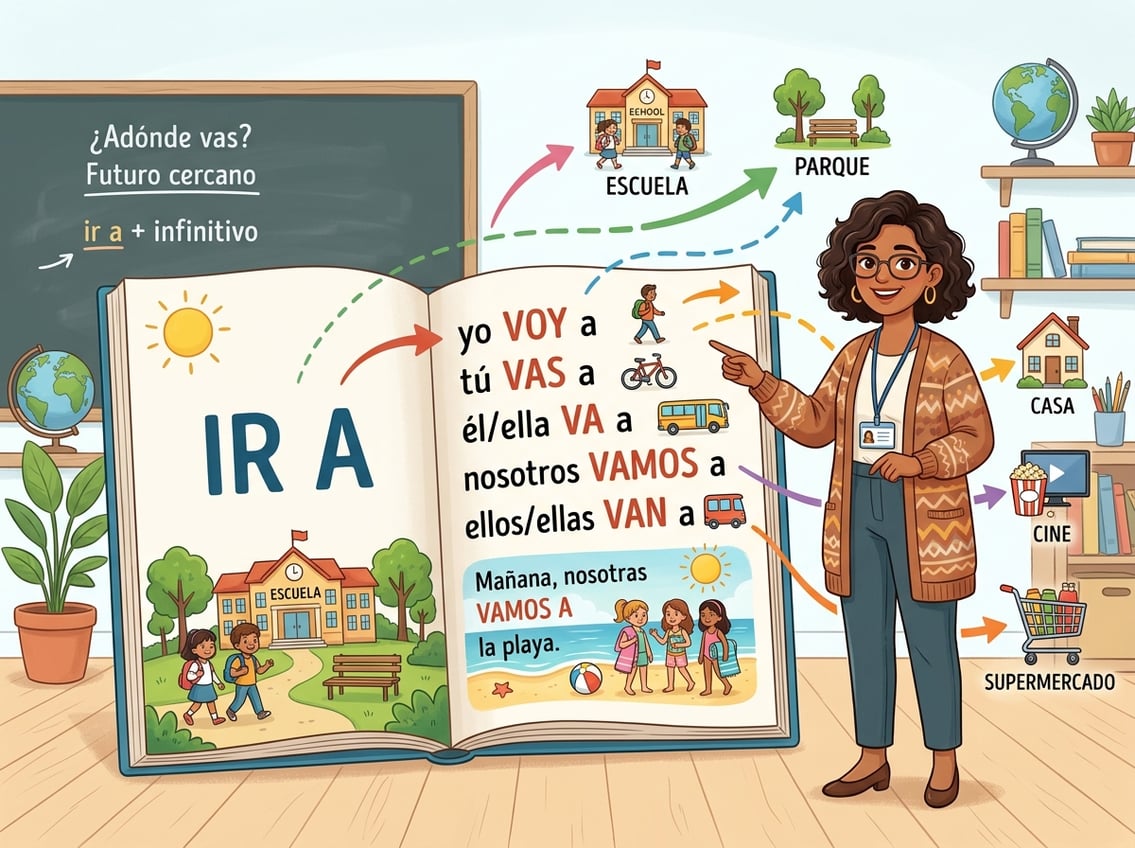
Essential Structure of Ir a + Infinitive
The ir a + infinitive structure uses three parts: ir (conjugated), "a," and an infinitive verb. It lines up with English "going to" and is the main way people talk about near-future plans.
The Formula
Basic Structure:
Conjugated ir + a + infinitive verb
| Subject | Ir Conjugation | + a | Infinitive | English |
|---|---|---|---|---|
| yo | voy | a | estudiar | I am going to study |
| tú | vas | a | comer | you are going to eat |
| él/ella/usted | va | a | trabajar | he/she is going to work |
| nosotros/nosotras | vamos | a | salir | we are going to leave |
| vosotros/vosotras | vais | a | dormir | you all are going to sleep |
| ellos/ellas/ustedes | van | a | viajar | they are going to travel |
Rules:
- Always conjugate ir in present tense
- The preposition "a" is required - don't drop it
- The second verb stays in infinitive (-ar, -er, -ir)
- Nothing goes between "a" and the infinitive
Examples:
- Voy a estudiar español = I am going to study Spanish
- Vas a comprar comida = You are going to buy food
- Vamos a ver una película = We are going to watch a movie
English 'Going to' vs. Spanish
| Spanish | English |
|---|---|
| Voy/vas/va/vamos/vais/van | am/are/is going |
| a | to |
| infinitive verb | base verb |
"Voy a estudiar" = "I am going to study." It's a direct match.
Similarities:
- Both show future plans
- Both work for near-future time
- Both express intention
- Both combine with time words (mañana, esta noche, etc.)
Key Difference:
English speakers often say "gonna" instead of "going to." Spanish never does this. Each part stays separate.
Why Use Ir a + Infinitive?
| Reason | Details |
|---|---|
| Frequency | Most common way to talk about the future in conversation |
| Simplicity | Only one irregular verb (ir) to learn |
| Flexibility | Works with any infinitive verb |
| Usability | Instantly useful for beginners |
Practical Uses:
- Personal plans: "Voy a estudiar esta noche"
- Predictions: "Va a llover mañana"
- Questions: "¿Vas a venir a la fiesta?"
- Group actions: "Vamos a cenar juntos"
If you know the six forms of ir, you can say almost any future action you want.
Step-by-Step Guide to Conjugating Ir
The verb "ir" changes depending on who's doing the action. The present tense is the one you need for ir a + infinitive. The simple future (iré, irás...) is used less in speech.
Present Tense Forms
| Person | Conjugation | Example | English |
|---|---|---|---|
| yo | voy | Voy a estudiar | I'm going to study |
| tú | vas | Vas a estudiar | You're going to study |
| él/ella/usted | va | Va a estudiar | He/She/You is going to study |
| nosotros/nosotras | vamos | Vamos a estudiar | We're going to study |
| vosotros/vosotras | vais | Vais a estudiar | You all are going to study |
| ellos/ellas/ustedes | van | Van a estudiar | They're going to study |
Rule → The present tense of ir is irregular and must be memorized.
Example: "Voy a estudiar" can mean "I'm going to study" or, sometimes, "I go to study" - context matters.
Simple Future Tense (Iré, Irás, etc.)
| Person | Future Form | English |
|---|---|---|
| yo | iré | I will go |
| tú | irás | You will go |
| él/ella/usted | irá | He/She/You will go |
| nosotros/nosotras | iremos | We will go |
| vosotros/vosotras | iréis | You all will go |
| ellos/ellas/ustedes | irán | They/You all will go |
Rule → Add future endings (-é, -ás, -á, -emos, -éis, -án) to the infinitive "ir."
Example: "Iré a España el próximo año" (I will go to Spain next year)
Simple future sounds more formal or distant. In conversation, people stick with ir a + infinitive.
When to Use Each Tense
| Situation | Use Present + a + Infinitive | Use Simple Future |
|---|---|---|
| Near-future plans | Yes | No |
| Casual conversation | Yes | No |
| Formal writing | No | Yes |
| Distant predictions | No | Yes |
Rule → Use "voy a + infinitive" for plans soon or casual talk; use "iré" for formal or far-off events.
Frequency: Present + a + infinitive is used about 80-90% of the time for future in speech.
Communicating Intentions, Plans, and Predictions
The ir a + infinitive structure lets you talk about what's coming up, what you plan to do, or what you think will happen.
Expressing Immediate Future
| Person | Example | Translation |
|---|---|---|
| yo | Voy a estudiar esta tarde | I'm going to study this afternoon |
| tú | Vas a trabajar esta noche | You're going to work tonight |
| él/ella/usted | Va a comer ahora | He/She is going to eat now |
| nosotros | Vamos a salir pronto | We're going to leave soon |
| ellos/ustedes | Van a llegar en cinco minutos | They're going to arrive in five minutes |
Common time words:
- ahora (now)
- esta tarde (this afternoon)
- esta noche (tonight)
- mañana (tomorrow)
- en cinco minutos (in five minutes)
- pronto (soon)
Rule → The conjugation of ir is irregular and must be memorized.
Sharing Personal Intentions
| Type | Example in Spanish | English |
|---|---|---|
| Career | Voy a estudiar medicina | I'm going to study medicine |
| Travel | Vamos a viajar a España el próximo mes | We're going to travel to Spain next month |
| Learning | Va a aprender japonés | He's going to learn Japanese |
| Life change | Van a mudarse a otra ciudad | They're going to move to another city |
Questions for intentions:
- ¿Qué vas a hacer? (What are you going to do?)
- ¿Vas a estudiar esta noche? (Are you going to study tonight?)
- ¿Van a ir a la fiesta? (Are they going to go to the party?)
Rule → The second verb always stays in infinitive form. Never conjugate both verbs.
Making Predictions
Speakers use ir a to make predictions about the future when they notice something happening or have evidence at hand.
Weather predictions:
- Va a llover esta tarde (It's going to rain this afternoon)
- Va a nevar mañana (It's going to snow tomorrow)
- Va a hacer calor (It's going to be hot)
Event predictions:
- Van a ganar el partido (They're going to win the game)
- El tren va a llegar tarde (The train is going to arrive late)
- No va a funcionar (It's not going to work)
Negative predictions:
Place "no" before the conjugated ir.
| Rule | Example |
|---|---|
| Use ir a for predictions based on current evidence | Va a llover (It's going to rain) |
Real-Life Examples and Common Expressions
Rule → Example
- Rule: Use ir a + infinitive for plans, daily routines, and social situations.
- Example: Voy a estudiar en la biblioteca (I'm going to study at the library)
Typical Daily Activities with Ir a
Morning routines:
- Voy a desayunar a las siete (I'm going to eat breakfast at seven)
- Vas a ducharte antes de salir (You're going to shower before leaving)
- Va a preparar café (He's going to make coffee)
Work and study plans:
- Voy a estudiar en la biblioteca (I'm going to study at the library)
- Vamos a trabajar desde casa (We're going to work from home)
- Van a tener una reunión (They're going to have a meeting)
Evening activities:
- Voy a cocinar esta noche (I'm going to cook tonight)
- Vas a ver una película (You're going to watch a movie)
- Vamos a salir con amigos (We're going to go out with friends)
Shopping and errands:
- Voy a ir de compras mañana (I'm going to go shopping tomorrow)
- Va a comprar pan (She's going to buy bread)
- Van a pagar las cuentas (They're going to pay the bills)
Time Expressions to Use
| Time Expression | Example with Ir a | Translation |
|---|---|---|
| esta tarde | Voy a llamarte esta tarde | I'm going to call you this afternoon |
| esta noche | Vamos a cenar esta noche | We're going to have dinner tonight |
| mañana | Va a llover mañana | It's going to rain tomorrow |
| más tarde | Voy a terminar más tarde | I'm going to finish later |
| en una hora | Van a llegar en una hora | They're going to arrive in an hour |
| el próximo lunes | Voy a viajar el próximo lunes | I'm going to travel next Monday |
| pronto | Vas a entender pronto | You're going to understand soon |
Common time combinations:
- Voy a salir en diez minutos (I'm going to leave in ten minutes)
- Va a empezar en media hora (It's going to start in half an hour)
- Vamos a regresar el fin de semana (We're going to return on the weekend)
Practical Questions and Negations
Questions:
- ¿Vas a estudiar esta noche? (Are you going to study tonight?)
- ¿Qué vas a hacer mañana? (What are you going to do tomorrow?)
- ¿Cuándo van a llegar? (When are they going to arrive?)
- ¿Dónde vamos a comer? (Where are we going to eat?)
- ¿Con quién vas a ir? (Who are you going with?)
Negations:
- No voy a trabajar hoy (I'm not going to work today)
- No vas a necesitar dinero (You're not going to need money)
- No vamos a llegar tarde (We're not going to arrive late)
- No van a venir esta tarde (They're not coming this afternoon)
Responses:
- Sí, voy a ir (Yes, I'm going to go)
- No, no voy a poder (No, I can't)
- Tal vez voy a salir (Maybe I'll go out)
Common Mistakes and How to Avoid Them
| Mistake Type | Wrong Form | Correct Form |
|---|---|---|
| Wrong preposition | Voy para estudiar | Voy a estudiar |
| Missing "a" | Voy estudiar | Voy a estudiar |
| Conjugated verb after "a" | Voy a estudio | Voy a estudiar |
| Wrong word order in questions | ¿A dónde vas ir? | ¿A dónde vas a ir? |
Ir a vs. Ir con:
| Phrase | Meaning |
|---|---|
| Voy a la tienda | I'm going to the store (destination) |
| Voy con mi hermana | I'm going with my sister (companion) |
| Voy a comprar con mi hermana | I'm going to buy with my sister (action + companion) |
Vámonos vs. Vamos a ir:
| Expression | Use | Example |
|---|---|---|
| Vámonos | Let's go (now) | Vámonos a casa |
| Vamos a ir | We're going to go (future) | Vamos a ir al cine |
The Broader Meaning of Ira in Spanish
"Ira" is a feminine noun in Spanish. It means anger, wrath, or rage. Don't mix it up with the verb "ir" (to go) - they're unrelated.
Ira as a Feminine Noun
| Singular | Plural |
|---|---|
| la ira | las iras |
| una ira | unas iras |
Rule → Example
- Rule: "Ira" always takes feminine articles and adjectives.
- Example: la ira profunda (deep anger)
Common Phrase Patterns
- la ira de Dios (God's wrath)
- un ataque de ira (a fit of rage)
- lleno de ira (full of anger)
- desatar la ira (to unleash wrath)
- contener la ira (to contain anger)
Ira: Anger, Wrath, and Rage
| Spanish Term | English Equivalent | Intensity |
|---|---|---|
| enojo | annoyance | Low |
| enfado | anger | Medium |
| ira | wrath/rage | High |
| furia | fury | Very High |
Context Examples
- Su ira era evidente. (His wrath was obvious.)
- Habló con ira. (She spoke with rage.)
- La ira lo consumía. (Anger consumed him.)
- Sintió una ira profunda. (He felt a deep rage.)
Collocations:
- provocar la ira (provoke anger)
- despertar la ira (awaken wrath)
- sentir ira (feel rage)
- expresar ira (express anger)
Emotional Usage Versus Verb 'Ir'
| Feature | Ira (noun) | Ir (verb) |
|---|---|---|
| Part of Speech | Feminine noun | Verb |
| Meaning | Anger/wrath/rage | To go |
| Article Required | Yes (la/una) | No |
| Conjugates | No | Yes |
| Pronunciation | EE-rah | EER |
| Sentence | Usage |
|---|---|
| La ira es peligrosa. | Noun |
| Voy a ir mañana. | Verb |
| Ira appears in: | Ir appears in: |
|---|---|
| Emotional descriptions | Future constructions with "ir a" |
| Literary texts | Movement descriptions |
| Religious contexts | Daily conversation |
| Psychological discussions | Travel plans |
Comparing Cultural and Everyday Usage
| Phrase | Use | Example |
|---|---|---|
| Ir a + infinitive | Plans, casual speech | Voy a comer |
| Vámonos | Immediate group departure | Vámonos ya |
| Ir con | Accompaniment, urgency | Me voy con prisa |
Rule → Example
- Rule: Spanish speakers use ir a + infinitive for immediate and planned actions.
- Example: Voy a llamar mañana (I'm going to call tomorrow)
Memory Tips for Learners
- Pair ir a with daily activities
- Practice tomorrow's plans using ir a
- Listen to Spanish audio of ir a phrases
Regional Differences in Usage
| Region | Distinctive Usage | Translation |
|---|---|---|
| Spain | Me voy a la playa | I'm going to the beach |
| Mexico | Voy a ir al centro | I'm going downtown |
| Argentina | Voy para la estación | I'm going to the station |
| Caribbean | Voy pa'llá | I'm going there |
| Region | Pronunciation Pattern |
|---|---|
| Spain | Full "ir a" pronunciation |
| Latin America | "para" contracts to "pa'" |
| Coastal | Final consonants dropped in casual speech |
| Meal Time Phrase | Common Time |
|---|---|
| Voy a comer (Spain) | 2-3 PM |
| Voy a almorzar (Latin America) | 12-1 PM |
| Ir a cenar (All regions) | After 8 PM |
Key Phrases with Ir a and Ir con
High-Frequency Combinations
| Phrase | Literal Meaning | Usage Context |
|---|---|---|
| Voy a ver | I'm going to see | Plans, TV, meetings |
| Voy a hacer | I'm going to do | Tasks, activities |
| Ir con cuidado | To go with care | Warnings, advice |
| Ir con alguien | To go with someone | Accompaniment |
| Vámonos de aquí | Let's leave here | Urgent departure |
Phrase Building Steps
- Start with "ir"
- Add a preposition: "a" or "con"
- Finish with an infinitive or a noun
- Example: ir a estudiar, ir con María
- Day 1: Match phrases to situations
- Day 3: Fill in missing words
- Day 7: Translate from English prompts
- Day 14: Use phrases in real conversations
Common Response Patterns
When someone says "Voy a salir" (I'm going to leave):
| Situation | Example Spanish | English Translation |
|---|---|---|
| Ask destination | ¿A dónde vas? | Where are you going? |
| Ask companion | ¿Con quién vas? | Who are you going with? |
| Suggest together | Vámonos juntos | Let's go together |
Practice Rule → Example
Rule: Practice "ir a" + infinitive daily with Spanish audio for faster recall.
Example: Listen and repeat "Voy a estudiar" with a Spanish speaker.
Frequently Asked Questions
| Topic | Rule/Fact | Example/Link |
|---|---|---|
| Meaning change | "ir" alone = movement; "ir a" + infinitive = future plans, no movement required | The verb "ir" |
| Time frames | Use "ir a" for near-future intentions or logical conclusions | Voy a ordenar los archivos; Va a llover pronto |
| Spoken usage | "Ir a" for futuro próximo is more common in conversation than the simple future tense | futuro próximo with ir a |
What is the difference between using "ir" and "ir a" in Spanish?
| Form | Structure | Meaning | Example |
|---|---|---|---|
| ir | ir + destination | to go (movement) | Voy al parque (I go to the park) |
| ir a | ir + a + infinitive | going to (future intention) | Voy a estudiar (I'm going to study) |
- "Ir" alone: movement to a place.
- "Ir a" + infinitive: future plan or intention.
When should you use the "ir a" structure to talk about the future in Spanish?
| Situation | Example Spanish | English Translation |
|---|---|---|
| Near-future plan | Voy a ordenar los archivos | I'm going to organize the files |
| Group plan | Van a comprar una casa | They're going to buy a house |
| Logical conclusion | Vamos a llegar tarde | We're going to be late |
| Prediction | Va a llover pronto | It's going to rain soon |
How do you conjugate "ir" in the present tense for all subject pronouns?
| Subject Pronoun | Conjugation | English |
|---|---|---|
| yo | voy | I go |
| tú | vas | you go (informal) |
| él/ella/usted | va | he/she goes, you go (formal) |
| nosotros/nosotras | vamos | we go |
| vosotros/vosotras | vais | you all go (Spain) |
| ellos/ellas/ustedes | van | they go, you all go |
- "Ir" is irregular. None of its present forms look like the infinitive.
What is the "yo" conjugation of "ir" and how is it used in a sentence?
| Rule | Example Phrase |
|---|---|
| "Yo" form: voy | Voy a la tienda |
| Voy a trabajar mañana | |
| No voy al cine hoy | |
| ¿Voy contigo? |
- In practice, "yo" is usually left out since "voy" makes it clear who's talking.
How do you conjugate "ir" in the past tense to say "went" in Spanish?
Preterite (simple past):
| Subject Pronoun | Conjugation | English |
|---|---|---|
| yo | fui | I went |
| tú | fuiste | you went |
| él/ella/usted | fue | he/she/you went |
| nosotros/nosotras | fuimos | we went |
| vosotros/vosotras | fuisteis | you all went (Spain) |
| ellos/ellas/ustedes | fueron | they/you all went |
Imperfect (ongoing past):
| Subject Pronoun | Conjugation | English |
|---|---|---|
| yo | iba | I was going / used to go |
| tú | ibas | you were going / used to go |
| él/ella/usted | iba | he/she/you was going / used to go |
| nosotros/nosotras | íbamos | we were going / used to go |
| vosotros/vosotras | ibais | you all were going / used to go |
| ellos/ellas/ustedes | iban | they/you all were going / used to go |