Spanish Numbers 1700–1800: Microlearning Strategies for Rapid Recall
Use y only between tens and units, never between hundreds and tens - unlike some other languages
Posted by
 Stewart Kaplan
Related reading
What Does Adonde Mean in Spanish? How Movement 'Clicks' for Learners
You have to know when prepositions combine with donde to show direction or position
What Does Ahi Mean in Spanish? Cognitive Mastery That Sticks
Learners mix up ahí, hay, and ay because they sound the same but mean totally different things.
What Does Aki Mean in Spanish: Unpacking Real Usage for Learners
Regional differences exist, but nearly everyone in Spanish-speaking communities gets what "aki" means in a text
TL;DR
- Spanish numbers 1700–1800 use the pattern: mil + hundreds + tens + units, with y only between tens and units
- Adults remember these faster by chunking: thousands block, hundreds block, compound tens - skip memorizing every single form
- The main pieces - mil, setecientos, ochocientos, novecientos, and tens (30–90) - mix and match through the whole range, lowering cognitive load
- Retrieval practice with progressive digit removal (like 1743 → mil setecientos cuarenta y ___ → mil setecientos ___ y tres) boosts recall more than just reading
- Use y only between tens and units, never between hundreds and tens - unlike some other languages
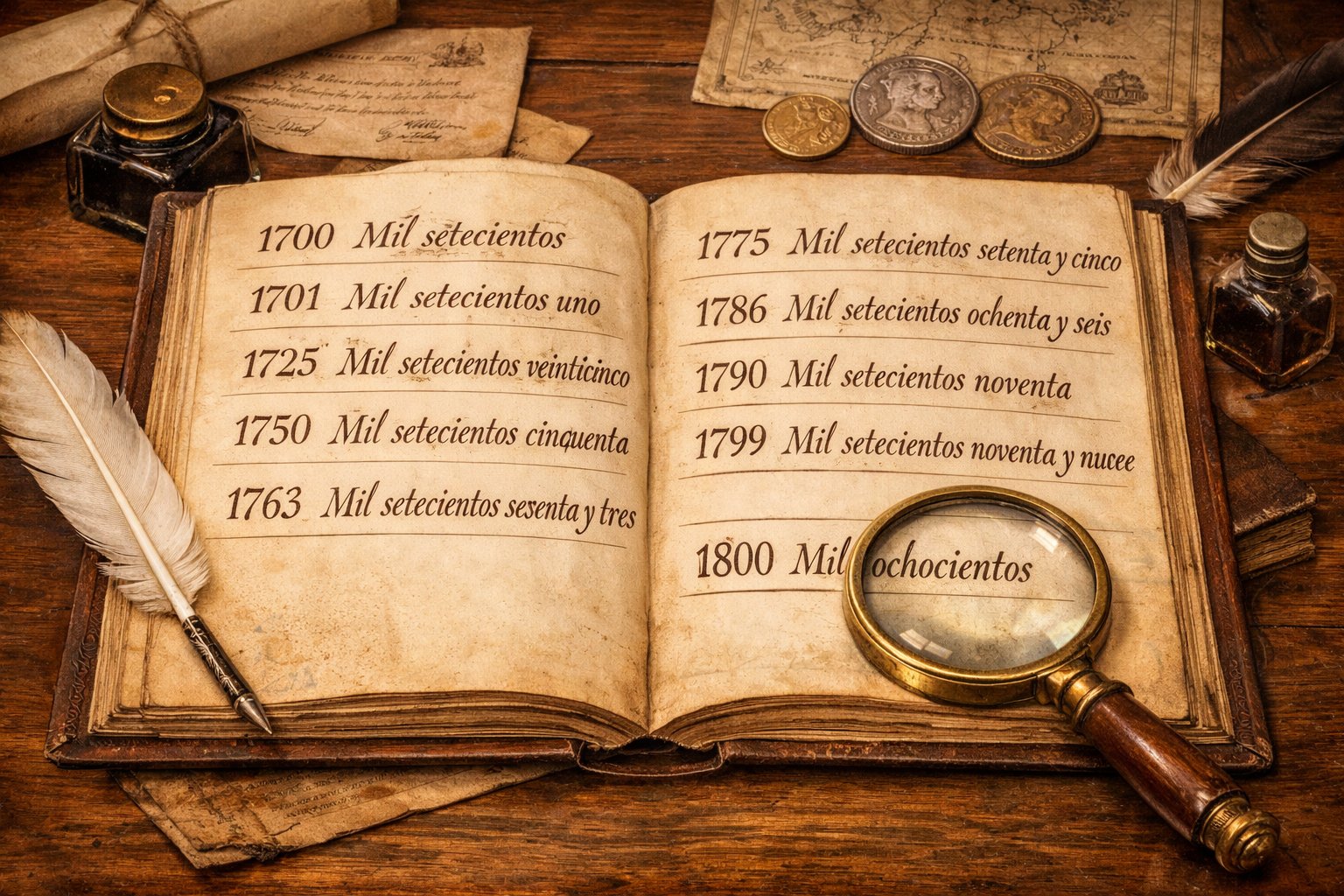
How to Understand and Build Spanish Numbers from 1700 to 1800
Spanish numbers from 1700 to 1800 always combine thousands, hundreds, and tens. The range uses mil (1000) plus hundreds like setecientos (700) and ochocientos (800).
Number Construction Rules in the 1700–1800 Range
Base components:
- mil = 1000 (never plural)
- setecientos/setecientas = 700
- ochocientos/ochocientas = 800
Formation pattern:
- Start with mil
- Add hundreds (pick the right gender: setecientos or setecientas)
- Add tens and ones, using y only between tens and ones
Core structure examples:
| Number | Spanish | Breakdown |
|---|---|---|
| 1700 | mil setecientos | mil + setecientos |
| 1701 | mil setecientos uno | mil + setecientos + uno |
| 1721 | mil setecientos veintiuno | mil + setecientos + veintiuno |
| 1750 | mil setecientos cincuenta | mil + setecientos + cincuenta |
| 1799 | mil setecientos noventa y nueve | mil + setecientos + noventa + y + nueve |
| 1800 | mil ochocientos | mil + ochocientos |
Gender agreement rules:
- 1701 books (masculine): mil setecientos un libros
- 1701 houses (feminine): mil setecientas una casas
- 1750 cars (masculine): mil setecientos cincuenta coches
- 1750 tables (feminine): mil setecientas cincuenta mesas
Hundreds change gender even if other number parts come before the noun.
Patterns and Structure: Rapid Recognition Techniques
Chunk recognition method:
- 1700-1799: Always starts with mil setecientos/setecientas
- 1800: mil ochocientos/ochocientas
Common number patterns:
| Range | Shared prefix | Variable ending |
|---|---|---|
| 1700-1709 | mil setecientos | uno through nueve |
| 1710-1719 | mil setecientos | diez through diecinueve |
| 1720-1729 | mil setecientos | veinte through veintinueve |
| 1730-1739 | mil setecientos | treinta through treinta y nueve |
| 1740-1749 | mil setecientos | cuarenta through cuarenta y nueve |
| 1750-1759 | mil setecientos | cincuenta through cincuenta y nueve |
| 1760-1769 | mil setecientos | sesenta through sesenta y nueve |
| 1770-1779 | mil setecientos | setenta through setenta y nueve |
| 1780-1789 | mil setecientos | ochenta through ochenta y nueve |
| 1790-1799 | mil setecientos | noventa through noventa y nueve |
Recognition shortcuts:
- Find mil first (always there)
- Next, spot setecientos or ochocientos
- Last, break down the final two digits using standard 1-99 rules
- Check noun gender: -os for masculine, -as for feminine
Practical Usage in Contexts: Money, Dates, and Counting
Historical dates:
- 1776: mil setecientos setenta y seis
- 1789: mil setecientos ochenta y nueve
- 1800: mil ochocientos
Currency amounts:
- 1705 pesos: mil setecientos cinco pesos
- 1750 dólares: mil setecientos cincuenta dólares
- 1792 euros: mil setecientos noventa y dos euros
Inventory counting:
- 1703 items (masculine): mil setecientos tres artículos
- 1725 boxes (feminine): mil setecientas veinticinco cajas
- 1797 products (masculine): mil setecientos noventa y siete productos
Written number punctuation:
| Country/Region | 1,750 Written As |
|---|---|
| Spain | 1.750 |
| Mexico/Puerto Rico | 1,750 |
Practice sequence for fluency:
- Memorize mil setecientos and mil ochocientos as single units
- Drill endings 1-99 until they're automatic
- Combine chunks without pausing
- Apply gender rules after you build some speed
Cognitive Shortcuts: Accelerating Spanish Number Mastery for Adult Learners
Adults pick up big Spanish numbers faster using pattern recognition and spaced retrieval, not just rote memorization. Cognitive strategies and historical context help numbers like 1700–1800 stick.
Why Traditional Memorization Fails with Large Numbers
Working Memory Limits
| Limitation | Example |
|---|---|
| Holds 4–7 chunks | mil + setecientos + y + uno = 4 elements |
| Overload leads to forgetting | Memorizing 1700–1800 as separate numbers |
Pattern Recognition vs. Repetition
| Method | Retention After 24 Hours | Application Speed |
|---|---|---|
| Rote drilling | 15–20% | Slow (need to reconstruct) |
| Pattern chunking | 65–75% | Fast (recall by chunk) |
Key Processing Rules
- Mil (1,000) stays the same for all numbers in this range
- Setecientos (700) is irregular (never sietecientos)
- Only the last two digits (0–99) change
Rule → Example
Always use mil setecientos for 1700–1799: mil setecientos cuarenta y cinco
Microlearning and Retrieval Practice Methods Backed by Research
Spaced Retrieval Protocol
| Day | Activity |
|---|---|
| 1 | Say mil setecientos 5 times with audio |
| 2 | Add random units (e.g., 05, 23, 47) out loud |
| 4 | Write numbers from audio cues |
| 7 | Generate numbers from event prompts |
Progressive Word Removal Steps
- Full: mil setecientos ochenta y nueve
- Remove 1: ___ setecientos ochenta y nueve
- Remove 2: ___ ___ ochenta y nueve
- Remove 3: ___ ___ ___ y ___
Contextual Anchoring Table
| Number | Historical Event | Retrieval Cue |
|---|---|---|
| 1776 | Mil setecientos setenta y seis | American independence |
| 1789 | Mil setecientos ochenta y nueve | French Revolution |
| 1762 | Mil setecientos sesenta y dos | British occupy Manila |
Rule → Example
Connect numbers to memorable events: 1789 → French Revolution
Application in Real Life: Spanish Numbers in Spain, Philippines, and the Spanish Empire
Colonial Administration Dates (1700–1800)
| Context | Spanish Example | English Equivalent |
|---|---|---|
| Decree | El decreto se firmó el dieciocho de mayo de mil setecientos cuarenta y dos | The decree was signed May 18, 1742 |
| Census | La población era mil setecientos noventa y tres habitantes | The population was 1,793 |
| Trade | Mil setecientos setenta y ocho pesos | 1,778 pesos |
Philippines Under Spanish Rule
| Context | Spanish Format | English |
|---|---|---|
| Galleon trade year | Mil setecientos cincuenta y cinco | 1755 |
| Manila population | Mil setecientos ochenta habitantes | 1,780 inhabitants |
| Colonial tax | Mil setecientos veinte pesos | 1,720 pesos |
Regional Variations in Spain
| Region | Standard Form | Note |
|---|---|---|
| Madrid | mil setecientos | Used in notarial docs |
| Seville | mil setecientos | Same as Madrid |
| Barcelona | mil setecientos | No regional change |
Retrieval Practice for Historical Context
- Match years to events (e.g., 1762 → British occupation → mil setecientos sesenta y dos)
- Convert written dates to spoken Spanish
- Generate random years in this range under time pressure (5 seconds per number)
Rule → Example
Link numbers to events for better recall: 1776 → mil setecientos setenta y seis
Frequently Asked Questions
| Topic | Rule or Pattern | Example |
|---|---|---|
| Pronunciation | y only between tens and units | mil setecientos cuarenta y tres |
| Gender agreement | Match hundreds to noun gender | mil setecientas casas |
| Historical dates | Use cardinal numbers, no century split | mil setecientos ochenta y nueve |
How do you pronounce numbers between 1700 and 1800 in Spanish?
Every number here starts with "mil" (thousand), then tacks on the hundreds.
Pattern:
- mil + setecientos/as (700)
- mil + ochocientos/as (800)
Examples:
| Number | Spanish | Pronunciation |
|---|---|---|
| 1700 | mil setecientos | meel seh-teh-SYEN-tohs |
| 1725 | mil setecientos veinticinco | meel seh-teh-SYEN-tohs vayn-tee-SEEN-koh |
| 1750 | mil setecientos cincuenta | meel seh-teh-SYEN-tohs seen-KWEN-tah |
| 1775 | mil setecientos setenta y cinco | meel seh-teh-SYEN-tohs seh-TEN-tah ee SEEN-koh |
| 1800 | mil ochocientos | meel oh-choh-SYEN-tohs |
- Main stress lands on "-cien-" in setecientos/ochocientos.
- "y" (and) only pops up between tens and ones.
What are the Spanish number equivalents for 1700, 1750, 1800?
| Number | Spanish | Literal translation |
|---|---|---|
| 1700 | mil setecientos | one thousand seven hundred |
| 1750 | mil setecientos cincuenta | one thousand seven hundred fifty |
| 1800 | mil ochocientos | one thousand eight hundred |
Gender agreement:
- mil setecientos años (masculine)
- mil setecientas páginas (feminine)
Can you provide a list of Spanish numbers from 1700 to 1800?
Every ten from 1700-1800:
| Number | Spanish |
|---|---|
| 1700 | mil setecientos |
| 1710 | mil setecientos diez |
| 1720 | mil setecientos veinte |
| 1730 | mil setecientos treinta |
| 1740 | mil setecientos cuarenta |
| 1750 | mil setecientos cincuenta |
| 1760 | mil setecientos sesenta |
| 1770 | mil setecientos setenta |
| 1780 | mil setecientos ochenta |
| 1790 | mil setecientos noventa |
| 1800 | mil ochocientos |
Examples between:
- 1701: mil setecientos uno
- 1715: mil setecientos quince
- 1723: mil setecientos veintitrés
- 1734: mil setecientos treinta y cuatro
- 1745: mil setecientos cuarenta y cinco
- 1756: mil setecientos cincuenta y seis
- 1767: mil setecientos sesenta y siete
- 1778: mil setecientos setenta y ocho
- 1789: mil setecientos ochenta y nueve
- 1799: mil setecientos noventa y nueve
What are the rules for constructing numbers in the 1700-1800 range in Spanish?
| Rule | Example |
|---|---|
| Start with "mil" (1000) | mil setecientos |
| Add hundreds: "setecientos" (700) or "ochocientos" (800) | mil ochocientos |
| Add digits 1–99 with standard rules | mil setecientos cuarenta y dos |
Gender agreement:
| Context | Masculine form | Feminine form |
|---|---|---|
| Standalone | mil setecientos | mil setecientas |
| Before masculine noun | mil setecientos libros | - |
| Before feminine noun | - | mil setecientas páginas |
| Ending in "uno" + masculine | mil setecientos un años | - |
| Ending in "uno" + feminine | - | mil setecientas una casas |
Conjunction "y":
- Use "y" only between tens and ones
- Correct: mil setecientos treinta y cinco (1735)
- Incorrect: mil y setecientos treinta y cinco
Numbers 21–29:
- 1721: mil setecientos veintiuno
- 1722: mil setecientos veintidós
- 1726: mil setecientos veintiséis