How Long Does It Take Adults to Learn Spanish? Science-Backed Speed & Unlocking Rapid Fluency
Adult learners can reach Spanish fluency faster than you think. Explore realistic timelines based on proficiency levels, proven learning methods, and how to align your goals with your study commitment.
Posted by
 Stewart Kaplan
Related reading
Basic Spanish Words Every Beginner Should Learn (Organized by Category)
Master 200+ essential Spanish words organized by category: greetings, food, travel, and emergency phrases. Includes example sentences for each word. Perfect for beginners building vocabulary.
Best Apps to Learn Spanish (2026 Review): Ranked by Speed & Retention
Compare the best Spanish learning apps in 2026. Ranked by speed to fluency, retention rates, and value. Includes Duolingo, Babbel, Rosetta Stone, Pimsleur, and more.
Can You Learn Spanish in 3 Months? Reality Check + 90-Day Sprint Plan
Honest assessment of what's achievable in 3 months of Spanish learning. Includes realistic expectations, fluency levels, and a complete 90-day sprint plan.
Defining 'Learning Spanish' for Adults
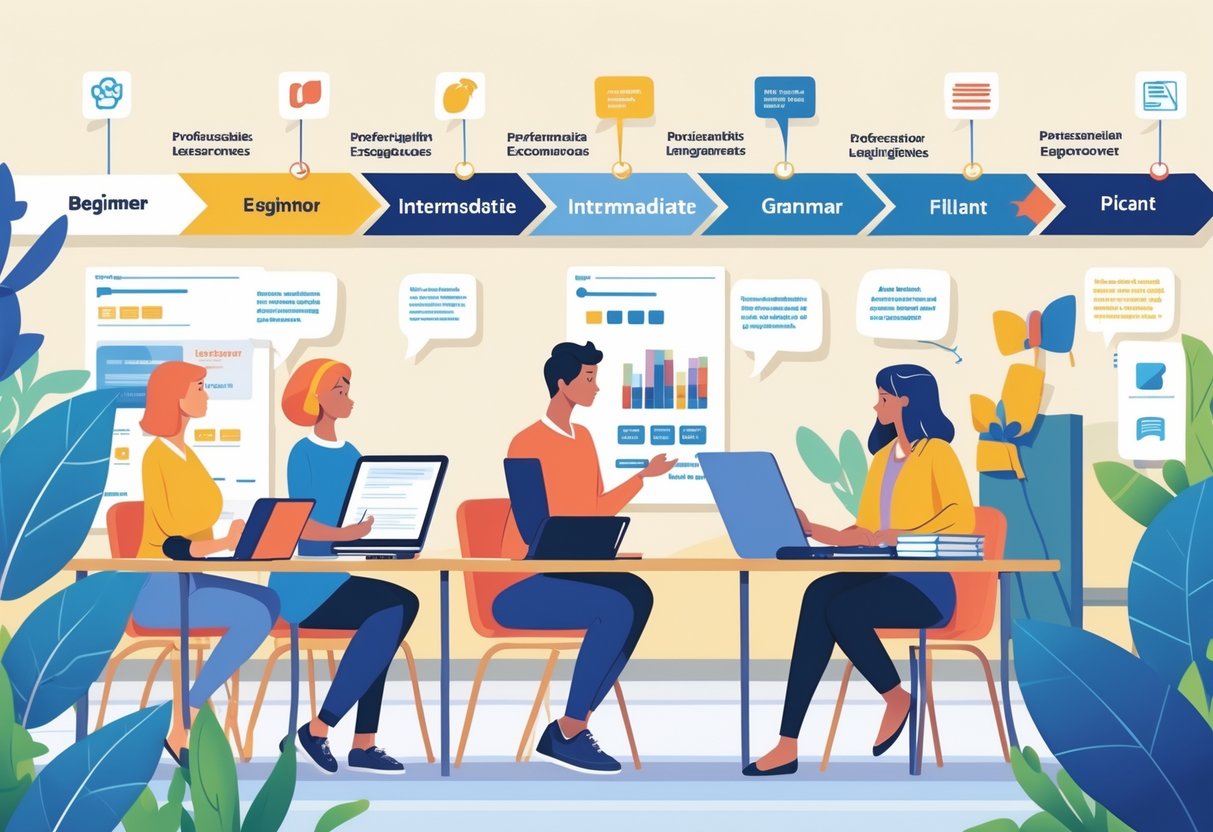
Spanish proficiency exists on a spectrum from basic travel phrases to near-fluent mastery, with formal frameworks like CEFR and FSI providing measurable benchmarks. Adult learners benefit from understanding these scales and aligning them with personal goals, whether conversational fluency, workplace communication, or advanced comprehension. For a comprehensive overview, see how long it takes to learn Spanish.
Levels of Spanish Proficiency Explained
Spanish proficiency breaks into six main levels under the Common European Framework of Reference. A1 and A2 represent basic users who handle simple, everyday exchanges. B1 and B2 mark independent users capable of handling most conversations and workplace situations.
C1 and C2 define proficient users with near-fluent command. Each level requires progressively more study hours, with A1 requiring 70-80 hours and C2 demanding 920-1,100 total hours.
Adults acquire these levels more efficiently when learning materials activate multiple memory pathways simultaneously. Spaced repetition prevents forgetting by reintroducing phrases at calculated intervals. Contextual recall strengthens when learners encounter vocabulary within full sentences rather than isolated word lists.
Auditory reinforcement through Spanish audio embeds pronunciation patterns that visual study alone cannot replicate. Progressive phrase training, where words gradually disappear from written text while audio continues, forces active retrieval rather than passive recognition. These methods align with how adult brains form durable language memories.
CEFR vs. FSI Frameworks
The Foreign Service Institute estimates 600-750 hours for Spanish fluency, though this applies specifically to English speakers with strong language-learning aptitude. FSI measures time to professional working proficiency, not conversational comfort or C2 mastery.
CEFR provides more granular stages that match real-world abilities. A learner at B1 can discuss familiar topics and handle travel independently. B2 enables workplace conversations and detailed explanations.
FSI's framework focuses on intensive, classroom-based instruction with homework. CEFR accounts for varied learning environments and self-study approaches. Most adult learners find CEFR's incremental stages more motivating than FSI's broader categories.
Daily exposure through short, consistent sessions produces better retention than sporadic marathon study blocks. Five-minute daily routines with Spanish audio and disappearing-text exercises create stronger neural pathways than hour-long vocabulary drills twice weekly.
Conversational, Professional, and Natural Goals
Conversational Spanish typically requires reaching B1 or B2, taking 7-24 months depending on study intensity. This level handles social situations, travel, and casual workplace chat. Adults aiming for professional use need B2 minimum, often C1 for technical fields or client-facing roles.
Natural fluency at C2 demands understanding cultural nuances, idioms, and regional variations. This goal requires 1.5-3 years of dedicated study for most English speakers.
Adults should define their endpoint before choosing learning methods. Travel goals need basic vocabulary and pronunciation confidence. Professional goals require grammar accuracy and expanded vocabulary within specific domains. Check how many hours a day to study for optimal scheduling.
Context-based learning accelerates all three goal types. Phrases learned within realistic scenarios stick better than decontextualized grammar rules. Spanish audio paired with written text trains both comprehension and pronunciation simultaneously. Progressive word removal from familiar phrases forces active recall, the most effective memory consolidation technique for adult learners.
Realistic Timeframes to Spanish Fluency
The U.S. Foreign Service Institute estimates adults need 600 to 750 classroom hours to reach professional working proficiency in Spanish, though total study time including self-directed practice typically reaches 1,200 to 1,500 hours. Actual timelines depend heavily on study intensity, method quality, and whether learners incorporate spaced repetition and contextual reinforcement into daily routines.
Time Estimates for Each Proficiency Level
Basic conversational ability emerges after 150 to 250 hours of study, allowing learners to handle everyday topics and simple social exchanges. This level requires mastery of roughly 1,000 high-frequency words and present, past, and basic future tenses.
Professional working proficiency arrives between 600 and 1,000 hours for most adults. At this stage, learners can discuss complex topics, handle work situations in Spanish, and understand Spanish speakers at normal speeds. Vocabulary expands to 3,000 to 5,000 words, and all major verb tenses become accessible.
Near-full fluency demands 2,000 to 3,000 hours spread over several years. Adults reaching this level can navigate regional dialects, understand cultural nuances, and produce speech with minimal accent interference. The cognitive load required to process Spanish drops significantly as the brain builds automatic retrieval pathways through repeated contextual exposure.
Proficiency Milestones:
- Tourist survival: 40-60 hours (300 core words, present tense only)
- Basic conversations: 150-250 hours (1,000 words, three primary tenses)
- Work proficiency: 600-1,000 hours (3,000-5,000 words, full tense system)
- Advanced fluency: 2,000-3,000 hours (10,000+ words, cultural mastery)
Study Hours: Classroom, Self-Study, and Immersion
One hour of daily study produces basic conversational skills in five to eight months. Two hours daily accelerates learning Spanish to 10 months for working proficiency, while three-plus hours reaches the same milestone in six to seven months.
Immersion environments cut timelines dramatically because adults receive six to 10 hours of comprehensible input daily. Living in a Spanish-speaking country can produce conversational ability in three to six months and professional proficiency within eight to 12 months.
The quality of study hours matters more than quantity. Spaced repetition systems strengthen memory consolidation by reintroducing material at optimal intervals, preventing the rapid forgetting that plagues cramming sessions. When adults encounter new phrases in varied contexts rather than isolated lists, the brain forms multiple retrieval pathways that resist decay.
Daily email-based learning creates consistent touchpoints that leverage spaced repetition naturally. Adults who process five minutes of contextually rich Spanish phrases each morning, with Spanish audio reinforcement and progressive word removal, build stronger recall than those drilling vocabulary for 30 minutes weekly. The disappearing-text training forces active retrieval, which cognitive research shows creates more durable memory traces than passive recognition.
Professional Working Proficiency Timelines
Professional working proficiency requires 1.5 to three years when adults study one hour daily. This timeline assumes balanced practice across listening, reading, speaking, and writing, with regular conversation exchanges starting within the first two months.
Adults studying two hours daily reach this level in 10 to 20 months. The accelerated pace comes from increased exposure to comprehensible input and more frequent retrieval practice, both critical for automaticity in language production.
Study Intensity Comparison:
| Daily Study Time | Months to Proficiency | Total Hours |
|---|---|---|
| 1 hour | 20-40 months | 600-1,200 |
| 2 hours | 10-20 months | 600-1,200 |
| 3+ hours | 6-13 months | 600-1,200 |
| Immersion | 8-12 months | 1,200-1,800 |
Method selection dramatically impacts these timelines. Adults using pattern recognition and contextual learning reach conversational milestones 30 percent faster than those relying on grammar tables and translation exercises. The brain acquires language through meaningful exposure, not memorization of rules.
Auditory reinforcement from Spanish speakers accelerates pronunciation accuracy and listening comprehension. Adults who hear target phrases spoken naturally, then reproduce them in context, develop more authentic speech patterns than those reading textual explanations. Daily exposure to Spanish audio paired with written text creates dual encoding that strengthens retention across modalities.
Key Factors That Influence Learning Speed

How quickly adults learn Spanish depends on three core elements: the internal drive that keeps them engaged when progress feels slow, any previous experience with language structures, and the daily habits that turn sporadic effort into steady skill-building.
Individual Motivation and Mindset
Adults who connect Spanish to a specific purpose - career advancement, family communication, or extended travel - typically progress faster than those learning casually. The brain prioritizes information it perceives as necessary, so motivation directly affects memory consolidation. When learners tie new phrases to real situations they expect to encounter, retention improves measurably.
A growth mindset also shapes speed. Adults who view mistakes as natural feedback rather than personal failures stay engaged longer and experiment more with speaking. This willingness to use imperfect Spanish in real conversations accelerates fluency because active recall strengthens neural pathways more than passive study. Learners who embrace incremental progress - celebrating the ability to order coffee before expecting full conversations - build momentum that sustains them through intermediate plateaus.
Motivation matters significantly when paired with tangible daily touchpoints. Brief, consistent exposure to contextual phrases trains the brain to retrieve vocabulary automatically rather than through conscious translation.
Prior Language Experience
Adults who already speak multiple languages generally learn Spanish faster because they've developed metacognitive strategies for pattern recognition and self-correction. They understand how verb conjugations work conceptually, which helps them map Spanish tenses to familiar structures.
Romance language speakers (French, Italian, Portuguese) gain immediate advantages through shared vocabulary and grammar patterns. An Italian speaker recognizes importante without memorization. Even speakers of unrelated languages benefit if they've previously navigated the challenges of gendered nouns or irregular verbs.
First-time language learners face a steeper initial curve but can still achieve fluency with effective methods. The key difference lies in metalinguistic awareness - the ability to think about language as a system. This skill develops through learning any second language, making the third and fourth progressively easier.
Consistency and Habits
Spaced repetition - reviewing material at increasing intervals - produces stronger long-term retention than cramming. When adults encounter the same Spanish phrase after one day, then three days, then a week, they force their brain to actively reconstruct the memory each time. This retrieval practice solidifies learning far more effectively than re-reading vocabulary lists.
Daily exposure matters more than session length. Five focused minutes each morning builds habit automaticity and keeps Spanish accessible in working memory. Adults who receive daily contextual phrases through email or audio maintain steady progress because the material arrives consistently without requiring willpower to seek it out.
Progressive difficulty - starting with complete sentences, then removing key words for learners to recall - leverages the testing effect. When adults must produce missing words from context rather than recognize them passively, they create deeper memory traces. Pairing this with Spanish audio adds auditory reinforcement, training the ear while building vocabulary. These layered approaches transform isolated words into automatic responses during real conversations.
Learning Methods and Their Impact
The way adults choose to study Spanish directly affects how quickly they reach fluency. Active engagement with the language builds stronger memory pathways than passive exposure alone, while short daily sessions often produce better results than cramming.
Active vs. Passive Learning Strategies
Active learning requires learners to produce language through speaking or writing, which creates stronger neural connections than passive activities like watching videos. When adults practice recalling Spanish phrases without looking at translations, their brains form deeper memory traces through a process called retrieval practice.
Passive learning includes listening to Spanish podcasts or reading without interaction. While these activities help learners recognize words, they don't build the recall strength needed for conversation. Research shows that combining both approaches works best.
Daily active strategies include:
- Speaking responses out loud to audio prompts
- Writing sentences from memory
- Translating thoughts into Spanish throughout the day
Spaced repetition schedules reviews at increasing intervals, which fights memory decay. Adults who review new phrases after one day, then three days, then one week retain vocabulary 80% longer than those who study the same material in one session. This approach takes advantage of how the brain consolidates long-term memories during sleep cycles.
Acceleration Through Microlearning
Five-minute daily sessions produce better retention than hour-long weekly study blocks because the brain needs time to process new information between exposures. Adults juggling work and family can fit these short practices into morning routines or lunch breaks without overwhelming their schedules.
Contextual learning embeds new vocabulary in full sentences rather than isolated word lists. When learners encounter "biblioteca" in the phrase "Voy a la biblioteca los martes," they remember both the word and how to use it naturally. This mirrors how children acquire language through meaningful context.
Progressive disclosure methods gradually remove support as mastery develops. A learner might see "I go to the library on Tuesdays - Voy a la biblioteca los martes" on day one, then "Voy a la _______ los martes" on day three, and finally just the English prompt by day seven. This disappearing-text approach forces active recall while preventing frustration.
Spanish audio reinforcement teaches proper pronunciation and rhythm from the start. Adults who hear authentic Spanish pronunciation during their practice sessions develop better accents than those who rely on text alone.
Role of a Spanish Tutor
A qualified Spanish tutor provides immediate feedback on errors that self-study materials cannot catch. When adults mispronounce words or use incorrect grammar structures, tutors correct these mistakes before they become ingrained habits. This real-time adjustment helps learners learn Spanish faster than waiting weeks to discover problems.
Tutors adapt lessons to individual learning styles and goals. One student might need more conversation practice while another requires grammar reinforcement. This personalized approach targets weak areas efficiently rather than following a generic curriculum.
Accountability from regular tutor sessions keeps adults consistent with their practice. Many learners start strong but lose motivation after a few weeks. Scheduled meetings create external pressure that maintains momentum through difficult phases.
Tutor sessions work best when combined with:
- Daily independent practice between meetings
- Homework assignments that reinforce lesson content
- Conversation practice that applies new structures immediately
Immersion and Its Effects for Adult Learners
Immersion speeds up Spanish learning by forcing the brain to process the language constantly, and adults can create immersive conditions both at home and through travel while building skills with everyday phrases.
Immersion at Home and Abroad
Adults don't need to book a flight to benefit from immersion. Daily exposure to Spanish through structured routines creates the repeated context that strengthens memory pathways in the brain.
Language immersion programs for adults work because they eliminate English as a fallback option. But home-based immersion can replicate many of these conditions. Listening to Spanish audio recordings while commuting reinforces correct pronunciation and rhythm. Labeling household items in Spanish activates visual memory each time you see them.
Spaced repetition builds retention more effectively than cramming. When learners receive a new Spanish phrase on Monday, review it on Wednesday, and encounter it again on Friday, the brain strengthens the neural connection each time. This spacing creates longer-lasting memory than studying the same phrase five times in one sitting.
Daily email systems that deliver one phrase per day with Spanish audio provide this spaced approach automatically. Progressive removal of words from familiar phrases forces active recall rather than passive recognition. When learners see "Buenos ___" instead of "Buenos días," they must retrieve the word from memory rather than simply reading it.
Intensive immersion programs in Mexico City compress learning timelines dramatically, with visible improvements within days. Travel immersion works because every interaction requires Spanish use, but consistent home practice delivers results without the expense.
Real-World Practice with Basic Spanish
Basic Spanish phrases form the foundation for real conversations. Adults learn faster when they practice high-frequency expressions that appear in daily life rather than memorizing isolated vocabulary words.
Contextual recall outperforms list-based learning. When adults learn "¿Dónde está el baño?" while imagining themselves in a restaurant, the brain links the phrase to a specific situation. This connection makes retrieval easier when that situation actually occurs.
Essential basic Spanish phrases for immediate use:
- Greetings and introductions
- Asking for directions
- Ordering food and drinks
- Shopping transactions
- Time and scheduling
Auditory reinforcement through Spanish recordings teaches proper accent and intonation that textbooks cannot convey. Hearing "gracias" spoken by a Spanish speaker reveals the soft "c" sound that English speakers often miss.
Disappearing-text training strengthens active recall by gradually removing words from familiar phrases. This technique mirrors how memory actually works. The brain must fill in missing information rather than passively reading complete sentences.
Five-minute daily practice sessions spread across weeks beat hour-long weekend cramming sessions. The brain consolidates new language information during sleep and downtime between study sessions. Adults who practice basic Spanish every morning before work build stronger retention than those who study intensively once per week.
Popular Tools and Programs for Learning Spanish

Adults need tools that support how the brain actually builds long-term memory through repetition, context, and active recall. Apps that rely on isolated vocabulary drills produce weaker retention than methods combining spaced repetition with meaningful phrases and auditory reinforcement.
Evaluating Language Apps and Self-Study Platforms
Apps like Duolingo, Babbel, and Rosetta Stone offer gamified lessons that cover basic vocabulary and grammar rules. These platforms work well for initial exposure but often fail to build deep recall because they present words in isolation rather than natural context.
The adult brain stores information more effectively when new material connects to existing knowledge through meaningful phrases. Tools using spaced repetition algorithms schedule reviews at optimal intervals to strengthen neural pathways. This approach prevents the forgetting curve that happens with one-time exposure.
Platforms with Spanish audio strengthen pronunciation and listening comprehension simultaneously. Hearing phrases spoken by Spanish speakers helps adults internalize rhythm and intonation patterns that textbooks cannot convey. Daily email programs that deliver short lessons directly to inboxes maintain consistent exposure without requiring app logins.
Progressive word removal exercises force active recall rather than passive recognition. When learners must fill in missing words from familiar phrases, they engage deeper cognitive processing that solidifies memory formation more effectively than multiple-choice quizzes.
Curriculum-Based vs. Immersive Learning
Traditional curriculum-based courses follow structured textbook progressions that systematically introduce grammar concepts and vocabulary lists. These courses typically take three to four years to reach fluency because they prioritize theoretical knowledge over practical application.
Immersive methods prioritize real communication from day one. Language partners, conversation practice, and fluent content expose learners to authentic Spanish as it actually sounds in daily life. Immersion in Spanish-speaking countries can achieve fluency in nine to twelve months when learners commit fully to the environment.
Home immersion combines elements of both approaches by surrounding learners with Spanish input through media, podcasts, and structured conversation practice. This method typically requires around 1.5 years to reach advanced proficiency when maintained consistently.
Blending Methods for Optimal Results
Adults learn Spanish fastest when combining multiple approaches that reinforce each other. Daily phrase practice builds core communication abilities while grammar study provides structural understanding. Spanish audio input trains the ear while speaking practice activates production skills.
A five-minute daily routine using contextual phrases with progressive word removal creates stronger neural connections than hour-long vocabulary cramming sessions. The brain consolidates information during sleep, so brief daily exposure produces better long-term retention than sporadic intensive study.
Learners who combine structured tutoring sessions three times weekly with daily phrase reinforcement reach conversational fluency in approximately one year. Adding authentic content like podcasts and conversation exchanges accelerates comprehension skills while solidifying vocabulary in practical contexts.
Strategies to Accelerate Spanish Learning as an Adult

Adults can reduce their learning timeline significantly by setting specific targets, embedding Spanish into existing routines, and monitoring their retention patterns. These three approaches work together to create the consistent exposure and feedback loops that drive language acquisition.
Establishing Clear and Measurable Goals
Adults need concrete targets rather than vague aspirations like "becoming fluent." A learner should define exactly what fluency means for their situation. Someone planning a trip to Spain might aim to order food, ask directions, and handle basic social exchanges within three months. A professional might target conducting meetings in Spanish within 18 months.
Breaking down larger language goals into measurable milestones keeps motivation high and progress visible. A learner might set weekly targets such as mastering 50 high-frequency words, constructing 20 sentences using a new verb tense, or completing three 15-minute conversations with Spanish speakers.
The most effective goals focus on output rather than input. Instead of "study for one hour daily," a better goal is "build 10 original sentences using the preterite tense." This shift forces active construction rather than passive review. Learners who construct sentences from scratch develop deeper neural pathways than those who simply recognize correct answers in multiple-choice formats.
Integrating Spanish into Daily Life
Adults learn faster when Spanish becomes part of their existing routines rather than a separate study block. A learner can switch their phone's language settings, listen to Spanish podcasts during commutes, or follow Spanish-speaking social media accounts in their areas of interest.
Daily email programs that deliver short phrases with Spanish audio create consistent exposure without requiring schedule changes. These brief touchpoints work because spaced repetition strengthens memory formation more effectively than cramming. When a learner sees a phrase on Monday, hears it again on Thursday, and uses it in conversation on Saturday, the brain encodes it as important information worth retaining.
Contextual learning accelerates acquisition because the brain links new vocabulary to real situations. A learner who practices ordering coffee in Spanish at their actual morning café creates stronger neural connections than someone memorizing restaurant vocabulary from flashcards. The physical location, the barista's face, and the smell of coffee all serve as memory anchors.
Adults should also leverage cognates during daily reading. Words like "información" and "atención" require zero memorization. Recognizing these patterns in authentic content like news articles or social media builds confidence quickly.
Tracking Progress and Self-Assessment
Regular self-testing reveals which material has truly stuck versus what feels familiar but hasn't been internalized. A learner should test themselves by constructing sentences without reference materials rather than reviewing notes passively.
Progressive difficulty exercises where words gradually disappear from sentences force active recall. When a learner sees "Quiero ___ al cine" and must supply "ir," they engage deeper memory processes than simply reading "Quiero ir al cine" repeatedly. This retrieval practice creates stronger retention because the brain must work to access the information.
Adults should track specific metrics weekly:
- Number of sentences constructed without translation
- Minutes of conversation completed with Spanish speakers
- Paragraphs read in Spanish without looking up words
- Audio content understood without subtitles
Recording short voice memos in Spanish once per week provides clear evidence of pronunciation improvements and growing fluency. Listening back to week one versus week twelve shows progress that daily practice makes hard to notice. These recordings also highlight persistent errors that need targeted correction.
Learners should assess not just what they know but how quickly they can access it. If someone needs 10 seconds to form a simple sentence, they need more construction practice rather than more vocabulary study.